
Technical analysis of the Saudi East-West Pipeline outage and the lessons for redundancy, infrastructure dependencies, pipeline integrity, buffer inventory, recovery time and safe restart.
A route built for flexibility can also become unavailable
On 10 September 2026, multiple attacks affected areas associated with Saudi Arabia's East-West Pipeline in the Riyadh and Madinah regions. The Ministry of Energy, through the Saudi Press Agency, said the line was shut down as a precaution, injured people received medical care and emergency and specialist technical teams were mobilised to secure the system and assess its safety.
At the 13 September revalidation, no public official statement confirmed a partial or full restart. The detailed damage mechanism, exact locations, any loss of containment, inspection method, repair scope and restart schedule also remained undisclosed.
The decision to stop before the full condition was publicly known captures the engineering distinction: integrity determines whether an asset can operate; resilience determines how the system continues when it cannot.
Official fact, reported estimate and technical reference
Officially confirmed facts are the 10 September attacks, precautionary shutdown, medical response and technical safety assessment. Aramco reported that the corridor had reached a maximum capacity of about 7 million barrels per day in the first quarter of 2026.
Reuters reported on 13 September that the corridor had been diverting about 4 million bpd to the Red Sea coast and cited estimates that Yanbu inventory could support roughly five to seven days of exports at the assumed rate. These are attributed reported figures, not an Aramco operating update.
CISA, PHMSA and Brazil's ANP form a third layer: they structure learning about dependencies and integrity. They neither regulate the Saudi system nor diagnose this event.
| Layer | Responsible conclusion |
|---|---|
| Saudi official / Aramco | Precautionary shutdown, technical assessment and historic maximum capacity |
| Reuters | Recent flow and estimated inventory horizon, with attribution |
| Technical references | General questions and principles without diagnosing the event |

What the East-West Pipeline does
The corridor connects oil facilities in eastern Saudi Arabia, including the Abqaiq area, with Yanbu on the Red Sea. Aramco describes a route of roughly 1,200 kilometres and a maximum capacity of around 7 million bpd.
That number is not automatically export capacity. Aramco's first-quarter presentation indicated that about 2 million bpd of capacity serves connected refineries. Physical capacity, actual throughput, domestic use, terminal inventory and tanker schedules are different quantities.
The strategic function is to create east-to-west flexibility and reduce reliance on the Strait of Hormuz for part of Saudi flows. The EIA calls Hormuz one of the world's most important oil chokepoints and notes that available bypass pipelines can move only part of the volume normally transiting the strait.
Redundancy, availability and resilience are not synonyms
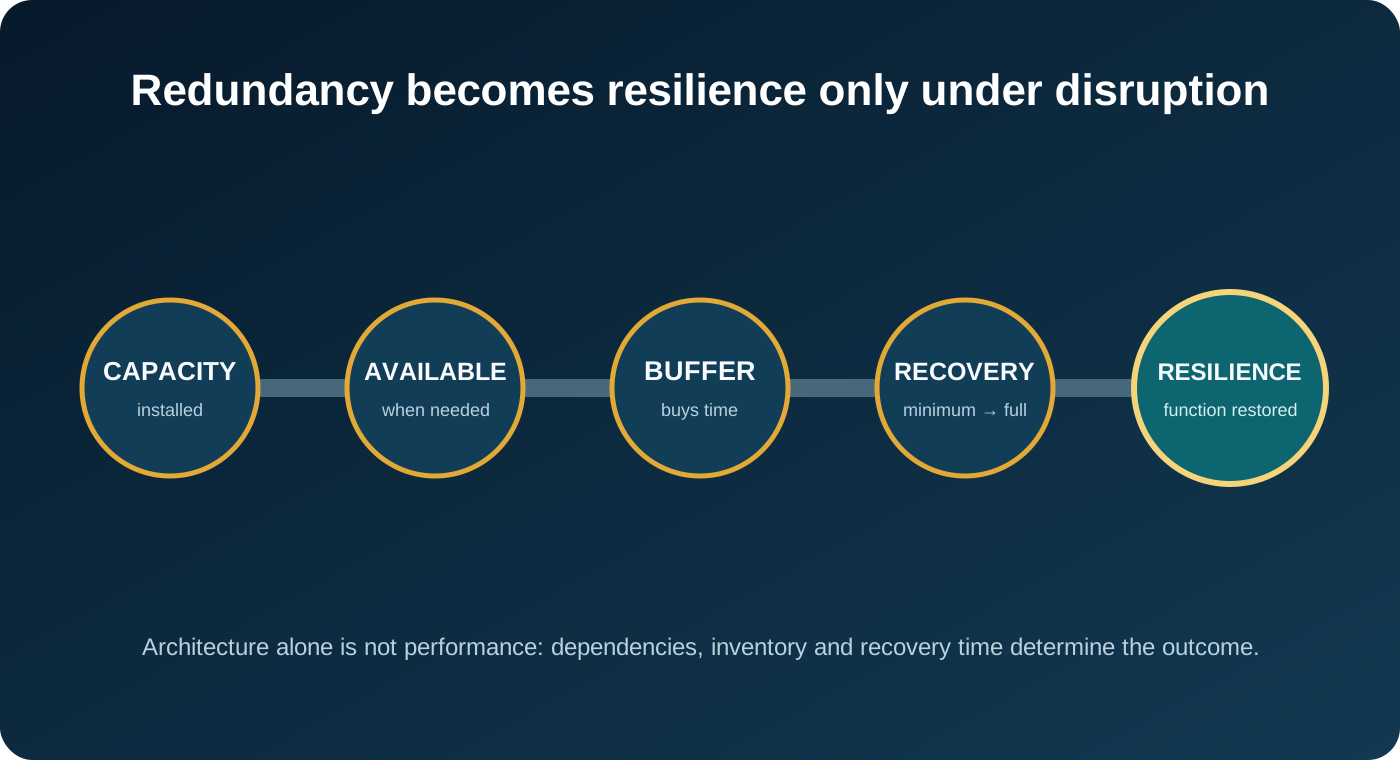
Redundancy is the existence of an alternative path, asset or resource capable of taking over a function. Availability asks whether that alternative is ready when required. Resilience is the ability to prepare, absorb disruption, adapt and restore the function.
Two routes on a diagram can both be unavailable at the critical moment. A system may also preserve minimum function through inventory, reduced throughput, customer prioritisation and staged recovery. Redundancy is architecture; resilience is performance under disruption.
It would therefore be premature to say the entire redundancy strategy failed. The pipeline outage reveals a critical dependency, while the full system also includes storage, terminals, other routes, operational decisions and recovery time.
Installed capacity is not delivered flow
Seven million bpd is the corridor's stated maximum capacity, not a confirmed September flow loss. Actual throughput depends on available production, stations, hydraulic limits, connected refineries, storage and demand.
Export capability also depends on Yanbu receiving, storing and loading crude. Beyond the terminal, tankers still depend on Red Sea access and, by destination, Bab el-Mandeb, Suez, SUMED or longer maritime routes.
Capacity looks impressive in design. Availability shows what remains usable in the real failure scenario.
| Common metric | Resilience question |
|---|---|
| Nominal capacity | How much remains usable in the failure scenario? |
| Number of routes | Are their failure mechanisms truly independent? |
| Inventory | How many hours or days of critical function does it sustain? |
| Repair time | When do minimum and full capacity return? |
| Availability | Is the backup functional when required? |
| Integrity | What evidence authorises a safe return? |
An alternative route inherits new dependencies
Reducing reliance on Hormuz creates reliance on pumping stations, valves, power, telecommunications, control systems, physical integrity along 1,200 kilometres, specialist teams, spares and repair logistics.
At the western end, Yanbu adds tanks, loading facilities, vessels and Red Sea routes. An alternative loses independence when it shares a failure mode or converges on another critical dependency.
This is common-cause failure in plain language: two solutions can be lost to one factor. Two data centres fed by one substation, two pumps on one suction line or two suppliers using one port are redundant only until the common dependency stops.
Stop, isolate and understand before restarting
After external impact on a hazardous-liquid pipeline, the first objective is a controlled condition. Depending on design and event, this may include stopping pumps, isolating segments, controlling access and ignition, checking for release, collecting pressure and flow data and inspecting pipe, stations, valves, instruments and utilities.
This is general response guidance; the Saudi statement did not list every action performed. A precautionary shutdown preserves decision margin while engineers characterise the actual condition before pressure or flow can enlarge an unknown consequence.
Urgency asks when it will return. Engineering asks under what condition it may return.
Visible damage may not be the whole damage
External impact can cause deformation, dents, gouges, metal loss, cracks or damage to welds, coating and corrosion protection. Above-ground components, pumps, valves, supports, power, automation and communications may also be affected.
None of these defects has been publicly confirmed on the East-West Pipeline. They explain why fixing a visible point is insufficient: the assessment must address containment, isolation capability and whether instrumentation reflects the system's physical state.
Robust integrity programmes integrate operating history, inspection, risk, defect assessment, repair criteria and mitigation. PHMSA is used here as an international benchmark, not Saudi law.
Safe restart requires engineering evidence
Restart should not depend only on completing a local repair or responding to market urgency. Engineering must justify that affected segments, stations and relevant interfaces can sustain stable operation and transients within defined limits.
Direct examination, non-destructive testing, dimensional measurement, in-line inspection, functional checks and, where technically suitable, pressure testing are possible tools. The correct method depends on the damage mechanism and design; public data cannot prescribe one for this case.
Return may be staged, with defined pressure or throughput, enhanced monitoring and explicit authority to shut down again. Restart is itself a risk-bearing operating phase.
- Affected area and segments identified
- Damage mechanism sufficiently characterised
- Repairs classified, approved and inspected
- Pressure and throughput criteria defined
- Valves, isolation, instruments and alarms tested
- Containment and environmental impacts ruled out or controlled
- Utilities and pumping stations available
- Contingency for degradation or renewed shutdown
- Progressive return with enhanced monitoring
- Clear authority to stop again
Inventory buys time; it does not restore the asset
Storage can sustain deliveries during a short outage, reduce pressure for premature restart and create space for assessment and repair. It is a continuity barrier, not an integrity solution.
The five-to-seven-day Yanbu estimate reported by Reuters depends on the assumed export rate. The useful metric is not only barrels in tank but hours or days of critical function purchased under the real scenario.
As the buffer declines, economic pressure rises. Mature governance prevents that pressure from lowering the evidence threshold for restart.
Recovery time turns redundancy into measurable performance
Recovery time can be decomposed into detection and isolation, damage assessment, mobilisation, repair, inspection, minimum-capacity return and full-capacity return. Each stage has different dependencies and uncertainty.
In April 2026, a separate event reduced East-West pumping capacity by about 700,000 bpd. SPA reported full capacity restored shortly afterwards. That demonstrates past recovery capability, but it cannot predict September because mechanism, location and extent may differ.
A route taking weeks to recover may remain valuable if the system knows the minimum function to preserve and buffers cover the interval. Resilience means planned, measurable recovery — not the absence of shutdown.
Critical infrastructure and cascading effects
Infrastructure is critical when its outage affects functions far beyond the equipment itself. Potential propagation from this corridor reaches production, refining, terminals, inventory, vessels, customers and energy-dependent supply chains.
CISA highlights dependencies and cascading effects in resilience planning. Here that is a conceptual framework: map the resources sustaining the function, identify what is shared and understand where a local failure can cross system boundaries.
OT and SCADA are operational dependencies, not alleged causes. Pressure, flow, valve state and communications support isolation and restart decisions. No public evidence indicates a cyberattack in this case.
The Brazilian RTDT comparison
Brazil's ANP maintains the Technical Regulation for Onshore Pipelines, RTDT, within its jurisdiction. Its integrity-management approach includes data collection and integration, risk assessment, integrity assessment, mitigation and programme evaluation.
Brazilian regulation does not apply in Saudi Arabia. The comparison shows that pipeline integrity is not one inspection: it is a continuous cycle connecting data, risk, verification, repair, operation and learning.
The same discipline applies outside routine operation. A stopped plant remains hazardous, as the Catalyst Refiners H2S decommissioning case illustrates.
Questions still requiring evidence
Without public answers, these must remain questions rather than theories presented as fact.
- Which segments or stations were hit?
- Was buried pipe, above-ground equipment or both damaged?
- Was there loss of containment or environmental impact?
- What pressure, flow and alarm data were preserved?
- Which inspection method is characterising the damage?
- What repairs are required?
- What capacity can return first and under which limits?
- Which external dependencies constrain recovery?
- How do inventory and other routes sustain continuity?
- What formal engineering criterion will authorise restart?
Conclusion: capacity impresses; resilience appears under disruption
The East-West Pipeline was built to expand Saudi system flexibility. September adds another engineering layer: redundancy that becomes essential must itself be protected, inspectable, recoverable and supported by buffers and alternatives.
Resilience does not promise that nothing will stop. It ensures that when something stops, the organisation knows what to preserve, how much time it has, which minimum function matters and what evidence is required before return.
Capacity impresses in design. Resilience appears when part of the design is lost and the system still protects people, contains consequences and restores function without sacrificing integrity.
Frequently asked questions
What happened to Saudi Arabia's East-West Pipeline?
After multiple attacks on 10 September 2026, the system was shut down as a precaution while technical teams assessed its safety.
Is the East-West Pipeline still shut down?
At the 13 September revalidation, no public official statement confirmed a partial or full restart.
What is the pipeline's capacity?
Aramco states a maximum capacity of about 7 million bpd. That is not automatically the interrupted flow or export capacity.
Why is it an alternative to the Strait of Hormuz?
It moves crude from eastern Saudi Arabia to Yanbu on the Red Sea, allowing part of the flow to bypass Hormuz.
How are redundancy and resilience different?
Redundancy provides an alternative. Resilience maintains or restores function through availability, independence, buffers and recovery.
Can a pipeline restart immediately after external impact?
Only when the operator's assessment and criteria demonstrate acceptable damage, repair, isolation, instrumentation and return conditions.
How is pipeline integrity checked before restart?
The method depends on damage and design and may integrate operating data, direct examination, NDT, in-line inspection, functional tests and engineering assessment.
Does terminal inventory replace the pipeline?
No. Inventory buys finite time but does not restore asset integrity.
What is common-cause failure?
It occurs when apparently independent alternatives can be lost through one shared factor such as power, communications, a terminal or a logistics corridor.
Does Brazil's RTDT apply in Saudi Arabia?
No. It is presented only as a Brazilian comparison for continuous pipeline integrity management.
References
- East–West Pipeline Shut Down as a Precaution Following Multiple AttacksSaudi Press Agency / Saudi Ministry of Energy
- Saudi East-West oil pipeline was temporarily shut down after attacksReuters
- Saudi pipeline outage threatens loss of 4% of global oil supplyReuters
- Aramco announces first quarter 2026 resultsSaudi Aramco
- Aramco announces second quarter and half year 2026 resultsSaudi Aramco
- World Oil Transit ChokepointsU.S. Energy Information Administration
- Infrastructure Dependency PrimerCybersecurity and Infrastructure Security Agency
- Hazardous Liquid Integrity Management Fact SheetPipeline and Hazardous Materials Safety Administration
- Regulamento Técnico de Dutos Terrestres — RTDTAgência Nacional do Petróleo, Gás Natural e Biocombustíveis