
Case study of the CSB final report on the Clairton explosion, focusing on work as imagined versus work as done, valve overpressure, contractor management, facility siting and process safety governance.
Known for years, but never controlled as a method
For at least three years, pressurized water had been used to clear residue from valve seats at Clairton. The practice was known and had become a preferred response when valves would not fully close. Yet no task-specific procedure defined the sequence, limits, overpressure protection, roles or stop criteria.
Frequency does not turn an improvisation into a procedure. Repetition can make a practice familiar while leaving it outside the organization’s ability to analyze, authorize, train, audit and improve it.
What happened and what the CSB concluded
At 10:47 a.m. on 11 August 2025, about 19 pounds of coke oven gas—U.S. Steel’s estimate reported by the CSB—were released during work on the Battery 13 isolation valve. The toxic, flammable gas ignited and exploded.
Two people died and 11 were injured, five seriously. Property damage was estimated at $52.5 million. The CSB issued its final report on 10 August 2026.
The CSB determined that a cast-iron double-disc gate valve was overpressurized. Missing safe procedures and hazard analysis, insufficiently robust process-safety systems and occupied-building siting contributed to the incident or its severity.

How the valve was overpressurized
The 18-inch valve contained two gates. When fully or nearly lowered, they enclosed a cavity between them. A cleanout port at the bottom provided access for cleaning.
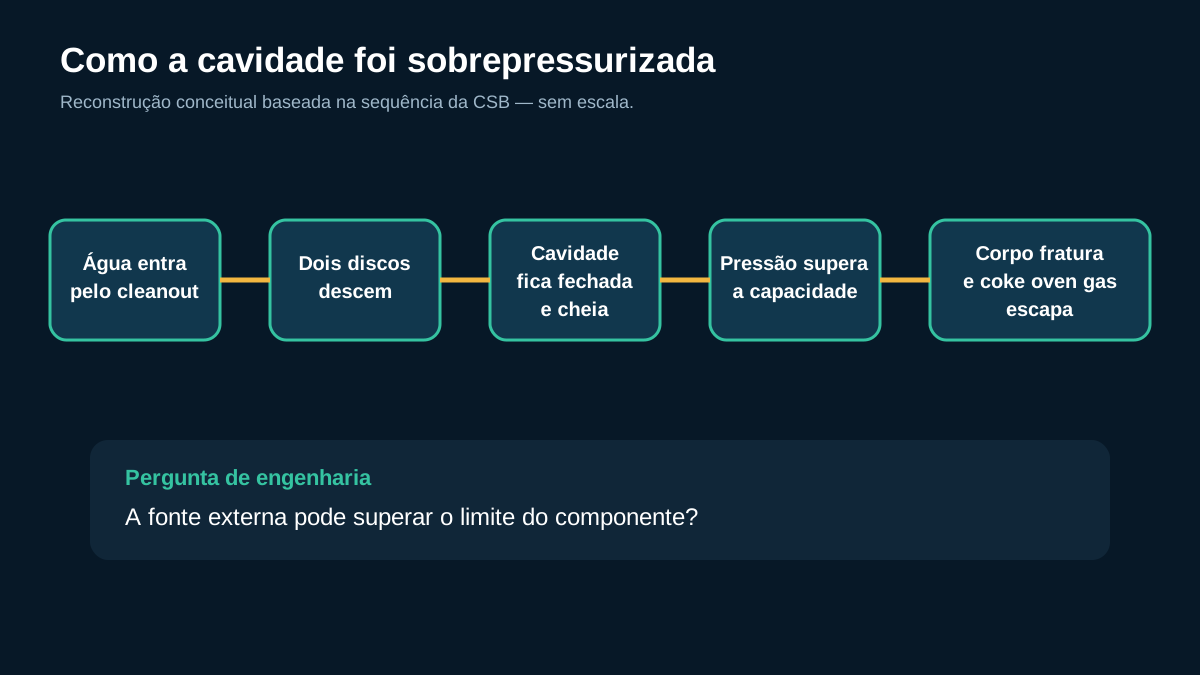
Water from an MPW pump truck entered while workers exercised the valve. The gates lowered, the cavity became enclosed and water continued to enter. Pressure exceeded the body and cap capacity, the valve fractured and coke oven gas bypassed the gates into the transfer area.
The engineering question is source-to-component compatibility: could the external source exceed the component rating, and what independent barrier prevented that outcome?
Age was not the failure mechanism
The valve was manufactured in 1953, rated at 50 psig and refurbished in 2013. But the CSB’s visual examination, ultrasonic thickness testing, magnetic particles, 3D laser work and X-ray fluorescence found no significant corrosion thinning or relevant pre-existing crack.
The fracture was visually consistent with a sudden brittle failure after overpressure. Cast iron’s low ductility and the difference between the installed valve and internal carbon-steel specifications matter to asset integrity, but they do not replace the demonstrated mechanism with an “old valve” story.
Work as imagined versus work as done
Two weeks earlier, a Hazardous Job Meeting had planned a future replacement of a different cracked valve. The plan covered isolation and purging but did not include exercising, steaming or washing the Battery 13 valve that day.
A supervisor later added valve exercising and washing. None of the workers performing that task had attended the planning meeting. A valve-exercising procedure existed, but it did not cover water washing.
A resilient system does not pretend work never changes. It provides a route for the changed task to return to analysis before execution.
When scope changes, analysis must follow
A late-added task does not automatically inherit the controls of the original job. It can introduce a new energy source, configuration, personnel and failure mode.
JHA, permit review, scope confirmation, stop-work authority and management of change are ways to return adaptation to conscious decision. “Normalization of deviance” is an Andrade Safe organizational lens for repeated deviations that begin to feel normal; it is not the CSB’s formal cause label.
A procedure is not a transcript of habit
The answer was not merely to write down the customary steps. Proceduralizing requires challenging the method: sequence, limits, instruments, valve states, energy sources, foreseeable failures, contingencies, competence and stop criteria.
The CSB therefore recommended a written procedure, hazard analysis or safety validation and participation by workers who perform or may perform washing. Worker knowledge improves engineering; it does not replace it.
Hazardous energy and the contractor interface
The operation added hydraulic energy to equipment still connected to a chemical inventory. Energy control is more than applying a lock; it must prevent pressure, hazardous inventory, heat or motion from reaching the work zone and provide a means of verification.
MPW brought the pump truck and industrial-cleaning personnel. U.S. Steel held process knowledge; MPW held equipment and cleaning knowledge. The CSB found that MPW did not challenge the practice and its workers lacked a specific procedure and training. Outsourcing execution does not outsource hazard knowledge.
Facility siting changed the consequences
Control rooms and a break room were less than 20 feet directly above the coke oven gas piping. They were not designed to withstand an explosion and were destroyed.
The CSB concluded that this siting and construction caused or worsened both fatalities and two serious injuries. API RP 752, 753 and 756 and CCPS guidance help evaluate occupied buildings, temporary structures and exposure to fires, explosions and toxic releases. They do not provide one universal safe distance.
The 2010 warning and regulatory knowledge
A 2010 coke oven gas explosion injured 20 people but did not lead to a battery facility-siting evaluation. The CSB viewed this as a missed opportunity to recognize the wider consequences of a basement explosion.
The CSB also found that U.S. Steel relied on a 1992 view of the PSM fuels exemption after OSHA rescinded that position in a 2013 interpretation. Local management did not know of the change, while old or incomplete inventory calculations influenced coverage discussions.
The CSB concluded that PSM appeared applicable. OSHA issued citations, U.S. Steel contested them and the outcome remained unresolved in the final report. A contested citation is not a final adjudication.
What PSM, NFPA, API and ISO add
OSHA PSM connects process safety information, PHA, procedures, training, mechanical integrity, contractors, MOC, incident investigation and audits. NFPA 56 is cited by the CSB as guidance for controlled cleaning and purging. API and CCPS support facility siting and governance.
ASME B31.3 did not expressly prohibit cast iron in this service, although it cautioned about low ductility and shock sensitivity. It should not be used as a simple proof of noncompliance.
ISO 45001:2018 remains the published edition while a 2027 revision is under development. It provides a systems lens for participation, operational control, change, contractors and improvement; certification alone does not prove effectiveness.
Detection worked, but prevention had to come first
Personal carbon-monoxide monitors and a four-gas monitor alarmed after the release. Workers evacuated and radioed a warning. The explosion occurred 24 seconds after the radio evacuation order.
Detection and alarm were important mitigative barriers, but they acted after loss of containment. Detecting the consequence does not replace preventing the release.
Questions for any task added outside the plan
Before starting, ask whether the task is in the approved scope; whether the method is written and validated; what new energy source is being connected; whether it can exceed equipment capacity; what valve state creates blocked volume; who must leave the consequence area; what process hazards the contractor received; what objective stop criteria apply; and whether the task must return to JHA, permit, authorization or MOC.
The Clairton problem was not simply a wrong sequence of movements. A critical task existed for years between what people knew how to do and what the organization had never converted into a safe, analyzed and controlled method.
Frequently asked questions
What caused the Clairton explosion?
Pressurized water overpressurized the enclosed cavity between two valve gates, fractured the valve and released coke oven gas that ignited.
Did the valve fail because it was old?
No. Age was a fact, but examinations found no significant corrosion loss or relevant pre-existing crack.
What is an ad hoc procedure?
A practice improvised for a particular need without a fully analyzed, validated and controlled method.
What is facility siting?
Assessment of occupied buildings and critical structures against potential fire, explosion and toxic-release consequences.
Did OSHA finally establish a PSM violation?
No final adjudication was public in the report. OSHA cited U.S. Steel, the company contested the citations and the CSB said PSM appeared applicable.
Did gas detectors work?
Yes, but the explosion occurred only 24 seconds after the radio evacuation order.
References
- Fatal Coke Oven Gas Explosion at U.S. Steel Clairton Coke Works — Final ReportU.S. Chemical Safety and Hazard Investigation Board
- Clairton Plant Coke Oven Explosion — investigation pageCSB
- CSB issues final report on Clairton explosionCSB
- 29 CFR 1910.119 — Process Safety ManagementOSHA
- NFPA 56NFPA
- ISO 45001:2018ISO
- NR-20 — Segurança e Saúde no Trabalho com Inflamáveis e CombustíveisMinistério do Trabalho e Emprego
- NR-01 — Disposições Gerais e Gerenciamento de Riscos OcupacionaisMinistério do Trabalho e Emprego