
Engineering guide to air compressors and receiver tanks, with a clearly delimited explanation of Brazil's NR-13 framework and the roles of Inmetro, ASME, OSHA and ISO.
The first question is: which component?
“Is the compressor NR-13 compliant?” collapses several objects into one name. A package may include the motor, compression element, air-oil separator, cooler, receiver, dryer, filters and distribution piping.
The compressor produces compressed air; the receiver stores pressure energy. A photograph or sales name does not settle the classification. Nameplates, design, pressure, volume, diameter, function and actual configuration do.
Map the system before selecting a standard
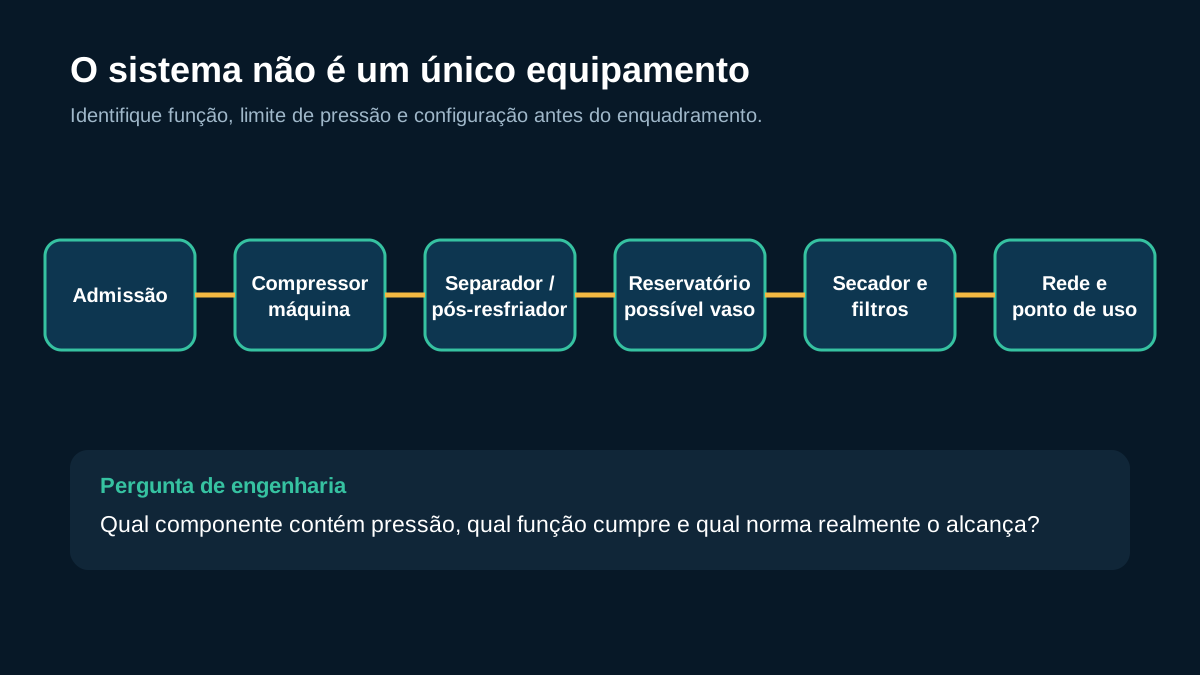
A common path is intake, compressor, air-oil separator where applicable, aftercooler, receiver, dryer, filters, distribution and point of use. Each boundary answers a different engineering question.
An external receiver, package vessel, separator or dryer vessel may be a pressure vessel. That does not make every filter housing a regulated receiver; identify the design and pressure boundary first.

Brazilian NR-13 framework
NR-13 is Brazilian occupational legislation, not an international code. An external receiver may fall fully within its scope. A vessel that is part of an auxiliary machinery package may fit an express exclusion in item 13.2.2, so package configuration must be examined before deciding.
Exclusion from the specific scope is not permission to ignore integrity. Item 13.2.3 retains inspection and maintenance under technical responsibility for hazardous pressurised equipment, following manufacturers, codes and standards.
Scope P.V and risk-group P.V use different units
For NR-13 scope, maximum operating pressure P is entered in kPa and internal volume V in m³; P.V must be greater than 8. For the potential-risk group, P is entered in MPa and V in m³.
For a 1.0 MPa, 0.50 m³ external receiver: scope P.V is 1,000 × 0.50 = 500 kPa·m³. Risk-group P.V is 1.0 × 0.50 = 0.50 MPa·m³. Mixing those units changes the number by a factor of one thousand.
Compressed air is class C in Brazil
Under NR-13, compressed air is class C. For that fluid class, potential-risk groups 1 through 5 map to categories I through V.
This is a Brazilian category, not an international vessel grade. Pressure alone, material or temperature does not replace the table method, although all may matter to design and damage assessment.
Inmetro product certification is a separate route
Brazil's Inmetro Ordinance 120/2021 addresses conformity assessment for series-produced boilers and pressure vessels. Inmetro clarified in 2026 that series vessels coupled or integrated with machinery also require certification and registration for Brazilian sale under article 8-A introduced by Ordinance 531/2025.
Product certification is evidence about manufacture. It does not establish the installed vessel's condition forever and does not replace in-service inspection.
What an in-scope Brazilian receiver requires
Core elements include a safety device set consistently with the PMTA—the Brazilian term related to maximum allowable working pressure—and construction code, protection from inadvertent isolation, a pressure indicator, identification, safe access and the prescribed records.
The prontuário is the Brazilian design and manufacturing file. It is not the same as the safety log, repair project, inspection report or safety-device certificate. A PLH is a professional legally authorised in Brazil; it is not an international certification title.
There is no universal annual inspection
For facilities without SPIE recognition, NR-13 Table 2 sets maximum external/internal examination intervals of 1/3, 2/4, 3/6, 4/8 and 5/10 years for categories I to V. SPIE and specific alternatives have different conditions.
Those are Brazilian maximum intervals, not a schedule for other jurisdictions and not a reason to defer action when condition or damage calls for an earlier examination.
New vessels and pressure testing
NR-13 generally requires an initial inspection, with a specific exception for new, series-produced category IV or V vessels certified by an accredited body and installed to the manufacturer's instructions. The installation date then starts the periodic interval.
Hydrostatic testing is not a universal every-five-years task. In-service examinations and tests must respond to the applicable code, records, damage mechanisms and qualified judgement.
Safety valve, gauge and condensate
A safety valve limits overpressure and a gauge tells operators the pressure. Maintenance and testing must follow the governing requirements and the actual protected system; a valve certificate is not proof that the rest of the receiver is sound.
Compression and cooling produce condensate. Drain strategy depends on design, operation and manufacturer—there is no universal drain frequency. Poor drainage can promote internal corrosion, while oily condensate requires suitable treatment.
What ASME, OSHA and ISO actually do
ASME BPVC Section VIII Division 1 (2025) and ISO 16528-1:2007 concern construction; ISO 16528 expressly does not address operation, maintenance or in-service inspection. OSHA 1910.169 is a United States rule for air receivers, not a Brazilian requirement.
ISO 1217 addresses compressor acceptance and performance. ISO 8573-1 classifies compressed-air purity. ISO 4126-1 addresses safety valves. ISO 4414 covers pneumatic systems in machinery but excludes compressors and factory distribution systems including receivers. ISO 12100 supports machinery risk assessment.
Field checklist and conclusion
Identify every component; capture nameplate, serial number, MAWP/PMTA, volume, code and manufacturer; distinguish external from package-mounted receivers; verify certification where applicable; examine relief devices, gauges, drains, corrosion, leakage, vibration, undocumented welding, access and machinery safeguards.
Compliance begins by naming the correct equipment. Design code, product certification, correct installation and in-service integrity are four different questions. A sound programme connects them without allowing one certificate to stand in for the others.
Frequently asked questions
Does every air compressor fall under Brazilian NR-13?
No. The machine and each pressure-containing component must be identified, and scope and exclusions assessed separately.
Is a package-mounted receiver automatically excluded?
No. Actual configuration and the exact exclusion criteria must be assessed.
Does ASME replace NR-13 or Inmetro?
No. Construction code, Brazilian product certification and in-service legal duties are separate layers.
Is ISO 8573 a receiver integrity standard?
No. It classifies compressed-air purity by particles, water and oil.
Must every receiver be inspected annually?
No. Intervals depend on the governing jurisdiction, category, regime, condition and damage mechanisms.