
A technical look at the BYD Camaçari fall investigation, fall clearance, anchors, collective controls and contractor safety under Brazilian rules.
Fall protection as a system
Reporting and recheck: October 23, 2026. No official technical conclusion establishing the cause of the fall was located in the official sources consulted. The MPT-BA statement is dated October 20; the event occurred October 19. Generic roof hazards discussed below are not established conditions at this site.
Editorial disclosure: This article discusses an actual fatal incident. Its calculations, illustrations and hypothetical configurations do not depict the victim's work position, equipment or fall. The circumstances remain under investigation. This is educational material, not a fall-protection design, compliance certificate or installation procedure.
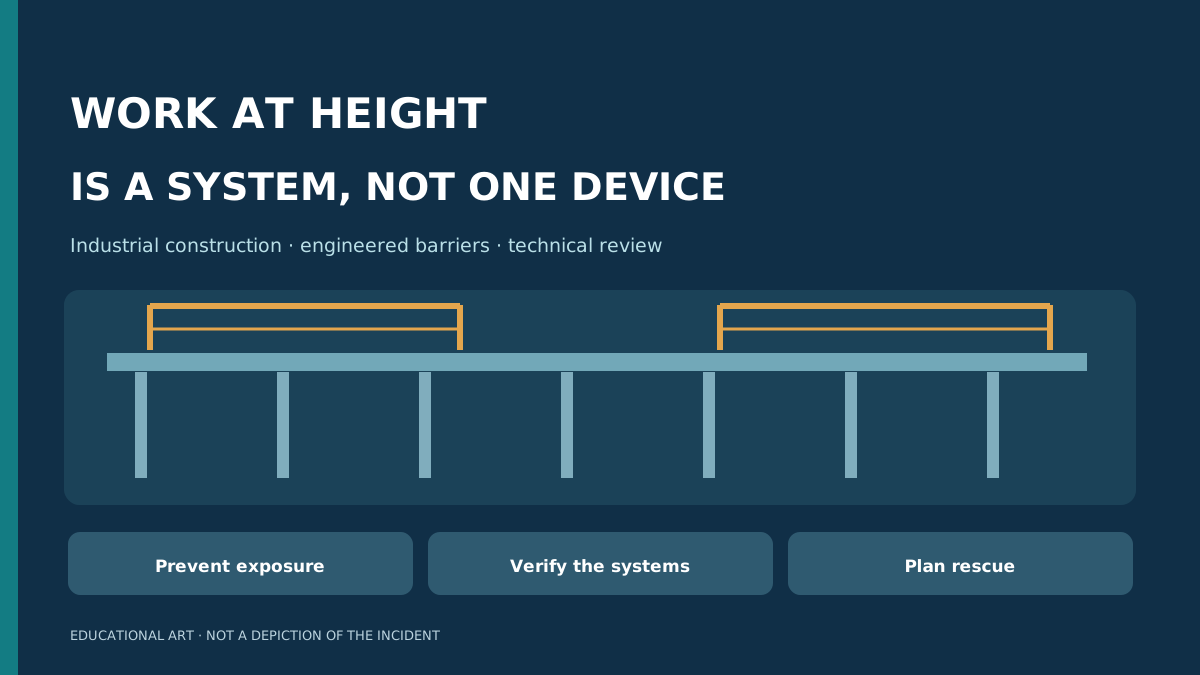
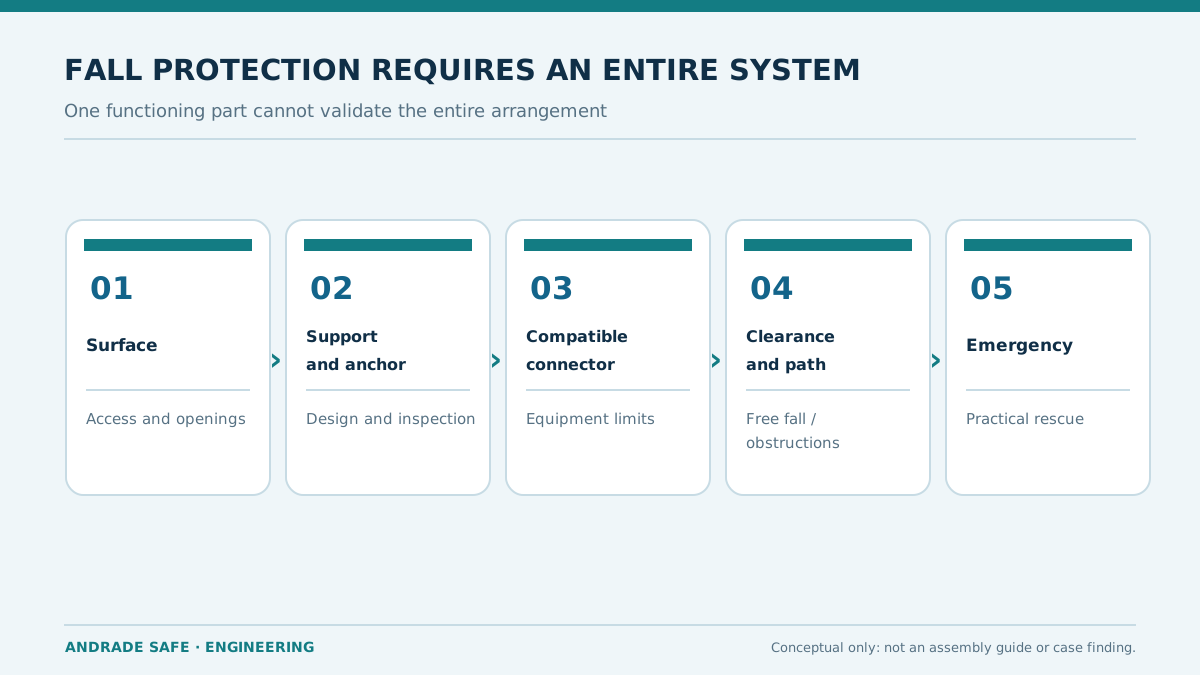
A large industrial construction site may have numerous contractors working above floor level: roof installers, structural assemblers, welders, maintenance crews and lifting teams. Even when a worker wears a full-body harness, safety depends on the full system: the working surface, access, collective protection, connectors, anchorage structure, available fall clearance and rescue arrangements. A single component cannot take responsibility for all those functions.
On October 19, 2026, an employee of a service contractor died after a fall at the construction site of BYD's industrial complex in Camaçari, Bahia, Brazil. The company said the worker fell approximately 13 metres and was taken to hospital, where he died. Brazil's Labor Prosecutor's Office in Bahia (MPT-BA) announced an investigation into the circumstances, employer responsibilities and preventive measures. The reported height is a company statement, not a dimension independently established by a public forensic report. [MPT-BA] [Camaçari Notícias]
A trade union expressed concerns about possible shortcomings in equipment or anchorage arrangements. Those statements warrant examination; they must not be turned into forensic findings or definitive conclusions of non-compliance. At the time this article was prepared, the available official material did not establish the root cause, final event sequence or responsibility of an individual or company. [Jornal Correio]
The engineering question is therefore not “which item failed?” but “what makes a height-work protection arrangement function as a system?”
What has been confirmed?
This distinction matters. A photograph does not show the complete work sequence; a union allegation cannot replace equipment testing; and the height of a fall does not identify a particular technical cause. Investigators must reconstruct the activity using physical evidence, documents and interviews before reaching a supported conclusion.
| Topic | Evidence position on October 23, 2026 |
|---|---|
| Fatal work accident on October 19 at the BYD construction site in Camaçari | Confirmed by the MPT-BA and media reporting the company statement |
| Victim employed by a contractor | Reported by BYD; the MPT-BA statement reproduces the contractor-employment information |
| Approximate fall height of 13 m | Company figure, as carried by the press; not a public forensic measurement |
| Formal Labor Prosecutor investigation | Confirmed by MPT-BA |
| Actual harness type, attachment, clearance and anchorage capacity | Not established conclusively in the consulted official materials |
| Root cause, event sequence and legal responsibility | Undetermined in the available public evidence |
Fall prevention begins before selecting personal equipment
A personal fall-protection system is not synonymous with a harness. Depending on the task, it may include a full-body harness, connectors, energy-absorbing lanyard or fall arrester, anchors, structural elements, a suitable travel path and sufficient clearance. Equipment compatibility and manufacturers' limits are essential.
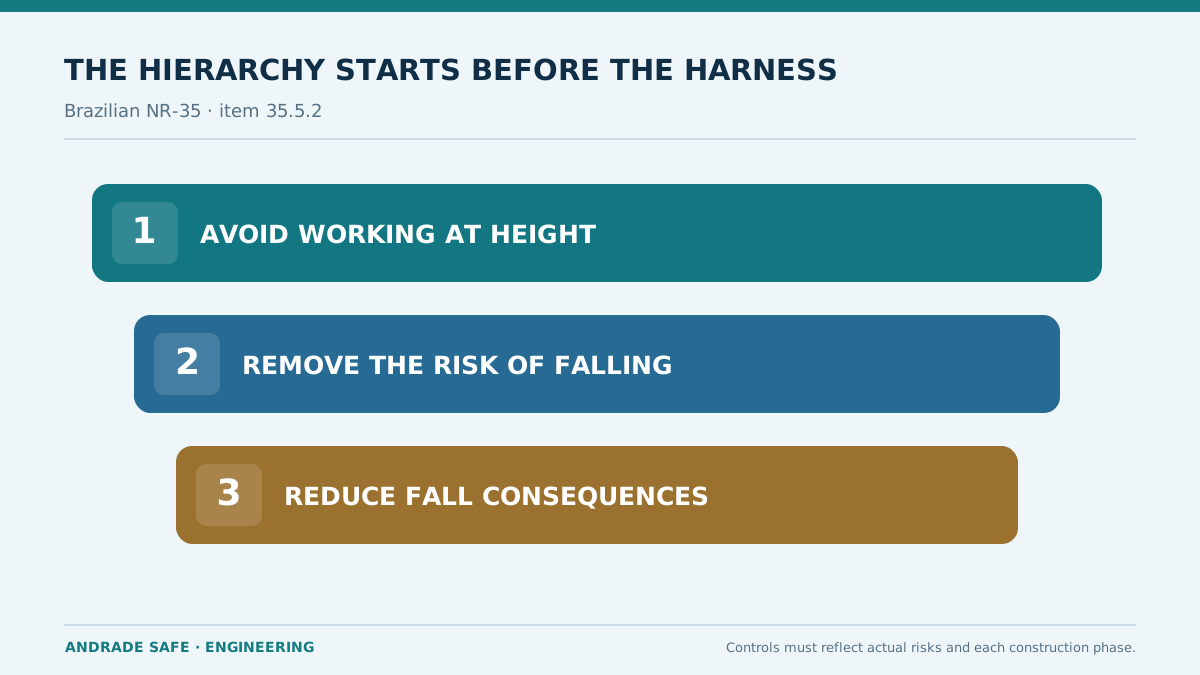
Brazilian NR-35, section 35.5.2, adopts a clear planning hierarchy: avoid working at height when another method exists; eliminate the risk of falling if work at height is unavoidable; and minimize the consequences of a fall when prevention of exposure cannot remove the risk. This hierarchy helps explain why prefabrication at ground level, properly designed platforms, guarded edges and protection of openings can be more effective upstream controls than relying on personal equipment alone.
For Brazilian construction sites, NR-18, item 18.9.1, requires collective protection where workers may fall or materials and objects may be projected around the construction site, with design by a legally qualified professional. The appropriate solution for a particular roof depends on its design, condition, geometry and construction stage.
The five links in a functioning protection arrangement
Working surface and access. Is the roof load-bearing and adequately verified? Are fragile sheets, skylights, openings and edge conditions known? How does the worker move between access and work location without an unprotected transition? The answer cannot be inferred from the final work position alone.
Anchorage and supporting structure. The rated strength of a carabiner or lanyard does not establish the adequacy of the structural member or connection supporting the anchorage. NR-35, Annex II, item 3.1.1, requires a structure forming part of an anchorage system to resist the maximum applicable force. Under item 3.2, the structural anchorage and its fixing elements are subject to design and construction responsibilities assigned to a legally qualified professional.
Connection system. Energy-absorbing lanyards, guided fall arresters and self-retracting devices have different operating principles and clearance requirements. Brazil's NR-35 specifies an integrated energy absorber when a lanyard is used for fall arrest (item 35.6.9.1.1). This is not an instruction to select a particular product without an assessment of suitability.
Continuous protection. A protected workplace can still have a hazardous transition. NR-35, item 35.6.11, directs risk assessment to consider continuous connection throughout exposure to the risk of falling, as well as free-fall distance, fall factor, clearance and compatibility.
Emergency retrieval. If a fall is arrested, a suspended worker may still require immediate specialist assistance. NR-35, section 35.7, requires appropriate emergency and rescue procedures, analysis of emergency scenarios, trained rescuers and the necessary resources. A telephone number alone does not show how a suspended person can actually be recovered from the location.
Available clearance and the danger of general-purpose formulas
Fall clearance is not simply the roof-to-ground height. It is a device- and geometry-dependent condition involving anchor height, free-fall distance, extension during arrest, body geometry, potential swing, obstacles and margin. The NR-35 glossary defines its measurement reference differently for safety lanyards (below the anchor) and fall-arrest devices (below the worker's feet). A number measured from the wrong reference can be misleading.
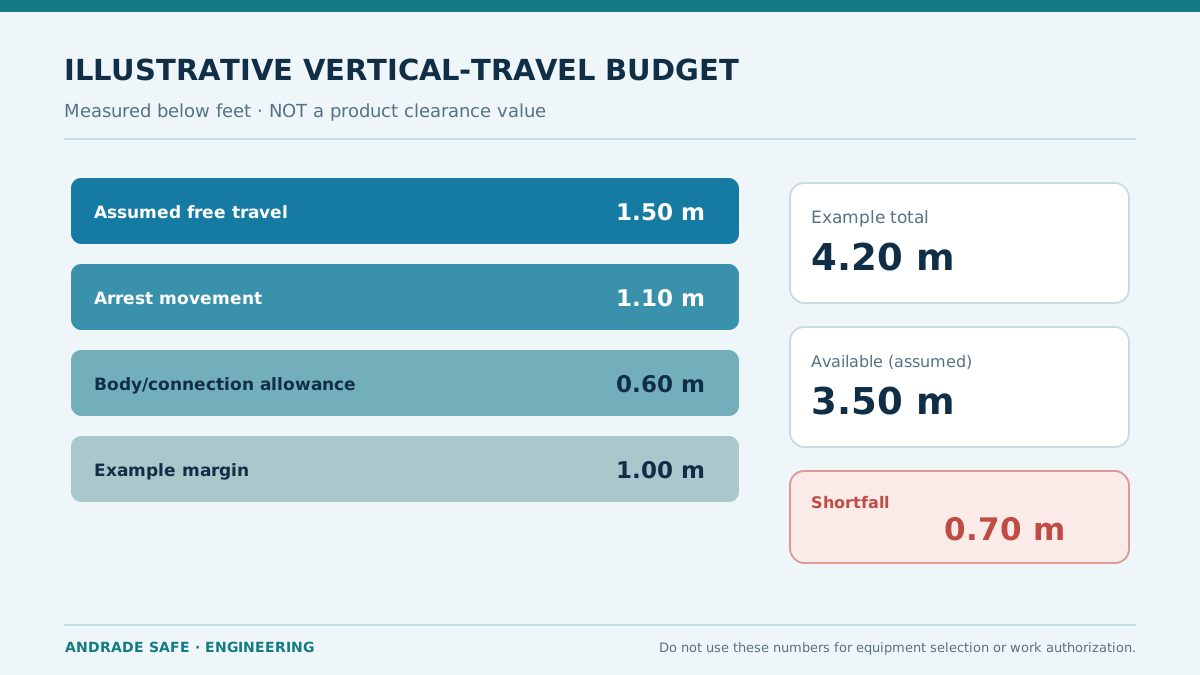
Consider a fictional vertical movement budget referenced below the worker's feet, deliberately not presented as a manufacturer-rated fall clearance for a lanyard:
The demonstration totals 4.20 m. If a theoretical obstruction were just 3.50 m beneath the feet, the difference would be −0.70 m. This does not assess any real fall-protection system; real clearances must be obtained and verified for the selected device, configuration, anchor, project and task. Do not use the figures to release height work.
A meaningful engineering review must confirm the actual manufacturer/project clearance, structural movement, device travel, possible pendulum motion and obstacles — using one consistent geometric datum.
- Illustrative free travel before deceleration: 1.50 m.
- Further movement during the stopping interval: 1.10 m.
- Assumed body/connection geometry allowance: 0.60 m.
- Illustrative clearance margin: 1.00 m.
The physics of a fall: energy is not peak arrest force
A simplified gravitational energy expression is
E=mgh.
For a purely educational 100 kg total mass descending 1.50 m, with g=9.81 m/s², the potential-energy change is 1,471.5 J, approximately 1.47 kJ. At 3.00 m, it would be 2.94 kJ. These values do not describe the BYD incident.
The peak force on a worker cannot be calculated from this energy value alone. The actual force-time response depends on deceleration, the energy absorber, device mechanics, geometry and compliance. NR-35, item 35.6.7, requires selecting personal fall protection so the impact force transferred to the worker in an arrested fall is at most 6 kN. That number is neither a universal structural design load for an anchorage nor a measured force in this incident.
The HTML laboratory accompanying the publication lets readers explore the illustrative geometry and gravitational energy. It intentionally refuses to calculate a certified clearance, peak arrest force or structural anchor strength.
Laboratory: fictional geometry and energy
Explore a fictional movement budget below the feet separately from gravitational potential energy. The incident height is not used in these controls. These examples provide no product clearance, arrest force, anchor capacity or work authorization.
Work at height: fall clearance and energy
Educational simulation with fictional inputs. Does not compute manufacturer-approved clearance, impact force, anchor capacity or work authorization.
Assumed vertical-travel budget
All travel components are fictional and REFERENCED BELOW THE FEET. This is NOT a manufacturer clearance value for a lanyard.
Brazilian NR-35 uses different measurement references for lanyards and fall arrest devices. Never use this sum to select equipment, design an anchor or authorize work.
Scenario comparison
Only compares assumed travel distances. It does not test compliance.
- Illustrative travel budget
- 4.20 m
- Available distance
- 3.50 m
- Available minus budget
- -0.70 m
Shortfall in this fictional geometry: the assumed travel exceeds the obstacle clearance.
Gravitational energy: E = m × g × h
Ideal scalar model, unrelated to the actual accident.
Change in gravitational potential energy
1.472 kJ100 kg × 9.81 m/s² × 1.50 m = 1,471.50 J
Energy alone cannot determine peak force or prove compliance with the 6 kN worker impact criterion. Dynamic forces and structural loads are not calculated.
CSV uses explicit units and decimal points; it is not a compliance report.
Regulatory context: Brazilian Ministry of Labor, NR-35 (items 35.6.7, 35.6.11, glossary), NR-18. “Available” refers only to an assumed geometric distance. Educational use only; no engineering sign-off.
Managing contractors is part of managing physical risk
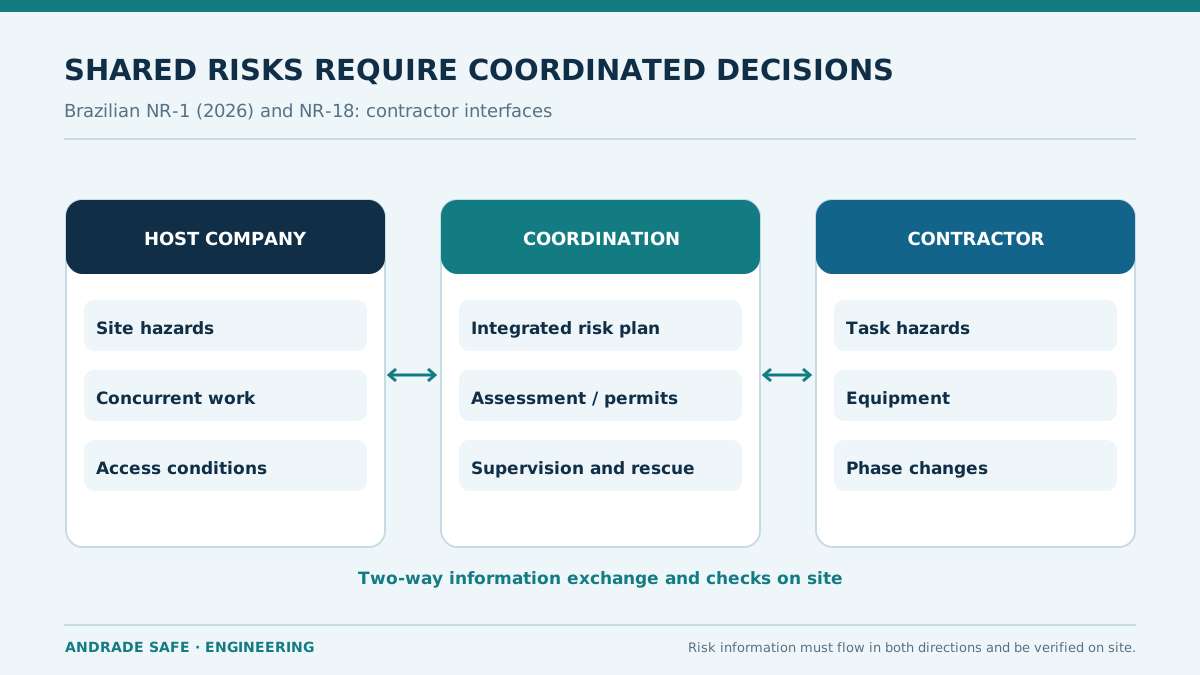
A major construction project may involve the owner, general contractor, engineering consultants and specialised subcontractors. The interfaces between their work packages create exposures that are not visible in a single company's inventory.
The revision to Brazil's NR-1 effective May 26, 2026, particularly items 1.5.8.1–1.5.8.4, provides for information exchange and coordination between host and contractor; when risks arise from the interaction of activities, preventive measures are jointly defined under the host organisation's coordination. NR-18, items 18.4.3–18.4.4, addresses construction-site risk-program documentation, relevant fall-protection design documents and inclusion of contractor-specific risk inventories.
The practical questions are whether the documents reflect actual work, whether high-risk simultaneous operations have been considered and whether authorization, supervision, stoppage rules and emergency arrangements work in reality.
Risk assessment, work permits and inspections
Under NR-35, all work at height requires a risk assessment (AR). Non-routine height tasks require a work permit (PT); risk assessment for routine tasks may be incorporated into the operating procedure. It would therefore be wrong to say that a separate PT is mandatory for every height task, irrespective of its nature.
The assessment should cover site and surroundings, weather, anchorage locations, collective and personal protection, inspections, falling materials, simultaneous work, communication, supervision and rescue. NR-35, item 35.6.6, distinguishes initial, pre-use/routine and periodic inspections of personal systems. Its periodic inspection interval is at least once every 12 months, shortened when the usage environment requires it.
Questions investigators should verify — without assuming answers
These are methodological questions, not findings about the Camaçari site.
- What was the exact task, location and access path?
- Which surfaces and openings were exposed and protected?
- Which personal/collective systems, devices and anchor structures were specified and installed?
- Are there traceable design documents, manufacturer limits, inspection records and evidence of compatibility?
- Were work permits required and issued, and did the risk assessment match the actual situation?
- How were risks shared and supervised across contractors, including simultaneous work?
- What emergency response plan was intended for the specific work location?
What engineers and safety professionals can take away
The investigations into the Camaçari fatality must establish the facts and any responsibilities. Meanwhile, the transferable lesson is clear: fall risk management is an engineering and operational assurance problem. It begins with eliminating exposure where feasible, continues with designed barriers, known load paths and compatible devices, and ends only when access, work, changes and rescue have been considered.
A mature safety programme should not ask only how many harnesses were delivered or training certificates issued. It should ask whether each work phase has verified, functioning protections and clear responsibility for their implementation.
Further reading
The working-at-height guide (Portuguese) organizes preventive measures. The lifeline and anchorage design article (Portuguese) examines the device–structure interface. Accident investigation beyond blame (Portuguese) discusses evidence. Steel erection in Taiwan explores temporary stability and structural dependencies, a complementary topic distinct from this event.
Laboratory and study materials
These educational materials preserve the originals and identify revisions. They do not authorize work, installation or equipment selection.
Open standalone laboratory PT/EN/ES →
Fictional values and limitations (JSON) →
Sources and editorial transparency
The cited NRs are Brazilian requirements; they do not automatically apply outside Brazil. If new official evidence is located, the same URL can be updated with a record of substantive changes.
Camaçari Notícias — 19/10/2026 →
NR-35 — MTE, texto oficial / official text →
Frequently asked questions
Is a harness alone sufficient fall protection?
No. Protection depends on the prevention hierarchy, compatible components, structure, access, geometry, supervision and rescue arrangements for the task.
Is the reported 13 metres a forensic measurement?
Not in the sources consulted. The approximate height came from a company statement reproduced by the press.
Does the laboratory calculate product fall clearance?
No. It adds fictional movement below the feet and illustrates potential energy. Real references and parameters depend on the manufacturer, design and task assessment.
Does every height task require a separate work permit?
Brazilian NR-35 requires a risk assessment for all height work and a work permit for non-routine tasks. Routine-task assessment may be included in the operating procedure.
Is 6 kN a universal anchorage design load?
No. It limits impact force transferred to the worker when selecting personal protection. It is not a universal structural design load.