
Technical analysis of the Brickell foundation drill rig collapse and the questions around working platforms, bearing capacity, configuration and public protection.
What happened in Brickell
At about 8 a.m. on 14 September 2026, an approximately 85-foot foundation drill rig overturned at 1201 Brickell Bay Drive near Southeast 12th Street in Miami. The assembly moved beyond the immediate construction area and reached the public road.
It struck three vehicles and a temporary container occupied by two workers. Miami Fire Rescue fought a vehicle fire, performed technical rescue and managed a fuel spill. The operator, the two workers and an SUV driver were hospitalized with injuries reported as minor.
Recovery work continued on 15 September. OSHA and local authorities are investigating. At the 16 September revalidation, neither the cause nor exact rig model had been made public.
Direct answer: what the case allows us to say
Video captures the fall, but it does not reveal the initiating mechanism. Ground, working platform, slope, mast configuration, drilling reaction, travel, wind, mechanical condition and operator action remain questions—not confirmed causes.
A drill rig may be structurally robust and still depend on the combined system of machine, configuration, support surface, task and surroundings. Tall equipment turns site geometry into a public-safety question as well as an occupational one.

Fact, unknown and engineering question
Separating evidence from hypothesis prevents dramatic footage from replacing investigation.
| Confirmed | Unknown | Engineering question |
|---|---|---|
| An 85-ft rig reached the road | Working platform condition | Was support compatible with the real configuration? |
| Vehicles and a container were struck | Initial equipment state | What consequence envelope informed the layout? |
| OSHA is investigating | Initiating mechanism | What do manuals, records, ground and inspections show? |
| Video shows the visible fall | Root cause | Does it show initiation or only the final phase? |
A drill rig is not automatically a crane
Early reports used crane, but authorities and local outlets later described a drill rig or piling rig. Its primary function is foundation construction, although it may use winches and handle tools, casing or task components.
That does not make crane load charts the default basis for its stability. Capacity, angles, counterweights, travel and setup must come from the manual for the specific model, which remains unconfirmed.
Working platform: the first stability interface
A working platform supports assembly, travel and operation. It must be compatible with rig mass and configuration, track pressures, subgrade, fill, compaction, water, drainage, slope and repeated traffic.
Voids, utilities, tanks and buried structures may alter the load path. NIOSH identifies inadequate platforms in earlier overturn cases. That evidence supports prevention; it does not establish a platform defect in Miami.
Connected reading
The influence zone connects directly to mobile-equipment exclusion zones, evidence-based inspections and risk-programme updates when site conditions change.
- Backhoe blind spots and exclusion zones.
- How to perform an effective field inspection.
- Decent work and a living construction risk programme.
Track pressure is not simply weight divided by area
Loading beneath tracked equipment need not be uniform. Geometry, mast and tool position, task reaction, slope, acceleration and travel condition can change demands.
Industry guidance therefore calls for loads from the actual rig and planned configurations. A generic number copied from another machine can hide critical differences; this article offers no universal formula or Miami calculation.
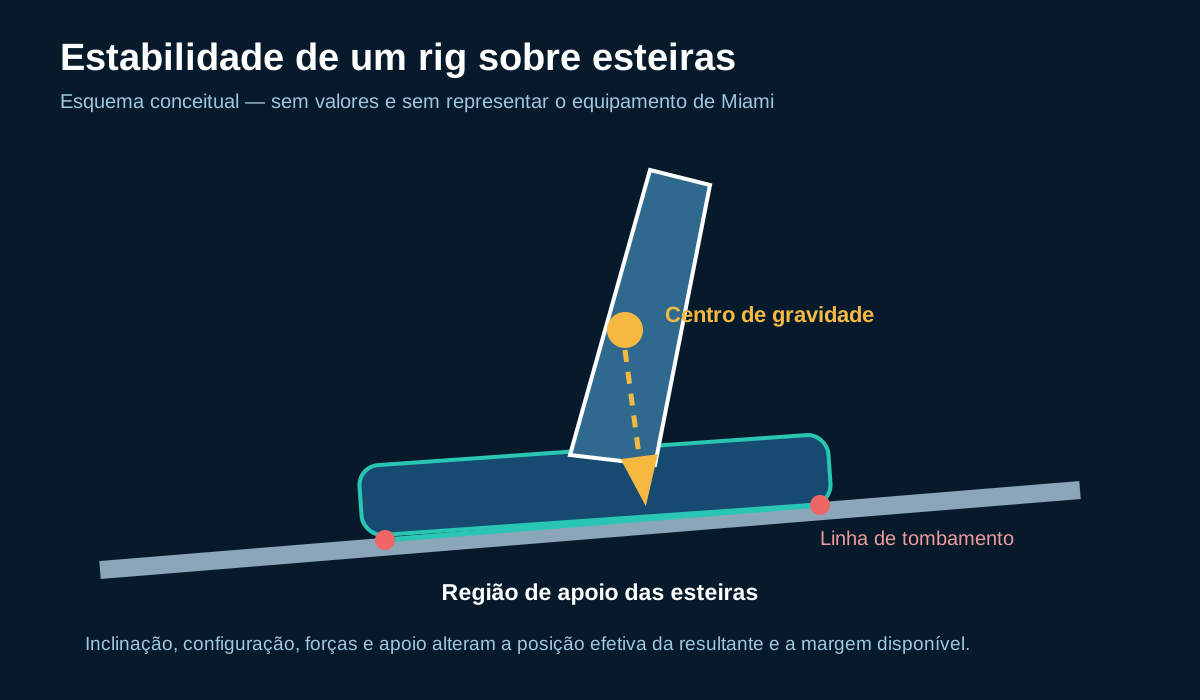
Centre of gravity, support region and tipping line
In simplified terms, static stability depends on the effective resultant remaining within the support region with suitable margin. Moving the projection towards an edge reduces that margin.
Mast, tools, attachments, counterweights, slope, dynamics and support deformation all affect the problem. There is no universal safe angle: limits belong to the manufacturer, model, configuration and activity.
Configuration, drilling and transitions
Transport, setup, travel, drilling and maintenance are different states. Mast position, kelly bar, rotary head, tool and attachments change mass geometry and forces.
Drilling can create torque, thrust and axial reaction, showing why stability is more than dead weight. It does not prove drilling reaction initiated this collapse, and public sources do not establish whether the rig was drilling or repositioning at initiation.
Travel on slopes or across level changes can require a dedicated configuration and prepared route. A condition suitable for drilling is not automatically suitable for travel.
Influence area beyond the fence
A fence controls property and access; it cannot contain the fall of tall equipment. Fall radius is a useful teaching phrase, not a universal formula equal to mast height.
Actual reach depends on geometry, direction, position, tools, rotation, residual movement, obstacles and struck structures. Planning must consider roads, pavements, neighbouring buildings and occupied areas, and decide whether repositioning, temporary closures, spotters or authority coordination are required.
Temporary facilities and third parties
Two workers were trapped in a container struck by the rig. That fact does not prove its location breached a requirement, but it makes layout a necessary question.
Offices, storage, parking and welfare areas should reflect equipment movement and plausible loss of stability. A location that was acceptable in one phase may enter the influence area when larger equipment arrives.
Wind, competence and inspection are variables—not verdicts
Tall equipment may have manufacturer wind limits for particular configurations. Without the model, manual and site measurement, wind cannot be assigned a causal role or compared with limits from another rig.
Investigation must separate machine condition, surface, configuration and operational action. Reducing the case to human error would hide design, planning, supervision and information controls. ADSC materials inform good practice but do not judge the Miami operator.
OSHA, NIOSH and the Brazilian parallel
OSHA's pile-driving rule includes stability provisions, but applying it to every aspect of a foundation drill rig requires proper classification. No public evidence supports predicting a citation or declaring a violation.
NIOSH and the OSHA-ADSC Alliance cover platforms, slopes, pressures, subgrade, access and public risk. These are preventive references, not Miami findings.
Brazilian NR-18 and NR-12 do not apply in Florida. For Brazilian sites, they offer a bridge to construction risk management, self-propelled machinery and general machine safety. Neither supplies a universal working-platform calculation or safe angle.
Questions the investigation needs to answer
A sound reconstruction tests hypotheses against evidence.
- What model, manual and configuration applied?
- Was the rig drilling, travelling or repositioning?
- What loads and track pressures were expected?
- How was the platform designed, built, inspected and maintained?
- What geotechnical data and buried anomalies were known?
- What were the actual slope and machine position?
- Does the video show initiation or only the final phase?
- What consequence envelope informed the site layout?
Conclusion: stability belongs to the system
Height draws attention; stability is decided by forces, geometry and support. None should be inferred from a few seconds of video.
The investigation will determine why the Brickell rig overturned. Engineering can already say this: mobilising foundation equipment changes ground loads, consequence zones and the decisions a site must control.
Frequently asked questions
What happened to the Brickell drill rig?
An approximately 85-foot piling rig overturned on 14 September 2026, reached Brickell Bay Drive and struck vehicles and a temporary container.
Has the cause been identified?
No. OSHA and local authorities were still investigating on 16 September.
Is a drill rig the same as a crane?
Not automatically. It may use winches, but its primary function and stability criteria are specific to foundation work and the model.
What is a working platform?
A prepared surface that supports foundation equipment during assembly, travel and operation.
Should the exclusion distance equal mast height?
There is no universal rule. Geometry, position, direction, configuration, movement and obstacles affect the consequence area.
Did wind cause the collapse?
There is no public evidence for that conclusion.
References
- Officials say 4 people were hospitalized after a construction drill rig collapseAssociated Press
- Video shows Brickell drill rig fall and driver's escapeNBC 6 South Florida
- Videos show piling rig's collapseLocal 10
- Prevention of Injuries and Fatalities Involving Overturn of Drill RigsNIOSH/CDC
- ADSC Foundation Drilling AllianceOSHA
- 1926.603 - Pile driving equipmentOSHA
- Working PlatformsFederation of Piling Specialists
- Norma Regulamentadora nº 18Ministério do Trabalho e Emprego
- Norma Regulamentadora nº 12Ministério do Trabalho e Emprego