
Fatal scaffold fall in Gramame, João Pessoa: verified reporting, police indictment, Brazilian NR-18/NR-35 requirements and evidence gaps.
Context and reporting
A 19-year-old construction worker died after a reported fall from scaffolding in the Gramame district of João Pessoa, Brazil, on 23 November 2026. Police reported an indictment related to contractual supervision of personal protective equipment. The available information does not establish the complete technical sequence. Here is what Brazilian scaffold and work-at-height rules can teach us.
Editorial note: This report does not reconstruct the accident scene, identify the investigation target by name, use distressing photographs or assert a definitive cause. Illustrations describe generic prevention mechanisms, not the Gramame site. Brazilian regulatory requirements are jurisdiction-specific.
Sources checked again on November 26, 2026. The available reporting continues to describe the fall and the police decision. No public forensic report resolving the mechanism of the fall was located in this check.
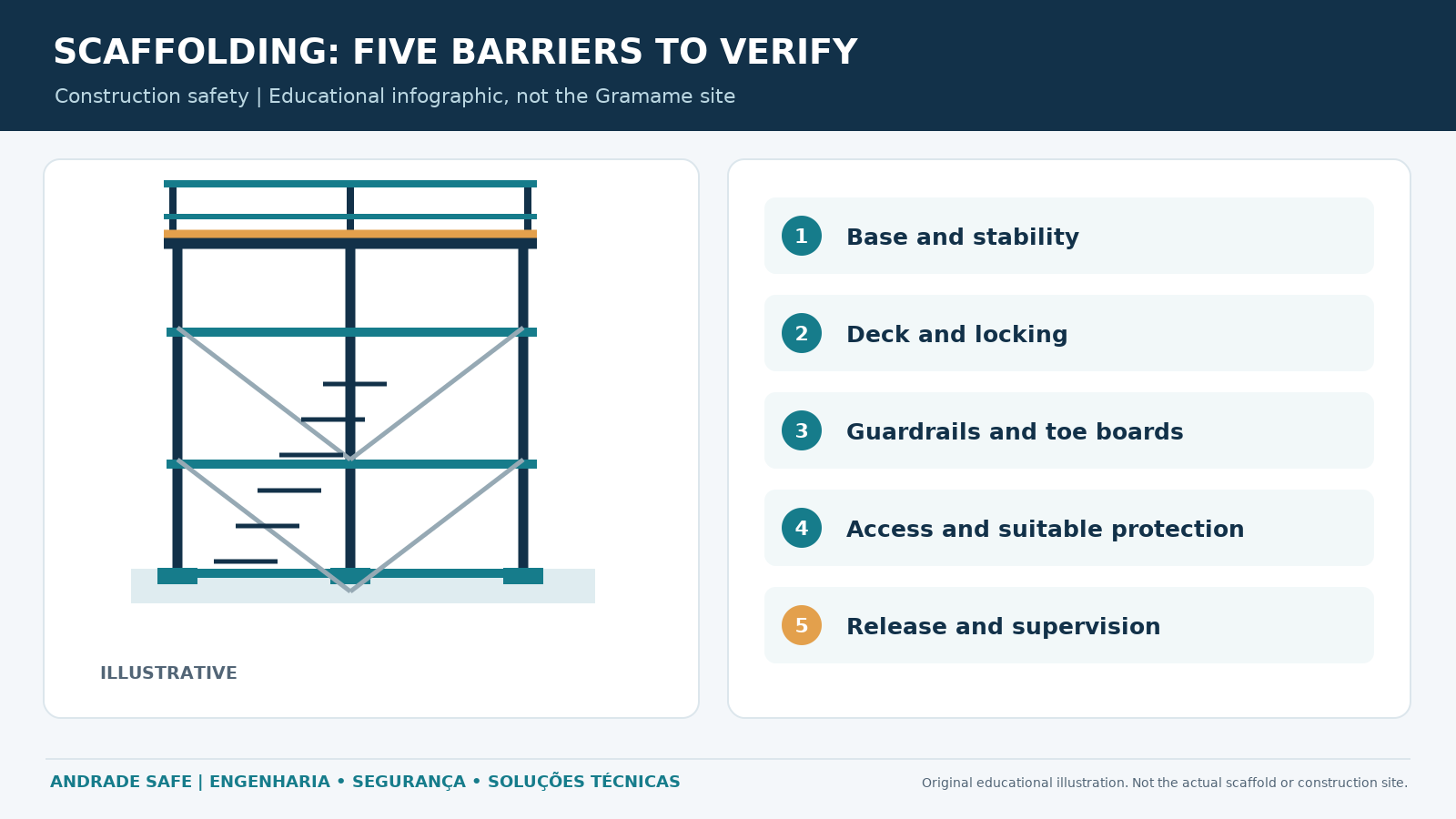
What happened in Gramame?
A 19-year-old masonry helper died on Monday, 23 November 2026, after a reported fall while working at a building site in Gramame, in the southern area of João Pessoa, Paraíba state, Brazil. Local news outlets identified the worker as Kevyn Dantas. According to information provided by police delegate Rafael Oliveira to TV Cabo Branco and published by Jornal da Paraíba, the Civil Police were contacted at approximately 12:20 p.m. [1]
The tragedy calls for more than a discussion of whether an individual worker was wearing a harness. Scaffolding is a temporary work system involving a load-bearing structure, deck, access route, perimeter protection, inspection process and management decisions. A fatal fall should be examined across those interconnected barriers rather than reduced to a single item of equipment.
The objective here is not to determine why this particular worker fell. The publicly accessible material reviewed by 24 November does not include a complete forensic engineering reconstruction. Instead, we examine what is known, what remains unverified and what an informed prevention program must demonstrate before anyone starts working on a scaffold.
What local reporting establishes — and what it does not
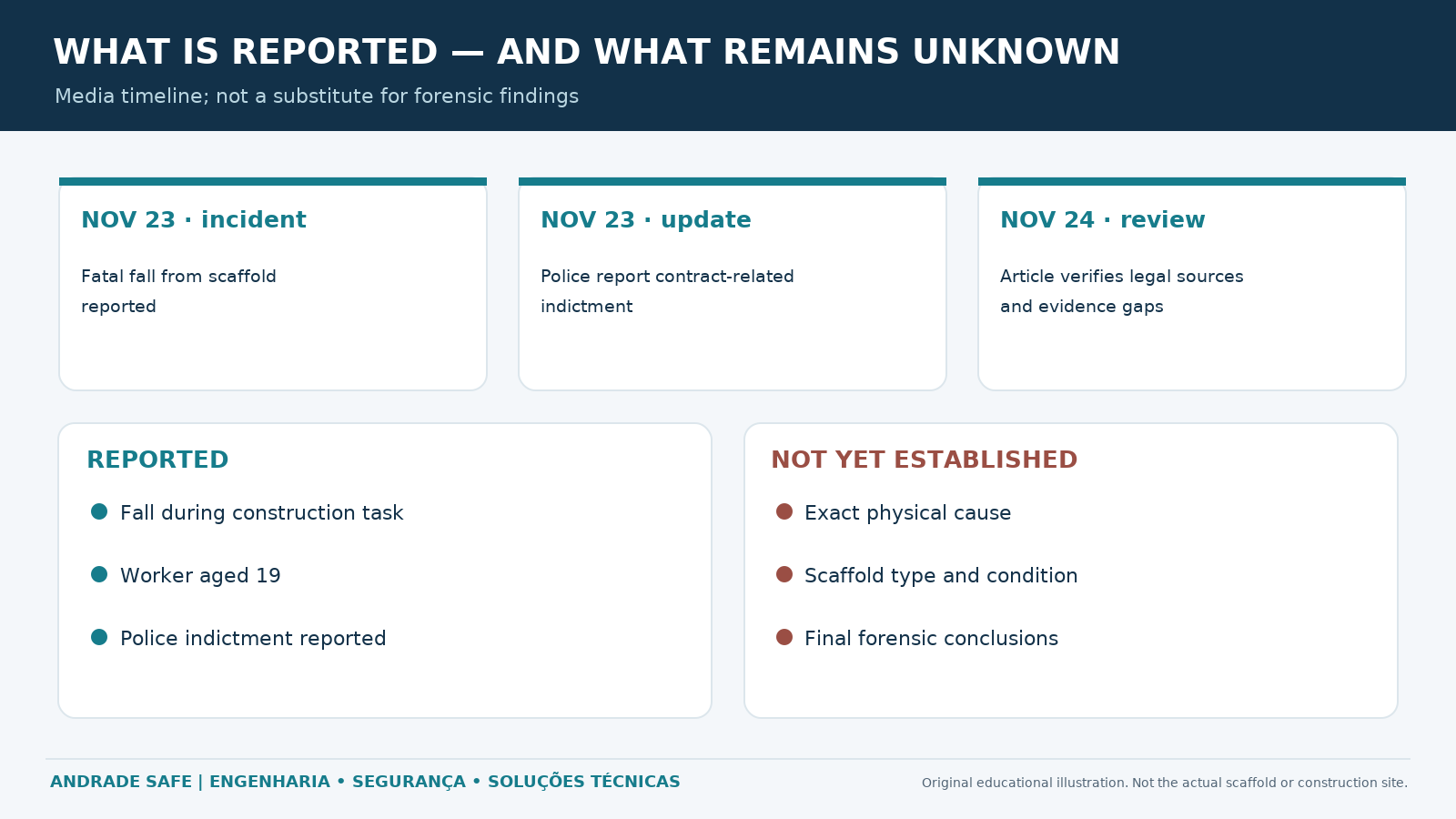
Initial reports published on 23 November stated that the worker fell from scaffolding during construction activities. Portal Correio reported that forensic examination would be necessary to determine the circumstances. [2]
Later that day, Jornal da Paraíba published the police delegate's account: the site foreman, the property owner and the person responsible for the service agreement were taken for questioning. The delegate said that a clause in the service agreement required supervision of personal protective equipment use. According to the report, police indicted the person responsible for that agreement on suspicion of negligent homicide; the person was described as an engineer. [1]
The same reporting says police established that the victim was not wearing a safety harness at the time. This statement is attributed to the delegate: it is not an independent conclusion of Andrade Safe. An indictment is not a criminal conviction, and it is not the same as an exhaustive finding about the physical cause of the fall, the adequacy of the work platform or the allocation of all duties.
A linguistic detail is also important: saying somebody “fell from scaffolding” does not mean that the scaffold collapsed. There is no verified public basis in the reviewed sources for alleging overturning, structural failure, breaking components or a specific fall height. The precise type of scaffold, its dimensions, perimeter protection, access arrangements and history of inspections remain unknown to this report.
| Question | Public status as of 24 November 2026 |
|---|---|
| Fatal accident at a Gramame building site on 23 November | Consistently reported by local outlets |
| Victim aged 19, working as a masonry helper | Reported by the local press |
| Reported fall from a scaffold | Consistent press description |
| Alleged lack of harness use | Attributed by Jornal da Paraíba to the police delegate |
| Indictment connected to a service agreement | Reported, attributed to police |
| Scaffold collapse, precise height and mechanism of the fall | Not established by a public technical report reviewed |
| Condition of guardrails, platform, access and formal release | Not documented in reviewed public sources |
| Specific findings by labor inspectors or the regional engineering council | Not located in this reporting exercise |
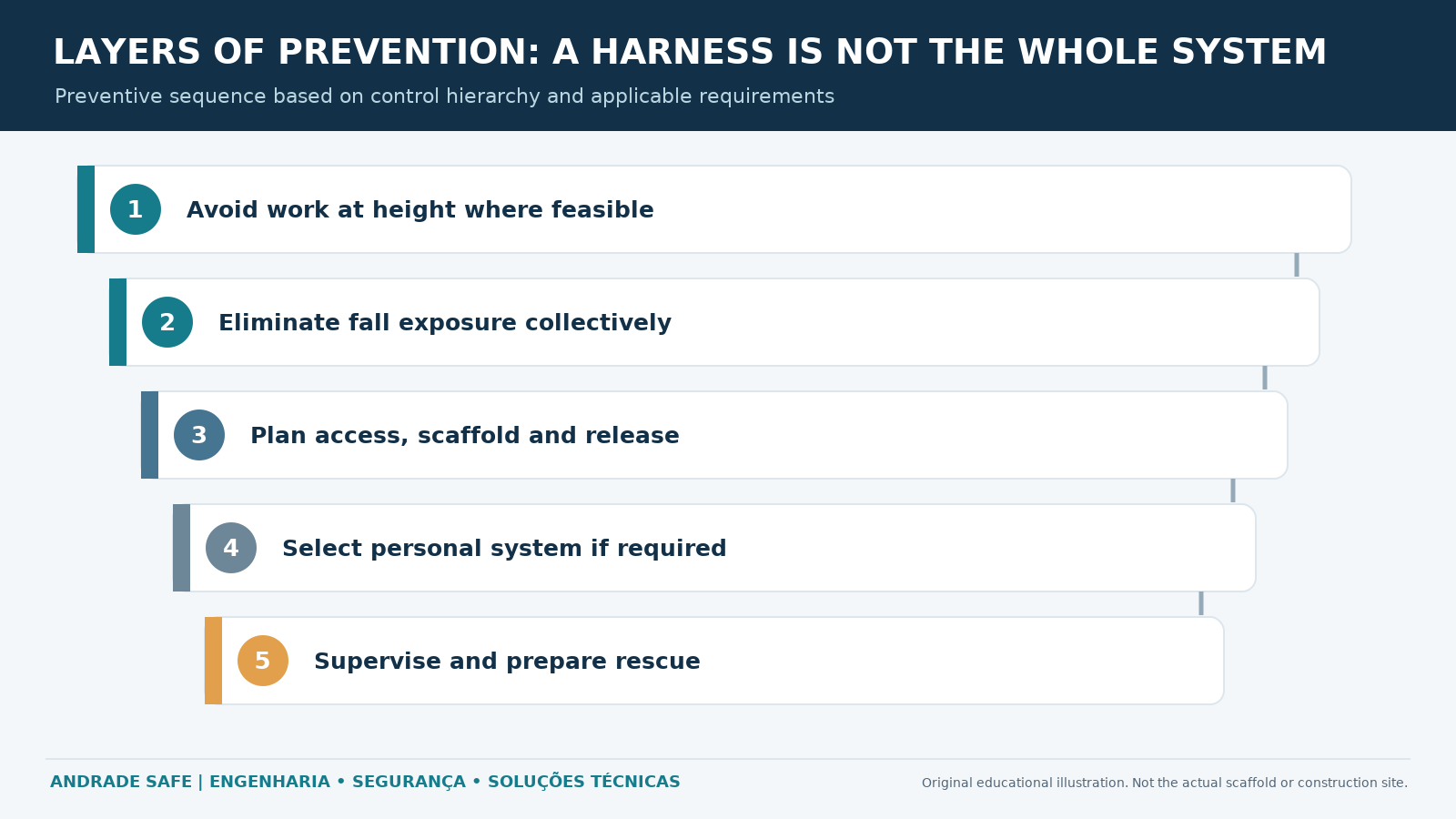
One harness cannot compensate for a missing prevention system
A full-body harness may be a necessary component of a personal fall protection system, but it does not by itself prevent all types of falling. When individual protection is selected, the elements need to be compatible: approved connection points, compatible connectors and connecting devices, an adequate anchoring structure, a workable movement path and the clearances required by the system's manufacturer. The arrangement must reflect an actual task-specific risk assessment. [4]
Brazil's NR-35, section 35.5.2, places prevention in a hierarchy: avoid work at height wherever possible; where this cannot be done, eliminate fall hazards; and only then limit the consequences of a fall that cannot be eliminated. In the construction sector, NR-18, section 18.9.1, calls for engineered collective protection wherever there is a risk of workers falling or materials being projected. [3][4]
This is why an allegation about a missing harness, even if confirmed, cannot be the whole story. Investigators should examine whether the working surface was complete and stable, whether appropriate collective fall protection was present, how the worker accessed the platform, whether individual protection was needed and feasible, who authorized the work and how changes and unsafe conditions were handled.
These are lines of inquiry, not findings about Gramame. Publicly available evidence does not yet support declaring those barriers present, absent, compliant or noncompliant at that particular site.
Scaffold safety under Brazil's updated NR-18
Brazilian construction safety regulation NR-18, as updated by MTE Ordinance 836/2026, contains a dedicated section, 18.12, on scaffolds and work platforms. Some of its provisions are highly relevant to the general prevention discussion: [3]
This is not a one-size-fits-all list. Supported, suspended, multidirectional, mobile and rack-platform equipment require distinct design and operational checks. The kind of scaffold used at Gramame has not been independently established in the publicly reviewed sources.
Similarly, the height-to-base relationship for untied, unbraced scaffold towers is a specific regulatory constraint, not a universal approval criterion for all scaffold configurations. Proper classification, manufacturer's instructions, competent engineering decisions and site conditions remain essential. [3]
Since June 29, 2026, item 18.12.1(d) refers to the guardrail and toe-board system in item 18.9.4.2 around the perimeter, except on the working-face side, subject to provisions applicable to the scaffold configuration. [3]
- 18.12.1: scaffold design by duly licensed professionals, manufacturing and manual requirements, perimeter guardrails and toe boards under the post-June-2026 wording, and safe access when relevant work locations exceed 0.4 m.
- 18.12.2: erection according to a design produced by a legally qualified professional. 18.12.2.1 contains a limited exception for a single-tower supported scaffold with height less than four times its smaller base dimension, where the assembly design may be waived but assembly must follow the manufacturer's manual.
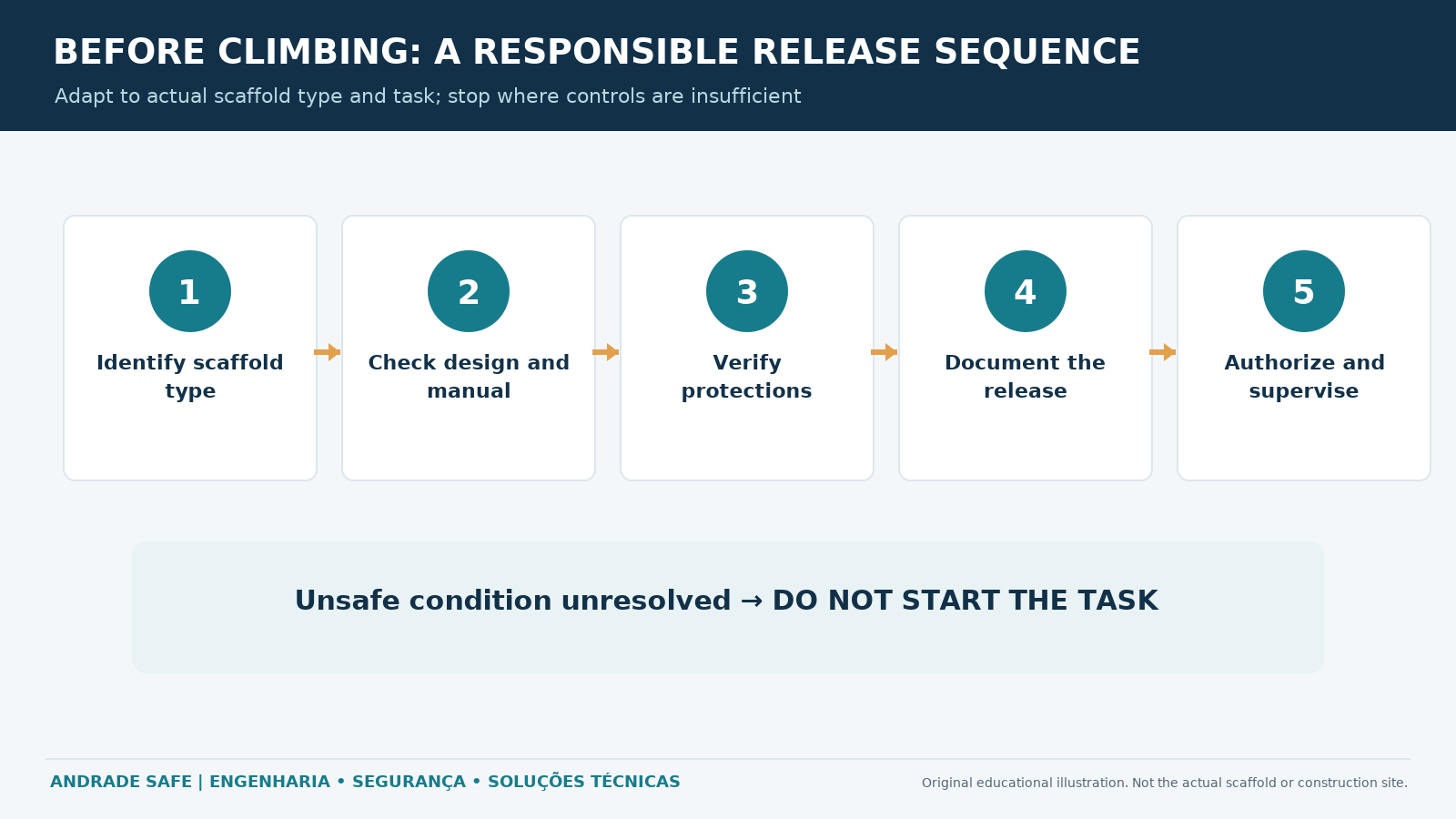
- 18.12.4: a formal release-for-use record, signed by a qualified occupational safety professional or the responsible site/work-front manager.
- 18.12.5: a resistant, fully decked, slip-resistant, level and secured work surface.
- 18.12.6: specific measures for erection and dismantling, including appropriate training, personal fall protection, secured tools and isolation/signaling of the area.
- 18.12.13 and following: particular requirements for supported scaffolds, including foundations, bracing or ties when necessary, access provisions and casters when applicable.
A site risk management plan must operate in the field
NR-18 requires a Risk Management Program (PGR) at construction sites (18.4.1) and updates that reflect changing construction stages (18.4.3.1). It also requires integrating activity-specific occupational hazard inventories provided by subcontractors (18.4.4). An express provision, 18.4.2.1, allows a qualified occupational safety professional, rather than a legally licensed safety professional, to prepare a PGR at a site no higher than 7 m with no more than 10 workers. This limited allowance does not remove the PGR requirement or the organization's duty to implement it. [3]
NR-35 adds Risk Assessment (AR) before every work-at-height activity (35.5.5); a specific Work Permit (PT) is required for non-routine work (35.5.7). For routine work, the risk assessment may be included in the relevant operating procedure. Authorized workers must meet training and fitness requirements, and the form of supervision is to be defined in the assessment. [4]
A document is not proof that the associated control was functioning at a particular location and time. A release record does not restore a missing deck. A PPE receipt does not demonstrate that a connector was fastened. A risk assessment only contributes to prevention when its identified measures are actually available, checked, understood and followed.
Contractual duties versus criminal responsibility
The local police account linked the reported indictment to a service-agreement clause addressing PPE supervision. This makes contractual interfaces a legitimate topic for engineers and managers. It does not permit a journalist to determine legal guilt or mechanically assign every safety obligation to one individual. Contract terms, the organization's duties under labor regulation, actual authority at the workplace, causal evidence and criminal liability are distinct questions. [1]
A technically useful inquiry asks who selected the work method, who was authorized to release the scaffold, who checked it after a modification, how the operation was supervised, who could suspend an unsafe activity and how concerns reached decision-makers. Small construction projects need such answers as much as large industrial sites.
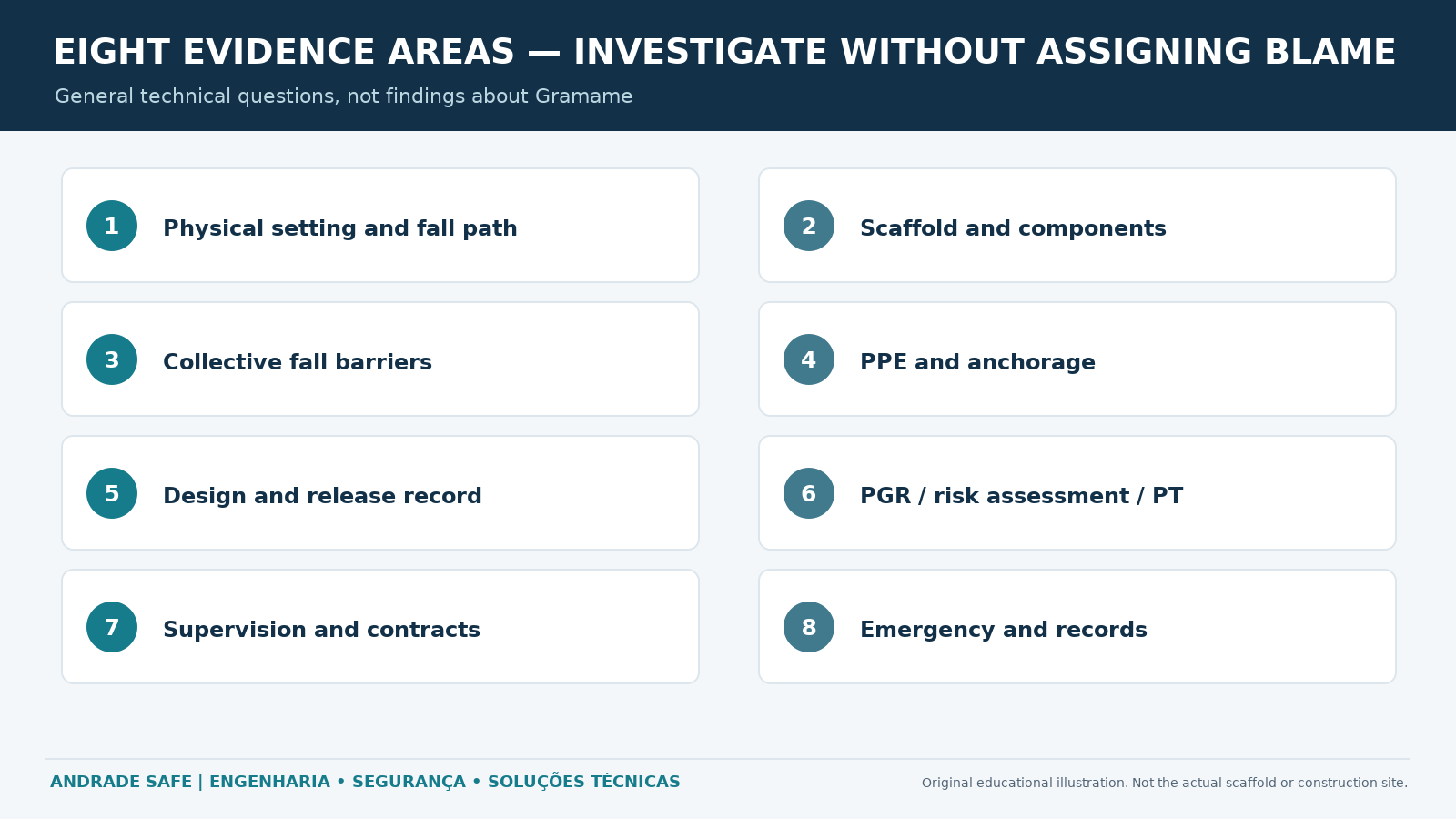
An evidence-led investigation: eight questions
The following categories describe potential evidence, not established failures at the Gramame site.
- 1. Physical setting: deck geometry, gaps, access, work zone, edge proximity and surface condition.
- 2. Equipment: scaffold identification and type, supplier manuals, components, connections, supports and ties.
- 3. Collective barriers: guardrails, toe boards, protected openings and approved alternatives, as applicable.
- 4. Individual fall protection: system selection, components, anchors, proper connection and inspection records where relevant.
- 5. Design and release: design or justified regulatory exception, formal release record and subsequent changes.
- 6. Work organization: PGR, task risk assessment, applicable permit, training, authorization, supervision and contracts.
- 7. Organizational factors: work sequencing, time pressure, communication, access to protective equipment and right to stop work.
- 8. Emergency and reporting: response plans, preservation of relevant evidence, legally required reports and traceability of records.
Practical action before the next scaffold is used
When a dangerous condition is observed, access to the unsafe area should be stopped and controlled without exposing other people to new hazards. Corrective measures should be technically verified before resuming work. Emergency response and protection of people take precedence; preservation of evidence should follow the authorities' instructions without delaying rescue.
Under Brazilian social-security reporting rules, a fatal work accident must be reported immediately through the required Work Accident Communication (CAT) process, including the eSocial S-2210 event where applicable. Filing the report does not itself establish fault and does not replace other required notifications. [5]
The accompanying kit includes a practical scaffold triage and release checklist intended to help teams ask better questions. It does not replace a qualified inspection, a design, the manufacturer's instructions, legal records or the formal release required by NR-18.
Download inspection screening checklist (PDF, Portuguese) →
Engineering is not the same as hindsight
A 19-year-old worker died doing his job. Accurate reporting honors that fact without turning unanswered technical questions into accusations. The critical lesson is practical: before a worker climbs, an organization must be able to demonstrate that the actual task, equipment and protection system can be used safely.
This report is an evolving record of sources available by 24 November 2026. New authoritative findings may be incorporated with dates and attribution at the same URL. This is a Brazilian regulatory case study; NR-18 and NR-35 are not automatically enforceable in other jurisdictions.
Sources
[1] Jornal da Paraíba, 23 November 2026 →
[2] Portal Correio, 23 November 2026 →
[3] Brazilian Ministry of Labor, NR-18 (2026 consolidated text) →
[4] Brazilian Ministry of Labor, NR-35 official consolidated text →
[5] Brazilian government, Work Accident Communication (CAT), updated August 2026 →
Frequently asked questions
Did the scaffold collapse?
The reviewed reports describe a fall from scaffolding. They do not establish a collapse or structural failure.
Does a harness alone make scaffold work safe?
No. The full hierarchy of controls, access, collective protection, any individual protection, supervision and rescue arrangements must fit the task.
Does every scaffold need a separate erection design?
NR-18 sets a general rule and a limited exception under item 18.12.2.1. Equipment classification matters.
Is a work permit mandatory for every task at height?
Under Brazilian NR-35, every task at height requires a risk assessment; an additional permit is specifically mandatory for non-routine activities.
Who signs the release record?
NR-18 item 18.12.4 specifies a qualified occupational safety professional or the person responsible for the site/work front.
Does the police indictment establish guilt?
No. It marks a stage of the investigation, not a final judicial decision.