
Explore Klabin’s Otacílio Costa incident and the engineering of Kraft black liquor recovery boilers, molten smelt hazards, steam systems and Brazilian NR-13.
Context and purpose
A black liquor recovery boiler is a rare combination of a chemical-recovery reactor and a steam-generation system. It recovers valuable pulping chemicals while releasing energy from the organic fraction of spent process liquor. Its design brings together combustion, fluid mechanics, heat transfer, metallurgy and advanced process protection. It also introduces hazards that cannot be understood by treating the equipment merely as a pressurized vessel.
An incident at Klabin's Otacílio Costa mill in Santa Catarina, Brazil, on November 18, 2026, brings these issues into focus. This article examines the engineering, the evidence currently available and the lessons that can be transferred to industrial integrity programs. It does not claim to identify the cause of the incident.
The incident: confirmed facts, updated reporting and open questions
In a material disclosure dated November 18, 2026, Klabin reported an occurrence involving the recovery boiler at its Otacílio Costa unit. It said operations were immediately suspended, the site was isolated, emergency protocols were activated and ten employees had been taken to a regional hospital at the time of the disclosure. The company said it was working with relevant authorities to establish the causes and circumstances.
Firefighters and news organizations described an explosion. A later evening report from GZH cited eleven injured people, based on a subsequent hospital update. These are not necessarily separate groups: the first number concerns employees taken to hospital in the company's initial statement; the second is a later injury count reported by the press. Neither should be added to the other.
November 19, 2026 update: according to a Klabin statement reproduced by Metrópoles, 11 employees were taken to hospital; ten had been discharged and one remained under medical care. This updates the initial disclosure and must not be added to its count.
As of the preparation of this dossier, no publicly located final forensic investigation established whether the event began in a pressure boundary, combustion system, furnace floor, dissolving tank or elsewhere. There was no verified public basis for linking the occurrence to any previous maintenance intervention. Klabin's third-quarter 2026 results mention a scheduled shutdown that included recovery-boiler work; this is operational background, not evidence of causation.
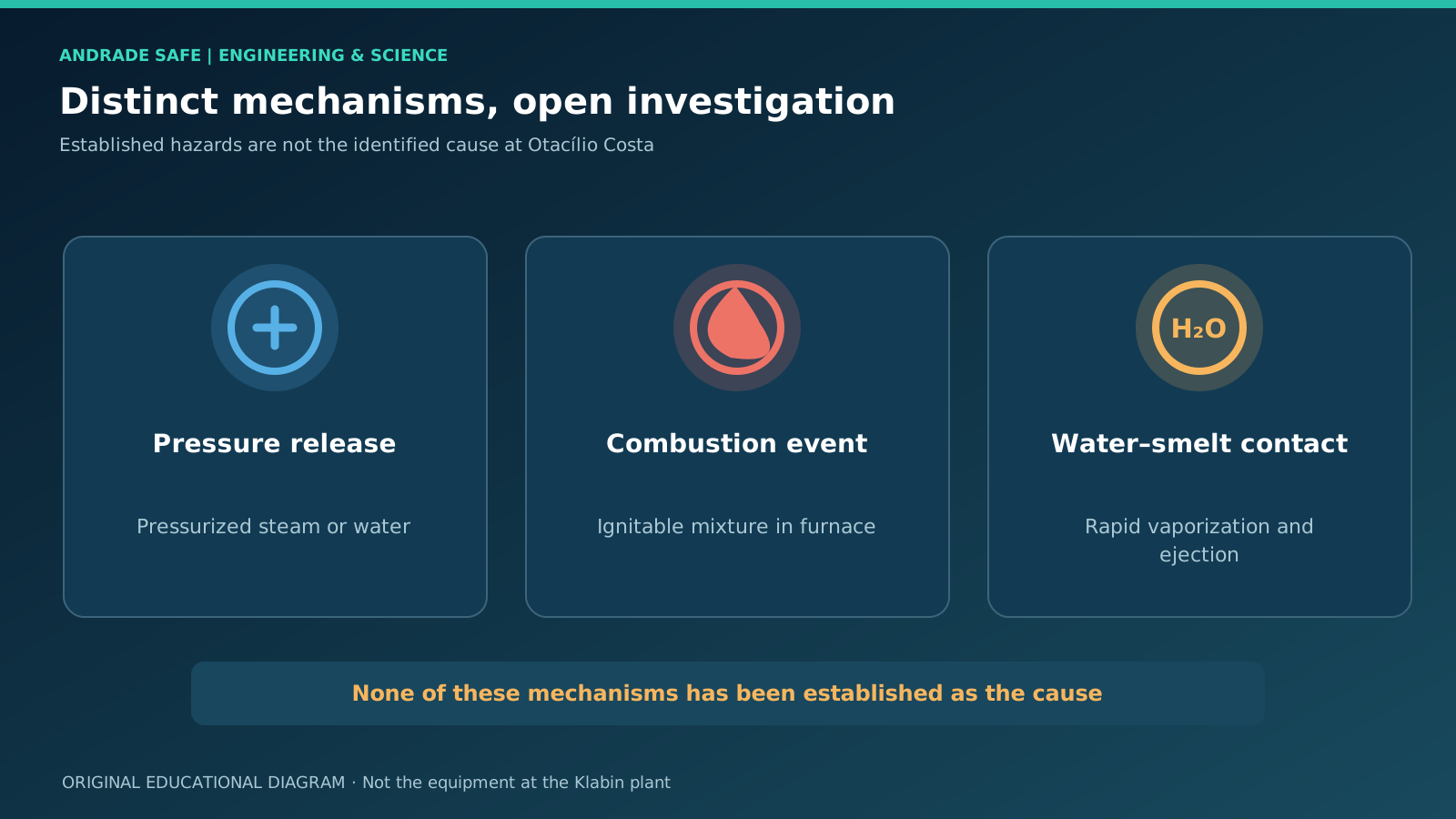
The distinction matters: “explosion at a boiler” is an incident description, not a technical diagnosis. Pressure-boundary failure, furnace combustion events and rapid steam generation following water–smelt contact are different physical mechanisms and require different evidence.
First understand the Kraft cycle
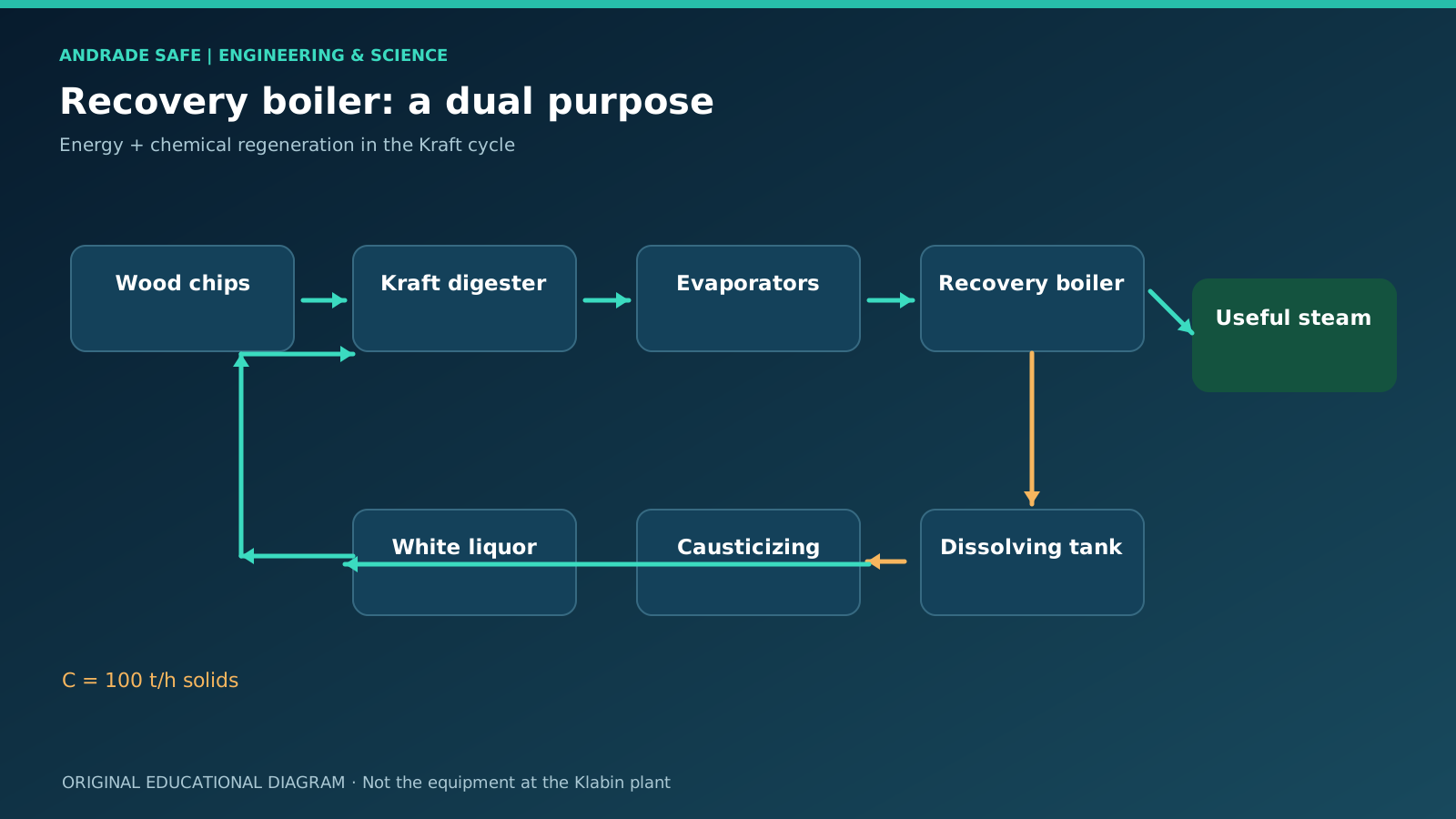
In Kraft pulping, wood chips are cooked with an alkaline solution to separate useful cellulose fibers from much of the lignin and other constituents. The exhausted liquor leaving the digester contains dissolved organic matter and chemical species from the pulping process. This stream is called black liquor.
Rather than discarding the liquor, mills concentrate it in evaporation equipment and send it to a recovery boiler. The organic fraction acts as an energy source; the inorganic fraction is processed to regenerate pulping chemicals. At the furnace floor, a hot inorganic melt called smelt is produced. It flows through designed spouts to a dissolving system, producing green liquor. Downstream causticizing steps ultimately recover white liquor for the digester.
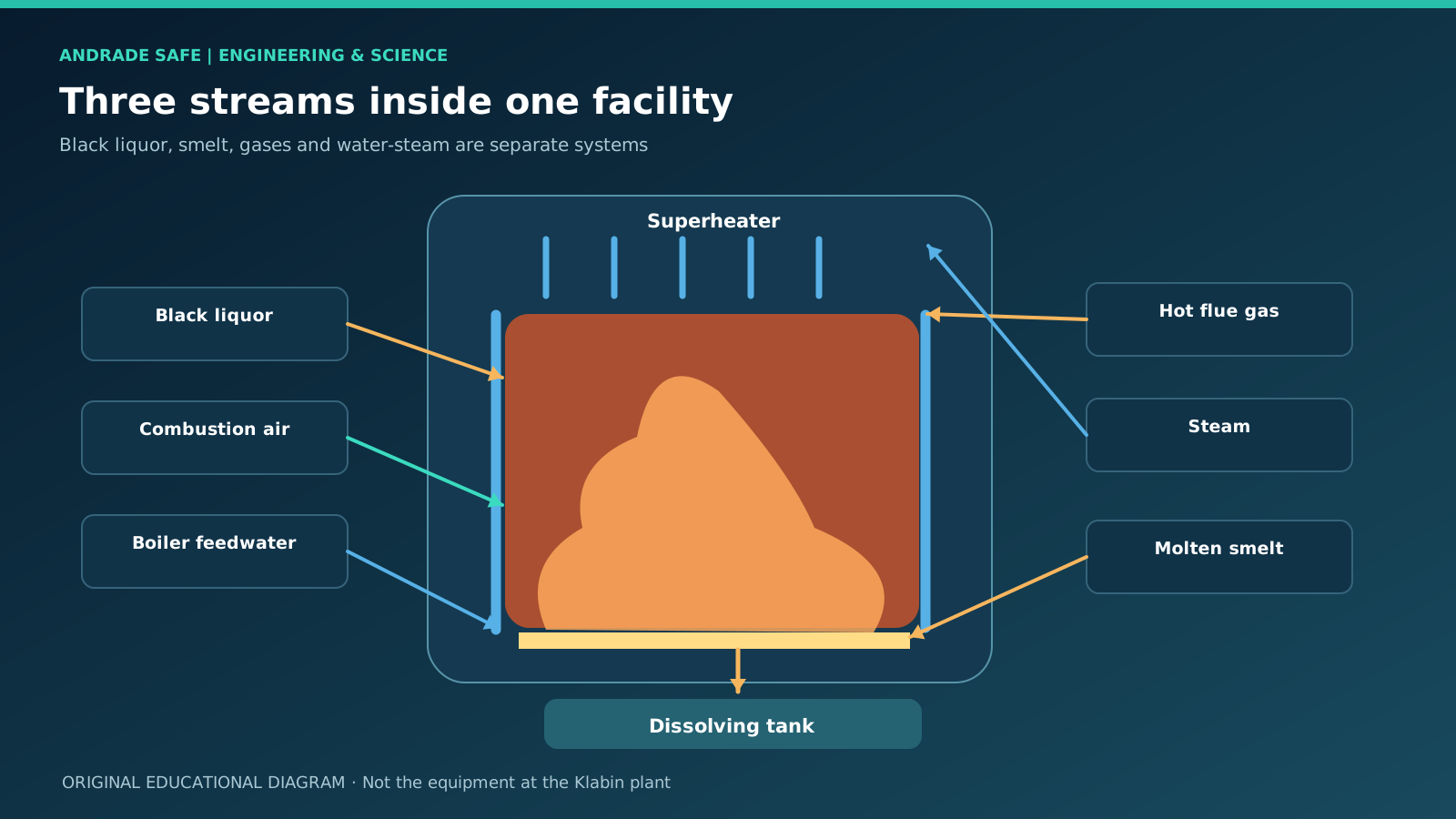
The boiler therefore connects three different streams: black liquor and smelt, combustion gases, and the water–steam circuit. Every stream has different chemistry, operating constraints and failure modes. The National Board of Boiler and Pressure Vessel Inspectors emphasizes that the black liquor recovery boiler is both a chemical-recovery system and an energy-recovery unit.
What is inside the recovery boiler?
Concentrated liquor enters the furnace through an engineered distribution system. Combustion air is supplied in stages, allowing a combination of organic combustion and chemical reduction. Hot gas travels upward through heat-transfer surfaces, while the water–steam circuit removes energy through waterwalls, generating banks, superheaters and, depending on design, economizers.
Steam can support mill processes and power-generation equipment. On the chemical side, the inorganic melt forms at the lower furnace and exits through smelt spouts. These operations are simultaneous but must not be confused. The controlled use of liquid in a smelt dissolving tank does not imply that accidental water entry into a hot furnace is safe.
Recovery boilers face elevated thermal gradients, high-temperature corrosion, deposition, erosive and chemical attack, as well as risks associated with tube damage. The relevant design details depend on metallurgy, pressure, chemical conditions, firing arrangements and maintenance history. It would be improper to apply a generic failure explanation to the Otacílio Costa unit without those details.
Three distinct hazard mechanisms
Pressure-boundary release
High-pressure hot water or steam contains substantial stored energy. A failure of a tube, header, pressure part or connected system may result in a sudden fluid release, burns, mechanical damage or impaired function. The pressure condition, temperature, fluid state and physical geometry determine the consequences. This is a conventional boiler and pressure-equipment integrity concern, although the operating environment of a recovery boiler adds complexity.
Furnace combustion event
Furnaces may have auxiliary fuel systems. Under inappropriate conditions, an ignitable atmosphere may form and ignite. Combustion management, flame supervision, permissives, purging arrangements and safety interlocks are relevant engineering safeguards. A furnace combustion event is not the same as a rupture of a pressure boundary.
Smelt–water interaction
The recovery boiler's distinctive hazard involves molten inorganic material and the possibility of rapid vapor generation if water contacts it unexpectedly. The WorkSafeBC risk advisory, published in 2024, highlights water ingress, hot-smelt ejection, smelt accumulation and dissolving-tank events. These hazards also pose severe risks to personnel working near spouts or during field inspection.
All three are established general hazard categories. None is established as the cause of this particular event. Selecting a mechanism requires instrument histories, examination of damaged components, documented operating sequences and qualified forensic analysis.
The Brazilian legal requirements: NR-13
Brazil's NR-13 — Boilers, Pressure Vessels, Piping and Metallic Storage Tanks establishes mandatory requirements for structural integrity management during installation, inspection, operation and maintenance. The official text supplied by the Brazilian Ministry of Labor incorporates amendments through MTP Ordinance No. 4,219/2022. The equipment's specific classification and applicable inspection framework require verified design and operating data; they cannot be inferred from news coverage.
The regulation addresses safety valves, pressure indication, water-level control, equipment documentation and technical responsibility for safety inspections. Particularly relevant is NR-13 item 13.4.1.2(d), requiring a dedicated rapid water-drainage system for alkali recovery boilers, with automatic actions after operator activation. This requirement recognizes a hazard specific to recovery boilers. It does not establish whether a particular system was present, tested, activated or defective at the affected plant.
Another important legal distinction concerns incident reporting. NR-13 item 13.3.11 sets out notification duties for events meeting specified criteria, including worker death, hospital admission, or an event of major proportion. Someone being taken to a hospital is not necessarily the same as being admitted as an inpatient. Therefore, media reports alone do not settle the application of every reporting provision.
The official source is the NR-13 text published by the Ministry of Labor. Technical guidance from the Black Liquor Recovery Boiler Advisory Committee is valuable but does not automatically have the force of Brazilian law. A facility's project, governing codes and legal obligations must be assessed separately.
Safety as a layered system
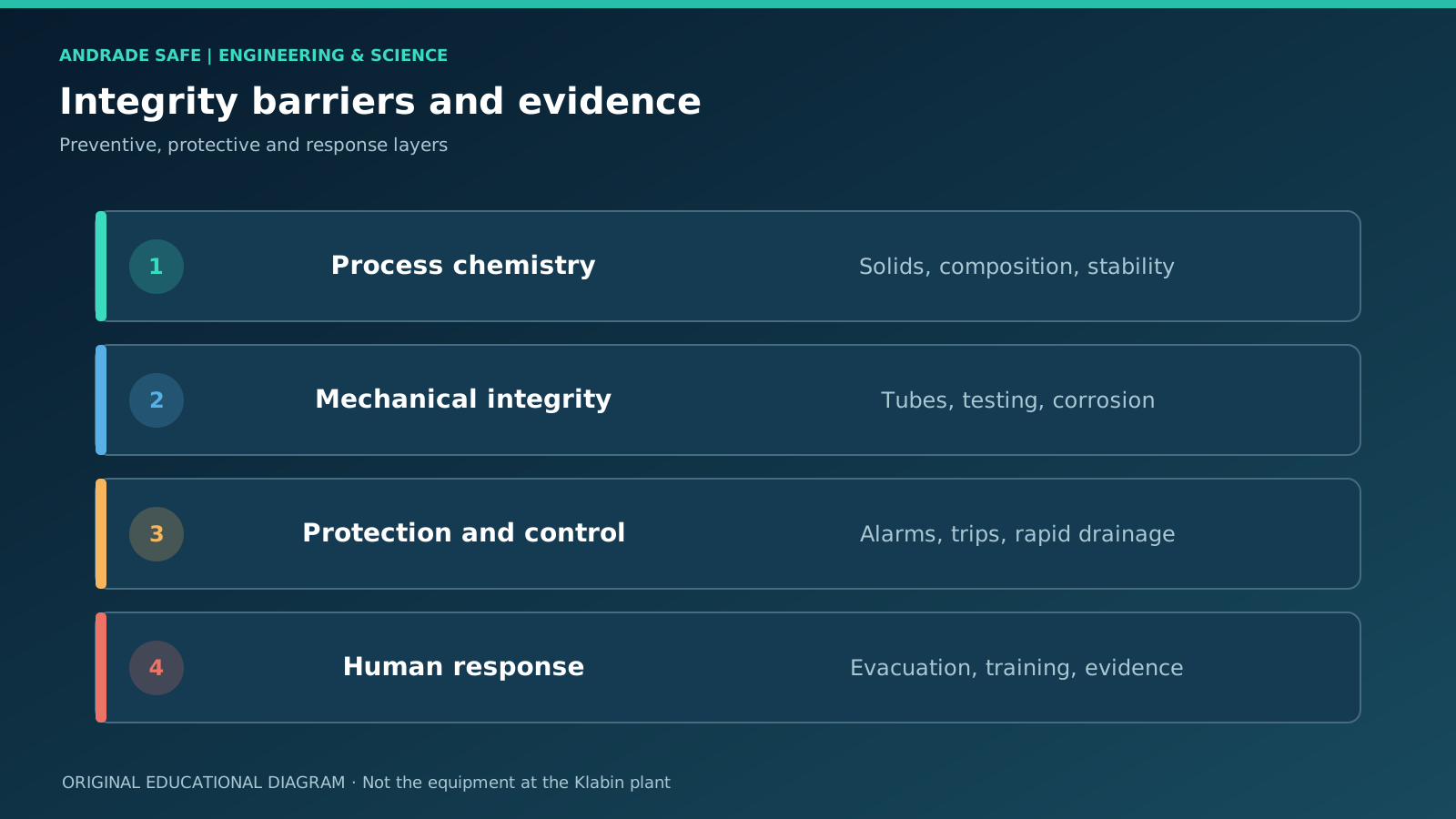
A mature integrity strategy is much broader than an annual inspection. It coordinates black liquor chemistry and solids content, combustion stability, water and steam chemistry, waterwall integrity, corrosion monitoring, leak detection, pressure and level protection, instruments, interlocks, human exposure reduction and emergency planning.
Independent safeguards should be examined for common-cause vulnerabilities. For example, an alarm that depends on the same faulty sensing chain as a control function may provide less independence than its block diagram suggests. Emergency-response procedures must be appropriate to the actual equipment and controlled by qualified personnel; this article intentionally does not reproduce operational shutdown instructions.
The BLRBAC's guidance library covers emergency shutdown, black liquor firing, welding, boiler water and instruments. WorkSafeBC also highlights remote monitoring and automation as potential means of reducing exposure near smelt-handling points. These considerations are transferable to other industrial systems that combine high thermal energy, hazardous process material and pressurized fluids.
Worked example: a simplified energy balance
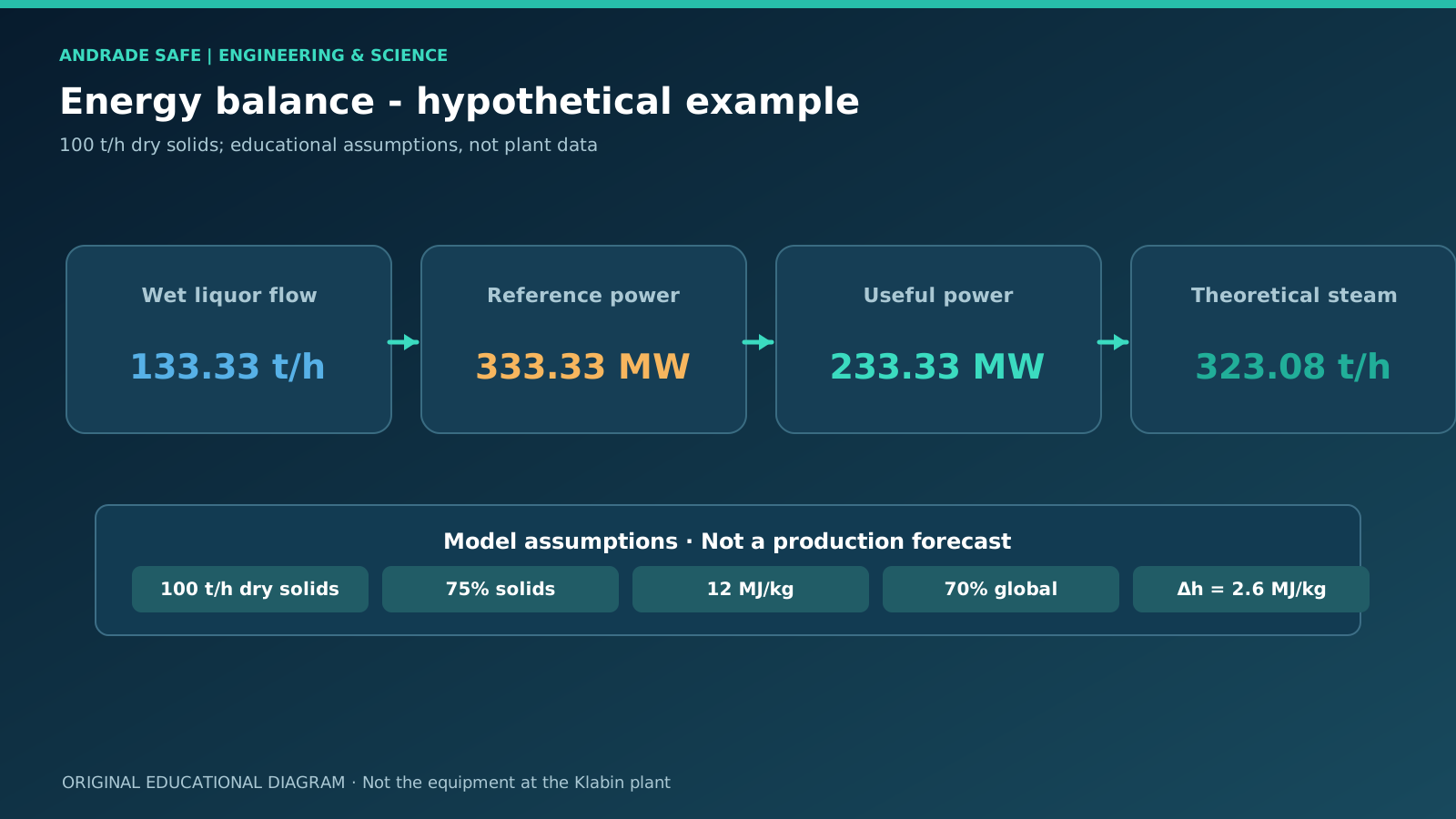
The following example is entirely hypothetical and has no relationship to the Klabin boiler's operating parameters. Consider a black liquor recovery system receiving 100 metric tonnes per hour of dry solids, with an assumed liquor dry-solids fraction of 75%.
The total wet-liquor flow is:
100 / 0.75 = 133.33 t/h
The wet liquor therefore contains 33.33 t/h of water. Assume an illustrative energy content of 12 MJ/kg of dry solids, a global 70% net conversion factor to useful steam enthalpy and an enthalpy increase of 2.6 MJ/kg between boiler feedwater and steam.
100 × 1000 × 12 / 3600 = 333.33 MW
0.70 × 333.33 = 233.33 MW
233.33 / 2.6 × 3.6 = 323.08 t/h
The calculated steam flow can exceed liquor feed flow because boiler feedwater is a separate mass stream. The simplified global conversion factor subsumes effects that require separate accounting in a real boiler: moisture heating and evaporation, composition, stack losses, radiative losses and operational details. Engineering design requires a full mass-and-energy balance, measured performance and appropriate steam-property tables. These numbers are not an efficiency claim, plant forecast or risk calculation.
The accompanying interactive laboratory varies dry-solids throughput, solids fraction, assumed energy content, global conversion factor and steam enthalpy rise. It produces a downloadable CSV summary but does not model furnace explosions, safety valves, shutdown sequences or structural integrity.
What would a robust investigation examine?
A proper investigation preserves and reconstructs control-system trends, temperature and pressure histories, water levels, valve states, alarm sequences, operating logs, liquor and water chemistry, equipment inspections, thickness measurements, repair records, work permits, maintenance history and physical evidence. It also considers the location of workers, emergency access, evacuation timing, exposure pathways and the effectiveness of response arrangements.
The question is not merely “which part failed?” It is also “which safeguards were expected to prevent or limit the event, and what verifiable evidence exists of their performance?” Care is needed not to treat a recent maintenance shutdown, a photograph or an unverified claim as a causal finding.
Conclusion
The Otacílio Costa incident is serious and deserves continued factual reporting. The public information supports the occurrence, the suspension of operations, emergency response and medical care, while leaving the mechanism undetermined. A black liquor recovery boiler belongs to a distinct class of complex industrial systems: chemical regeneration and steam generation must be managed as a connected whole.
The transferable engineering lesson is the importance of integrating process chemistry, thermal design, mechanical integrity, instrumentation and worker protection instead of treating each as an isolated discipline.
Related reading: explore the existing Andrade Safe NR-13 and integrity guide, as well as a separate case study on an incident in Tapiratiba. For appropriately scoped services, the company also presents NR-13 inspection and documentation support.
Frequently asked questions
Did Klabin establish the physical cause? No conclusive public investigation was located for this research snapshot. The company reported an occurrence; other sources described an explosion.
What is black liquor? Spent alkaline cooking liquor containing dissolved wood-derived organic matter and recoverable process chemicals.
What is smelt? Molten inorganic material formed inside the recovery furnace and managed through a controlled chemical-recovery system.
Is the risk identical to that of an ordinary boiler? No. Recovery boilers combine steam and pressure risks with specific chemical and molten-material hazards.
Does NR-13 explicitly mention recovery boilers? Yes. Item 13.4.1.2(d) contains a specific rapid-drainage requirement for alkali recovery boilers.
Primary sources and technical references
Educational analysis only. Not a forensic report, an NR-13 inspection, or an emergency operating procedure.
- Klabin, material disclosure, November 18, 2026
- Brazilian Ministry of Labor, NR-13 consolidated text
- WorkSafeBC, Recovery Boiler Risk Advisory RA 2024-01
- BLRBAC, Guidelines & Recommended Practices
- National Board, Black Liquor Recovery Boilers: An Introduction
- GZH, later November 18 hospital reporting