
The November 2026 FAA network outage explained: 17 affected centers, common-cause failures, redundancy and safe operation in critical systems.
The critical function comes before the hardware
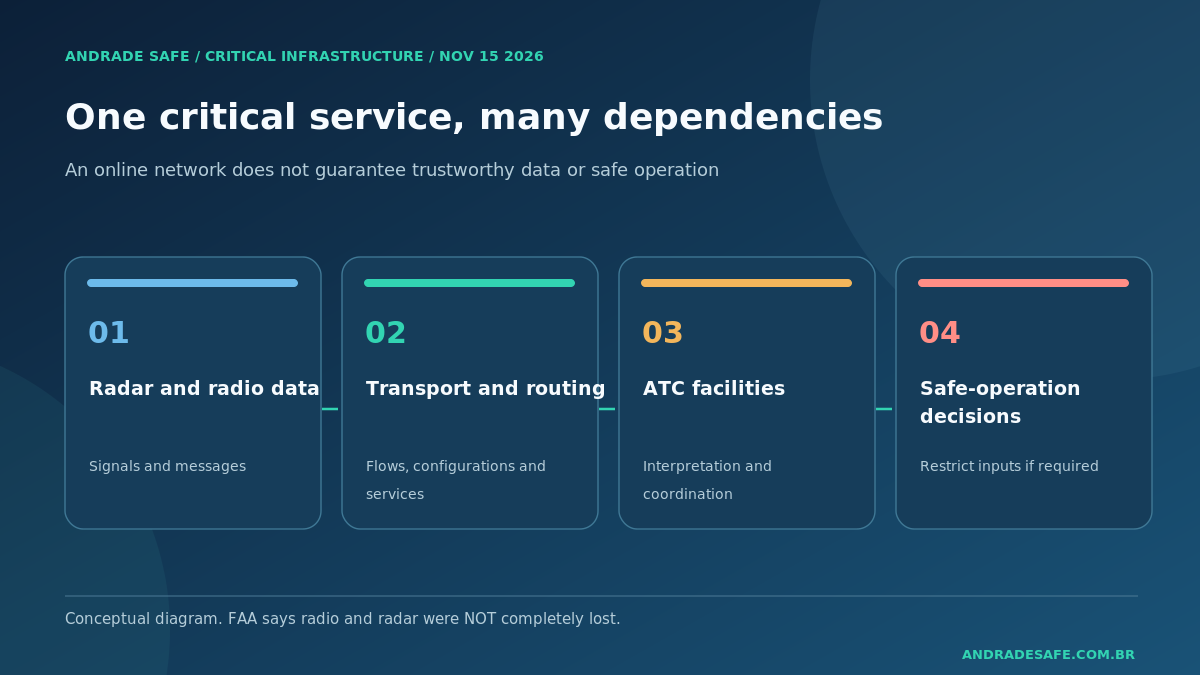
Central argument: a safety-critical network does not have to lose every component to become unsuitable for normal operation. Reliability is the capacity to preserve essential functions, trustworthy information and safe decisions under abnormal conditions.
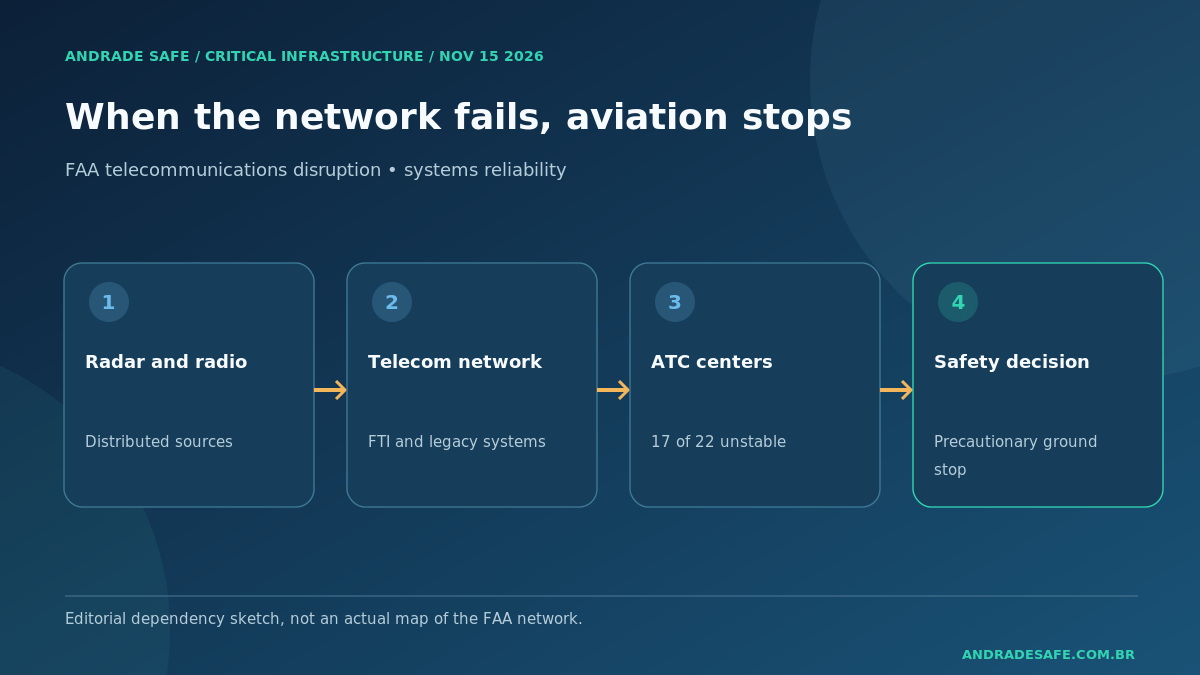
A telecommunications disruption stops departures across the United States
On November 13, 2026, the U.S. Federal Aviation Administration (FAA) issued a nationwide ground stop because telecommunications serving air traffic control facilities had become unstable. In its November 15 briefing, the agency stated that technical trouble began at approximately 3:30 p.m. Eastern Time, with departures resuming from 8:15 p.m. The interval between those markers is roughly four hours and 45 minutes; it should not be represented as the precise duration of the ground-stop order [1].
The agency said 17 of its 22 Air Route Traffic Control Centers experienced instability, with effects extending to several terminal radar approach control facilities. This was not a total nationwide blackout: some radio frequencies and radar feeds remained reliable, and controllers could support aircraft already airborne. The ground stop was a precautionary measure to keep the system within a safe operating envelope [1][2].
The U.S. Department of Transportation described the careful handling of more than 3,500 flights and the gradual resumption of operations after the restrictions were lifted [2]. In its November 15 FAQ, the FAA reported approximately 12,462 canceled flights on November 13, explicitly cautioning that not all cancellations were directly attributable to the ground stop [1]. That warning matters: a reported total must not be converted into a loss estimate or causal claim without a defensible methodology.
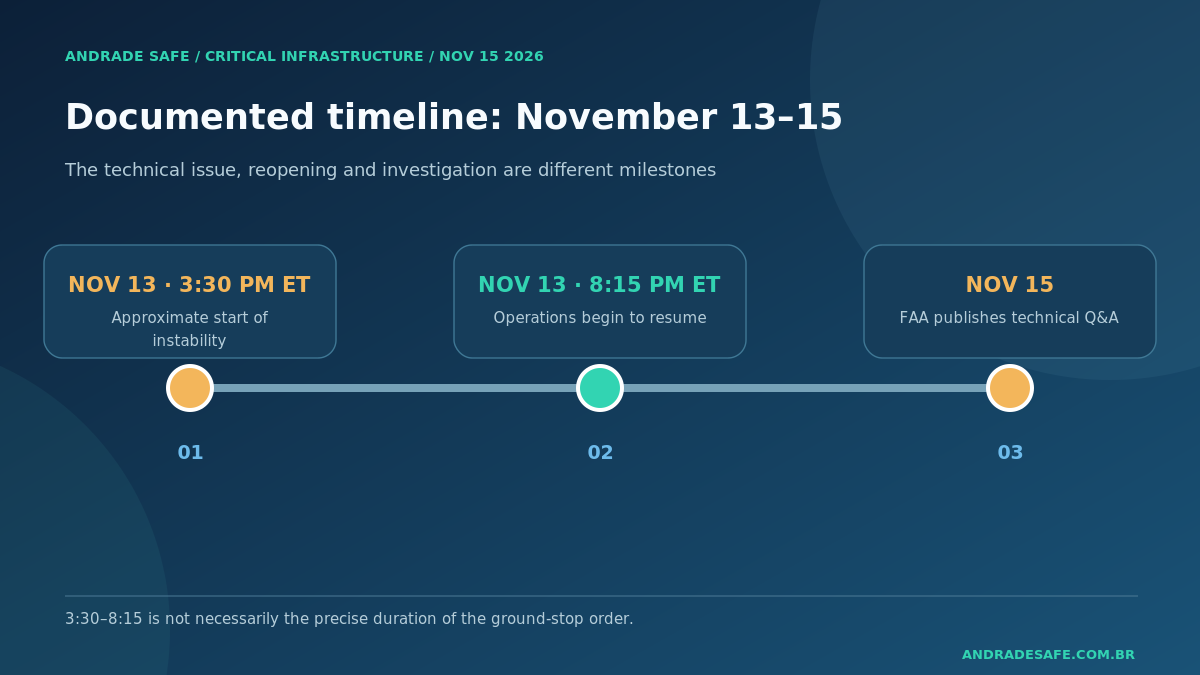
The findings so far — and what remains unknown
According to the FAA, legacy equipment in the FAA Telecommunications Infrastructure (FTI) network became unstable as unusual amounts of data were being generated. The agency cited about 1,000 connection attempts every four to five seconds, equivalent to approximately 200–250 attempts per second for that specific reported metric. This is not a measurement of total network throughput or a statement about all FAA traffic [1].
Early investigation identified two possible originating locations: a radar site in Amarillo, Texas, and a radio communications facility in El Dorado, Arkansas. Network service provider L3Harris had performed work at El Dorado, including deployment of a router. Blocking traffic from the two sites helped stabilize the network, and the agency disabled a broadcast function on roughly 60 similar routers as a precaution [1].
The sequence describes a preliminary operational explanation, not a completed forensic root-cause analysis. It does not establish which change initiated the event, precisely how the traffic propagated, whether redundancies behaved as designed or how responsibility should be allocated. The FAA said it had no indication of a cyberattack on the evidence then available, while continuing its investigation [1].
Documented: nationwide ground stop; instability at 17 of 22 centers; partial degradation of radar and communications information; isolations and preventive router changes. Unresolved: initiating mechanism, propagation path, independent failure modes, common dependencies and final root cause.
Official update of November 15, 2026: the Department of Transportation said the routers related to the disruption were undergoing diagnostics in L3Harris laboratories with FAA staff involved. Review of the equipment and installation process was continuing; this update is not a final root-cause report [6].
Availability, integrity and safety are different engineering properties
A network interface can be powered, connected and responsive while the information it delivers becomes inconsistent or untimely. This distinction is central to critical-infrastructure engineering. Availability asks whether a service can be accessed. Integrity asks whether its information remains correct and coherent. Timeliness asks whether information arrives before it becomes operationally stale. Safety asks whether the overall system can continue without unacceptable risk.
These properties overlap but are not interchangeable. A control facility receiving conflicting or unreliable information may be forced to restrict operations even if much of the physical network is still online. This is not evidence that pilots were abandoned without communications. It explains why a deliberate safe restriction can be an effective defense while the underlying technical incident still demands investigation.
The same distinction appears in industrial process control, hospital systems, water utilities, electric grids and transportation logistics: keeping hardware energized is not the same as preserving the function that matters.
Why redundant equipment can still fail together
Real systems depend on equipment, power, software, time synchronization, data routing, configuration, maintenance and human decisions. Two routers may appear redundant on a drawing but share a control-plane defect, software version, configuration template, service provider or maintenance process.
A common-cause failure occurs when the same initiating condition affects components intended to provide independent protection. Independent redundancy can improve availability dramatically; shared vulnerabilities can erase much of that improvement.
NIST SP 800-53, particularly the CP-8 family, addresses alternate telecommunications and reducing single points of failure and shared vulnerabilities [3]. NIST SP 800-34 addresses business impact assessment, continuity arrangements, recovery strategies and exercises [4]. These are technical reference frameworks; they must not be presented as universal legal obligations outside their scope.
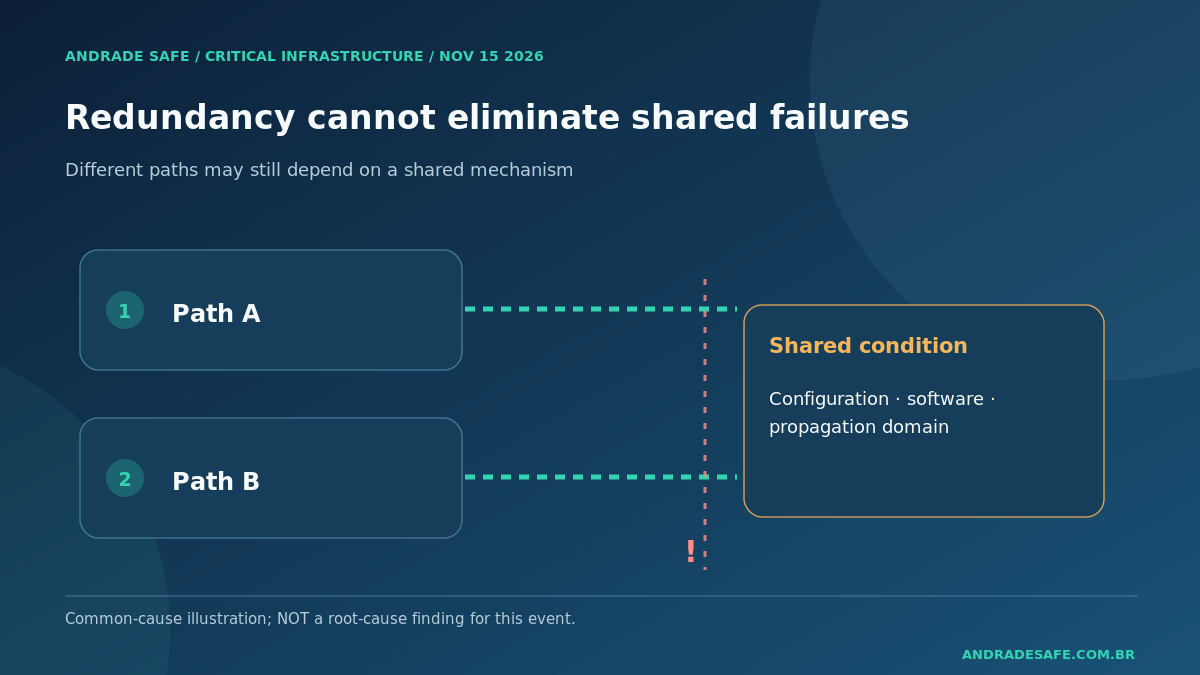
Worked example: series, parallel and a shared failure event
Assume a hypothetical component availability of A = 0.98, or 98% within a defined observation horizon, and independent component failures unless otherwise stated. Its unavailability is q = 1 − A = 0.02.
For two identical components in active parallel, each independently able to provide the service with perfect switchover:
Aₚ=1-(1-A)²=1-0.02²=0.9996=99.96%
Now add a hypothetical shared unavailable state c = 0.01, active with 1% probability at a sampled instant, independently of local branch failures, and affecting the whole parallel arrangement. Under the stated simplified assumption:
A꜀=(1-c)[1-(1-A)²]=0.99(0.9996)=0.989604
This is 98.9604%, not the original 99.96%. Comparisons must use compatible system boundaries: if the shared event also affects the single-unit reference, it must be modeled there too.
Three independent components arranged in series all have to work:
Aₛ=A³=0.98³=0.941192=94.1192%
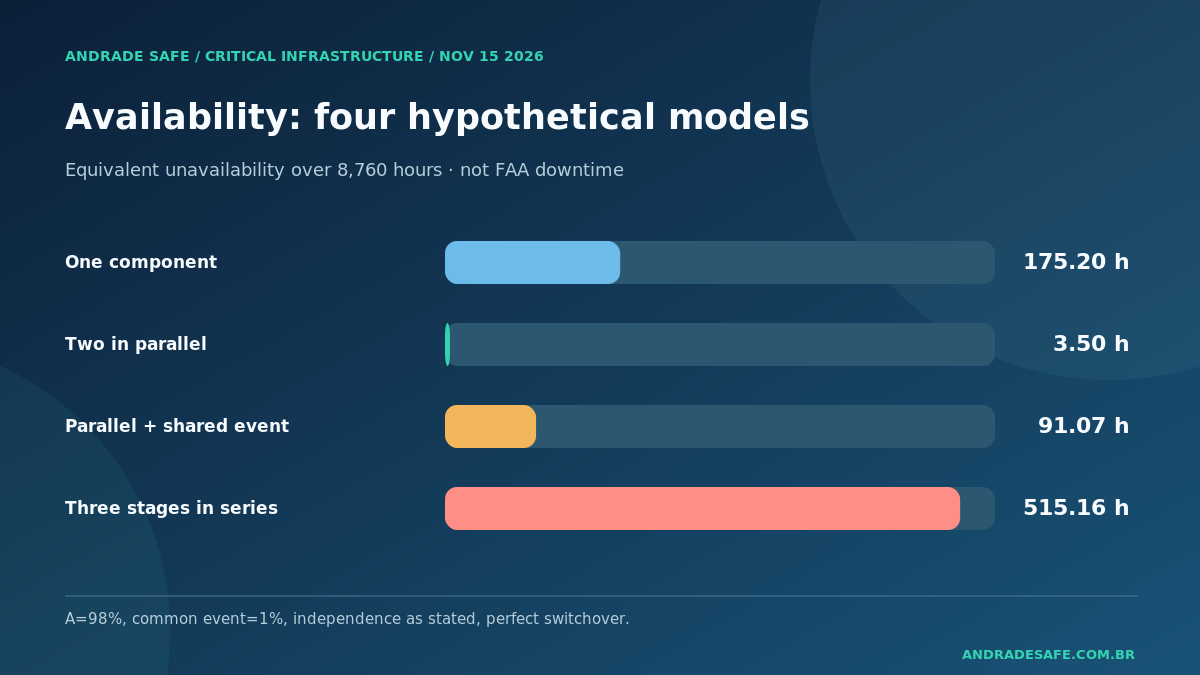
| Hypothetical model | Availability | Equivalent unavailability over 8,760 h |
|---|---|---|
| Single component | 98.0000% | 175.20 h |
| Two independent parallel components | 99.9600% | 3.50 h |
| Parallel plus 1% common-mode event | 98.9604% | 91.07 h |
| Three components in series | 94.1192% | 515.16 h |
Explore the reliability laboratory
These are mathematical equivalents, not actual FAA downtime or forecasts. The model assumes time-independent availability, no coverage failures, instant switching, no repair dynamics and no correlation other than the declared shared event. It does not certify system safety.
Interactive laboratory: change each component's availability, the shared-risk parameter and the series length to see how these assumptions affect the result.
Lab: reliability of critical networks
Compare mathematical availability models: series architectures, independent redundancy and common-cause failure. This is not a model of the actual FAA network.
Hypothetical parameters
Tip: redundancy offers limited protection if two routes depend on the same service or configuration.
Illustrative model. It assumes component independence except for the stated common event and perfect switchover. It does not predict FAA failures or system safety.
Calculated results
- Single component
- 98.0000%Component availability
- Independent parallel
- 99.9600%Two identical components
- Parallel with shared event
- 98.9604%Shared event scenario
- Series chain
- 94.1192%Every stage is necessary
Aₚ = 1 − (1 − A)²
A꜀ = (1 − c) × Aₚ
Aₛ = Aⁿ
H = (1 − Aₘ) × 8,760 h
Equivalent unavailability comparison
| Model | Hours/year |
|---|---|
| Single component | 175.20 h |
| Independent parallel | 3.50 h |
| Parallel + shared event | 91.07 h |
| Series chain | 515.16 h |
How to read the results
These figures are mathematical averages over a conventional 8,760-hour year, not field measurements. Real operation depends on diagnostic coverage, failover, maintenance, hidden dependencies and repairs.
Compare architectures using the same boundaries. If the shared risk also affects a single-component baseline, include it before deciding which arrangement is better.
Single component exposed to the same shared event: (1 − c) × A = 97.0200%. Parallel under the same risk: 98.9604%.
Methodology: NIST SP 800-34 and NIST SP 800-53 (CP-8); FAA news context: official Nov 15, 2026 bulletin. This lab does NOT reconstruct the investigated failure.
Change management and propagation barriers
A remote equipment replacement can have a greater blast radius than its physical location suggests. In a complex network, a controlled change should consider topology, software dependencies, timing, configuration consistency, rollback conditions, monitoring thresholds and post-change verification. These are general engineering recommendations, not findings that a particular FAA procedure was absent.
The FAA said it would revisit the scheduling of some routine maintenance after the event [1]. The fact that a method worked for decades does not by itself establish that it remains safe after network architecture, traffic and software dependencies evolve.
Useful defensive layers include segmentation to contain propagation, observability to detect anomalous connection rates, staged deployment to limit exposure, independent fallback paths and a tested rollback plan. Every layer should be exercised under representative faults, rather than inferred from a diagram alone.
Why stopping departures can protect ongoing flights
When confidence in information declines, a critical service may need to reduce incoming workload while safely managing transactions already in progress. In aviation this means preserving safe control of airborne aircraft while restricting further departures. In industrial settings the analogous principle is controlled shutdown or load reduction; specific equipment, procedures and legal frameworks are different.
A resilient return should establish the abnormal behavior, contain it, verify stable data and communications, monitor under load, restore operations progressively and track downstream effects. Clearing a ground stop does not instantly reposition aircraft and crews or remove accumulated delays.
RTO sets the target time for restoring a resource before unacceptable impact; RPO identifies the pre-disruption point to which data must be recoverable, reflecting tolerable data loss. For real-time control, restoring a backup is insufficient: timeliness, consistency and validated information also govern resumption. The FTI objectives for this incident have not been disclosed here [4].
Lessons for engineering organizations
The transferable question is not simply whether a system has a backup, but whether that backup remains independent when the original failure propagates. Operators can map critical functions, dependency chains, shared vendors, power and data paths, change windows, telemetry, safe-state thresholds and recovery tests. The result should be an operationally verified resilience case, not just a hardware inventory.
For Brazil, the relevance extends to hospitals, ports, utilities, industrial automation, logistics and transport. Any legal or technical requirement must be checked against the actual installation and the applicable version and scope of the relevant standard; U.S. NIST publications are not automatically binding Brazilian regulations.
Conclusion
The November 2026 FAA disruption offers a valuable engineering lesson: digital infrastructure becomes safety-critical when its information determines physical operations. A system can have spare devices and still possess shared failure paths. And a decision to restrict operations can be the right protective response to an imperfectly understood failure.
The inquiry may eventually settle the initiating mechanism. Meanwhile, system engineers can test their own architecture against the more enduring question: what happens when a component fails in a way the redundancy plan did not anticipate?
Reporting and updates
Living-article status: information checked through November 15, 2026. Update all language editions if the FAA releases final technical findings.
Related engineering reading
East-West Pipeline: redundancy and resilience →
Hamaoka: data integrity and decisions →
Study files
Illustrative model. It assumes component independence except for the stated common event and perfect switchover. It does not predict FAA failures or system safety.
Sources and references
[1] FAA, Nationwide Ground Stop: Questions and Answers, Nov. 15, 2026 →
[2] U.S. DOT, Restoration of Airspace Following Nationwide Ground Stop, Nov. 14, 2026 →
[5] Reuters, U.S. flight disruptions continue into third day, Nov. 15, 2026 →
Frequently asked questions
Did all U.S. controllers lose radio and radar?
No. The FAA reported that some channels and radar feeds remained reliable.
Was the disruption caused by hackers?
As of November 15, the FAA reported no evidence of a cyberattack, while root-cause work remained underway.
Are two routers sufficient for high availability?
Only if the functional architecture, failure independence, switching and shared risks justify that conclusion.
Does 99.96% availability mean 99.96% safety?
No. Safety depends on the likelihood and consequences of dangerous failures and on dedicated safeguards.
Why can a local issue affect many sites?
Interconnected systems share protocols, services and control mechanisms; the precise propagation in this case remains under investigation.
References
- FAA, Nationwide Ground Stop: Questions and Answers, Nov. 15, 2026FAA
- U.S. DOT, Restoration of Airspace Following Nationwide Ground Stop, Nov. 14, 2026U.S. DOT
- NIST SP 800-53 Rev. 5NIST SP 800-53 Rev. 5
- NIST SP 800-34 Rev. 1NIST SP 800-34 Rev. 1
- Reuters, U.S. flight disruptions continue into third day, Nov. 15, 2026Reuters
- U.S. DOT — investigation update, Nov. 15, 2026U.S. DOT — investigation update