
A 2026 Brazil tank fire explains lightning ignition, vapor hazards, bonding, alcohol-resistant foam, emergency plans and evidence-based investigation.
Fire protection and evidence
Original research cutoff: October 26, 2026; sources rechecked November 12, the publication date. The event occurred October 25. Descriptions of a controlled fire, extinguishment work and cooling below refer to the company statement that day, not ongoing activity on November 12. No conclusive public engineering report on the ignition mechanism was located in the sources consulted.
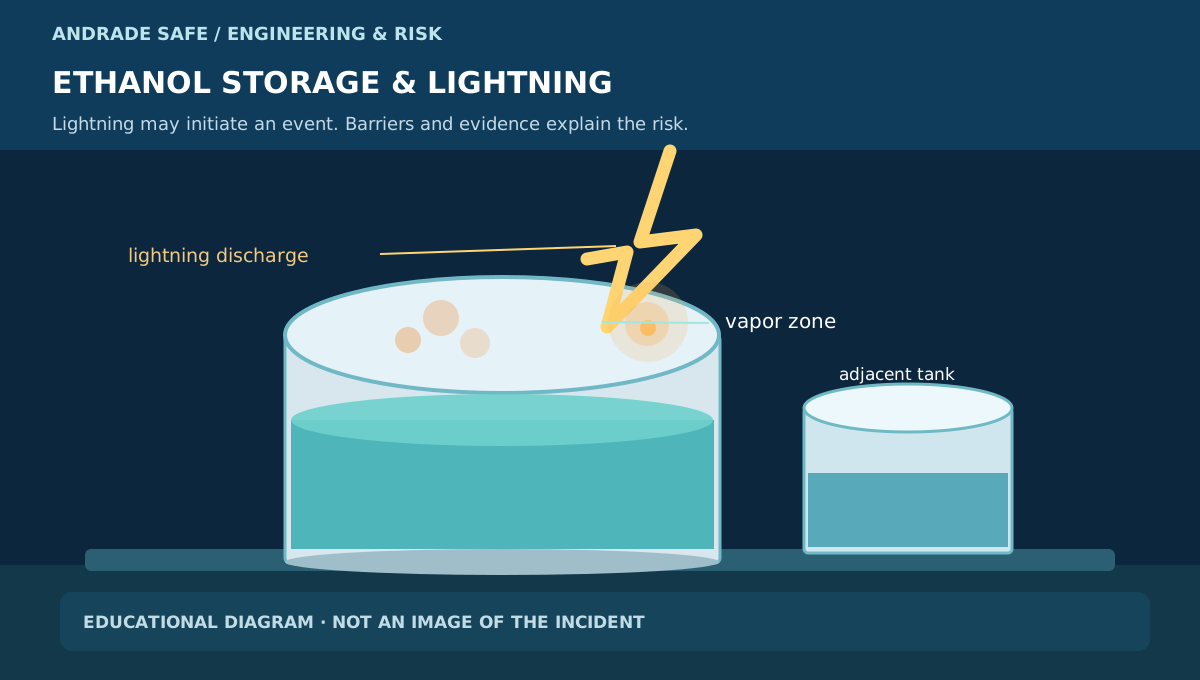
On 25 October 2026, a fire affected an ethanol tank at the Viralcool industrial site in Ibitiúva, Pitangueiras, São Paulo state. The company attributed the fire to lightning. Understanding a possible lightning-related ignition requires much more than the sentence “a tank was struck”: engineers need to examine vapors, electrical pathways, tank configuration and independent layers of protection.
What happened — and what has not been established
The event was reported on Sunday morning, 25 October 2026. Brazilian reporting states that firefighters received a call at approximately 9:23 a.m. In a public statement reproduced by regional news outlet Agora Interior, Viralcool said a lightning strike reached one of its ethanol tanks during strong thunderstorms. The company reported no casualties, said the fire was under control when the statement was issued, and described work to extinguish it safely and cool neighboring tanks. Under control does not necessarily mean extinguished.
An initial incident report mentioned an explosion involving unidentified equipment, according to Folha de S.Paulo. That entry must not be presented as proven evidence that a particular piece of equipment — or the tank itself — exploded. At the time of this research, no publicly accessible final engineering report detailing the ignition path, the tank's lightning protection design or the condition of relevant connections had been identified.
Documented: a storage-tank fire and an emergency response. Attributed statement: the company identified lightning as the initiating event. Open questions: the actual point of attachment and electrical path, vapor distribution, tank roof type, existing equipment, emergency-system performance and the final forensic mechanism. No public gap in information justifies alleging negligence or non-compliance.
Why ethanol storage requires specialist fire engineering
Ethanol is a flammable liquid that may release vapors capable of forming ignitable mixtures with air. The U.S. NOAA CAMEO database lists a representative flash point near 13°C, vapor density greater than air and complete miscibility with water. Actual properties depend on concentration, water content, temperature and product specification; the exact composition involved in this event has not been made public.
A lightning event need not heat a tank's entire liquid inventory to initiate a fire. Where the right vapor–air mixture and an effective ignition mechanism coexist, ignition may occur near a vent, a seal, a fitting or another exposed location. These are general physical possibilities, not findings from the Brazilian event. A storage tank could have a fixed roof, floating roof or other arrangement, and each configuration creates different interfaces and potential hazards; the accident tank's details are unknown.
Lightning protection is not simply “grounding the tank”
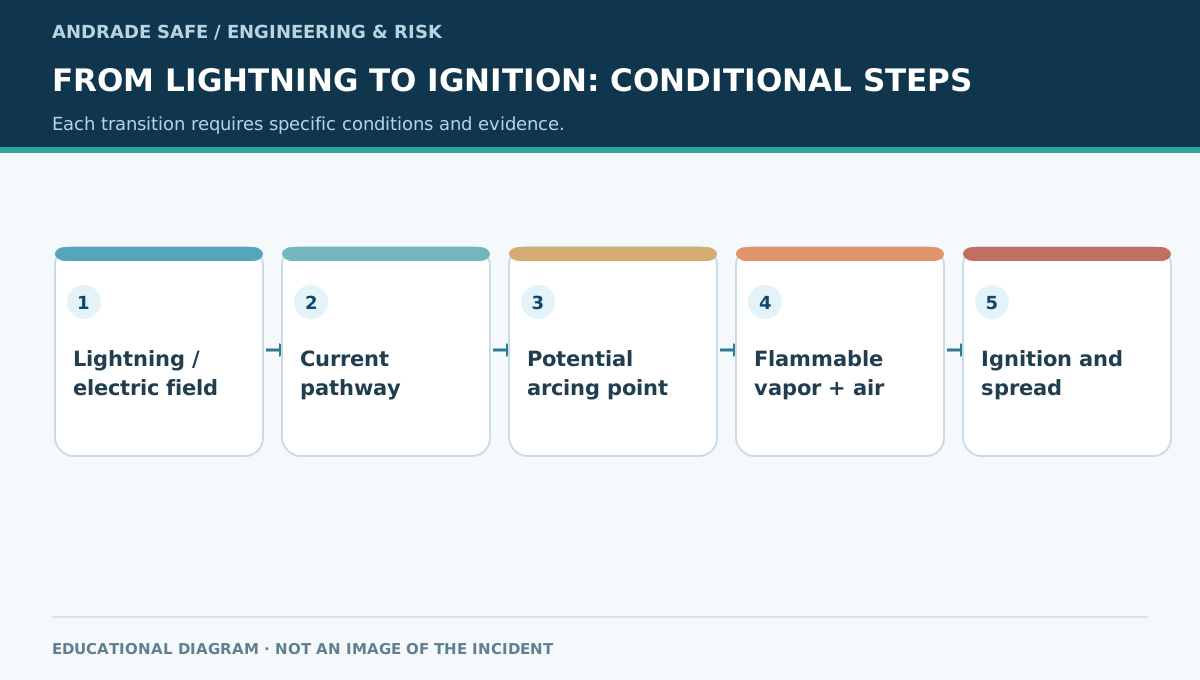
A lightning discharge combines transient current, electromagnetic fields and potential differences between conductive objects. Grounding serves defined electrical objectives; bonding reduces potentially hazardous potential differences; a lightning protection system (LPS) is an engineered arrangement that addresses direct and indirect effects; static electricity control manages charge generated during operations such as fluid transfer. The measures work together but are not interchangeable.
A low earth-resistance test result alone is not proof that a flammable-liquid storage tank cannot experience lightning-related ignition. Investigation and design reviews may need to address connection continuity, equipment interfaces, possible sparking paths, instrument protection, roof geometry and where vapors could accumulate. API RP 2003 and API RP 545 are relevant industry references, although their editions, scopes and specific applicability must be checked; requirements applicable to an external floating-roof tank must not automatically be assigned to an unidentified ethanol tank. The U.S. regulation 49 CFR §195.405 illustrates the importance of controlling lightning, static electricity and stray-current ignition risks within its own regulatory scope.
For Brazil, NR-20 (2025 consolidated text) §20.13.1 links lightning-control equipment to the electrical-safety framework of NR-10. §20.13.2 addresses specific measures for the generation, accumulation and discharge of static electricity. Project-level controls during tank filling and liquid transfer are also covered by §20.5.6. Those legal requirements should be distinguished from additional technical standards and company specifications.
Why cool neighboring tanks, and why does foam type matter?
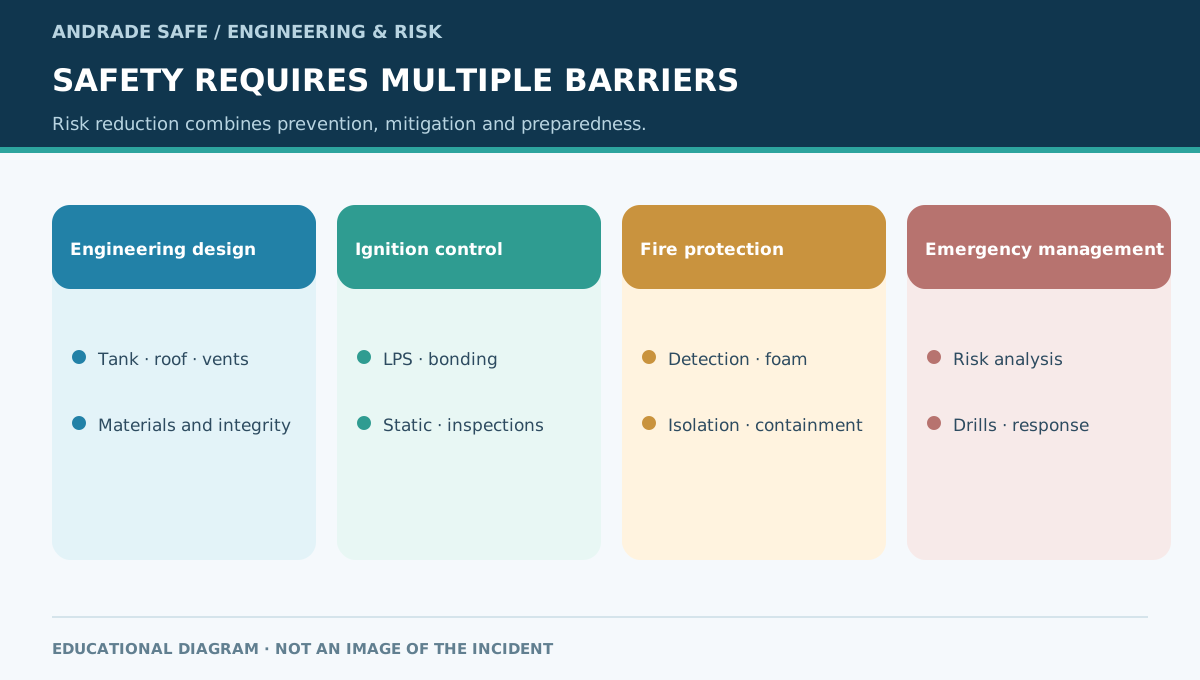
Heat radiated from a burning liquid surface or a flame can reach adjacent equipment. Cooling exposed vessels is one possible emergency measure to reduce escalation, which helps explain the reported efforts to cool other tanks. It does not establish that those tanks were on the verge of rupture.
Cooling neighboring equipment and extinguishing a burning ethanol surface are different tasks. Ethanol mixes with water, which can undermine some conventional foams. NOAA CAMEO specifically highlights alcohol-resistant foam for ethanol, and stresses appropriate tank-fire precautions. Extinguishing-agent selection, application and response tactics require a qualified emergency team, site-specific planning and verified engineering data; this article provides no operational firefighting directions. Public reports do not identify all agents actually used in the incident.
Water and firefighting-runoff management also matter. Bunds, drainage, potential dissolved ethanol and environmental containment cannot be separated from the process-safety problem. The required approach depends on facility geometry and conditions.
A reproducible engineering exercise — not the accident tank
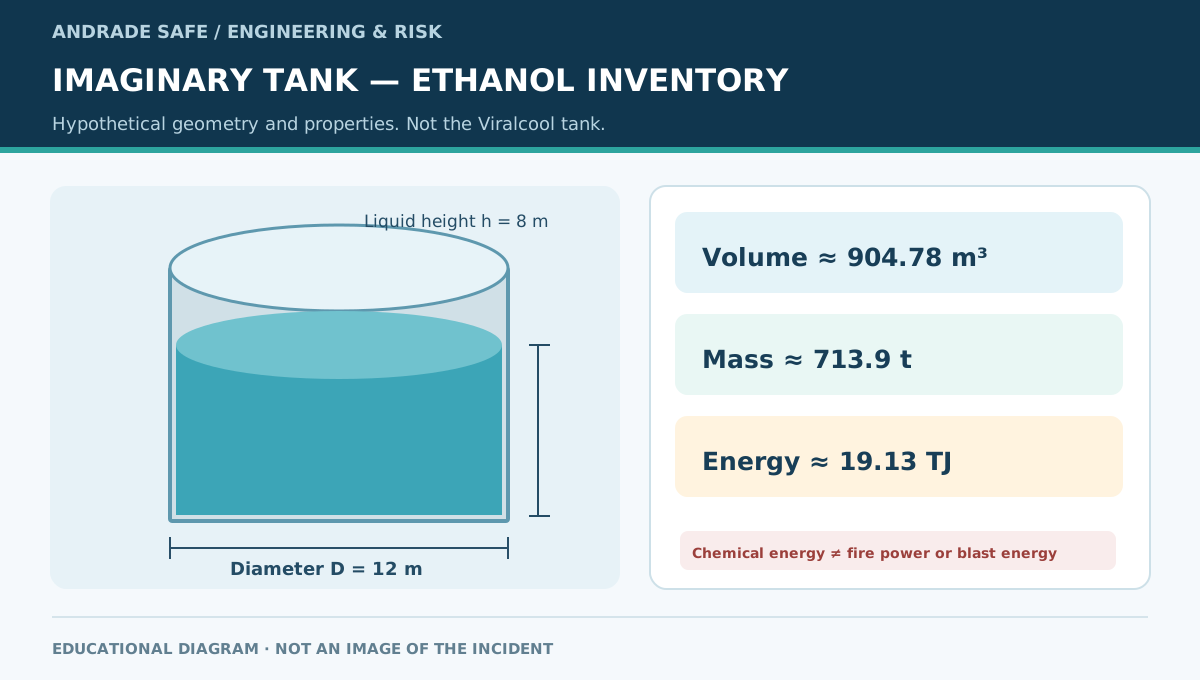
Consider an imaginary vertical cylindrical tank with a diameter of 12 m and a liquid fill height of 8 m. Ignoring geometric details and dead volumes:
A = πD²/4 = 113.097335529 m² ≈ 113.10 m²
V = (πD²/4)·h = 904.778684234 m³ ≈ 904.78 m³
With a hypothetical density of 789 kg/m³, the estimated liquid mass would be 713,870 kg (713.9 t). If an illustrative lower heating value (LHV) of 26.8 MJ/kg were applied, the theoretical chemical energy inventory would be 19.13 TJ. The interactive laboratory allows the reader to change tank dimensions, fill level, density and LHV. All assumptions are visible and adjustable.
The relationship is E = ρ × V × LHV. Most importantly, stored chemical energy is not instantaneous heat release rate, blast energy, a fire-duration forecast or proof of the actual inventory at Viralcool. Modeling a real fire requires burning surface area, fuel characteristics, ventilation, heat transfer, emergency controls and site-specific data.
Laboratory: geometric inventory and energy
Change only the fictional tank assumptions. Volume, mass and chemical energy do not determine power, duration, damage or blast energy. This model does not represent the Pitangueiras facility and is not for design, licensing or emergency command.
Educational model — fictional geometric inventory
How much ethanol can a tank hold?
Educational lab: geometry, mass and chemical-energy inventory. It does not design firefighting systems or lightning protection.
Values do not describe the tank involved in Pitangueiras. Do not use this tool for design, licensing, operations or emergency response.
Hypothetical parameters
CSV uses decimal points and explicit units. It records the hypothetical scenario only and does not estimate actual losses.
Geometry and inventory: educational scenario
Unscaled illustration; the drawing does not determine tank capacity or total height.
- Liquid volume
- 904.78 m³
- Estimated mass
- 713.87 t
- Chemical energy
- 19.132 TJ
- Base area
- 113.10 m²
- Mass in kilograms
- 713,870.38 kg
- Ratio to reference example
- 1.00 ×
V = πD²h / 4
m = ρV
E (TJ) = m (kg) × LHV (MJ/kg) / 10⁶
Stored energy is not fire heat-release rate, blast energy or a severity indicator. The drawing is illustrative only.
Ideal cylinder model: V=πD²h/4; m=ρV; E=m×LHV. Density and heating value are educational assumptions.
Background sources: NOAA CAMEO Ethanol; Brazil NR-20. The related article separates company statements from verified investigative conclusions. Standalone tool without external dependencies.
Brazilian legal requirements: how does NR-20 apply?
Brazil's NR-20 sets minimum occupational safety requirements for facilities dealing with flammable and combustible liquids. The classification table in §20.4.1 lists ethanol-production plants as Class III by activity; this is not a claim about the actual capacity of the affected tank or proof of compliance/noncompliance.
Relevant sections include 20.5 (facility design), 20.6 (installation safety documentation), 20.7 (risk analysis), 20.10 (maintenance and inspection), 20.13 (ignition control), 20.14 (loss-of-containment and fire prevention), 20.15 (emergency response) and 20.16 (event reporting). Under §20.14.2(c), the applicable prevention plan must be reviewed after a leak, spill, fire or explosion. The reporting deadline of the second business day after the event under §20.16.1.1 depends on specific consequences described in §20.16.1, not on the mere existence of any small incident. Official NR-20.
NR-23 addresses fire prevention at workplaces, referring to applicable state legislation and, when relevant, official technical standards. Standards from API or NFPA do not automatically acquire binding legal status throughout Brazil merely because an article mentions them. Requirements must be traced to their legal, contractual or project context. MTE NR-23.
Section 20.16.1 covers death, specified injuries requiring hospitalization, and large-scale intervention under the emergency plan; no casualties alone does not determine whether reporting is required. Failure to locate a public final report does not prove that no internal investigation or documentation exists.
What would a competent investigation examine?
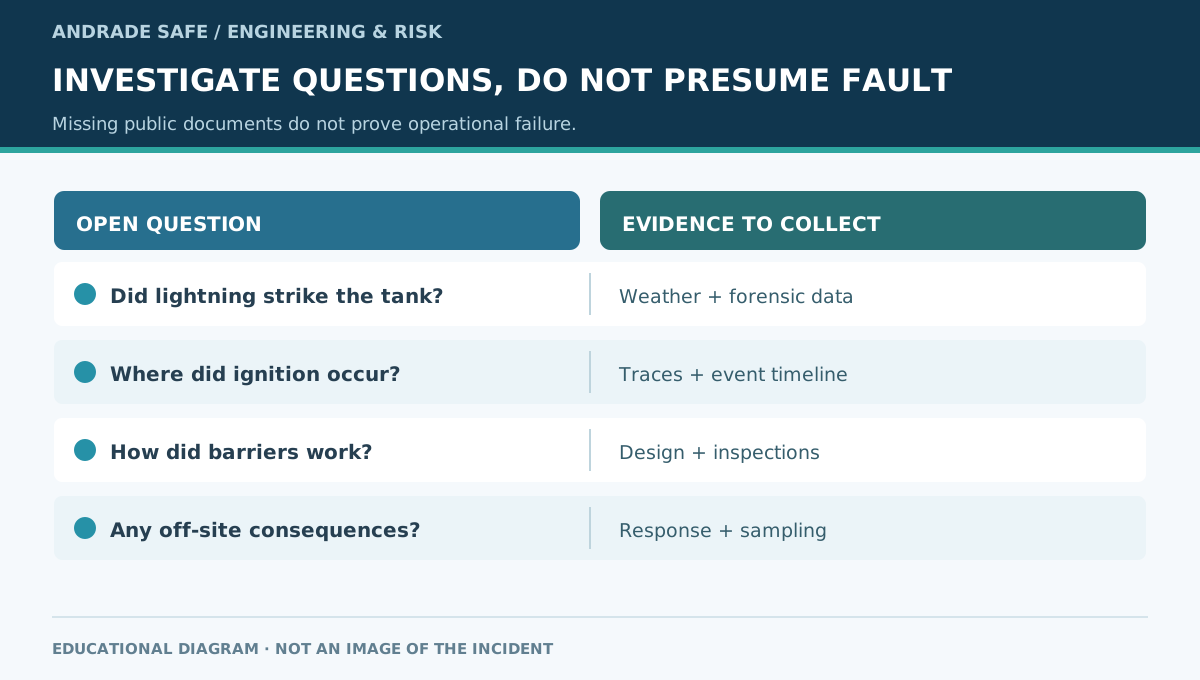
An evidence-based investigation would consider weather and lightning-detection records; authenticated imagery; alarm and process timelines; as-built drawings; roof, vent, seal and instrument configurations; electrical bonding details; inspection records; tank level and transfer logs; emergency-response data; possible arc or leakage evidence; and environmental sampling where appropriate. Each proposed inquiry identifies an unknown, not a defect already found.
| Investigation question | Needed evidence | Misinterpretation to avoid |
|---|---|---|
| Did lightning reach this specific tank? | Lightning-detection data and forensic inspection | Treating a nearby storm as proof of exact strike location |
| Where did ignition occur? | Physical traces, timeline, instruments | Claiming an arc at a specific vent without proof |
| How did protection perform? | Design and inspection records | Assuming defective grounding from a fire alone |
| Why cool other tanks? | Thermal exposure and response logs | Inferring imminent failure from precautionary cooling |
| Was there an environmental release? | Runoff and sampling records | Inventing pollutant concentrations |
The lasting engineering lesson
Neither “lightning alone explains everything” nor “the fire proves a safety system failed” is a professional conclusion. Lightning may initiate a hazardous event, while effective risk management depends on vapor control, electrical continuity, equipment design, containment, inspections and emergency preparedness. The specific mechanism in Pitangueiras remains to be established, but the engineering lessons are broadly transferable.
Further reading
The Ulsan case connects flammable materials and process safety without equating substances or causes. Accident investigation beyond blame (Portuguese) discusses evidence. Cooling towers explain heat rejection in another context; their circuit is not equivalent to a firefighting-water network.
Ulsan chemical fire and process safety →
Laboratory and study materials
The kit preserves the October 26 originals alongside published materials. All five figures are educational diagrams, not incident photographs or drawings of the actual facility.
Sources and editorial transparency
Company statements, initial incident records and technical knowledge serve different purposes. No exercise parameter has been assigned to the real tank. International references do not replace applicable Brazilian requirements and project verification.
Viralcool — nota reproduzida pelo Agora Interior, 25/10/2026 →
Folha de S.Paulo — registro inicial, 25/10/2026 →
JornalCana — reprodução de nota, 26/10/2026 →
MTE — NR-20, texto consolidado →
OSHA Technical Manual — Ethanol Processing →
Frequently asked questions
Can lightning ignite ethanol in a tank?
Known physical mechanisms can lead to ignition, but establishing how this occurred at a specific site requires investigation.
Does grounding eliminate lightning-related fire risk?
No. Grounding is only one aspect of a wider protection strategy.
Why is alcohol-resistant foam relevant?
Because ethanol is water-miscible and can affect conventional foam performance. Selection must follow site-specific fire engineering.
Are ethanol plants Class III under NR-20?
The Brazilian regulation lists ethanol-production plants as Class III by activity, subject to the norm's conditions.
Is the final cause already known?
The company attributed the event to lightning; a public final engineering report on the detailed ignition mechanism was not identified by this research cutoff.
References
- Viralcool — nota reproduzida pelo Agora Interior, 25/10/2026Viralcool
- Folha de S.Paulo — registro inicial, 25/10/2026Folha de S.Paulo
- JornalCana — reprodução de nota, 26/10/2026JornalCana
- MTE — NR-20, texto consolidadoMTE
- MTE — NR-23MTE
- NOAA CAMEO — EthanolNOAA
- OSHA Technical Manual — Ethanol ProcessingOSHA
- eCFR — 49 CFR 195.405, escopo americano específicoeCFR
- ANP — EtanolANP