
Explore NSTX-U’s central magnet, toroidal and poloidal fields, Lorentz force, and particle motion with verified equations and an interactive learning lab.
A six-metre magnet at the centre of a much larger engineering challenge
Research and publication: November 12, 2026. Installation on October 27 and the November 10 announcement are distinct milestones. The 2027 dates below are PPPL forecasts; 1 T, 2 MA and 10 MW are design capabilities, not measurements after installation.
The 100-million-degree figure in the title is the heating condition described by PPPL for the experiment, not a plasma measurement following the October installation. [3]
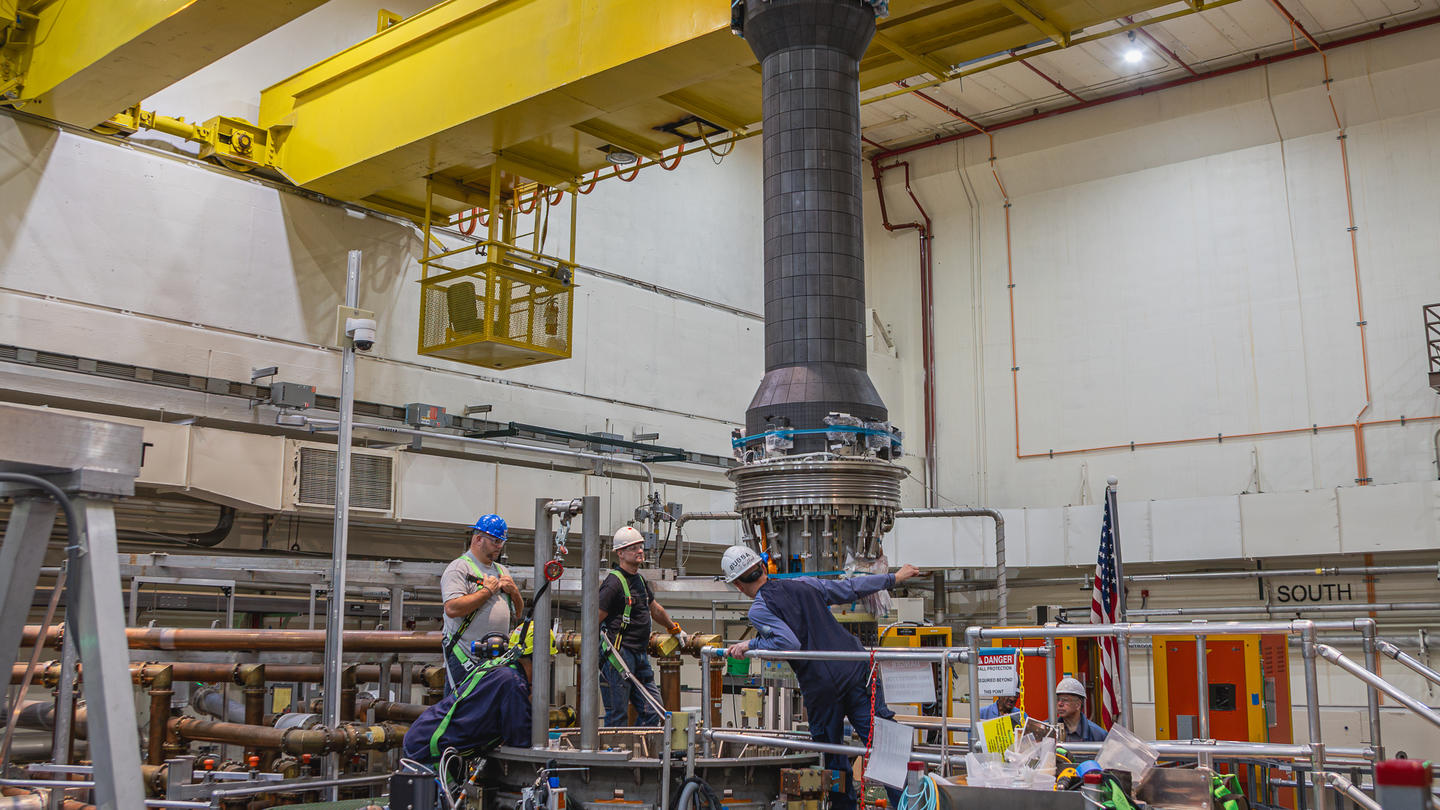
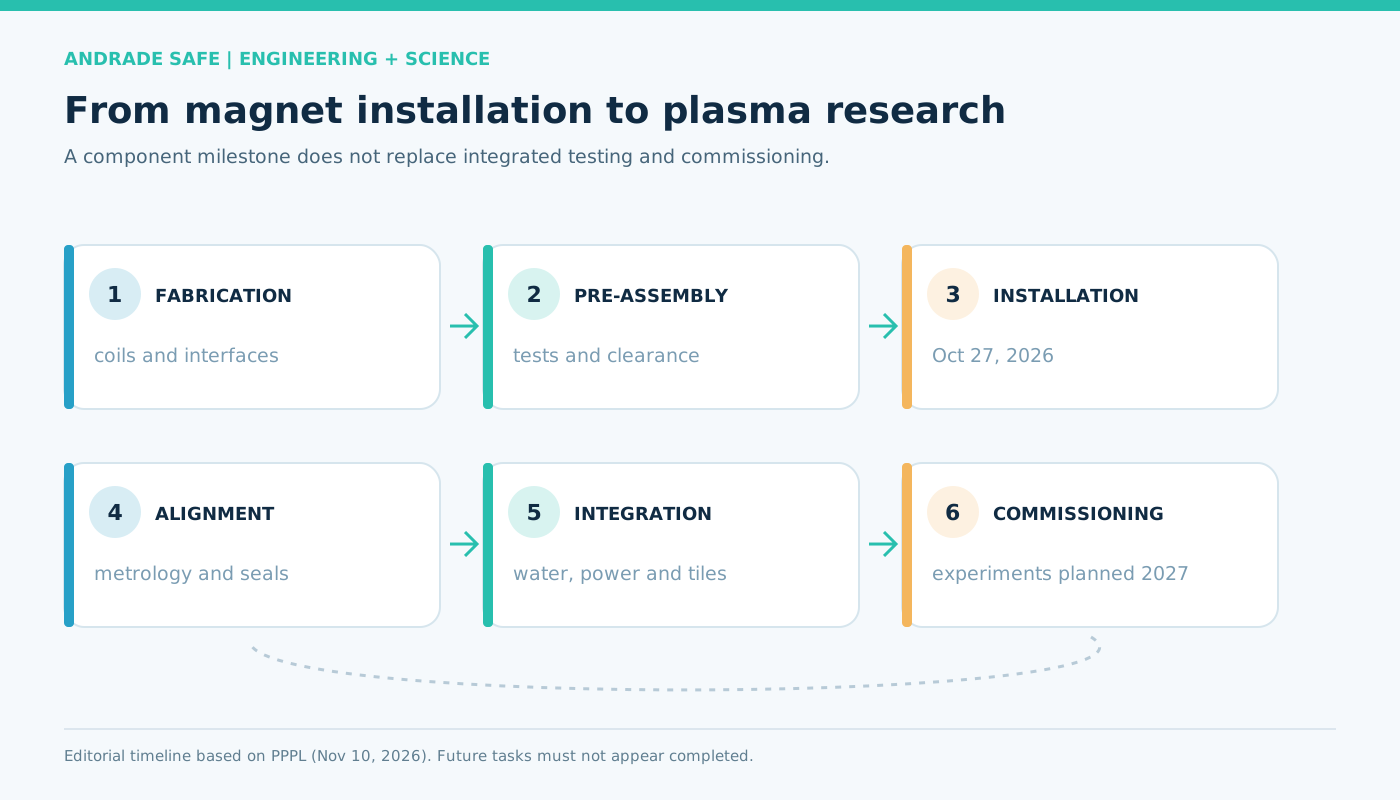
On October 27, 2026, technicians and engineers at the U.S. Department of Energy's Princeton Plasma Physics Laboratory (PPPL) lowered the central magnet assembly into the National Spherical Torus Experiment-Upgrade (NSTX-U). The laboratory announced the milestone on November 10. The assembly was inserted after preparation and trial movements; it was not the first plasma discharge of the rebuilt facility, nor a demonstration of electricity supplied to the grid. The PPPL still described precision alignment, vacuum-seal checks, water and electrical connections, internal tile installation and integrated commissioning as pending steps. Final machine assembly was expected by early 2027, with experimental operations envisaged later that year. [1]
Why does inserting a magnet matter so much? Because a fusion experiment is not simply a vessel filled with extremely hot gas. It is a complex electromagnetic, thermal, mechanical and control system. Researchers must generate shaped fields, drive electric current through ionized matter, prevent unacceptable heat loads on solid surfaces, measure a turbulent plasma and coordinate equipment during repeated experimental pulses.
Essential distinction: NSTX-U is a spherical tokamak research facility. It is not an operating commercial power station. Its heating-system rating does not represent net electric output; an assembly milestone does not mean plasma operations have resumed. [1][2][3]
What PPPL has actually completed
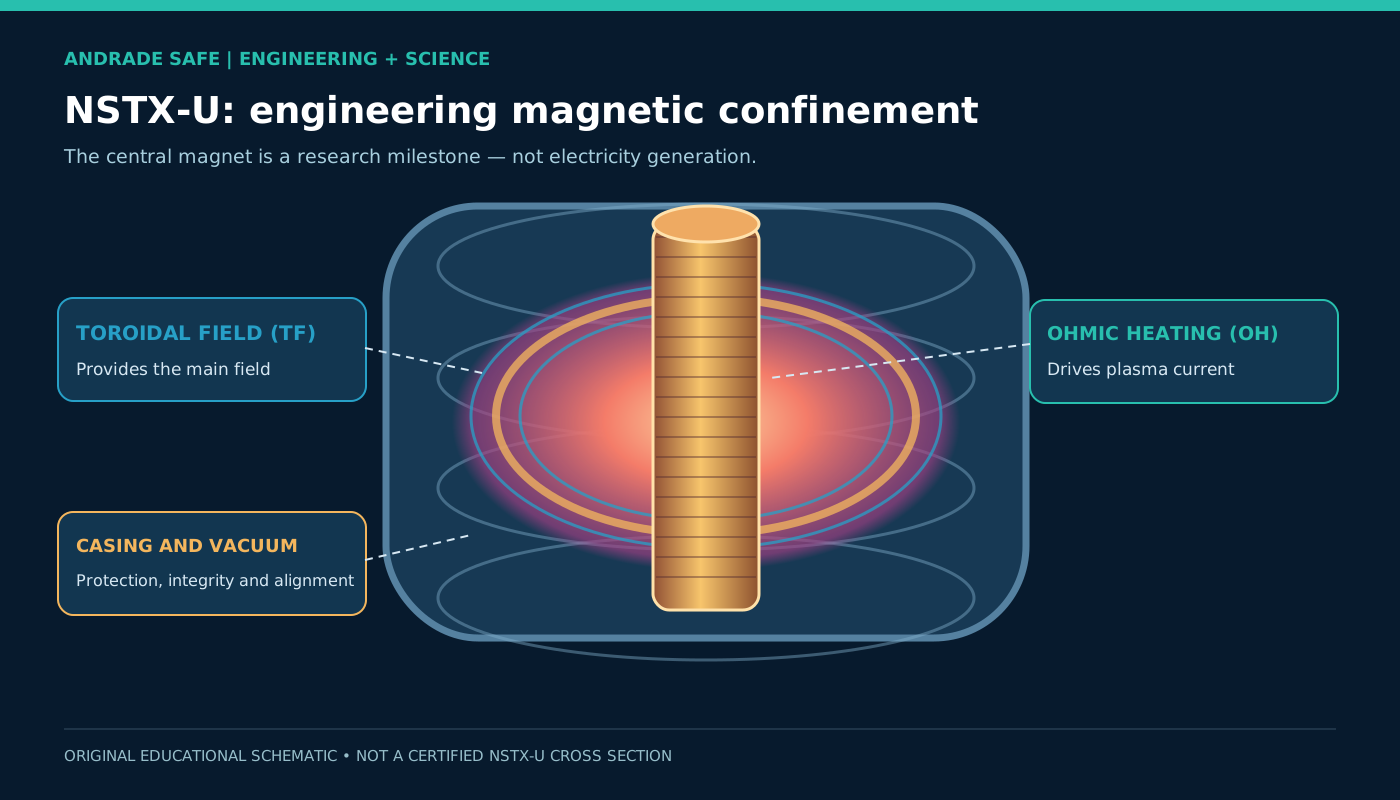
The central magnet assembly includes two main electromagnetic systems: toroidal-field (TF) coils, which provide much of the field around the plasma torus, and an ohmic-heating (OH) system, which induces an electric current in the plasma. According to PPPL, the central bundle is approximately 20 feet (6.1 m) long. It was delivered earlier in 2026 and later equipped with structural interfaces, cooling components, divertor-associated magnets and an inner protective casing before being lowered into the machine. [1][4]
PPPL described dry runs, narrow-clearance assessments and alignment measurements using lasers. This is a story about dimensional engineering as much as it is about nuclear physics. Geometry determines electromagnetic performance. A small displacement or compromised joint may affect alignment, electrical continuity, vacuum integrity or cooling. Installing a component is not equivalent to demonstrating integrated system readiness. [1]
| Date or phase | Verified status | Not a valid inference |
|---|---|---|
| June 2026 | Magnet bundle arrived at PPPL | The device was ready to operate |
| October 27, 2026 | Central assembly lowered into NSTX-U | Plasma shots had restarted |
| November 2026 | Fine alignment and vacuum verification planned | All seals and tests already passed |
| Early 2027 | Target for completing machine assembly | A guaranteed regulatory or operating date |
| Later in 2027 | Experimental operations anticipated | Commercial fusion electricity |
Fusion is not fission — and temperature is only part of the problem
Nuclear fission splits heavy nuclei; nuclear fusion combines lighter nuclei into heavier ones. Both involve mass-energy conversion, but their reaction physics and engineering systems differ substantially. Deuterium–tritium fusion is an important prospective route for future electricity production, yet it would be incorrect to label every experimental plasma facility an operating deuterium–tritium power reactor. NSTX-U is designed to investigate confinement and the engineering of plasma experiments. [5][6]
A hot plasma contains freely moving electrons and ions. Extreme temperature increases the probability that some positively charged nuclei can overcome their mutual electrostatic repulsion. Yet high temperature alone is insufficient for a useful fusion-energy device: particle density and energy-confinement time are also crucial. The Lawson criterion and related fusion performance measures express this multi-variable challenge. One impressive temperature number does not demonstrate energy gain, commercial feasibility or a working turbine-generator. [6]
The popular analogy of a “magnetic bottle” also has limits. Magnetic fields influence charged-particle motion, but turbulence, collisions, magnetic topology, radiative losses and plasma instabilities create transport and can damage exposed structures. A magnetic field is not an impermeable wall. [7]
Why a spherical tokamak?
The conventional tokamak is often depicted as a doughnut-shaped torus. A spherical tokamak uses a lower-aspect-ratio geometry, closer to a cored apple in cross-section. In the simplest geometrical description, aspect ratio is A = R/a, where R is the plasma major radius and a its minor radius. A compact spherical configuration offers the opportunity to explore high beta, the ratio of plasma pressure to magnetic pressure, and potentially favourable confinement regimes. These are research opportunities, not a proof that a future commercial plant will automatically be cheaper, more compact or easier to maintain. [2][8]
Engineering trade-offs remain significant: limited space in the central column, electromagnetic stresses, high heat fluxes on plasma-facing components, access for maintenance, neutron shielding for relevant future fuel cycles and sustained control. NSTX-U is intended to establish scientific evidence for evaluating the design concept rather than to settle those questions by publicity. [2][3]
Two magnetic-field directions create a helical configuration
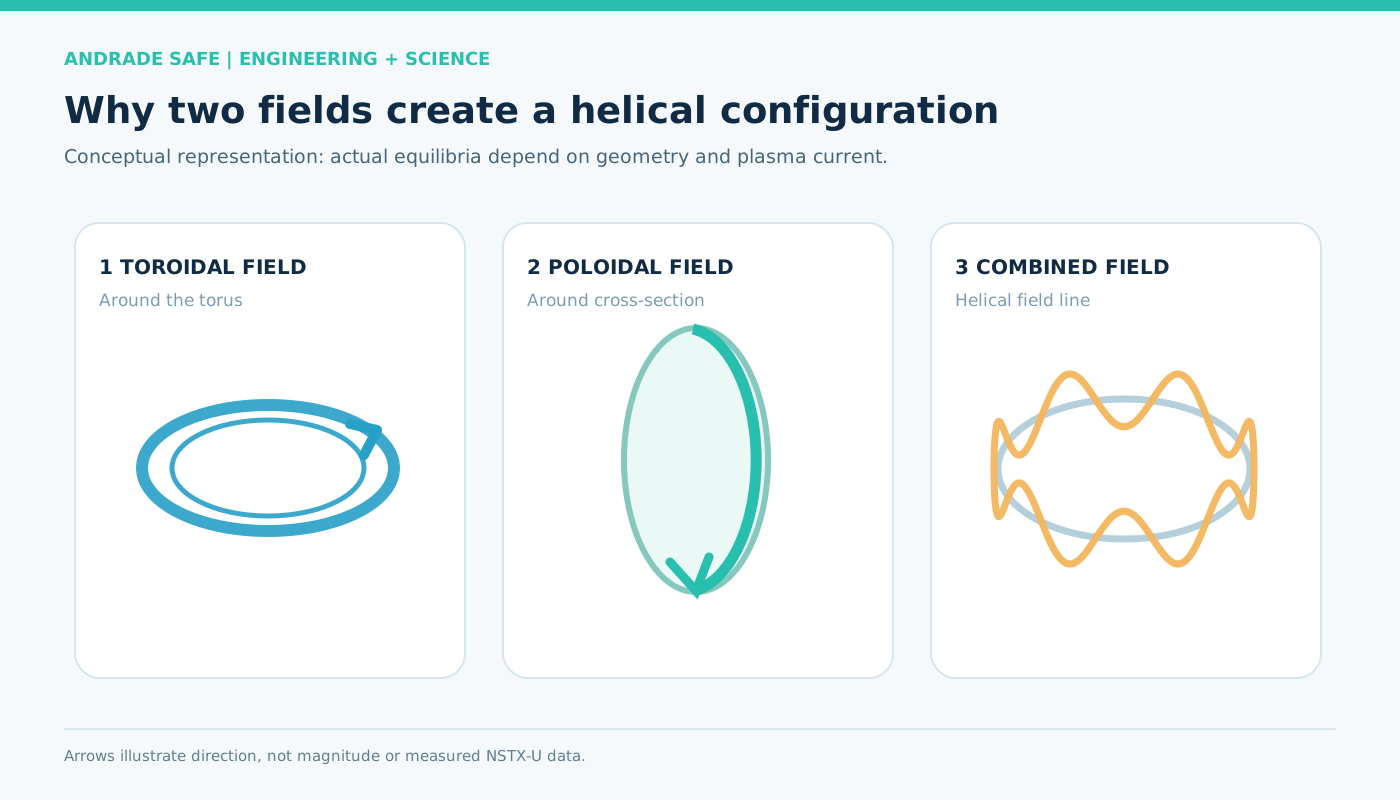
A toroidal field runs along the long way around the torus. A poloidal field loops around its cross-section. Tokamaks create the magnetic topology by combining these components. The resulting field lines wind helically; their configuration, not simply the existence of a strong magnet, contributes to confinement. The toroidal-field coils provide much of the toroidal component. Plasma current, induced in part through transformer action by the OH system, generates a poloidal component; external poloidal coils contribute to shaping and positional control. [9]
The OH system changes magnetic flux, inducing an electric field and plasma current. That current produces resistive heating and participates in magnetic equilibrium. As plasma properties change, ohmic heating alone is not the only tool for reaching relevant conditions. Neutral-beam injection and radio-frequency heating provide additional ways to supply energy and study plasma behaviour. [1][2][3]
The 2026 PPPL fact sheet lists design capabilities of up to 1 tesla of magnetic field, up to 2 megaamperes of plasma current and up to 10 megawatts of heating power. The dimensions matter: tesla describes magnetic flux density, ampere measures current and watt measures power. None of these numbers, by itself, is an electricity-generation figure. [3]
The Lorentz force: how charged particles follow magnetic fields
Charged-particle motion begins with the Lorentz-force law:
F = q (E + v × B).
SI units for Lorentz force: F in newtons (N), q in coulombs (C), E in volts per metre (V/m), v in metres per second (m/s), and B in teslas (T). The cross product v × B is vectorial; E⊥ in the gyro-motion equations is perpendicular kinetic energy and must be entered in joules.
Here q is particle charge, E is electric field, v is velocity and B is magnetic flux density. In a local uniform magnetic field, with zero electric field, the perpendicular component of particle velocity produces circular gyro-motion. A nonzero component parallel to the field adds translation along that direction: a helical trajectory results.
For nonrelativistic motion, perpendicular kinetic energy E⊥ and a singly charged ion:
rL = √(2mE⊥) / (|q| B) and fci = |q| B / (2πm).
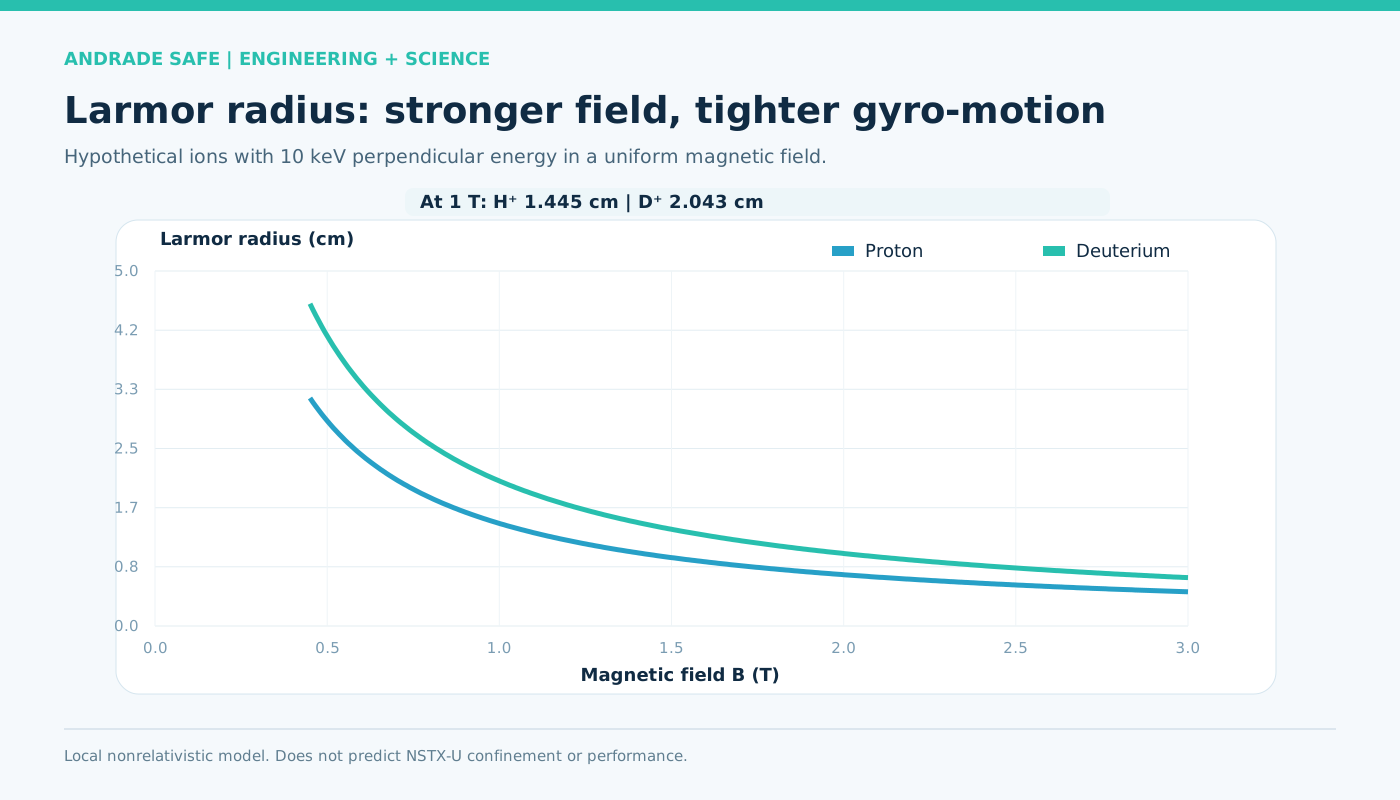
The first quantity is the Larmor radius; the second, the cyclotron frequency. Convert electron-volts to joules using 1 eV = 1.602176634 × 10⁻¹⁹ J. These formulas describe a local idealization. They do not calculate global plasma confinement, magnet design loads, collision frequency or power produced by a tokamak.
Worked example — a hypothetical 10 keV deuterium ion at 1 T
Let mD = 3.34358 × 10⁻²⁷ kg, q = 1.60218 × 10⁻¹⁹ C, E⊥ = 10 keV and B = 1 T. None of these parameters is presented as a measurement of an NSTX-U discharge.
• Energy: 1.60218 × 10⁻¹⁵ J.
• Perpendicular velocity: approximately 9.79 × 10⁵ m/s.
• Larmor radius: approximately 0.02043 m (2.043 cm).
• Cyclotron frequency: approximately 7.626 MHz.
• If field magnitude doubles to 2 T at unchanged energy, the idealized radius falls to about 1.0215 cm.
The result illustrates why magnetic field matters at particle level. It does not mean that doubling the field doubles experimental performance. A magnetic-confinement plasma involves collective behaviour, gradients, instabilities and transport effects that are absent from the simple gyro-radius formula. [6][9]
Strong fields also create mechanical loads
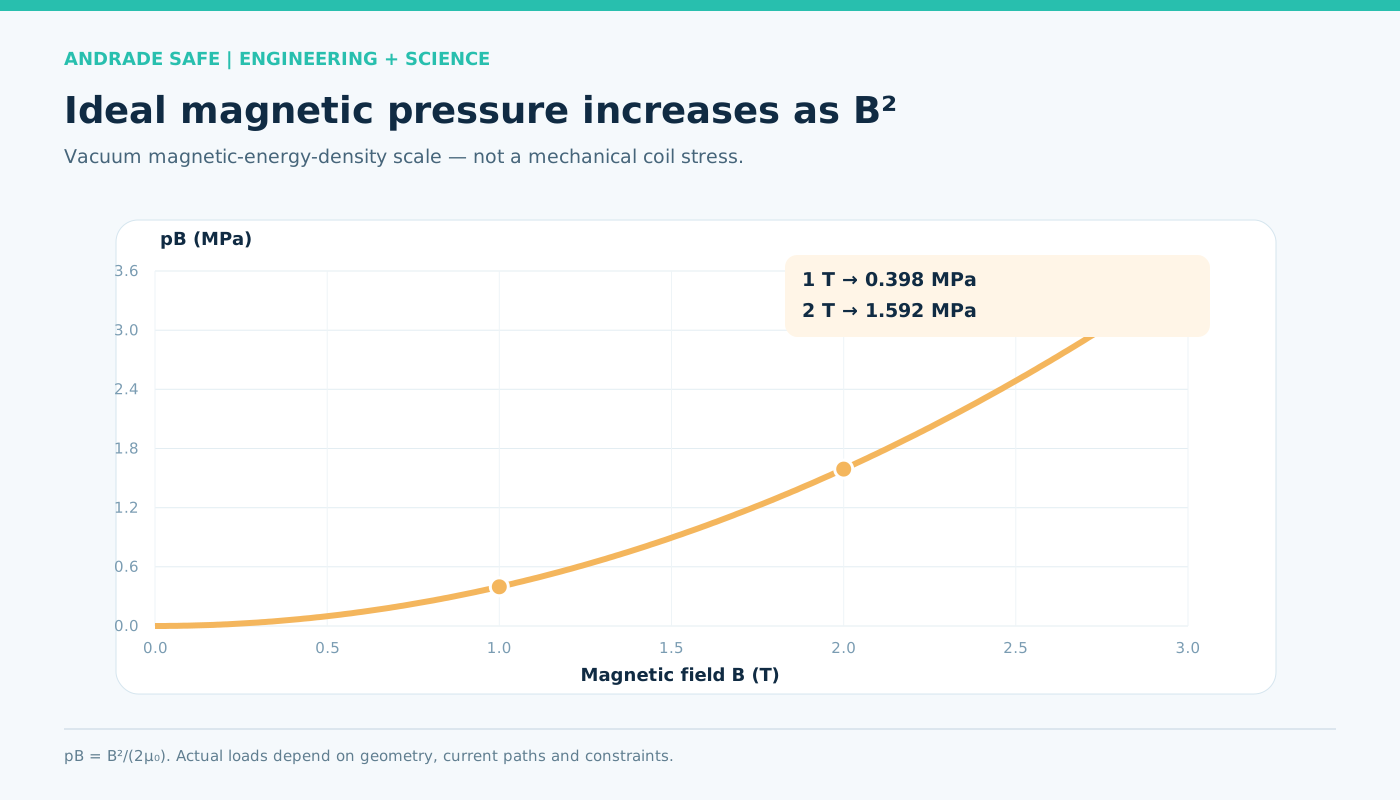
Magnetic systems are not mechanically weightless. Current paths interact with magnetic fields, causing stresses and deflections; conductors also experience resistive heating, with insulating and cooling systems exposed to demanding conditions. A useful scale indicator is magnetic energy density, numerically expressible as pB = B²/(2μ₀) for the appropriate vacuum field model. It must not be mistaken for the actual stress in an NSTX-U fastener, casing or winding.
Worked example — magnetic-pressure scale
Using μ₀ ≈ 4π × 10⁻⁷ H/m:
• For B = 1 T, pB ≈ 397,887 Pa = 0.398 MPa.
• For B = 2 T, pB ≈ 1,591,549 Pa = 1.592 MPa.
• Doubling B multiplies this scalar by four.
Real engineering calculations also need coil geometry, current distribution, load paths, contacts, thermal gradients, support conditions, fatigue cycles and credible fault scenarios. PPPL technical publications on the upgrade discuss electromagnetic torque and structural load transfer in the centre stack, along with water-cooling analyses of the OH coil. [10]
A very hot plasma, but not a uniformly hot machine
A plasma temperature of tens or hundreds of millions of degrees describes its particle distribution; it does not mean that every surface of the vacuum vessel is heated to that temperature. The engineering challenge concerns energy and particle fluxes, exposure duration, radiation, edge transport, plasma-wall interactions and transient events. Magnetic fields help manage confinement, while surface materials, divertors, vacuum systems, cooling circuits and protective interlocks address the physical consequences of energy leaving the plasma. [6][7]
Consider a completely separate, fictional water-cooling exercise. If a circuit must reject 2 MW of heat, assuming water with cp = 4,180 J/(kg·K) and a 10 °C water temperature rise, the ideal steady-state mass flow is ṁ = Q̇/(cp ΔT) ≈ 47.85 kg/s. This is not a flow requirement or measured operating condition at NSTX-U. Pump selection requires pressure-drop calculations, temperatures, transient loads, materials and margins.
Heat exhaust remains a major obstacle for commercial magnetic fusion. Even when the plasma centre is well confined, the divertor and first wall must accommodate loads that threaten materials and operational lifetime. Successful laboratory physics must eventually translate into maintainable engineering systems. [7]
Commissioning a complex machine is more than installing its last magnet
The PPPL work sequence highlights dry-run lifting plans, narrow clearances, precision alignment, vacuum seals, cooling-water connections, copper bus bars, protective tiles and integrated commissioning. Each subsystem needs component-level and interface-level evidence. For mechanical engineers, questions concern dimensional tolerances, insulation, vibration, fatigue, electrical contact resistance, leak tightness and thermal expansion. For operating teams, they concern instrumentation, interlocks, emergency management and repeatability. [1][4]
NSTX-U also has a history. It performed experimental operations in 2016, after which a coil failure led to a substantial recovery project. The present announcement should not be portrayed as an entirely new machine starting for the first time — or as a commercial nuclear power station restarting sales of electricity. [2][8][11]
Interactive learning lab: Larmor radius and magnetic-pressure scaling
The accompanying standalone trilingual HTML lets readers change ion species, perpendicular kinetic energy and field strength. It updates the Larmor radius, cyclotron frequency, magnetic pressure scale, plots and an illustrative particle-motion sketch. A CSV export supports classroom exercises. The lab is intentionally limited to uniform-field, nonrelativistic and vacuum-field idealizations. It cannot determine a tokamak's plasma equilibrium, confinement time, structural stresses or operational safety.
Without the interactive component, the reference scenario (deuterium, 10 keV, 1 T) gives rL ≈ 2.043 cm, fci ≈ 7.626 MHz and pB ≈ 0.398 MPa.
NSTX-U · Educational model — not NSTX-U measurements
How does a particle respond to a magnetic field?
Explore hypothetical ion Larmor radius, cyclotron frequency and the magnetic-pressure scale. This model does not simulate the actual NSTX-U plasma.
Educational uniform-field, nonrelativistic model. It does not calculate stability, confinement time, coil stresses, safety or electrical output.
Model parameters
CSV uses explicit units and decimal points. It includes the B curve and independent thermal example; it is not a test report.
Live results
- Larmor radius
- 2.043 cm
- Cyclotron frequency
- 7.626 MHz
- Perpendicular speed
- 0.979 ×10⁶ m/s
- Magnetic pressure (scale)
- 0.398 MPa
Governing equations
rL = √(2mE⊥) / (|q|B)
fci = |q|B / (2πm)
pB = B² / (2µ₀)
E⊥ in joules, m in kilograms, B in tesla and µ₀ ≈ 4π × 10⁻⁷ H/m. keV input is converted to joules before calculation.
At fixed E⊥, doubling B halves the Larmor radius. This does not guarantee improved global confinement.
Larmor radius vs magnetic field
The curve varies B, keeping species and energy constant.
Idealized local orbit
One gyro-orbit, not a real tokamak particle path.
Thermal-engineering connection
Independent example: ideal water flow needed to remove heat. Not an NSTX-U cooling-system model.
- Ideal mass flow
- 47.85 kg/s
ṁ = Q̇ / (cpΔT)
ṁ = Q̇/(cpΔT), cp = 4,180 J/(kg·K)
Steady-state example, liquid water with constant cp; ignores transients, pressure losses, boiling and design margins.
The hydraulic example is independent of ion motion. This tool calculates no force, coil stress, plasma equilibrium or real performance.
Physics: Lorentz force and uniform-field particle motion. NSTX-U context: PPPL and IAEA. These are not machine measurements. Andrade Safe Engineering · Nov 12, 2026.
What remains before fusion becomes a practical power source?
Commercial fusion requires much more than magnet installation or a hot plasma pulse: sustained confinement, heat-exhaust technology, reliable magnets and power electronics, materials that endure the relevant irradiation environment, remote maintenance, reactor-grade fuel handling where applicable, thermal-power recovery, turbines or other conversion systems and positive net electric performance at acceptable economics and availability. One must distinguish input heating power, fusion reaction power and net power exported to the grid. [5][6][7]
Research at NSTX-U is relevant precisely because the answers are not yet settled. The 2026 engineering milestone is meaningful on its own terms: it creates a route toward renewed experiments that may test whether spherical geometry can advance plasma physics and future plant design. It is a technological step — not an announcement that commercial fusion has arrived.
Related reading
Compare stellarators as another confinement architecture; nuclear restarts concern fission and licensing. Data-centre cooling connects heat-transfer principles in another industry without equating operating conditions.
Laboratory and study materials
These educational examples are not NSTX-U measurements, design calculations or operating authorization. The kit preserves the originals alongside published materials.
Sources and editorial transparency
Laboratory equations and results are hypothetical examples, not NSTX-U test data. Diagrams: Andrade Safe. Design capabilities and assembly forecasts are identified in the text; future status changes require official-source verification.
[1] PPPL, PPPL's major fusion experiment nears completion, Nov 10, 2026 →
[2] PPPL, NSTX-U, programme page →
[3] PPPL, NSTX-U Fact Sheet, 2026 →
[4] PPPL, Delivery of magnet bundle signals a new age of fusion research, June 8, 2026 →
[5] U.S. DOE, Fission and Fusion: What is the Difference? →
[6] IAEA, Magnetic Confinement Fusion & Inertial Confinement Fusion →
[7] IAEA, World Fusion Outlook 2023 →
[8] U.S. DOE, NSTX-U user facility →
[9] IAEA, Fusion Technologies →
[10] PPPL, Analysis of NSTX Upgrade OH Magnet and Center Stack →
[11] PPPL, An intricate jigsaw puzzle, 2025 →
Frequently asked questions
Is NSTX-U a fusion power station?
No. It is a research device, not a commercial electricity generator.
Has it restarted operations?
As of November 12, 2026, PPPL described unfinished assembly and commissioning steps, with experiments expected in 2027. [1]
Why are there two field directions?
Toroidal and poloidal field components combine into the helical magnetic configuration important for tokamak confinement. [9]
Does a 1 T field mean 1 MW of output?
No. Tesla and watt describe entirely different physical quantities.
Why does the machine need cooling if magnets keep plasma away from the walls?
Confinement is imperfect, and the device experiences heat and particle fluxes, component losses and transient loads. [7]
Is the central magnet superconducting?
This article does not assert that; NSTX-U has water-cooled resistive copper-coil engineering, distinct from superconducting magnet systems in some other machines. [10]
What differs from a stellarator?
Tokamaks rely heavily on induced plasma current and the field it produces; stellarators obtain much of their three-dimensional confinement field from external coils. [9]
When will NSTX-U deliver fusion power to the grid?
PPPL has announced no such date. The stated 2027 goal is experimental operation, not commercial delivery. [1]
References
- PPPL, PPPL's major fusion experiment nears completion, Nov 10, 2026PPPL
- PPPL, NSTX-U, programme pagePPPL
- PPPL, NSTX-U Fact Sheet, 2026PPPL
- PPPL, Delivery of magnet bundle signals a new age of fusion research, June 8, 2026PPPL
- U.S. DOE, Fission and Fusion: What is the Difference?DOE
- IAEA, Magnetic Confinement Fusion & Inertial Confinement FusionIAEA
- IAEA, World Fusion Outlook 2023IAEA
- U.S. DOE, NSTX-U user facilityDOE
- IAEA, Fusion TechnologiesIAEA
- PPPL, Analysis of NSTX Upgrade OH Magnet and Center StackPPPL
- PPPL, An intricate jigsaw puzzle, 2025PPPL