
Brazil approved 645 MW of contracted grid demand for a green-ammonia project. Explore electrolyser energy, water, mass balances and key uncertainties.
What ANEEL authorised
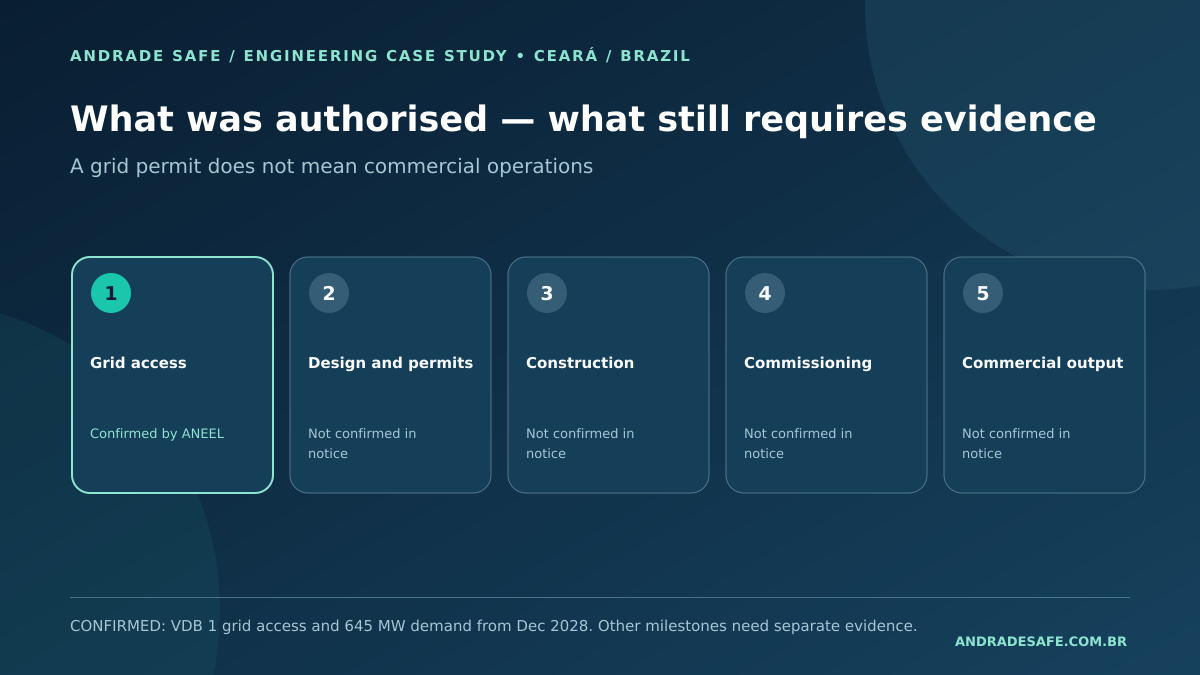
The essential distinction: Brazil's electricity regulator ANEEL authorized grid access for Pecém VDB 1 Ltda. at the 500 kV Pecém III substation, in Caucaia, Ceará. The company has 645 MW of contracted demand scheduled from December 2028. The connection relates to an industrial complex intended to produce green ammonia from electrolytic hydrogen. The 645 MW figure is a contracted electrical demand, not verified electrolyser capacity, annual hydrogen output, a plant start-up date, or proof of renewable power sourcing. [1]
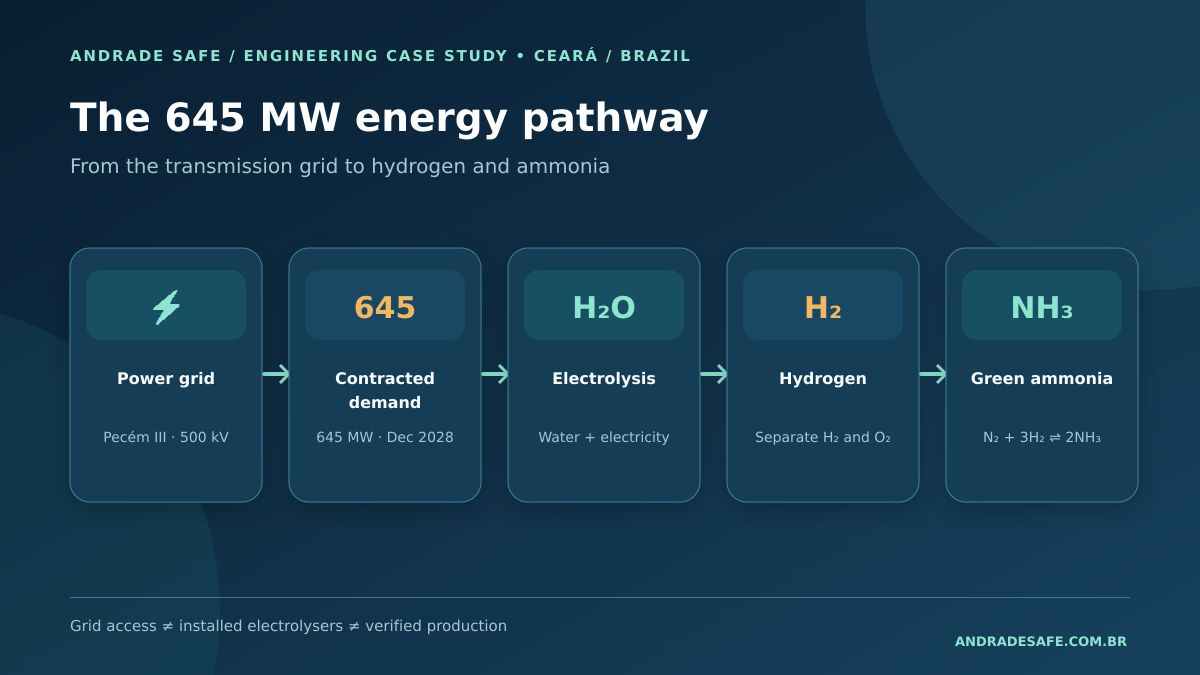
The grid comes before the hydrogen
Most explanations of green hydrogen begin with an electrolyser that splits water molecules. Industrial hydrogen projects begin much earlier: the electrical system must be able to supply and protect a potentially large, variable and power-electronics-intensive load. Without a working connection, transformers, protection, water systems and plant commissioning, an electrolyser has little value.
On November 11, 2026, ANEEL announced that Dispatch No. 4,249, published in Brazil's Official Gazette on November 10, allowed Pecém VDB 1 to access the National Interconnected System's transmission grid. It identified the Pecém III 500 kV substation in Caucaia, a 645 MW contracted demand from December 2028, and a wider green-ammonia development comprising four other consumer units, VDB 2 through VDB 5, which still awaited permanent access opinions from the system operator ONS. [1]
This is meaningful progress, but it is not an announcement that all five units have permanent access, that the plant has entered commercial operation or that ammonia exports have started. It is also not evidence of construction completion or of a particular electrolyser supplier.
MW, MWh and the temptation to overstate output
A megawatt (MW) measures power, the rate at which energy is transferred. A megawatt-hour (MWh) measures accumulated energy. If a hypothetical consumer used 645 MW continuously for every hour in a 365-day year, the energy would be:
645 MW × 8,760 h=5,650,200 MWh=5.6502 TWh
That figure is a mathematical full-load illustration, not announced energy consumption or guaranteed electricity supply. Industrial demand is shaped by operations, maintenance, availability, ramping, power contracts and network constraints. Critically, the regulator did not state that 645 MW would be installed as electrolysis stacks.
Some of the plant's electricity could supply rectifiers, compressors, pumps, cooling, demineralisation, nitrogen production, ammonia synthesis, safety systems and general utilities. Without a published engineering breakdown, converting the whole contracted demand into a named hydrogen production capacity would be misleading.
An industrial electrical chain, not a single machine
The notional energy path starts at the transmission interconnection and proceeds through switching, protection, metering and transformation. Rectifiers provide direct current to the electrolysis cells, while balance-of-plant equipment maintains water quality, temperature, gas separation and pressure. Hydrogen is then conditioned for its downstream use.
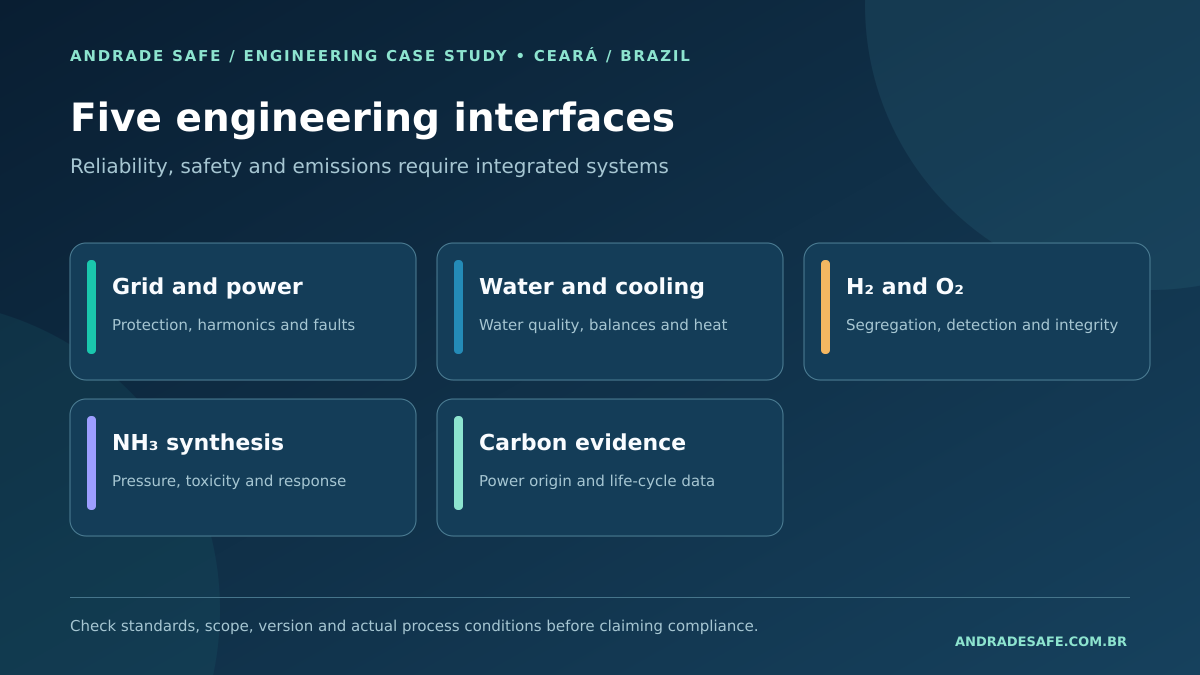
Each interface matters. Power-electronic converters can require harmonic studies; a large industrial connection requires fault studies, protection coordination, suitable earthing and careful operating procedures. Mechanical reliability depends on compressors, heat exchangers, pumps, separators, valves and piping. A shutdown in cooling or demineralised-water supply can interrupt hydrogen production even when electricity remains available.
The electrolysis technology for VDB 1 has not been disclosed in ANEEL's announcement. Possible technologies in the wider industry include alkaline, proton-exchange-membrane (PEM), anion-exchange-membrane (AEM) and solid-oxide electrolysis. Their materials, operating conditions, temperature ranges and flexibility differ. The US Department of Energy provides a useful technical explanation of these approaches. [2]
What electrolysis produces
Electrolysis uses electricity to drive water splitting. Its simplified net reaction is:
2H₂O → 2H₂+O₂
Hydrogen production is accompanied by oxygen formation. Those gas streams require appropriate separation. Cross-over or contamination between streams, imperfect sealing and transient operations must be considered during design, commissioning and monitoring. Oxygen is not itself a fuel, but oxygen enrichment can intensify combustion; hydrogen is flammable and can present challenging leak and ignition scenarios.
Hydrogen made using renewable electricity may meet the relevant definition of green hydrogen. The label says nothing about intrinsic fire resistance, pressure-system integrity or the absence of occupational hazards. These are distinct engineering questions, as addressed in our broader guide to hydrogen safety in Brazil. [8][13]
Why turn hydrogen into ammonia?
Ammonia is an established chemical feedstock for fertilisers and a candidate carrier for transporting hydrogen-derived energy. Nitrogen can be separated from air and reacted with hydrogen in a synthesis loop. The simplified balanced equation is:
N₂+3H₂ ⇌ 2NH₃
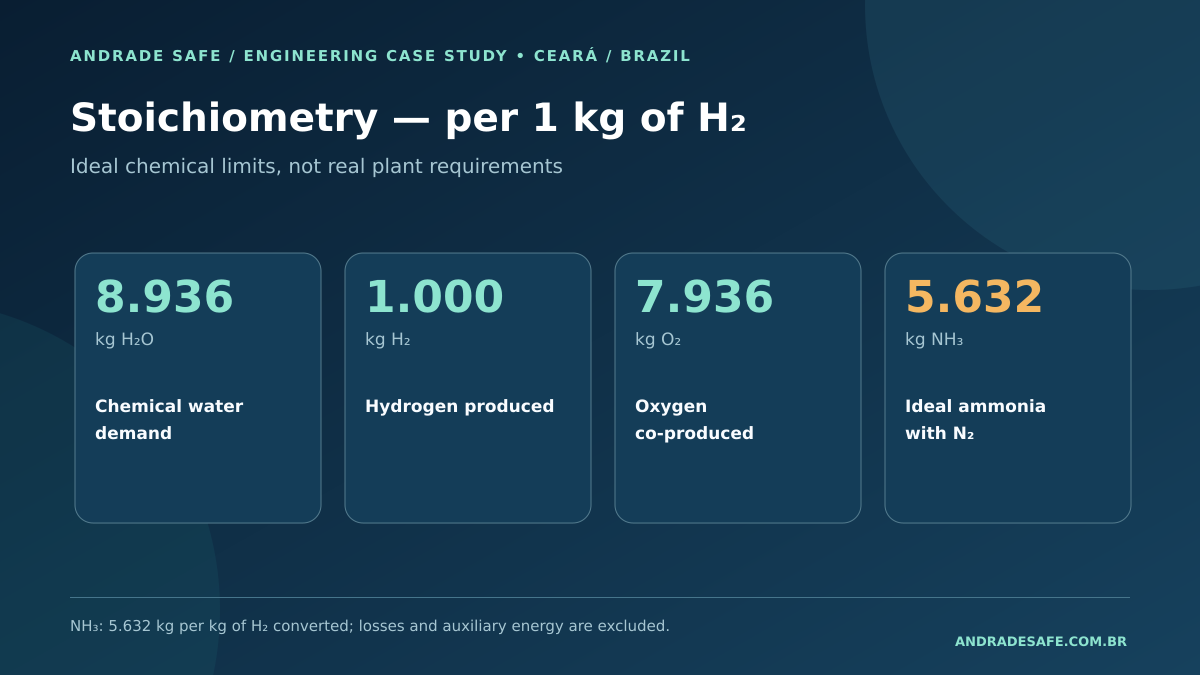
In an ideal stoichiometric balance, three moles of hydrogen produce two moles of ammonia. From molar masses of 2.016 g/mol for H₂ and 17.031 g/mol for NH₃, the ratio is approximately 5.632 kg NH₃ per kilogram of H₂ converted. Actual plant throughput must account for hydrogen utilisation, purge streams, recycle, purification, auxiliary power and system capacity. A one-pass reactor conversion is not the same thing as overall annual utilisation of feed hydrogen.
Ammonia introduces a new hazard profile: toxicity, potential pressurised releases, occupational exposure, materials compatibility and emergency response. There is no basis in the ANEEL announcement to claim a specific ammonia storage size, export agreement or operational shipping terminal for VDB 1.
A transparent numerical example: assumptions, not a forecast
To understand scale without inventing project specifications, consider an entirely hypothetical reference case using the announced 645 MW only as a power benchmark. All other inputs below are educational assumptions, not VDB 1 design data.
| Input | Illustrative value |
|---|---|
| Electrical-demand reference | 645 MW |
| Average annual utilisation | 65% |
| Electricity share allocated to electrolysis | 80% |
| Specific electricity use | 52 kWh/kg H₂ |
| Overall H₂-to-NH₃ utilisation coefficient | 90% |
| Hours per reference year | 8,760 |
From electrical energy to mass balances
Electricity allocated to electrolysis:
Eₑₗ=645 × 1000 × 8760 × 0.65 × 0.80=2.938104 × 10⁹ kWh/year
Hydrogen obtained with the assumed specific energy:
mH₂=Eₑₗ/52 ≈ 56,502 tonnes/year
The theoretical chemical water requirement follows from the molar masses: 18.015/2.016 ≈ 8.936 kg of water per kg of hydrogen, corresponding to approximately 505,000 cubic metres/year of stoichiometric water in this example, assuming a water density of 1,000 kg/m³. This is not facility water withdrawal. Pretreatment, cooling, losses and reuse change direct water demand, and indirect water associated with electricity must be considered under its own accounting boundary. A DOE record discusses these distinctions. [3]
Applying the hypothetical 90% overall utilisation coefficient to the ideal ammonia ratio produces about 286,400 tonnes of NH₃ per year in this mathematical exercise. That is not the authorised, planned or achievable production of the Pecém project. We do not know the selected electrolyser fleet, stack rating, nitrogen plant, synthesis loop, utilities consumption or expected operating profile.
Laboratory: energy, water, hydrogen and ammonia
Explore a hypothetical energy and chemical balance. Contracted electricity is not installed electrolysis power or announced plant output.
645 MW: from grid demand to hydrogen
Explore a hypothetical energy and chemical balance. Contracted electricity is not installed electrolysis power or announced plant output.
Educational model — not VDB 1 plant data. Only the announced 645 MW contracted demand is based on the public notice. All other inputs are adjustable assumptions.
Scenario parameters
Change the parameters to explore sensitivity.
Controls are hypothetical sensitivity assumptions, not specifications from a supplier, project owner or regulator.
Calculated results
Annualised educational figures, not production forecasts.
- Annual electricity to electrolysis
- 2.938TWh/year
- Illustrative hydrogen
- 56.50kt/year
- Adjusted theoretical ammonia
- 286.39kt/year
- Minimum chemical water
- 504.90thousand m³/year
- Oxygen co-produced
- 448.40kt/year
- Average electrolysis power
- 335.4MW
Illustrative electricity allocation
Eₑₗ = P × 1,000 × 8,760 × u × f
mH₂ = Eₑₗ / e
mNH₃ = mH₂ × (2 × 17.031 / (3 × 2.016)) × η
mH₂O = mH₂ × (18.015 / 2.016)
Water is a chemical minimum, not total plant withdrawal. Real water needs depend on cooling, treatment and losses. The NH₃ utilisation factor is not single-pass reactor conversion.
Sensitivity table
Keep all other inputs constant and vary annual utilisation only.
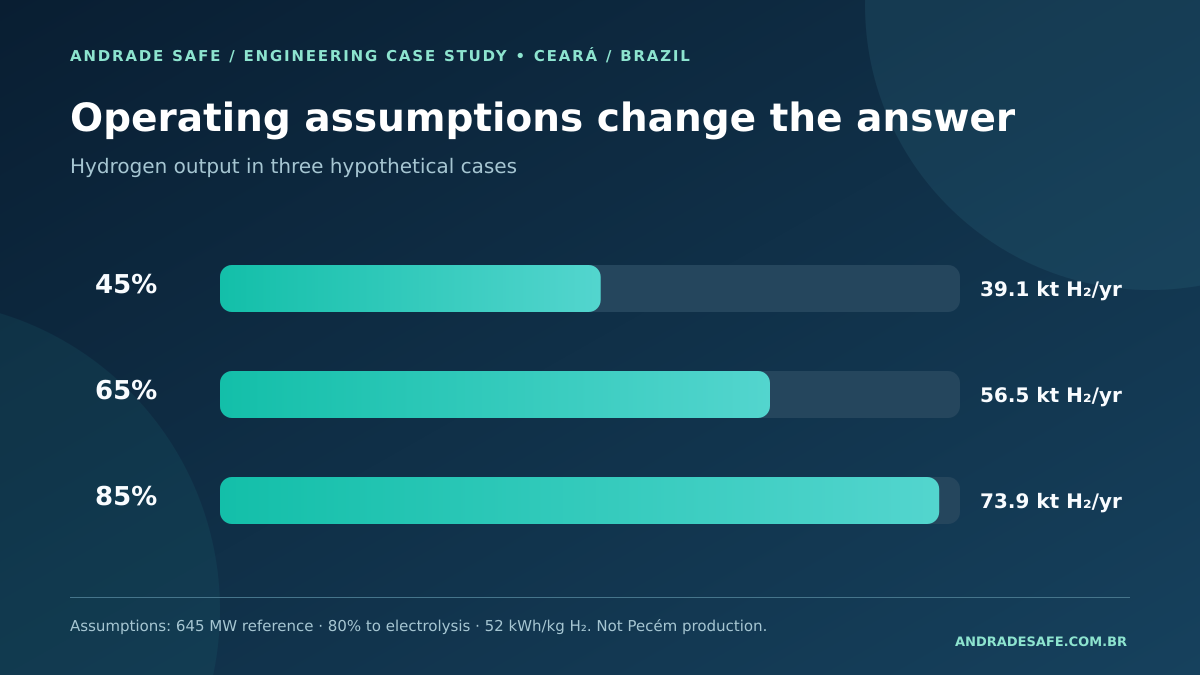
| Utilisation | Electrolysis (TWh/yr) | H₂ (kt/yr) | NH₃ (kt/yr) |
|---|---|---|---|
| 45% | 2.034 | 39.12 | 198.27 |
| 65% | 2.938 | 56.50 | 286.39 |
| 85% | 3.842 | 73.89 | 374.52 |
Original Andrade Safe laboratory; hypothetical figures.
Water: chemical demand is not total environmental demand
Water planning is particularly consequential for an industrial expansion in northeastern Brazil. Electrolysis needs appropriately conditioned water. Project choices might include reclaimed water, desalination and additional polishing, but each option depends on its own engineering, permits, source availability, operating conditions and environmental assessment.
Five quantities should remain distinct: water chemically consumed, process water consumed, total water withdrawn, water circulating through cooling systems and indirect water use in electricity generation. A favourable stoichiometric number does not establish the environmental acceptability of a water supply. ANEEL's grid-access notice does not identify VDB 1's intended source of water, so neither do we.
Does grid access prove renewable sourcing?
No. Under Brazil's Law No. 14,948/2024, low-carbon, renewable and green hydrogen are not interchangeable legal terms. Green hydrogen is defined through water electrolysis using renewable energy sources. The legal framework was further regulated in 2026, with rules relating to certification, authorisations and support mechanisms. [8][9][10]
An electricity interconnection agreement does not, on its own, establish the generation mix or the temporal alignment of renewable electricity purchases. Credible greenhouse-gas accounting requires defined system boundaries, emissions factors, energy sourcing evidence, applicable certification requirements and treatment of auxiliaries and logistics. Grid access is one necessary infrastructure step, not a green certificate.
Reliability, licensing and industrial safety
Future engineering decisions will cover interconnection equipment, switchgear, rectifiers, cooling and water systems, hydrogen purification, compressors, pressure systems, ammonia synthesis and emergency preparedness. Depending on activities and equipment, relevant Brazilian Occupational Safety Regulations may include NR-10, NR-12, NR-13 and NR-20. Applicability is established by their scope and exclusions, not merely by mentioning hydrogen or ammonia.
A particularly important timing detail: the 2026 revision of NR-10 is scheduled to become effective on June 1, 2027; the earlier text remains in force in November 2026, subject to specific transition provisions. International standards may assist design reviews but cannot be called Brazilian legal obligations without a valid basis. [11][12]
Project progress has several milestones: studies, interconnection authorisation, final investment decision, construction, permits, commissioning, start-up and commercial production. None should be silently substituted for another. There are also separate questions of market demand and offtake. The IEA's 2026 Global Hydrogen Review documents the global sector's persistent challenges in economics, infrastructure and project delivery. [4]
What to verify next
These are due-diligence questions, not allegations of deficiencies.
- The confirmed electrolysis technology, installed capacity and operating envelope.
- Credible evidence of renewable electricity supply and emissions certification.
- The complete water balance, including the source, pretreatment, cooling and discharge.
- Verified ammonia synthesis capacity, transport arrangements and any offtake agreements.
- The timetable for actual network works, plant construction, testing, licensing and commissioning.
Conclusion: a hydrogen industry begins at the substation
The 645 MW authorisation matters because it reveals green hydrogen as an integrated energy and industrial engineering challenge, stretching from high-voltage substations to water chemistry, electrolysis stacks, gas systems and ammonia production. The promised decarbonisation benefit must be supported by design, verifiable electricity attributes and reliable operation.
A technically sound account distinguishes power from energy, connection from construction, chemical minimums from site demand, and hypothetical balances from announced production. That is how a promising headline becomes useful engineering knowledge.
Related reading: Green hydrogen in Brazil: market, safety and regulatory challenges — Andrade Safe (Portuguese). This article complements the existing safety guide rather than restating it.
Editorial transparency
Editorial transparency: diagrams and calculator are original educational aids. They are not VDB 1 engineering data or third-party certifications.
Related engineering reading
Green hydrogen in Brazil: regulation and safety →
Study files
Controls are hypothetical sensitivity assumptions, not specifications from a supplier, project owner or regulator.
References
[1] Brazilian Electricity Regulator (ANEEL), 11 Nov 2026 →
[2] US Department of Energy — Hydrogen Production: Electrolysis →
[3] US DOE — Water Use in Hydrogen Production (2026) →
[4] IEA — Global Hydrogen Review 2026 →
[6] Ceará state government — Green Hydrogen Hub →
[8] Brazilian Law No. 14,948/2024 →
[9] Brazilian Ministry of Finance — Hydrogen regulation, 2026 →
[10] ANP — Hydrogen regulatory overview →
[11] Ministry of Labour — NR-10 and its effective date →
[12] MTE — official Occupational Safety Regulations →
[13] Andrade Safe — hydrogen safety in Brazil (Portuguese) →
Frequently asked questions
Is the Pecém plant already operating?
ANEEL's November 2026 announcement does not establish that; it authorises grid access and states contracted demand from December 2028.
Can we infer an annual tonnage from 645 MW?
Only by adding transparent assumptions. Such results are not official VDB 1 production figures.
Does electrolysis need just nine litres of water per kilogram of hydrogen?
About nine kilograms per kilogram is the ideal chemical minimum, not total site water demand.
Why ammonia?
It has established industrial uses and logistical pathways, but its synthesis consumes resources and introduces toxicity-related hazards.
Does connection to Brazil's power grid certify hydrogen as green?
No. Renewable sourcing and life-cycle attributes require separate evidence.
References
- Brazilian Electricity Regulator (ANEEL), 11 Nov 2026Brazilian Electricity Regulator (ANEEL), 11 Nov 2026
- US Department of Energy — Hydrogen Production: ElectrolysisUS Department of Energy
- US DOE — Water Use in Hydrogen Production (2026)US DOE
- IEA — Global Hydrogen Review 2026IEA
- Ceará state government — Green Hydrogen HubCeará state government
- Brazilian Law No. 14,948/2024Brazilian Law No. 14,948/2024
- Brazilian Ministry of Finance — Hydrogen regulation, 2026Brazilian Ministry of Finance
- ANP — Hydrogen regulatory overviewANP
- Ministry of Labour — NR-10 and its effective dateMinistry of Labour
- MTE — official Occupational Safety RegulationsMTE
- Andrade Safe — hydrogen safety in Brazil (Portuguese)Andrade Safe