
Explore the reported Tucumã mine-water overflow, acid mine drainage, copper mobility, containment engineering and a conservative river mass balance.
Context
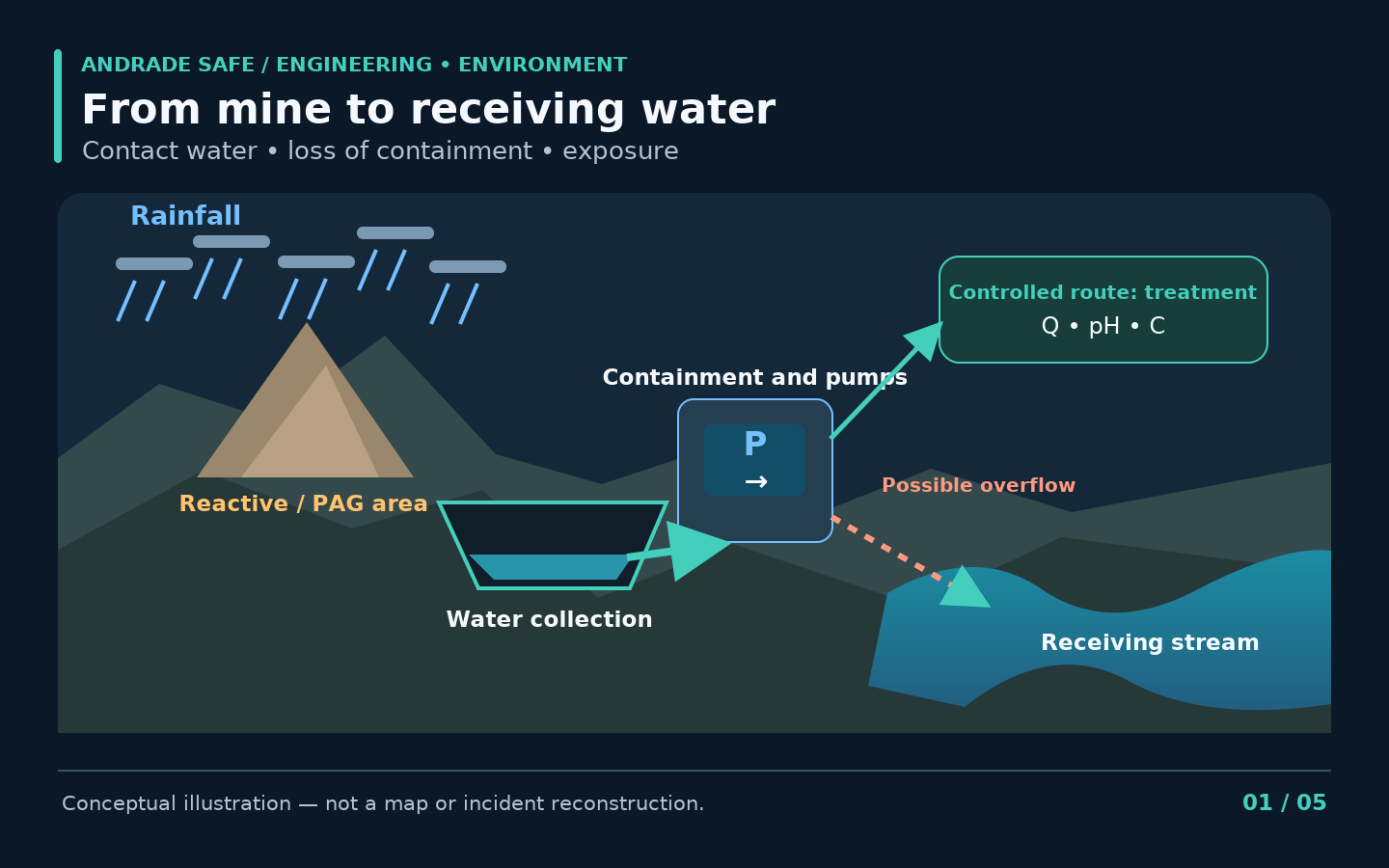
An environmental enforcement action at a copper mine in southeastern Pará illustrates a broader engineering challenge: water that contacts rock and mine waste may acquire acidity and dissolved constituents, and a hydraulic loss of containment can carry them beyond the operation.
Executive summary
On 24 November 2026, Pará's State Secretariat for Environment, Climate and Sustainability (Semas) announced administrative fines totaling BRL 16,932,250 against Mineração Caraíba S.A., known as Ero Brasil, together with the suspension of copper extraction and mineral processing at the Boa Esperança project in Tucumã. Inspectors reported an acidic industrial effluent overflow from a containment structure into a tributary of the Jatobá River. Reports of animal mortality were under investigation; no causal link was established in the sources reviewed by the reporting cutoff. [F01]
The case provides a starting point for understanding water management as an integrated system of hydraulic capacity, geochemistry, treatment and downstream protection. It does not provide sufficient information to reconstruct the actual plume or diagnose the cause of wildlife deaths.
1. What the public record establishes
Ero said that contact water overflowed on 17 and 20 November. It attributed the events to intense rainfall exceeding pumping capacity at one collection point, and stated that it had reported the events and implemented corrective measures, including increasing pumping capacity. The statement was carried by news organizations; it describes the operator's position, not an independently validated causal finding. [F02] [F03]
Semas carried out inspections on 22–23 November. According to its account, inspectors observed greenish water flowing from the mine area toward a Jatobá tributary through rural land. The agency identified the mine area and a stockpile of potentially acid-generating material (PAG) as the source, and an overflow of the containment structure referred to as lift station 3 as the release mechanism. [F01]
The larger fine concerns the industrial discharge and, according to Semas, was increased because the authorities had not been informed within the applicable period. The smaller one concerns installation of effluent management structures without prior authorization. Ero said it had reported the overflows; the precise notification timestamps have not been independently verified here. Semas allowed emergency containment, water management and remediation activities during the suspension, and announced deadlines of 15 days for a technical report and action plans and 20 working days for administrative defense, conciliation or payment. These are administrative actions, not a final judicial ruling. [F01] [F02] [F03]
The operator also disputed a link between the events and the reported mortality, stating that fish deaths had been recorded earlier and at a distance from the operation. That is its position, not a settled finding. What remains unknown includes the released volume and time profile, measured pH, metal concentrations and speciation, hydrological connectivity, ecological exposure, and potential alternative causes.
Avoid treating the event as a tailings dam failure: the inspected mechanism was a containment overflow. Neither a green appearance nor a video of affected animals is by itself a chemical analysis. The verified account does not establish contamination of the entire Xingu River system.
| Date | Record and evidentiary status |
|---|---|
| 17 and 20 Nov | Overflow dates as reported by Ero; extreme rainfall explanation attributed to the operator. |
| 22–23 Nov | State environmental inspections. |
| 24 Nov | Enforcement announcement: suspension and fines of BRL 16,881,750 and BRL 50,500. |
| 26 Nov | Editorial cutoff; quantitative chemistry, extent of exposure and ecological causation unresolved in the reviewed record. |
2. Why contact water is an industrial process stream
Mining changes the hydrological landscape. Open pits collect runoff; waste rock and ore stockpiles expose fresh minerals; haul roads redistribute drainage, and processing generates residues. Water may flow over surfaces, percolate through porous waste, encounter reactive minerals and emerge later as seepage.
Non-contact water should be kept separate from contact water where practicable: there is no engineering benefit in unnecessarily increasing the volume that must be contained and treated. Contact water is defined by its exposure history, not by a predetermined contaminant concentration. Waste rock removed to access the ore and tailings left after mineral processing are distinct material streams, yet both can be acid-generating depending on mineral composition.
Ero's annual information form filed in 2026 describes contact-water management and developments during 2025 in lift stations, equalization basins and effluent-treatment modules. Its Q3 2026 disclosure also identified further tailings filtration capacity planned for the fourth quarter. These disclosures give context for the complexity of process-water systems; neither establishes the operating status of every structure at the time of the overflow, nor a causal role for filtration in this particular incident. [F04] [F05]
Designing a complete system begins with a watershed and water-balance inventory: identify contributing areas, surface runoff and seepage, normal operations, peak inflows, storage, treatment and recycling capacity, and any permitted discharge. A high-capacity pump does not solve a bottleneck in downstream treatment or a common electrical failure.
3. Acid mine drainage: the mechanism behind a persistent hazard
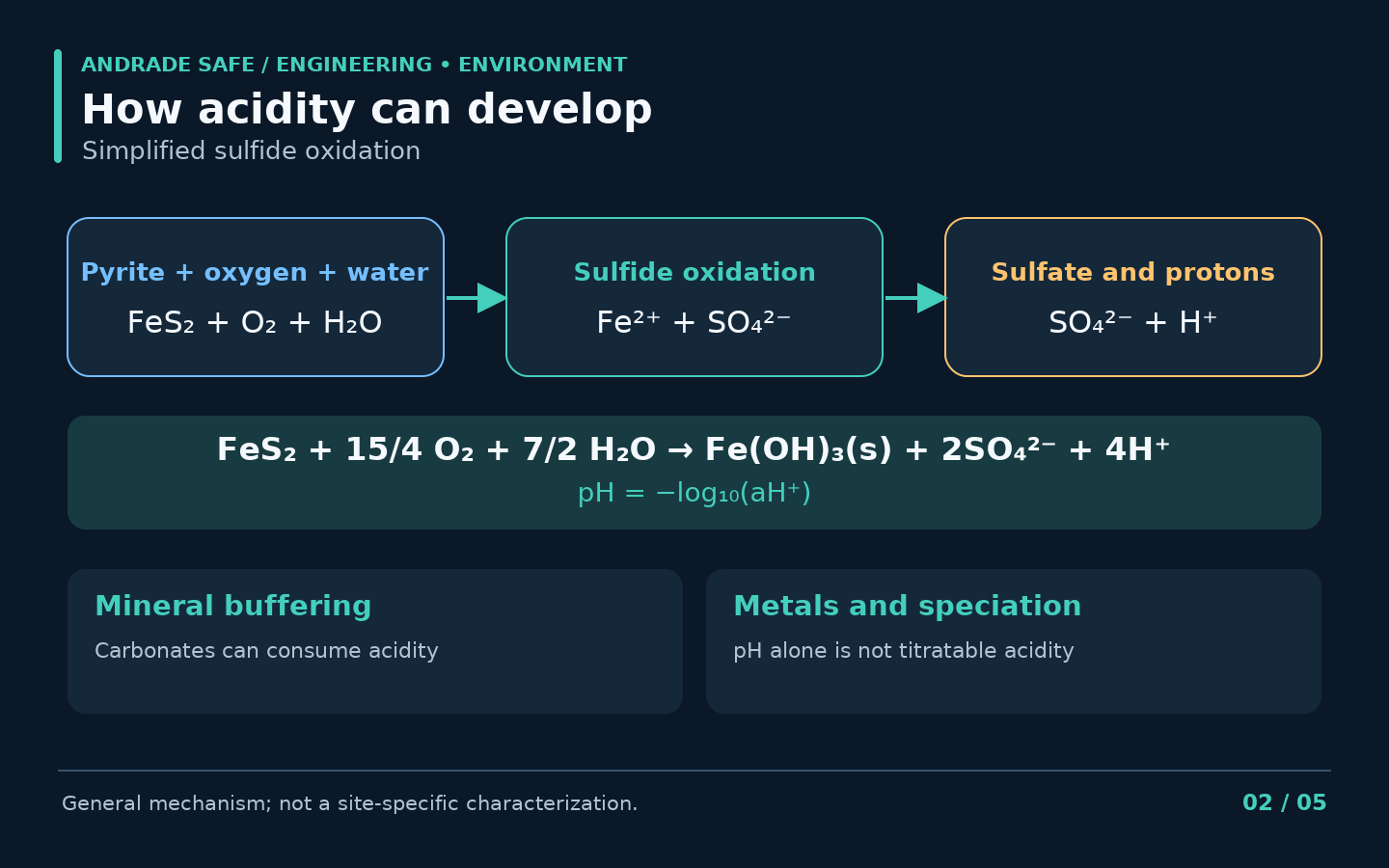
Acid mine drainage (AMD) generally arises when sulfide minerals exposed by mining react with oxygen and water. Pyrite, FeS₂, is a common example. The increased surface area of broken rock can facilitate reactions; acidophilic microorganisms may accelerate oxidation. An idealized first step is:
FeS₂ + (7/2) O₂ + H₂O → Fe²⁺ + 2 SO₄²⁻ + 2 H⁺
With subsequent iron oxidation and precipitation as ferric hydroxide, a simplified net reaction is:
FeS₂ + (15/4) O₂ + (7/2) H₂O → Fe(OH)₃(s) + 2 SO₄²⁻ + 4 H⁺
These balanced expressions illustrate proton generation and sulfate release. They are not a site-specific mineralogical result or a rate law. In natural systems, mineralogy, grain size, oxygen supply, saturation, temperature and microbial activity matter. Carbonates and other neutralizing minerals can consume acidity, so the balance between acid generation and neutralization determines whether drainage becomes acidic. Static acid-base accounting supports screening; kinetic tests and field monitoring provide evidence about rates and persistence. PAG classification describes a potential, not a guarantee of acidic discharge on every occasion. [F06] [F07]
pH is not the same as titratable acidity
The definition is pH = −log₁₀(a(H⁺)), where a is hydrogen-ion activity. A change from pH 5 to pH 3 means a hundredfold increase in hydrogen-ion activity. It does not automatically mean a hundredfold increase in the mass of neutralizing reagent required. Metals may hydrolyze and liberate protons as pH changes; alkalinity measures the water's acid-neutralizing capacity. Acidity and alkalinity data are needed to understand buffering.
For that reason, a flow-weighted arithmetic average of pH values is physically inappropriate. Even a calculation based on hydrogen-ion activities alone assumes away the buffering and reactions that are often central to mine-water chemistry. A realistic chemical evaluation requires measured composition and appropriate equilibrium or kinetic calculations.
4. Copper concentration, speciation and biological effects
Copper may be present as aqueous ions and complexes, adsorbed to suspended particles, or in mineral precipitates. Acidic conditions often promote metal mobilization, although redox conditions, mineral phases, dissolved organic carbon and competing ions can shift speciation. Near-neutral mine water can still carry significant constituents. [F06] [F07] [F08]
Color is useful as a trigger for investigation, not as a quantitative or unique chemical fingerprint. Greenish or bluish water cannot establish the copper concentration or compound identity. Similarly, orange iron-rich solids may form during oxidation and precipitation and do not imply that the dissolved phase is harmless.
Copper is an essential trace nutrient, but excessive exposure can adversely affect aquatic organisms. Bioavailability varies with pH, hardness, organic ligands and other chemical parameters. The US EPA's freshwater copper biotic ligand model illustrates why total concentration alone does not predict the amount interacting with biological sites; it is a scientific approach, not a Brazilian legal criterion. [F09]
The dissolved fraction is commonly defined operationally by filtration through a nominal 0.45 μm filter. It includes more than free copper ions and can depend on the analytical protocol. Paired dissolved and total measurements, suspended solids, and sediment tests can help establish where the material resides. Precipitation and adsorption can transfer metals from water to sediment rather than remove them from the environment; subsequent changes may remobilize them. [F08] [F10]
5. A hydraulic perspective: volume, inflow and removal
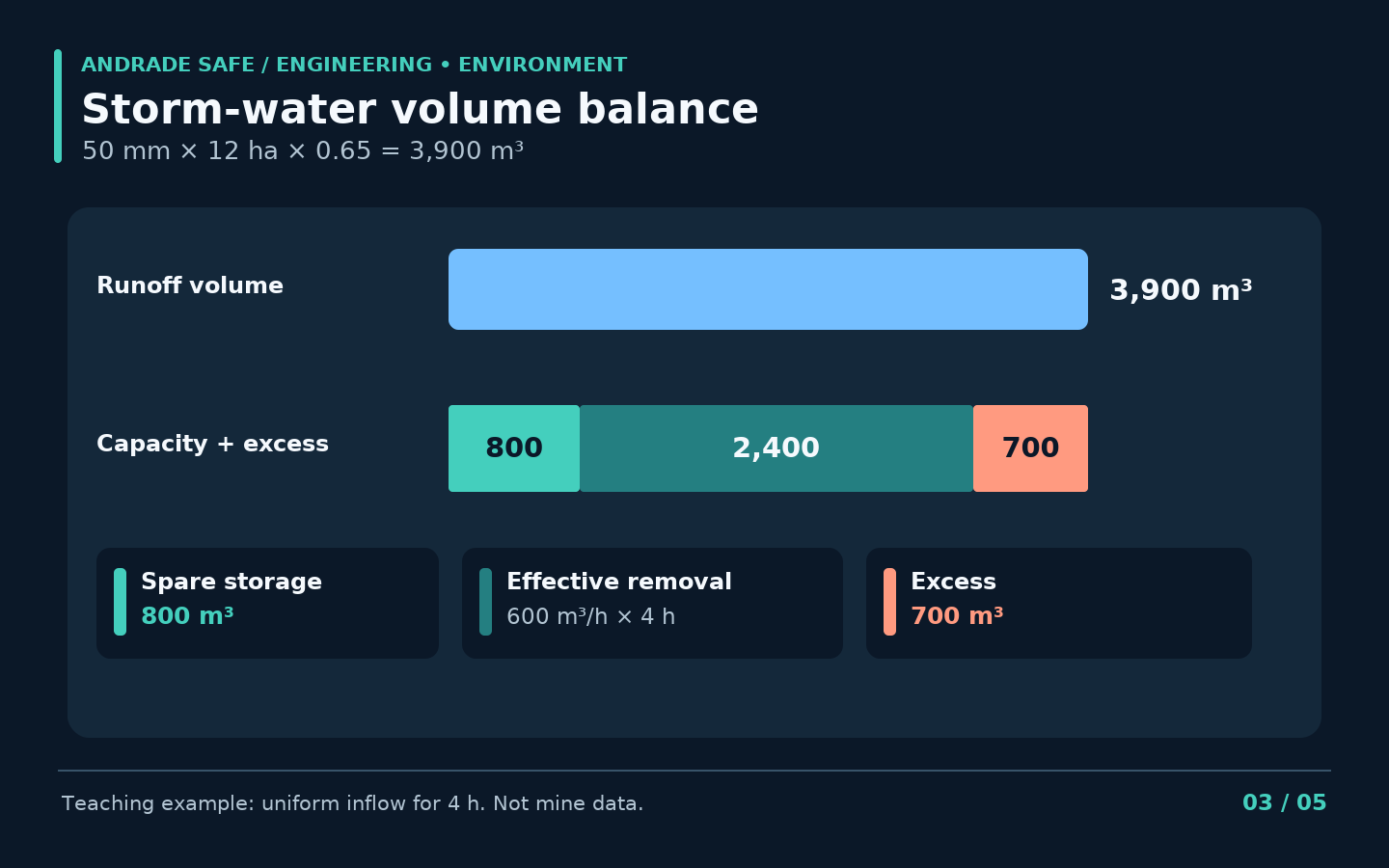
A simple storm runoff-volume estimate uses:
V_R=10P A C_R
with rainfall P in mm, contributing area A in hectares, volumetric runoff coefficient C_R dimensionless, and volume V_R in cubic metres. One millimetre over one hectare equals 10 m³.
Illustrative system, not the actual mine: assume 50 mm of rain over 12 ha, a runoff coefficient of 0.65 and a four-hour uniform inflow. The runoff volume is 3,900 m³. Suppose initial spare storage is 800 m³ and effective removal is 600 m³/h. The system can accommodate 800 + 2,400 = 3,200 m³ during this idealized event; excess volume is 700 m³.
dV/dt=Q[in]-Q[removal]-Q[overflow]
Real storm inflows are time dependent. Pumps have working levels, power and piping constraints; downstream tanks and treatment have finite capacity. The simple example assumes constant inflow, effective removal throughout the event, and no other flows. A short peak may cause overflow even if the overall event volume is below cumulative removal plus storage. A hydraulic model must represent inflow hydrographs, operational storage and failure scenarios, rather than relying only on rainfall totals.
6. Mass balance: dilution changes concentration, not the mass introduced
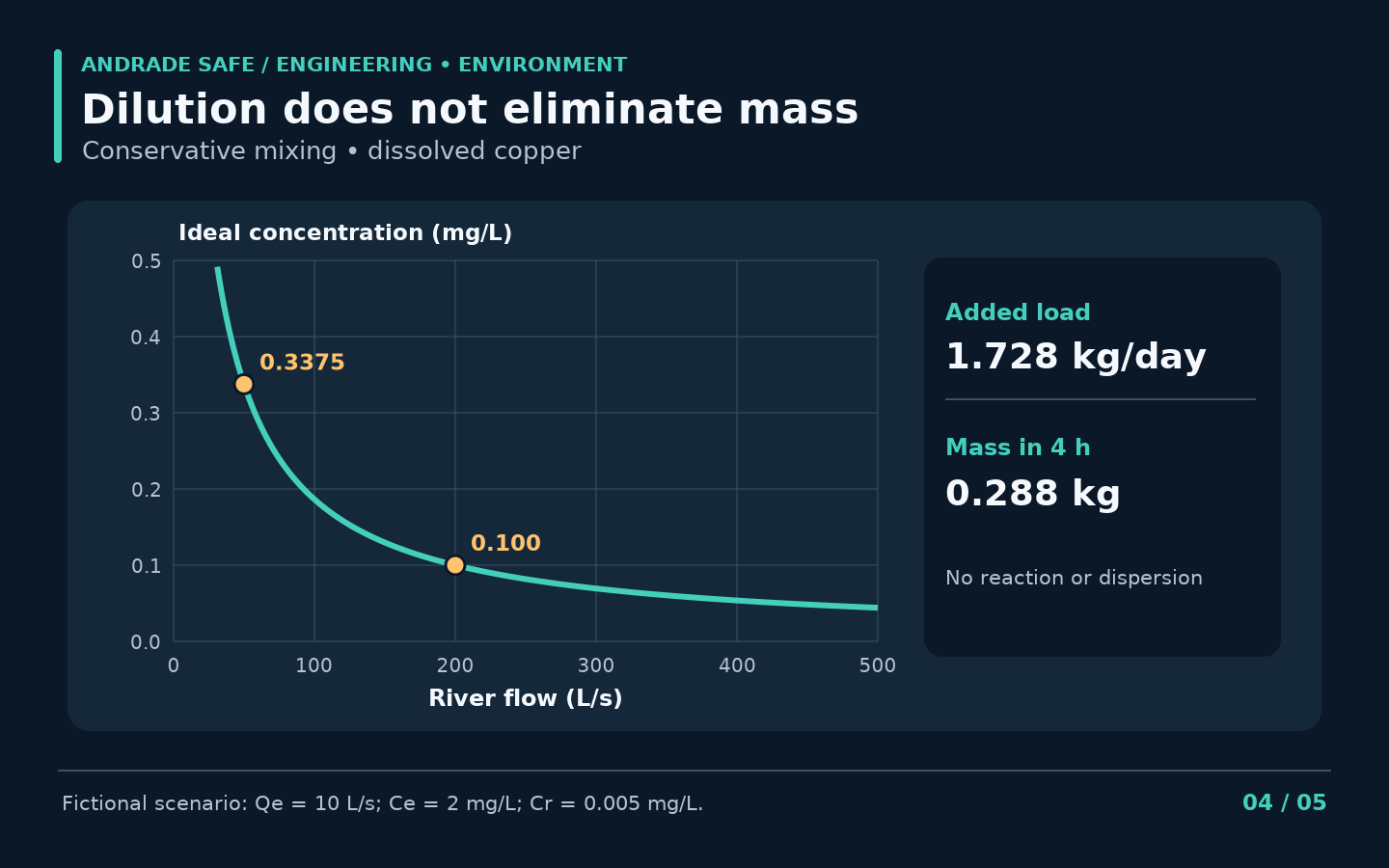
Take an upstream stream with flow Qᵣ and concentration Cᵣ, and an effluent with Qₑ and Cₑ. Assume steady flows, complete mixing and a conservative constituent with no reactions:
Cₘ = (Qᵣ Cᵣ + Qₑ Cₑ) / (Qᵣ + Qₑ)
When flows are L/s and concentrations mg/L, mass rate is L=0.0864QC kg/day, expressed as a 24-hour equivalent if the rate were maintained. For a constant release of duration t hours, mass added from the effluent is M=0.0036QₑCₑt kg.
Fictional worked example: 200 L/s upstream with 0.005 mg/L dissolved copper, mixed with 10 L/s of effluent at 2 mg/L for four hours. The ideal concentration becomes (200 × 0.005+10 × 2)/210=0.100 mg/L. The effluent contributes a daily-equivalent mass rate of 1.728 kg/day, or 0.288 kg in four hours. These assumptions are not measurements from Tucumã.
Reduce river flow to 50 L/s and retain the same source conditions. The calculated mixed concentration rises to 0.3375 mg/L, while the added effluent mass stays the same. Increasing flow can reduce concentration under the assumed conditions, but does not eliminate contaminant mass. In a real watershed, flow changes may also change pollutant generation, travel time, dispersion and sediment resuspension. Real dissolved metals are not always conservative because of geochemical transformations. [F08]
Interactive Andrade Safe laboratory
The accompanying laboratory varies source and upstream flows, copper concentrations and event duration, reporting ideal mixed concentration and effluent mass. A second module explores rainfall, runoff area, storage and effective removal. Export the scenario as CSV and independently reproduce the numbers.
It is a teaching tool, not a plume prediction, a water-safety determination, a chemical treatment design or a compliance calculator. It includes no actual Tucumã data. It deliberately does not mix pH or calculate wildlife toxicity.
7. Engineering barriers and evidence after a release
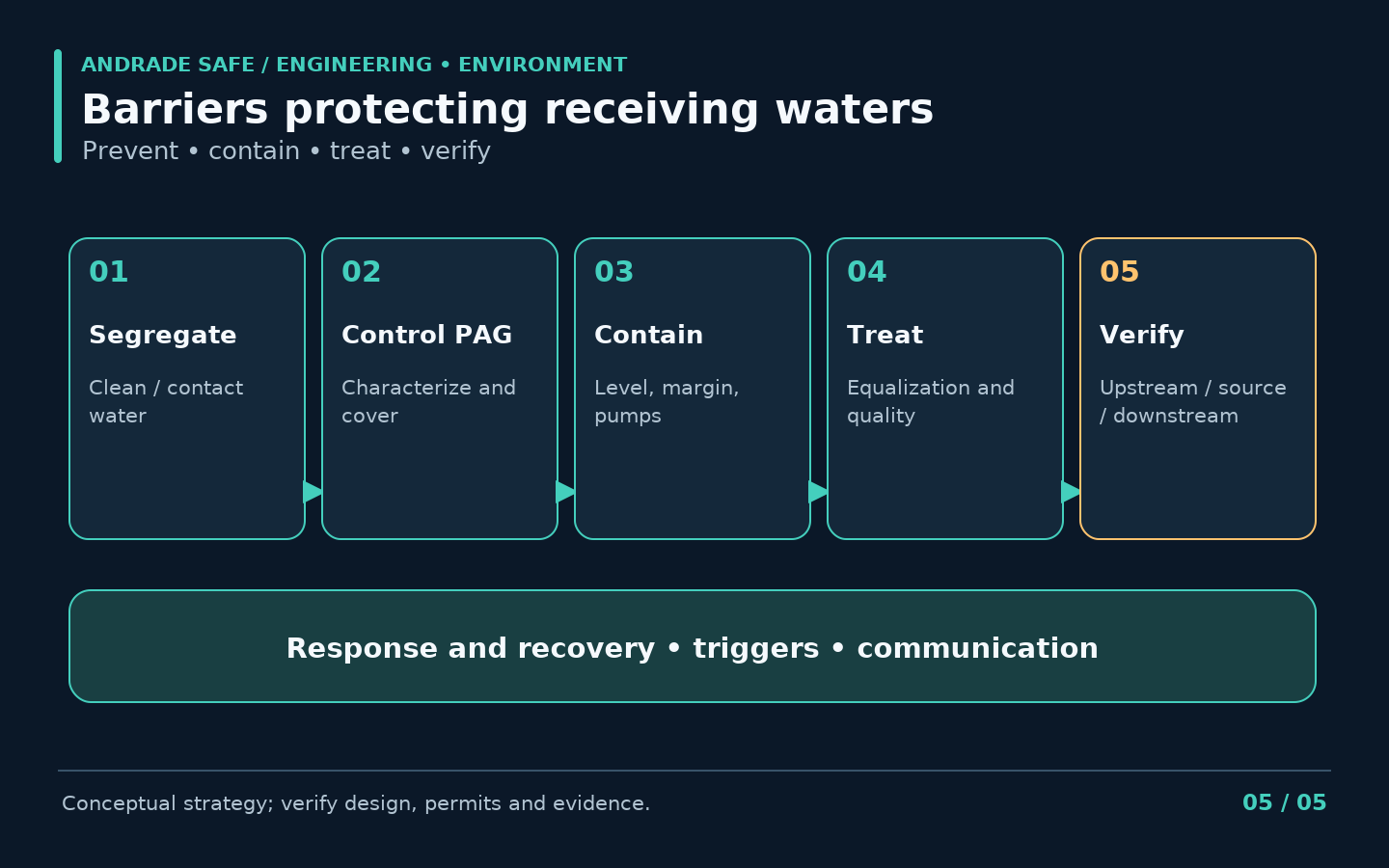
Control begins before water becomes contaminated. Separate drainage, identify reactive materials, minimize exposure where feasible, and assess the long-term water and geochemical behavior of placed waste. Design storage for an appropriate risk-based storm regime with credible equipment failures. Ensure pumping, equalization and treatment are sized as one connected system.
After a reported release, a defensible sampling campaign must address where, when and what to measure. Record rainfall, sampling time, flow, and field pH, temperature, conductivity, dissolved oxygen and turbidity using calibrated equipment. Obtain representative upstream reference sites, source samples where safely accessible, and multiple downstream locations, including tributaries. Analyze alkalinity/acidity, sulfate, relevant dissolved and total metals, and consider sediments and ecotoxicity tests. Report detection and quantification limits, blanks, duplicates, preservation and chain of custody. [F10]
Determining why animals died requires converging evidence of exposure, plausible dose and timing, biological effects and alternative explanations such as oxygen depletion or other sources. Sampling long after a short pulse may miss the exposure. A later clean sample does not rule out a previous pulse; a single high result does not, by itself, explain mortality.
Reconstruct the hydraulic timeline from rainfall, alarms, level records, pump controls, power availability and equipment performance. Check whether redundancy is genuinely independent: two pumps sharing a power supply can fail together. Define action levels and responsibilities in advance. For treatment, equalization, controlled neutralization, oxidation, precipitation and solids separation can be combined when justified by the water chemistry. Passive treatment can have a role in suitable settings but requires evidence of capacity and long-term performance. Treatment does not destroy metals; residues require characterization and appropriate management.
| Barrier | Key information | Verification |
|---|---|---|
| Contact-water segregation | Contributing area and clean-water routes | Current drainage survey and inspections |
| PAG control | Acid generation and neutralization potential | Material classification, kinetic testing, placement and cover design |
| Containment and transfer | Available storage, actual pumping and availability | Functional tests, level trends, emergency power and contingency |
| Equalization and treatment | Flow and incoming chemistry | Demonstrated capacity, treated-water analyses, sludge management |
| Receiving-water protection | Spatial and temporal exposure indicators | Upstream/source/downstream sampling and quality controls |
8. Brazilian regulatory context: effluent versus receiving water
Brazil's CONAMA Resolution 357/2005, Articles 14–15 and Table I, provides receiving-water quality standards, including 0.009 mg/L dissolved copper (9 µg/L) for Class 1 and 2 freshwaters, subject to the applicable classification and conditions. CONAMA Resolution 430/2011, Article 16 and Table I, establishes general direct-discharge conditions, including pH 5–9 and a dissolved-copper limit of 1.0 mg/L. [F11] [F12]
Regulatory transition: in September 2026, Brazil’s environment ministry announced approval of a new resolution intended to amend Resolution 357/2005 and repeal 430/2011. The numbered final act and official gazette publication could not be located by this cutoff; a 24 November legal commentary also reported that publication was pending. The figures above come from the published texts located, not draft legislation. Verify official publication, effective date and transitional provisions before applying them. [F14] [F15]
The values refer to different points and must not be substituted for one another. Applicable permits, specific standards, current amendments, river classification and mixing-zone conditions must be determined. Meeting a generic effluent standard does not authorize degradation of receiving waters or an unauthorized discharge. Article 9 of Resolution 430 prohibits pre-discharge dilution using better-quality water for that purpose. The actual receiving-water classification and permit terms for this incident are not established here.
Pará State Law 9,575/2022, Article 18(II), lists failure to notify the environmental authority and, where applicable, civil defense within 48 hours of an accident as an aggravating circumstance in administrative sanctions. [F13] This is a jurisdiction-specific provision, not a reason to delay emergency notification or a universal reporting deadline.
9. What a credible recovery and restart plan must demonstrate
- An updated water inventory and characterization of potentially reactive material. - Verified spare containment and removal capacity under plausible storm and failure scenarios. - Treatment capability across the range of influent chemistry, with clear hold/release criteria. - Representative evidence of downstream exposure, and a restoration plan agreed with the competent authorities. - Clear lines of decision-making, notification and independent verification.
This analysis complements the blog's discussion of mine stockpile geotechnical safety and critical minerals and industrial value chains. Those Portuguese-language articles address related but distinct engineering and industrial topics.
Closing perspective
Copper enables electrification, industrial infrastructure and emerging technologies. The value of the resource does not diminish the obligation to manage water throughout the mine's lifecycle. A loss of containment is not simply a hydraulic event; it can transfer matter and chemical reactivity into a shared ecosystem. Robust engineering makes that interface measurable, predictable and accountable.
Educational analysis, not an environmental assessment, engineering design, forensic opinion or legal advice. Update when official analytical results and decisions become available.
Sources and references
[F01] Semas/PA — comunicado de fiscalização de Tucumã, 24/11/2026 →
[F05] Ero Copper — Management Discussion and Analysis, Q3 2026 →
[F07] Bigham, J. M.; Cravotta, C. A. (2016). Acid mine drainage. DOI 10.1081/E-ESS3-120053867 →
[F09] US EPA — Copper Biotic Ligand Model, freshwater aquatic life criteria (2007) →
[F10] USGS — National Field Manual for the Collection of Water-Quality Data (NFM) →
[F11] CONAMA — Resolução 357, 17/03/2005, art. 14 tabela I e art. 15 →
[F12] CONAMA — Resolução 430, 13/05/2011, arts. 9 e 16, tabela I →
[F13] Pará — Lei 9.575, 11/05/2022, art. 18, II →
[F15] KLA — Resolução do Conama sobre efluentes é tema de artigo (24/11/2026) →
Frequently asked questions
Does the reported acidic discharge prove that acid mine drainage caused the fish deaths?
No. Semas identified an acidic overflow but was investigating the mortality link. The exact geochemical pathway and biological attribution require evidence.
Does green water indicate copper?
Color alone cannot identify or quantify a metal. Sampling and analytical characterization are needed.
Can dilution remove pollution?
It can change concentration, but the source mass remains unless another process transfers or removes it.
Does a neutral pH establish water safety?
No. Metals, ecotoxicity, other chemical constituents and intended use still matter.
What is the transferable lesson?
Treat water collection, storage, transfer, treatment, verification and receiving-water protection as one controlled engineering system.
References
- Semas/PA — comunicado de fiscalização de Tucumã, 24/11/2026Semas/PA
- Nordstrom, D. K. (2011). Mine waters: Acidic to circumneutral. Elements 7, 393–398. DOI 10.2113/gselements.7.6.393Nordstrom, D. K. (2011). Mine waters: Acidic to circumneutral. Elements 7, 393–398. DOI 10.2113/gselements.7.6.393
- Bigham, J. M.; Cravotta, C. A. (2016). Acid mine drainage. DOI 10.1081/E-ESS3-120053867Bigham, J. M.; Cravotta, C. A. (2016). Acid mine drainage. DOI 10.1081/E-ESS3-120053867
- Balistrieri, L. S. et al. (2007). Assessing the concentration, speciation, and toxicity of dissolved metals during mixing of acid-mine drainage and ambient river water downstream of the Elizabeth Copper Mine, Vermont, USA. Applied Geochemistry. DOI 10.1016/j.apgeochem.2007.02.005Balistrieri, L. S. et al. (2007). Assessing the concentration, speciation, and toxicity of dissolved metals during mixing of acid-mine drainage and ambient river water downstream of the Elizabeth Copper Mine, Vermont, USA. Applied Geochemistry. DOI 10.1016/j.apgeochem.2007.02.005
- US EPA — Copper Biotic Ligand Model, freshwater aquatic life criteria (2007)US EPA
- USGS — National Field Manual for the Collection of Water-Quality Data (NFM)USGS
- CONAMA — Resolução 357, 17/03/2005, art. 14 tabela I e art. 15CONAMA
- CONAMA — Resolução 430, 13/05/2011, arts. 9 e 16, tabela ICONAMA