
Texas paused state approvals sought by data centers while it audits grid and water impacts. Understand large loads, interconnection, transmission and what comes next.
Direct answer: electricity is now part of the AI product
Better models still depend on physical power delivered at the right place, time and quality. A campus requesting hundreds of megawatts turns a real-estate choice into a generation, transmission, substation, equipment and system-operations question.
The constraint is not an abstract global shortage of electricity. It is whether a large, concentrated and fast-growing load can connect without imposing unacceptable cost or reliability risk on other customers.
What Texas did — and did not do
On September 21, the Texas governor directed TCEQ to halt regulatory approvals sought by data centers until a coordinated audit of grid and water impacts is completed. This should not be described as a blanket ban on data-center construction; the directive concerns the state approvals it identifies.
PUCT, ERCOT and the Texas Water Development Board were asked to audit impacts, with an update due October 19. The important signal is that a fast-growth market is testing whether announcements, connection requests, onsite generation and water plans describe executable projects.
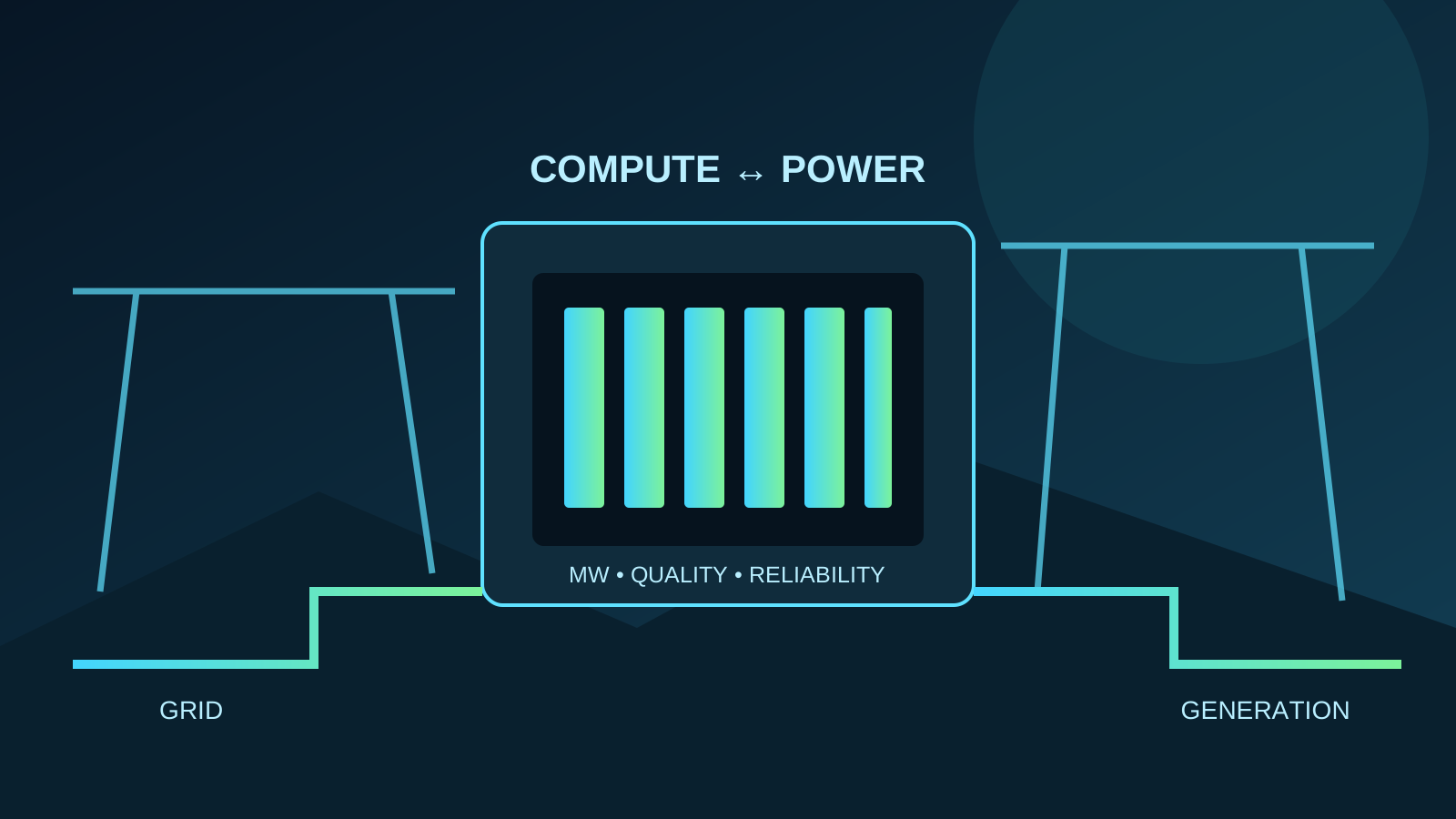
474 GW of requests is not 474 GW of consumption
Texas reported that ERCOT was considering more than 474 GW of large-load requests—over five times system peak—with roughly 90% associated with data centers. This is a queue or request universe, not contracted, built or consumed load.
Projects can overlap, resize, seek multiple points of interconnection or never proceed. Treating the queue as firm demand exaggerates the result; ignoring it misses the engineering workload and its effect on expansion decisions.
MW, GW, MWh and TWh are different
MW and GW measure power. MWh and TWh measure energy accumulated over time. A 100 MW facility at full load for one hour uses 100 MWh; annual energy depends on its actual load profile.
| Metric | Meaning | Frequent mistake |
|---|---|---|
| MW / GW | Instantaneous power or rated capacity | Calling it annual consumption |
| MWh / TWh | Energy over time | Comparing it directly with a GW queue |
| Connection request | Power submitted for study | Treating it as a built project |
| Firm load | Qualified commitment under local rules | Confusing it with an announcement |
The five physical bottlenecks
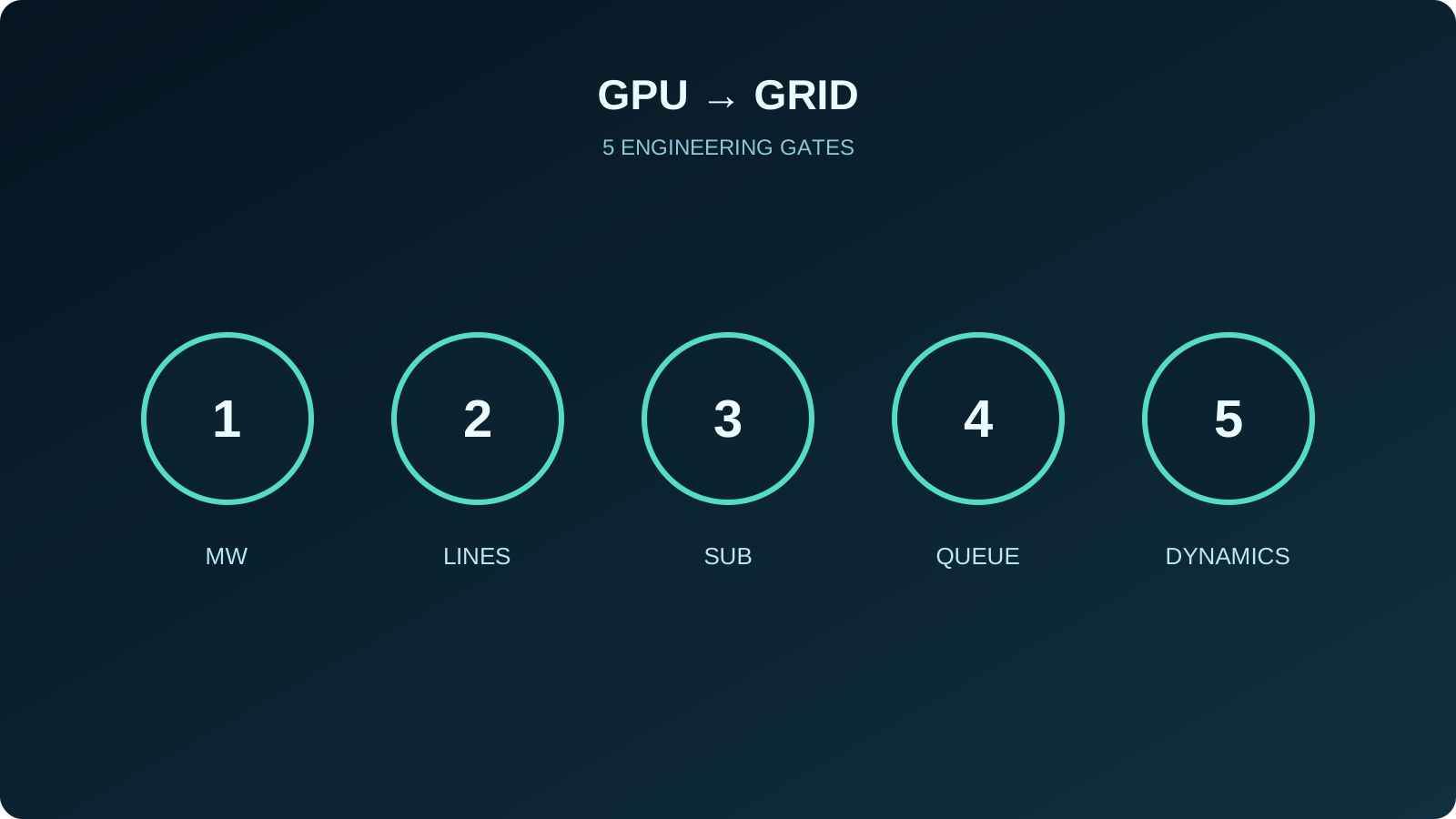
First, resource adequacy: the system must serve peaks, reserves and adverse events, not merely balance annual energy. Second, transmission: generation may exist far from the constrained connection node. Third, transformers, switchgear and substations have engineering, manufacturing and commissioning lead times.
Fourth, interconnection needs credible location, ramp, power-quality, protection, onsite generation and storage data. Fifth, dynamic reliability matters because electronically controlled loads may respond together to voltage or frequency events.
| Bottleneck | Decision question |
|---|---|
| Generation | What is available during critical hours? |
| Transmission | Can power reach this node? |
| Equipment | Are transformers and substations deliverable? |
| Interconnection | Are project data and milestones credible? |
| Dynamics | How does the load ride through, trip and return? |
Why losing load can also destabilize the grid
A coordinated trip of hundreds of megawatts can create surplus generation, overfrequency or overvoltage. The safe response is not simply ‘disconnect faster.’ Ride-through, settings, validated models and staged restoration need coordination with the operator.
NERC’s guidance is voluntary and non-binding. It is not Brazilian law, but it is useful engineering evidence that static studies alone may miss fast interactions.
Global growth is material—and uncertain
The IEA estimates that data-center electricity use increased 17% in 2025 and AI-focused facilities about 50%. Its central case moves from roughly 485 TWh in 2025 to 950 TWh in 2030, near 3% of global electricity demand.
These are projections, not destiny. Chip efficiency, utilization, model architecture, prices, location and grid constraints change the outcome. EPRI uses multiple U.S. scenarios for the same reason; its high case is not a single firm forecast.
No single technology removes the constraint
Solutions must match the local problem.
| Option | What it can do | Core limit |
|---|---|---|
| Transmission | Structural capacity and access | Time, permits and cost |
| BESS | Ramps, peaks and short contingencies | Finite energy |
| Nuclear | Firm low-carbon generation | Lead time, capital and licensing |
| Onsite generation | Resilience and local support | Fuel, emissions and maintenance |
| Load flexibility | Shift or curtail demand | Not every workload can wait |
| Microgrid | Local coordination and islanding | Does not erase external dependencies |
Flexibility must be measurable
Some training and batch jobs can move in time or geography; interactive inference and latency commitments may have less freedom. A flexibility claim needs metering, controls, a contract, testing and defined limits.
Restoration also matters. Reconnecting a large block immediately after a disturbance can create a second event, so staged return is part of the resource.
What Brazil should take from this debate
Brazil combines relatively low-carbon electricity, renewable potential, subsea cables and investor interest. These advantages do not remove nodal constraints, transmission lead times or equipment bottlenecks.
EPE already recognizes that data centers can materially influence transmission expansion. Sound policy should request location, phased power, hourly profile, water, onsite resources, flexibility and responsibility for upgrades—and distinguish a memorandum, access request, contract and operating load.
Ten questions for any data-center announcement
A large number is not evidence of a deliverable connection.
- Is the power a request, reservation, contract or operating load?
- Is a single connection point defined?
- What are the hourly profile and ramps?
- Which network upgrades are required?
- Are critical transformers ordered?
- What service is the BESS sized for?
- How long can onsite generation operate?
- Which load is truly flexible and tested?
- How will the load ride through and restore?
- Who pays and carries delay risk?
Conclusion: AI's limit is also electromechanical
The GPU race has placed the power system inside technology strategy. The decisive question is not annual electricity in the abstract, but whether each project has a viable connection, equipment, capacity and behavior compatible with a reliable grid.
Texas exposed a tension other markets will face. The opportunity is to turn announced megawatts into staged, evidence-based infrastructure rather than a queue of promises.
Frequently asked questions
Why do AI data centers pressure power grids?
They concentrate large loads and require generation, transmission, substations, equipment and dynamic coordination at the same place and time.
Did Texas ban new data centers?
No blanket ban was announced. The September 21 directive paused identified state approvals while agencies audit grid and water impacts.
Is 474 GW actual Texas consumption?
No. It is a set of large-load requests under ERCOT consideration, not built, contracted or consumed power.
What is the difference between MW and MWh?
MW measures power; MWh measures energy over time.
Can renewables solve the constraint?
They add supply, but connection also depends on location, transmission, critical-hour capability and stability.
Can BESS replace grid expansion?
Not universally. BESS can manage ramps, peaks and short events, but its stored energy is finite.
Can data centers support the grid?
Potentially, through tested flexibility, storage or onsite resources coordinated by contract and controls.
Why is sudden load loss risky?
A very large trip can create surplus generation and frequency or voltage excursions.
Is NERC guidance legally binding?
No. The cited guideline is voluntary and non-binding and does not become Brazilian law.
Is an interconnection queue a demand forecast?
No. It signals interest and study workload but includes projects that may change, overlap or never proceed.
References
- Governor Abbott Directs TCEQ To Halt Data Center Permits Pending AuditOffice of the Texas Governor
- Governor Abbott Directs Agencies To Audit Data Center ImpactsOffice of the Texas Governor
- Batch Zero Large Load Interconnection Study RFIERCOT
- Reliability Guideline: Large Loads IntegrationNERC
- Energy and AI: Key questions for 2026International Energy Agency
- Powering Intelligence: Analyzing Artificial Intelligence and Data Center Energy ConsumptionEPRI
- Data centers e o planejamento da transmissãoEPE