
A technical analysis of the limited Aqaba ammonia release and the barriers needed for process isolation, depressurization, draining, purging, verification and safe first break.
A limited release and a critical distinction
On 14 September 2026, a limited ammonia release occurred during maintenance at the Aqaba Industrial Complex in Jordan. Jordan Phosphate Mines Company later said the work involved removing an old ammonia compressor belonging to a client company and that the release did not originate from the complex's main ammonia storage tanks.
Teams shut the main valve and stopped the release. Workers were moved preventively to safe points inside the facility, while Civil Defence, ASEZA, local authorities and site personnel responded. Published environmental readings indicated no contamination in the monitored area, and readiness checks continued before operations resumed.
No public technical finding has established the cause. The responsible lesson is therefore not an accusation: idle equipment is not necessarily empty, depressurized, decontaminated or safe to open.
Why official reports mention both 14 and 11 people
At 15:16, the Aqaba governor told Petra that 14 people had been affected, mostly lightly to moderately; four went to hospital and the others were treated at site clinics. At 21:01, Petra carried JPMC's later update: 11 workers had minor injuries, most had been discharged and a few remained under precautionary observation.
No later official bulletin located by the 15 September revalidation explicitly reconciled the counts. This article preserves both, explains their sequence and treats JPMC's 11 as the latest update without calling it a final investigative total.

Direct answer: why can stopped equipment remain hazardous?
A stop command ends a function; it does not demonstrate that product has left every internal space. Residual ammonia can generically remain in compressor casings, low points, dead legs, trapped sections, seals, filters, hoses and connections, or return from a common source.
Those are general process-safety examples, not findings about Aqaba. The pressure, temperature, phase, released quantity, isolation arrangement and exact release point have not been published. Hazardous inventory need not sit in a large tank to create direct exposure.
Stopped, isolated and released are different states
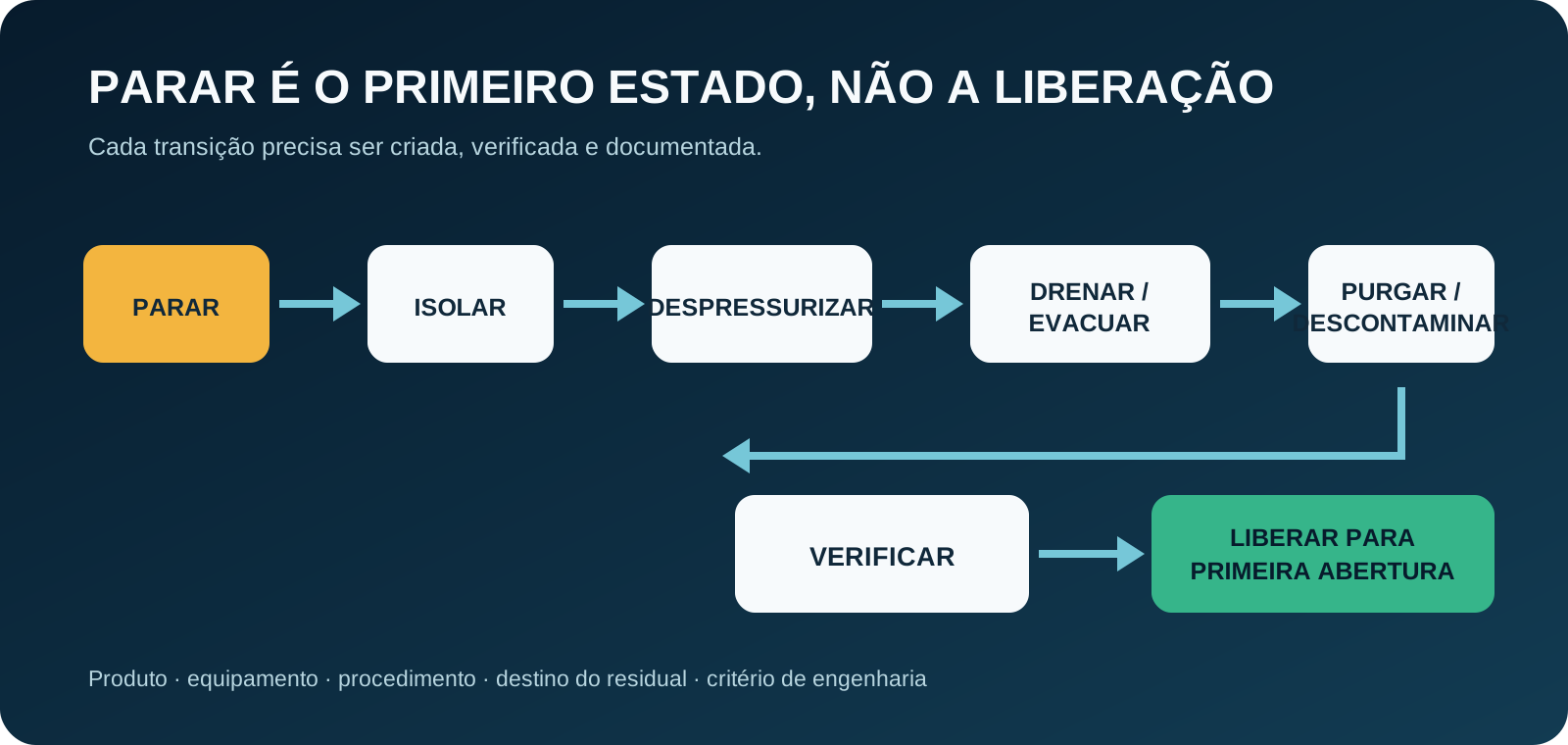
A useful conceptual chain is: stop, isolate, depressurize, drain or pump down, purge or decontaminate, verify and release for first break. Each arrow is a condition to be created and confirmed.
Not every system needs every step or the same method. Substance, design, geometry, temperature, pressure, residual destination, procedure and risk assessment determine the route. Closing a valve changes operating status; by itself it does not prove zero inventory or prevent backflow.
Isolation must account for every possible source
An isolation plan identifies all sources capable of feeding the equipment, including shared connections and return paths. It defines how each boundary will be applied, protected and verified, and whether trapped pressure can remain between valves.
Operational valve isolation differs from positive or more robust methods such as physical disconnection or appropriate blanking. Double block and bleed, blinds or spool removal are not universal prescriptions. Selection must follow the service, hazard, design and formal isolation philosophy.
Depressurizing, draining, pumping down and purging differ
Depressurization reduces pressure energy to the defined work condition. Draining removes liquid held by gravity or geometry. Pump-down transfers residual product to a controlled destination when the process permits. Purging displaces contamination with a compatible method; decontamination reduces the remaining chemical hazard to a defined criterion.
Verification proves those criteria were met. Water, nitrogen, ventilation or neutralization must never be presented as a universal ammonia solution: compatibility, pressure, effluent, recovery, treatment and destination require system-specific engineering.
The first break removes the physical barrier
Opening a flange, fitting, plug, cover, drain or casing is a distinct operating state. Once physical containment is broken, the worker depends on everything identified, isolated, removed and verified beforehand.
US OSHA materials discuss hazardous-energy control, equipment opening and line-breaking permits as international good practice. They are not Jordanian or Brazilian law. Access control, line of fire, body position, suitable tools, communication, emergency readiness and stop-work criteria must match the assessed scenario.
Ammonia hazards and the limits of public data
Ammonia is a colorless, pungent irritant gas, often stored as a liquefied gas under pressure. It can severely affect eyes, skin and the respiratory tract; high exposure may impair escape and damage lungs. Rapid evaporation of liquefied ammonia can also cause frostbite.
NIOSH lists an IDLH of 300 ppm, a REL of 25 ppm TWA and 35 ppm short-term; OSHA lists a 50 ppm TWA PEL. These are US references, not Jordanian or Brazilian legal limits. No concentration at Aqaba's maintenance point is public, so these values cannot reconstruct exposure or release conditions.
Odor is not a release criterion
Ammonia's odor may warn of exposure, but smell is not an instrument. Adaptation, irritation and individual differences mean that absence of odor cannot demonstrate absence of ammonia.
A generic multi-gas detector does not automatically measure NH3. The method needs the correct sensor, range, calibration, response characteristics and sampling strategy. Although warm ammonia gas is lighter than air under reference conditions, cold gas, flashing liquid, aerosols, wind, turbulence and obstacles make simple up-or-down rules unsafe.
Contractual boundaries cannot become information boundaries
JPMC's statement that the compressor belonged to a client makes organisational interfaces relevant without proving coordination failure. Equipment owner, process owner and maintenance contractor may be different organisations.
The work plan must make clear who knows every source, applies and verifies isolation, issues the permit, defines the gas-free or decontamination criterion, authorises first break and approves physical removal. P&IDs, tags, tie-ins, valves and changes must cross contractual boundaries intact.
Old-equipment removal can be local decommissioning
Permanent removal may require process separation, inventory elimination, hazardous-energy control, treatment of connected lines and a lasting configuration change. Equipment age or time out of service proves nothing about internal condition.
Management of change becomes relevant when removal alters tie-ins, logic, instrumentation, drawings or operational responsibility. Public information does not show which MOC system applied in Aqaba. Zero electrical energy and zero chemical inventory are different claims.
Stopping a release is not releasing an area
Source control, medical response, perimeter control, environmental monitoring, equipment stabilization, re-entry criteria and restart authorization answer different questions. Authorities said air in the monitored area was clean and readiness checks continued; that does not reveal the complete sequence or the concentration at the work point.
A defensible release decision identifies what was measured, where, for how long and by which method; what could cause a renewed release; and who had authority to permit re-entry and restart.
Confirmed facts, open questions and learning references
Confirmed reports cover a limited maintenance release, removal of a client company's old compressor, JPMC's exclusion of the main tanks as the source, main-valve closure, internal precautionary evacuation, coordinated response, subsequent air monitoring and readiness checks.
The root cause, exact point, mass, pressure, temperature, phase, isolation and purge sequence, pre-work readings, permit and detailed responsibilities remain unknown. Residual inventory, line breaking, isolation, ammonia monitoring, MOC and safe re-entry are analytical references, not investigation findings.
Questions investigators and organisations need to answer
Technical questions preserve evidence without turning uncertainty into blame.
- What was the actual compressor and connection configuration?
- Which sources could feed it and how were boundaries verified?
- Was liquid, vapor or trapped pressure present?
- How were depressurization, draining, pump-down or decontamination confirmed?
- Was ammonia measured before first break?
- What permit and criterion authorised removal?
- Did the P&ID match the field?
- Who owned each step across JPMC, client and contractors?
- Which barriers limited the release and what must change before restart?
Educational pre-opening checklist
This management aid does not replace a P&ID, risk assessment, permit, plant procedure or competent engineering judgment.
- Identify tag, scope and every source.
- Match drawings to field configuration.
- Stop, isolate and verify boundaries.
- Eliminate or confirm residual pressure.
- Drain or transfer liquids to a controlled destination.
- Purge or decontaminate where required.
- Define product and effluent destination.
- Verify residuals with a suitable method.
- Protect non-involved people and control access.
- Select PPE and respiratory protection from the assessment.
- Control first break, line of fire and stop work.
- Formalise organisational interfaces and emergency readiness.
Conclusion: safe condition must be constructed
The Aqaba case does not yet establish why ammonia remained available at the maintenance point, or even confirm that exact mechanism beyond secondary reporting. That answer depends on the announced review and any future technical findings.
The learning does not depend on the final cause. Before opening equipment that handled a hazardous substance, safe condition must be created step by step and demonstrated with evidence. A machine may have been idle for hours or years; while product, pressure or a return path remains, the hazard remains part of the job.
Frequently asked questions
What happened at the Aqaba Industrial Complex?
A limited ammonia release occurred during maintenance to remove an old compressor belonging to a client company. No technical cause has been published.
Did the leak come from an ammonia tank?
JPMC said it did not originate from the main ammonia storage tanks.
Why can ammonia remain in idle equipment?
Product may remain in internal volumes, low points, trapped sections, seals and connections, or return from another source. These are general possibilities, not Aqaba findings.
Does closing a valve make equipment safe?
Not by itself. Sources, boundary integrity, pressure and residual inventory still require verification.
What is line breaking?
The controlled first opening of piping or equipment that contained process material, such as a flange, fitting, cover or drain.
Is odor enough to release maintenance work?
No. Smell does not prove absence of ammonia; a suitable instrument and objective criteria are required.
How is safe re-entry decided?
Through defined criteria for source control, equipment stability, monitoring, re-entry and operational readiness under the local emergency plan.
References
- Phosphate company controls minor ammonia leak at Aqaba complex, 11 injuredJordan News Agency - Petra
- Aqaba Governor: Ammonia Leak Contained, 14 InjuredJordan News Agency - Petra
- Industrial ComplexJordan Phosphate Mines Company
- Ammonia leak at Aqaba industrial complex leaves 11 with breathing difficultiesThe Jordan Times
- Ammonia Refrigeration eTool - Receiving OperationsU.S. Occupational Safety and Health Administration
- Control of Hazardous EnergyU.S. Occupational Safety and Health Administration
- NIOSH Pocket Guide to Chemical Hazards - AmmoniaCDC/NIOSH
- Ammonia Chemical Fact SheetU.S. Centers for Disease Control and Prevention
- Norma Regulamentadora nº 1Ministério do Trabalho e Emprego
- NR-13 atualizadaMinistério do Trabalho e Emprego
- Norma Regulamentadora nº 20Ministério do Trabalho e Emprego