
Understand route design, ATC, TCAS, ADS-B, communication and risk management in the American 5342 accident, with lessons for occupational safety.
Look for the system before looking for someone to blame
After a major accident, a name can seem to offer a quick explanation. For safety engineering, identifying an action in a cockpit or control tower is only the beginning. An investigation must explain why the hazard was allowed, what information was available and why other defences did not interrupt the sequence.
The collision between a Black Hawk and American Flight 5342 provides an evidence-based case study. Its purpose is to examine interactions among people, technology, procedures, organisations and environment. Respect for the 67 people who died requires accuracy, without recreating their final moments or turning technical findings into personal judgments.
Last updated: 8 October 2026. Facts and findings are attributed to the NTSB and FAA; the military update is identified separately. Applications to occupational safety are Andrade Safe educational analyses, rather than aviation recommendations transferred literally to industrial workplaces.

The accident: 90 seconds of context
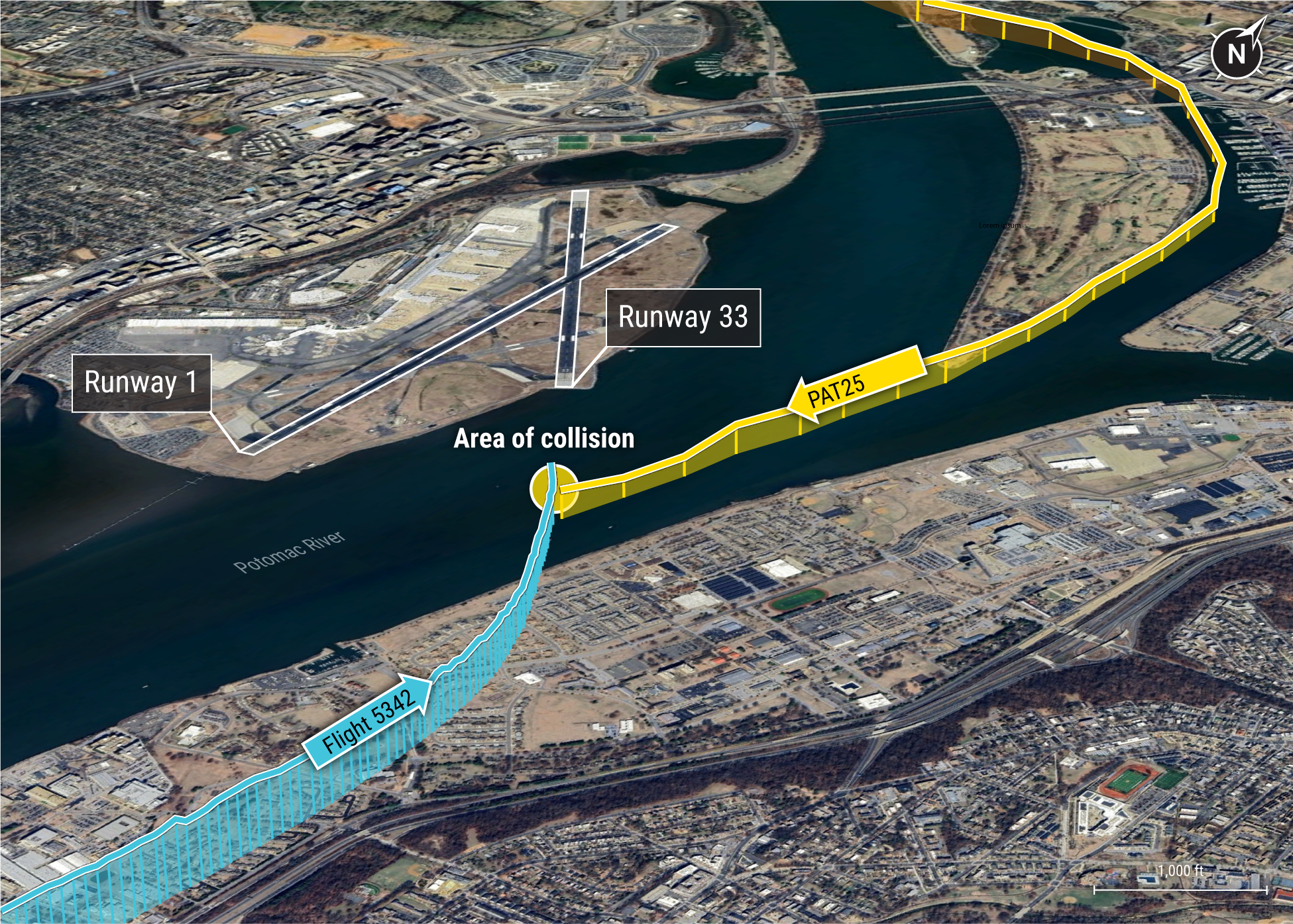
On 29 January 2025, at approximately 8:48 p.m. local time, a US Army UH-60L helicopter, call sign PAT25, collided over the Potomac River with a PSA Airlines CRJ700 operating American Airlines Flight 5342. The jet was approaching Ronald Reagan Washington National Airport near Washington, DC. There were 64 people aboard the jet and three aboard the helicopter; all died.
The context involved the relationship between a helicopter route and the runway 33 approach, rather than simply two aircraft being nearby. The official animation below presents the NTSB reconstruction, not footage of the accident. The linked official map and documents allow readers to examine geometry without invented paths or altitudes.
Official NTSB animation · investigation overview
Official NTSB reconstruction, not accident footage. English-language video.
What the NTSB found: a systemic probable cause
The probable cause combines FAA route design and risk review decisions, excessive reliance on visual separation and the helicopter crew’s ineffective application of it. It also includes the control team’s loss of situational awareness, workload associated with combined positions without an adequate risk assessment, and the Army’s failure to ensure awareness of altimeter tolerances, associated with flight above the published maximum altitude.
Technological limitations, inadequate safety management and weaknesses in data sharing also mattered. Describing organisational weaknesses alone would omit operational factors. Focusing on one individual action would conceal conditions that allowed it to have irreversible consequences. A useful investigation connects these levels while retaining the weight of each piece of evidence.
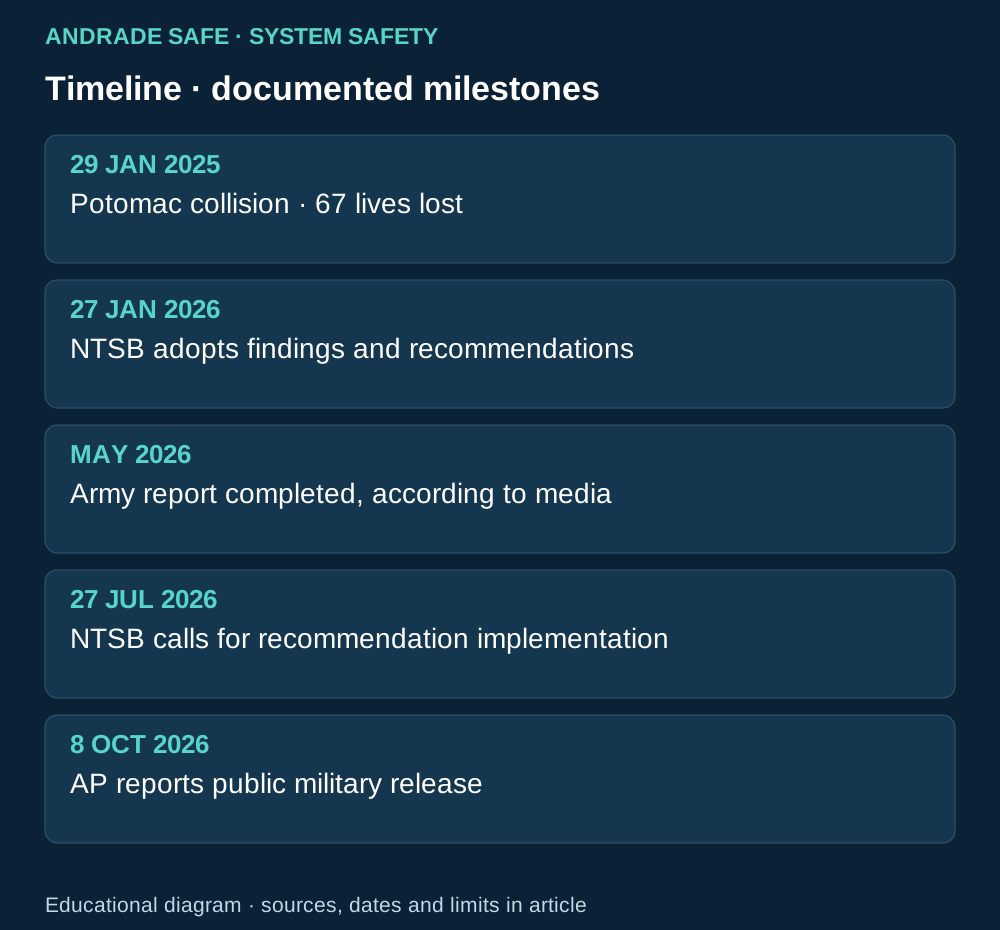
There is a documentary discrepancy: the January release reported 74 findings and 50 recommendations; the NTSB statement of 27 July 2026 reports 75 findings and 50 recommendations. This edition uses the later statement’s count, without treating the difference as a new investigation. The main investigation is complete; implementing its recommendations is a separate task.
NTSB · DCA25MA108 — completed investigation →
NTSB · Systemic Failures Led to Midair Collision Over Potomac River →
NTSB · Statement on open DCA recommendations — 27 July 2026 →
The Army update on 8 October 2026
Reuters says the military report, completed in May, highlights two interrupted radio transmissions, technical issues, training and coordination with the FAA. AP reported its public release on 8 October.
We could not access an official complete copy during this check; this update is attributed to news coverage. The military investigation adds an organisational perspective but does not replace the NTSB probable cause. A deficiency can warrant correction even when it has not been shown to cause this particular accident. Newly accessible documents should update this article while preserving the distinction between primary evidence and media reporting.
Reuters · US Army report cites systematic failures — 8 October 2026 →
Associated Press · Army finds systemic failures — 8 October 2026 →
When communication breaks: speaking does not ensure understanding
Simultaneous radio transmissions can block or mask part of a message. Participants on different frequencies may also not hear all the conversation available to a controller. A partially received instruction may omit precisely the information that changes a decision. The NTSB examined these risks and recommended technology to identify potentially blocked transmissions.
Telling people to communicate better is insufficient. A communication barrier needs a defined recipient, recognisable content, confirmation and an escalation condition when an adequate response is missing. Standard phraseology reduces ambiguity; it cannot eliminate interference, overlap or lost context. A later recording does not prove that an entire message was intelligible at the time.
An industrial analogy is releasing equipment for maintenance by radio. Saying that a machine is stopped does not establish that every energy source has been isolated. Confirmation must demonstrate the required critical state. This comparison illustrates an engineering principle; it does not equate industrial and aviation protocols.
NTSB · Systemic Failures Led to Midair Collision Over Potomac River →
See-and-avoid: a human barrier has limits
Visual separation relies on identifying and tracking traffic to maintain distance. Seeing a light is not the same as correctly identifying the relevant aircraft, its path and closing speed. At night, city lights, limited apparent relative movement and divided attention can make this difficult.
NTSB studies discuss night-vision goggle limitations, including a narrow field of view, depth perception and difficulty distinguishing lights. Such equipment also offers benefits. The responsible conclusion is not that goggles always make safety worse, but that their limits must inform training, procedures and the design of other defences.
An organisation should not design a system around unlimited attention. Risk grows when detection, interpretation, communication and action must occur under pressure and the same person is the final resource for several functions. Assess the time available, the signal presented, competing demands and the response that remains physically possible.
TCAS: traffic alerts and resolution guidance differ
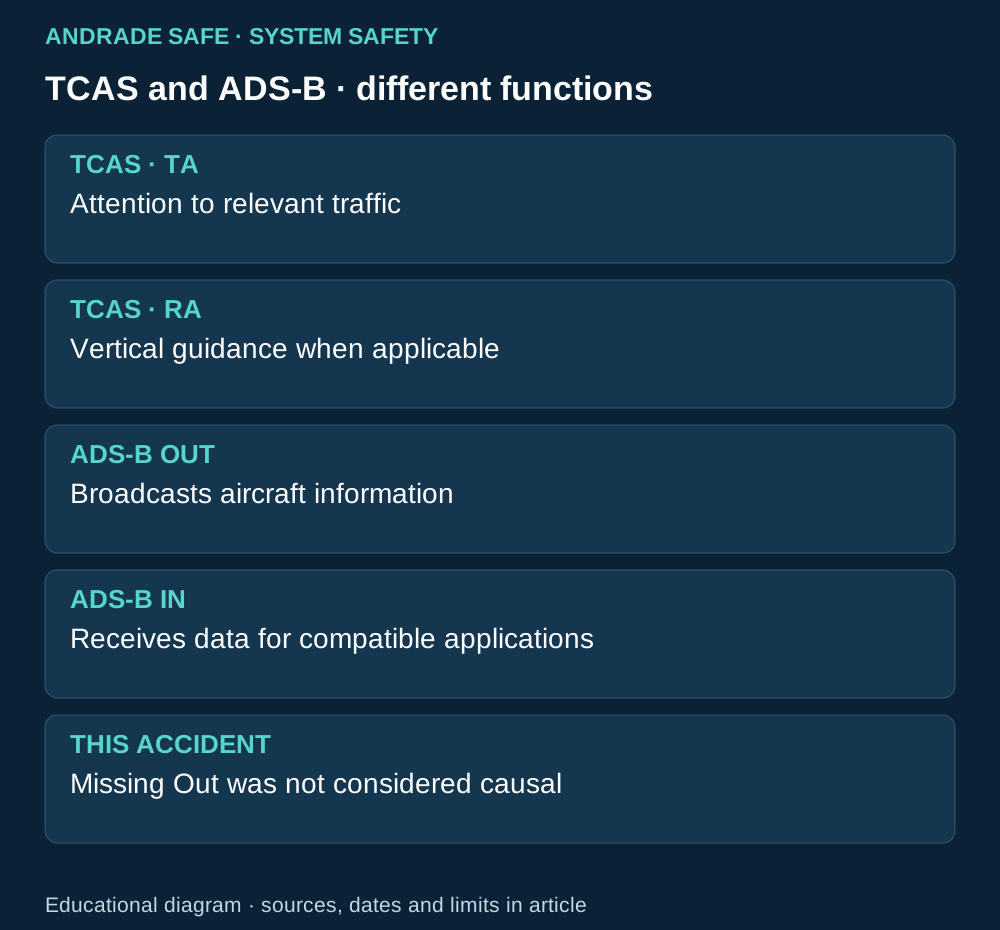
TCAS monitors transponder-equipped traffic and may issue a Traffic Advisory, or TA, to attract attention. A Resolution Advisory, or RA, provides vertical resolution guidance when applicable. Identifying a threat and receiving manoeuvring guidance perform different functions.
According to the NTSB, the CRJ’s TCAS II operated as designed and issued a TA approximately 20 seconds before impact. During descent, RAs were inhibited below 900 feet AGL, meaning height above ground level. The absence of an RA there does not establish an equipment failure. The logic seeks to avoid unsuitable commands near the ground, while leaving a coverage limitation that the operational system must address.
It is not possible to conclude that installing any alert would necessarily have prevented this accident. That would require evidence of detection, presentation, comprehension, response time and a feasible manoeuvre in the specific scenario. The design question is which risks remain when protection is inhibited and which other barriers control them.
NTSB · On the NTSB Final Report on the DCA Midair Collision →
ADS-B In, ADS-B Out and causality in this accident
ADS-B Out broadcasts aircraft information; ADS-B In receives information for compatible applications. Broadcasting does not ensure that another aircraft can receive and display those data. TCAS and ADS-B are not interchangeable names for a single device.
The helicopter was not broadcasting ADS-B Out because of incorrect transponder settings, but radar continued to track it. The CRJ did not have ADS-B In. The NTSB concluded that the lack of ADS-B Out did not change the circumstances of this accident. It should not be presented as a direct cause or a deliberate crew decision on that flight.
The configuration vulnerability still matters for other operations. Verification should test the function actually delivered rather than merely equipment presence on a list. Correcting a deficiency and demonstrating that it caused an event are different tasks; mature safety practice performs both without confusing their conclusions.
NTSB · On the NTSB Final Report on the DCA Midair Collision →
NTSB · Helicopter Operations — board presentation →
| Function | What it provides | Relevant limit |
|---|---|---|
| TCAS / TA | Draws attention to traffic | Not resolution guidance |
| TCAS / RA | Vertical guidance when applicable | Near-ground inhibitions |
| ADS-B Out | Broadcasts data | Another participant must receive them |
| ADS-B In | Receives data for compatible applications | Depends on equipment and presentation |
A barrier can operate correctly and still be insufficient
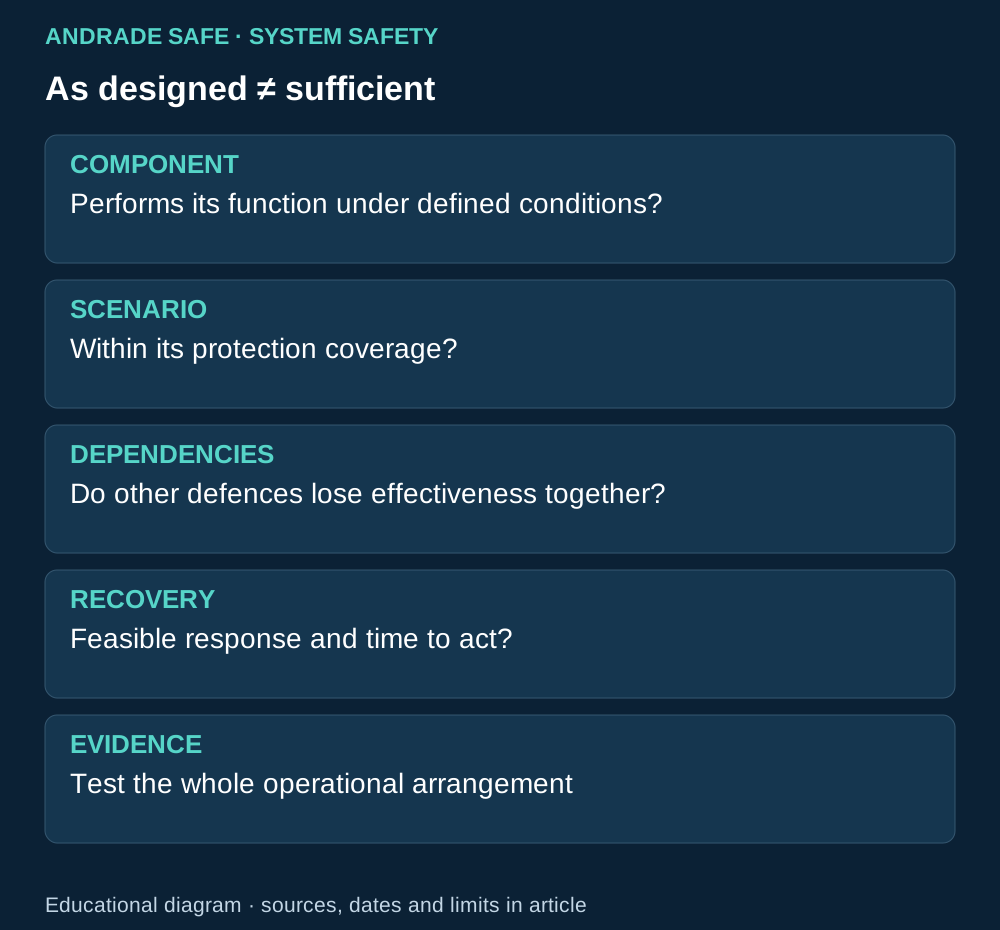
A barrier has a function, valid operating conditions and expected performance. A component can meet its specifications while the overall system does not protect an operational scenario. TCAS illustrates why component conformity and the adequacy of the safety architecture require separate assessments.
Identify dependencies. Two defences using the same information, relying on the same attention or losing effectiveness under the same condition do not necessarily provide two independent recovery opportunities. A procedure, training and a check by the same operator may share one vulnerability.
Record the hazard, barrier function, owner, test evidence, unavailability conditions and compensating response before an event. A matrix completed after an accident supports investigation. A matrix maintained during operation supports detection of degradation before the margin is lost.
Reading the layers without oversimplifying the investigation
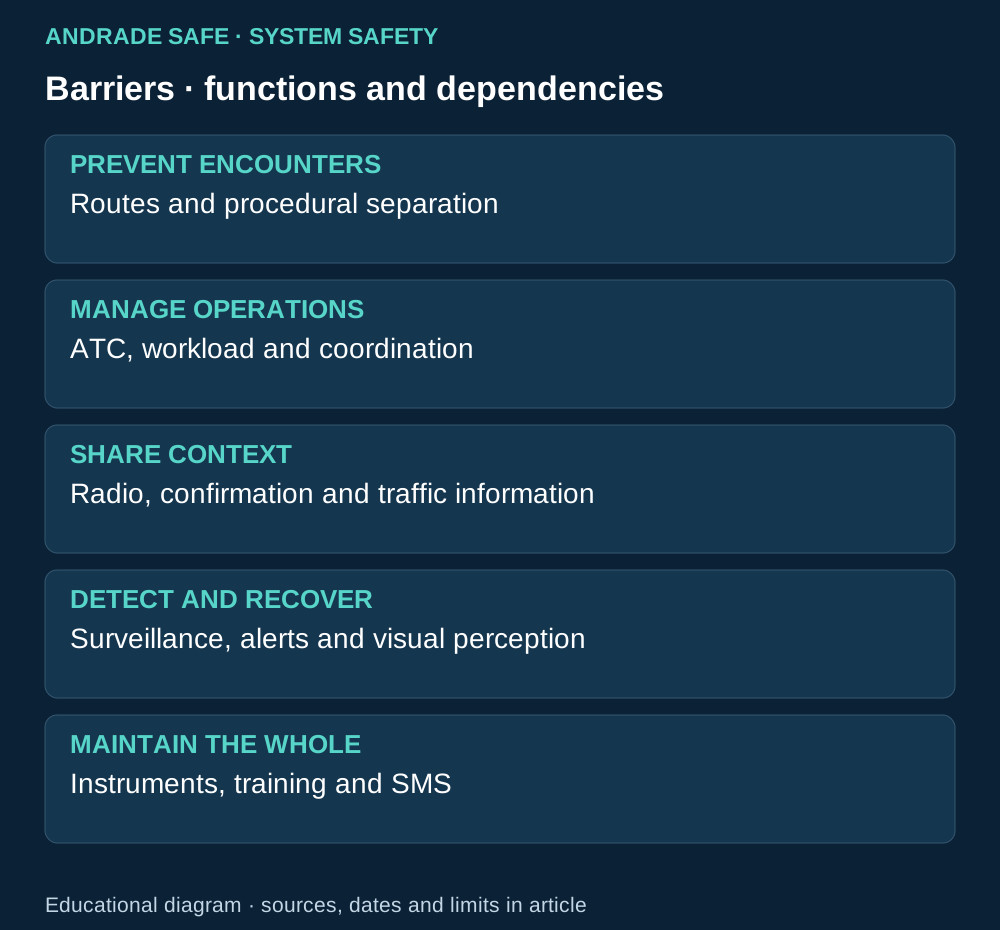
Route design prevents or creates hazardous encounters. Control manages traffic; communication supports shared decisions. Surveillance and alerts support detection. Visual perception, training and instruments support crew action. Safety management must monitor the performance of this entire arrangement.
The layered model, often associated with Swiss cheese, is educational. Alone, it does not explain causality, authority, adaptation or dynamic interaction. A bow-tie also helps: threats and prevention of loss of separation on the left, detection and recovery before consequences on the right. It does not justify inventing a saving manoeuvre.
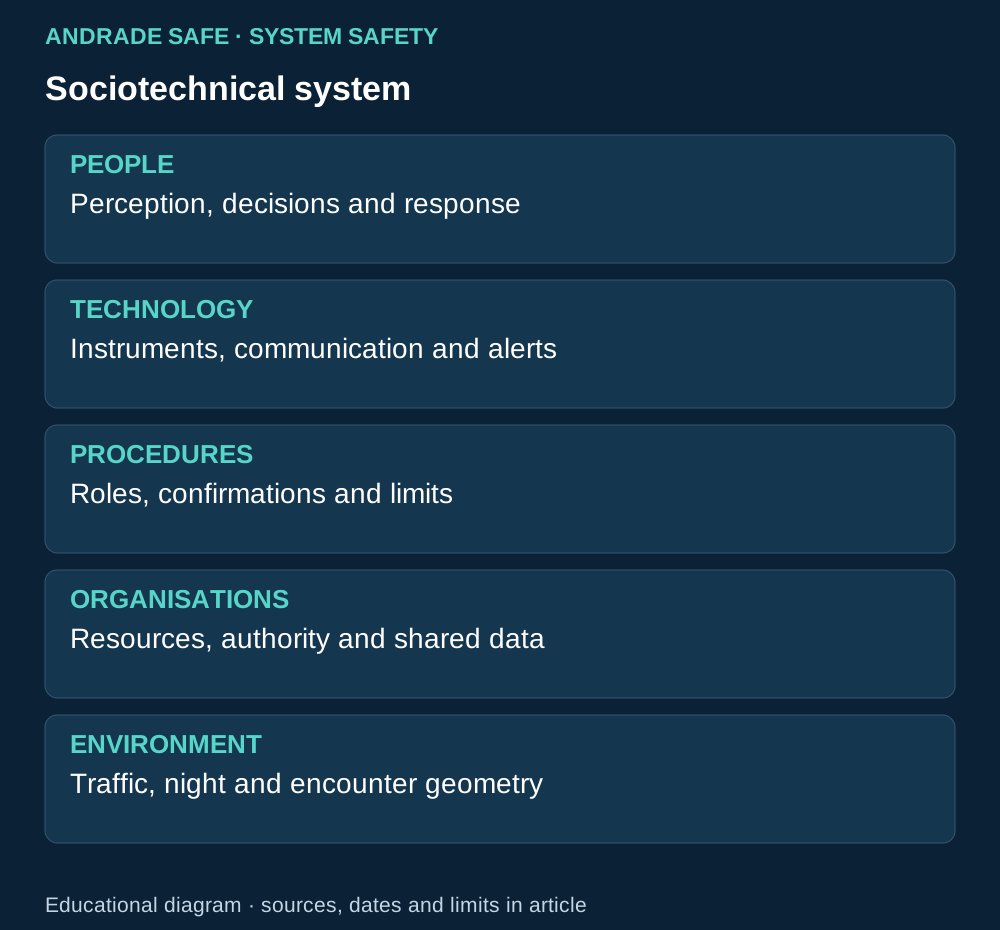
Sociotechnical analysis asks how local decisions were shaped by interfaces, rules, resources, goals and shared information. Each connection must be checked against documents. A persuasive diagram cannot replace evidence; it organises questions and exposes gaps that still need answers.
| Before loss of separation | Central event | After: detection and recovery |
|---|---|---|
| Routes, risk review, procedural separation | Loss of safe separation | Surveillance, alerts, perception and feasible response |
SMS and precursors: learn before the outcome
A Safety Management System, or SMS, must turn risk signals into verifiable decisions. Forms alone do not demonstrate that hazardous encounters, deviations or equipment issues have been analysed, shared and followed through to effective correction.
Proximity data can reveal patterns that isolated reports miss. However, a raw encounter count is not automatically an accident rate or proof that all encounters were equally severe. Exposure, geometry, data quality and classification criteria matter. The goal is to reduce uncertainty about risk rather than produce a reassuring chart.
Learning also requires governance: who receives the signal, who can change a route or operation, what deadline applies and who checks the result? Without that connection, information can circulate through several organisations without producing a decision. Barrier performance indicators should enable intervention, not merely accounting after an event.
What changed, and what still needs follow-up
In January 2026, the FAA announced an interim rule formalising restrictions near DCA. Its release records closure of part of Route 4, revised military agreements for ADS-B Out and removal of visual separation within five nautical miles of the airport, among other measures. Essential-operation exceptions apply; this is not a nationwide ban on all helicopters.
A later measure broadened the scope: on 18 March 2026, the FAA announced suspension of visual separation between airplanes and helicopters in Class B, Class C and TRSA airspace, using radar separation instead. DCA-specific measures therefore do not describe every announced change.
On 27 July, the NTSB warned that many gaps remained and called for implementation of all 50 recommendations. That statement describes conditions on that date. The October check did not establish a complete recommendation-by-recommendation reconciliation supporting a claim that all have closed. An announced measure, an effective rule and a formally closed recommendation are different states.
To follow developments, consult official recommendation records and applicable legal instruments. This article is not flight guidance or a substitute for current charts, NOTAMs and operating rules. For safety management, the question is whether a change reduced the hazard and whether data demonstrate that effect.
FAA · Permanent restrictions near Reagan National — 22 January 2026 →
NTSB · Statement on open DCA recommendations — 27 July 2026 →
What occupational safety can learn
The analogy starts with functions rather than equipment. A machine guard may meet a specification yet fail to cover a cleaning task. An alarm may work but be lost among hundreds of signals. A signed permit may not represent the physical state of an installation.
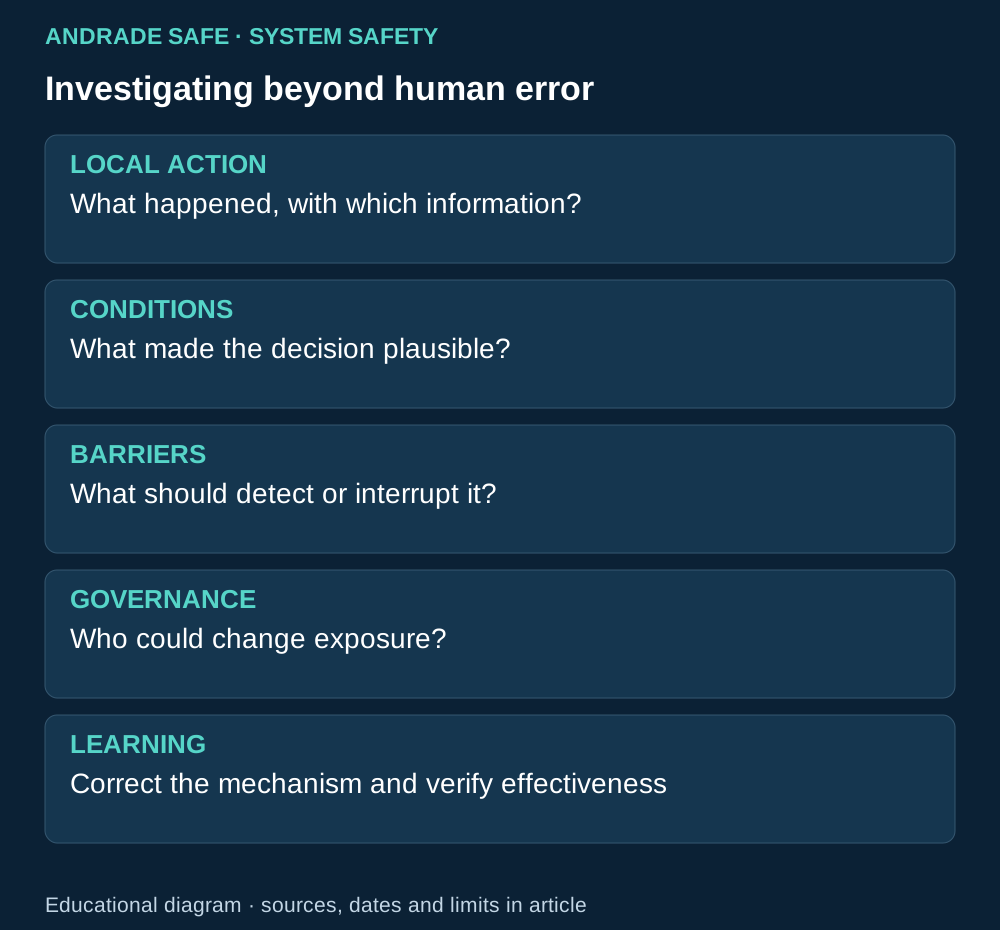
Investigate work as performed: sequence, information, tools, variability and limits. Compare it with prescribed work and ask what made an adaptation possible or necessary. This avoids both attributing everything to a person and dissolving responsibility into a vague word such as system.
Corrective actions should match the mechanisms identified. If the problem is access to danger, a talk may not change exposure. If it is an ambiguous signal, asking for attention may not make it distinguishable. If it is maintenance, a new procedure without resources may not restore the function. Choose actions with owners, acceptance criteria and effectiveness checks.
Checklist: ten questions for investigating barriers
Use these questions in an investigation or preventive review. They are not an aviation form and do not replace specialised technical assessment. The result should be evidence, gaps and verifiable actions rather than a quick classification of blame.
- What hazard and outcome should each barrier prevent?
- What information did each person have at the time?
- Did the barrier exist physically or only in documentation?
- Which limits and inhibition conditions were known?
- Was critical communication received, understood and confirmed?
- Which defences shared a dependency?
- Was there time and capacity for the expected response?
- Which precursor signals existed and who could act?
- Who owns the corrective action and its deadline?
- Which test will demonstrate effectiveness and no new hazards?
Safe systems leave room for recovery
An investigation does not need to choose between behaviour and organisation. It must demonstrate how decisions, conditions and limits interacted. Human action remains relevant; so does explaining why the system allowed incomplete understanding or a predictable limit to pass through so many defences.
Safe systems do not depend on heroes or perfect attention. They are designed so a predictable error encounters another opportunity for detection and recovery before becoming irreversible. The most useful tribute to victims is to translate that principle into decisions, tests and concrete follow-up.
Frequently asked questions
How do aircraft avoid midair collisions?
Through route design, control separation, communication, surveillance, perception and warning systems. No single barrier guarantees protection under every condition.
Why did TCAS not prevent the collision?
The NTSB found it operated as designed. A TA occurred, but RAs were inhibited below 900 feet AGL during descent. Other barriers needed to protect that scenario.
How do ADS-B In and Out differ?
Out broadcasts information; In receives it for compatible applications. Another aircraft must be able to receive and use those data.
Did missing ADS-B Out cause this accident?
The NTSB concluded it did not change the circumstances: radar tracked the helicopter and the CRJ lacked ADS-B In. The configuration deficiency still required correction.
Is human error a root cause?
An action can be causal, but investigation must examine information, resources, interfaces, organisation and recovery opportunities rather than stop at that label.
Does the Army report replace the NTSB?
No. It adds a military perspective. This edition attributes the October update to news coverage because an official full copy was not accessed.
References
- DCA25MA108 — completed investigationNTSB
- AIR-26-02 — final reportNTSB
- On the NTSB Final Report on the DCA Midair CollisionNTSB
- Human Performance Operations — board presentationNTSB
- Helicopter Operations — board presentationNTSB
- Systemic Failures Led to Midair Collision Over Potomac RiverNTSB
- Statement on open DCA recommendations — 27 July 2026NTSB
- Permanent restrictions near Reagan National — 22 January 2026FAA
- US Army report cites systematic failures — 8 October 2026Reuters
- Army finds systemic failures — 8 October 2026Associated Press
- Public investigation docketNTSB
- New measure between airplanes and helicopters — 18 March 2026FAA