
Learn how to verify corrective action effectiveness after workplace incidents, with evidence, clear acceptance criteria, a practical example and a tracking template.
Two boxes marked complete
An incident investigation can end with a signed report, an action tracker, named owners, a completed training session and a dashboard showing that every task is closed. Yet an essential question may remain unanswered: has the hazard that contributed to the incident actually been controlled?
A record of completion is not proof of effectiveness. A photograph may document that a guard was installed. It does not, by itself, demonstrate that the guard performs adequately during every relevant operating, cleaning and maintenance condition. A training attendance sheet proves participation, not that a defective physical safeguard has been corrected.
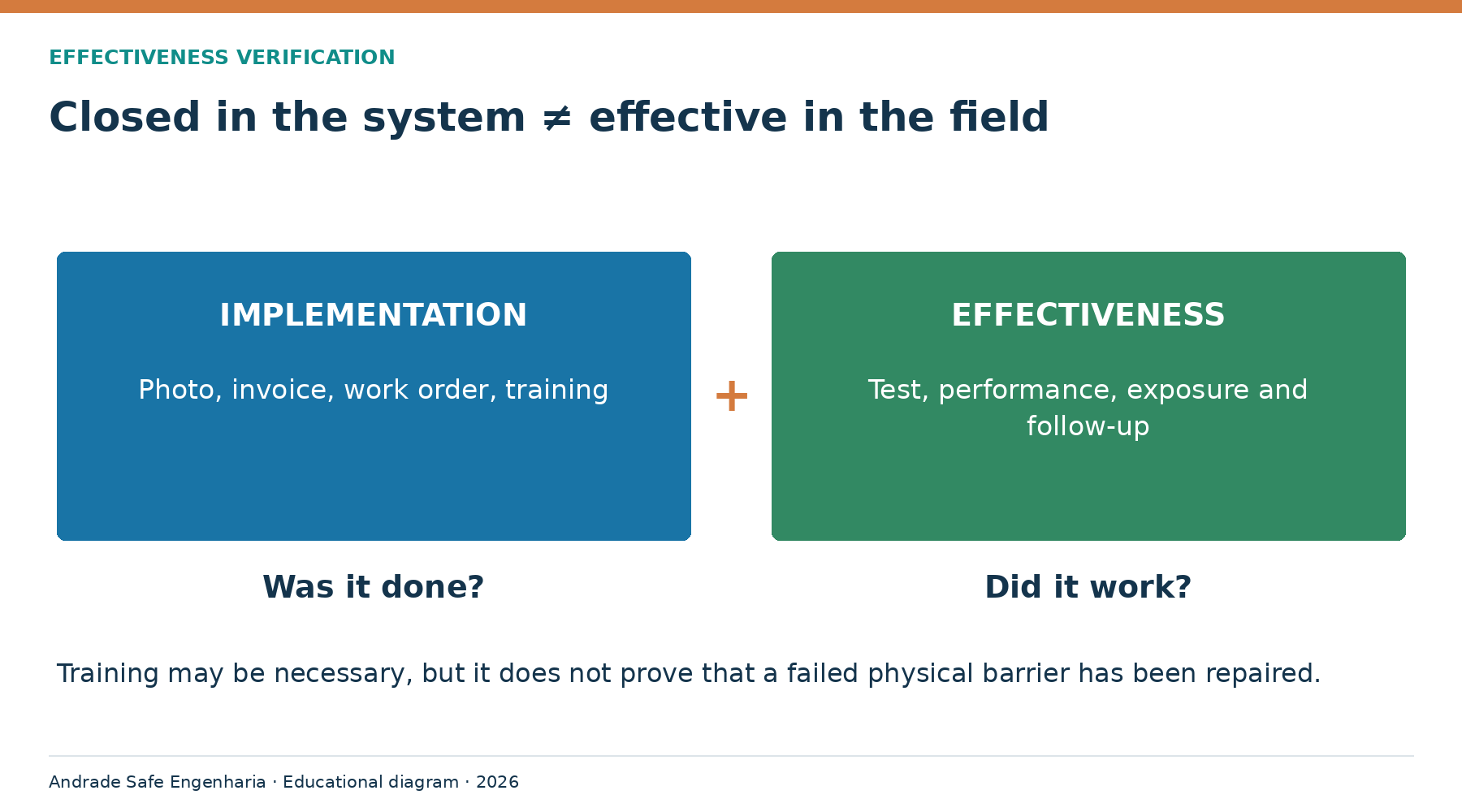
Planned, implemented and effective are different states
A planned action identifies a change, its owner and deadline. An implemented action has objective evidence that the work was done. An effectiveness-verified action has been assessed against clear acceptance criteria using a suitable method and relevant operating conditions.
Implementation asks, “Was the task completed?” Effectiveness asks, “Does the safeguard control the identified hazard?” Mixing these questions creates a false sense of completion.
Brazil's NR-1, as in force in October 2026, connects occupational risk management to action plans, responsible persons, results assessment and ongoing performance monitoring. It also calls for inadequate controls to be corrected. This Brazilian legal framework should not be presented as automatically applicable in other countries; the principles of evidence-based verification, however, are relevant beyond Brazil.
Brazil’s NR-1 clauses 1.5.5.2.2, 1.5.5.3.1 and 1.5.5.3.2 connect planning, owners, results assessment, records and control monitoring. Monitoring includes worker and CIPA participation, where such a commission exists, as well as inspections and exposure monitoring where applicable. Clause 1.5.5.3.2.1 addresses correction of ineffective measures. Accident-injury likelihood assessment considers exposure and control effectiveness (1.5.4.4.5.4), while risk assessment review covers implementation and other triggers under 1.5.4.4.6. Clauses 1.5.5.5.1 and 1.5.5.5.2 connect investigation to preventive improvement. These are Brazilian requirements, not automatically the law of other countries.
| Status | Question | Relevant record |
|---|---|---|
| Planned | What needs to change? | Proposed action, owner, deadline and acceptance criterion |
| Implemented | Was the change delivered? | Design, installation, instruction or other execution record |
| Effectiveness verified | Did the safeguard perform within the assessed scope? | Results compared with criteria and a technical decision |
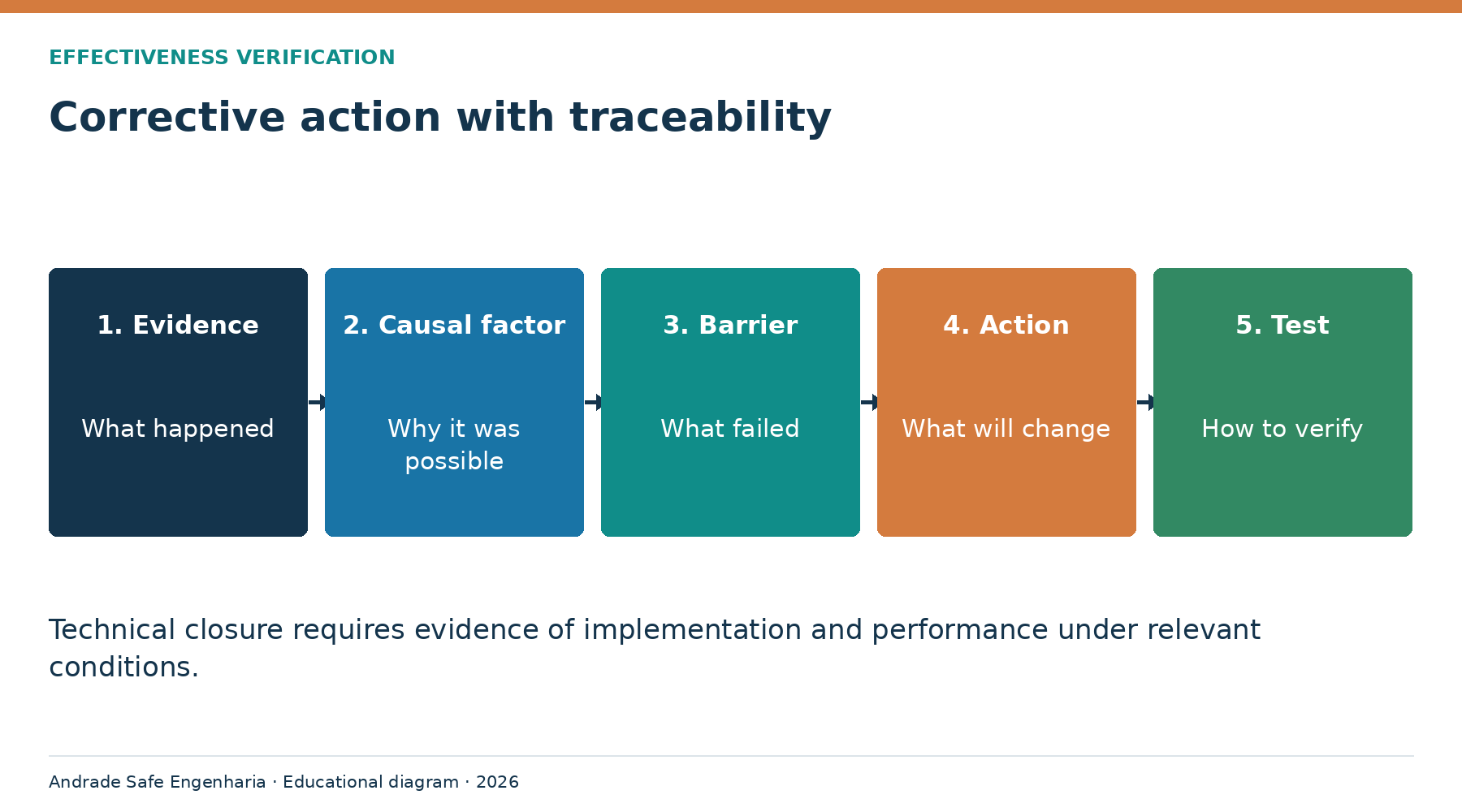
Traceability: from evidence to performance
A useful chain runs from evidence → contributing factor → failed or missing barrier → selected action → acceptance criterion → test → result → follow-up. The measure should address the finding it was designed to correct. If unsafe access to moving machinery is possible, behavioral reminders alone do not prove that the access hazard has been reduced.
The NIOSH hierarchy of controls provides a practical reminder: elimination, substitution and engineering controls generally offer more reliable protection than measures that depend exclusively on individual vigilance. Training can be useful, but it must complement rather than conceal missing safeguards.
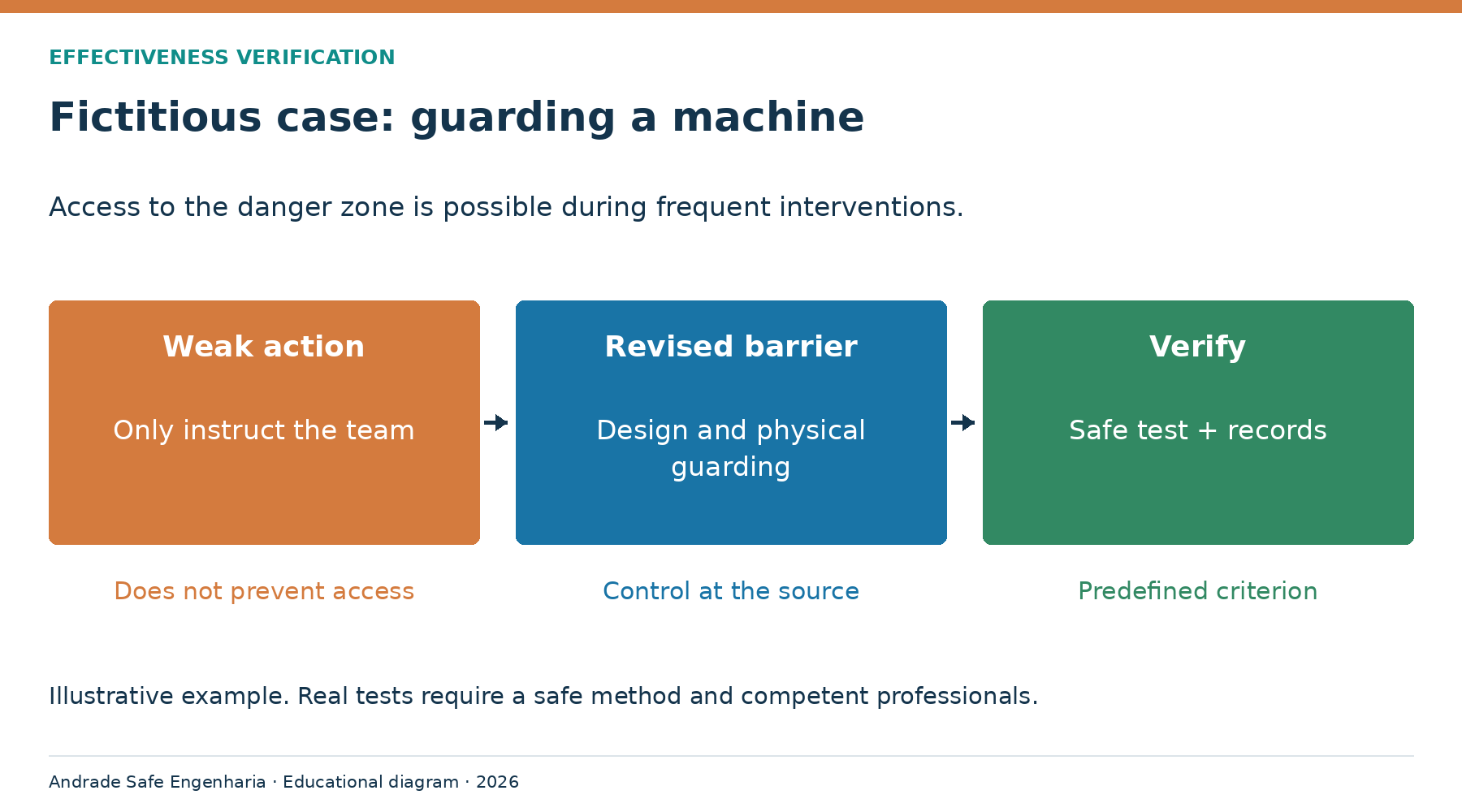
Fictional example: a machine guard
Consider a fictional factory in which frequent adjustments are carried out on a machine. Investigators identify an inadequately guarded danger zone. The first proposal is to retrain operators and place a new warning sign. A training session is completed and its attendance record is filed. The physical access route, however, remains unchanged.
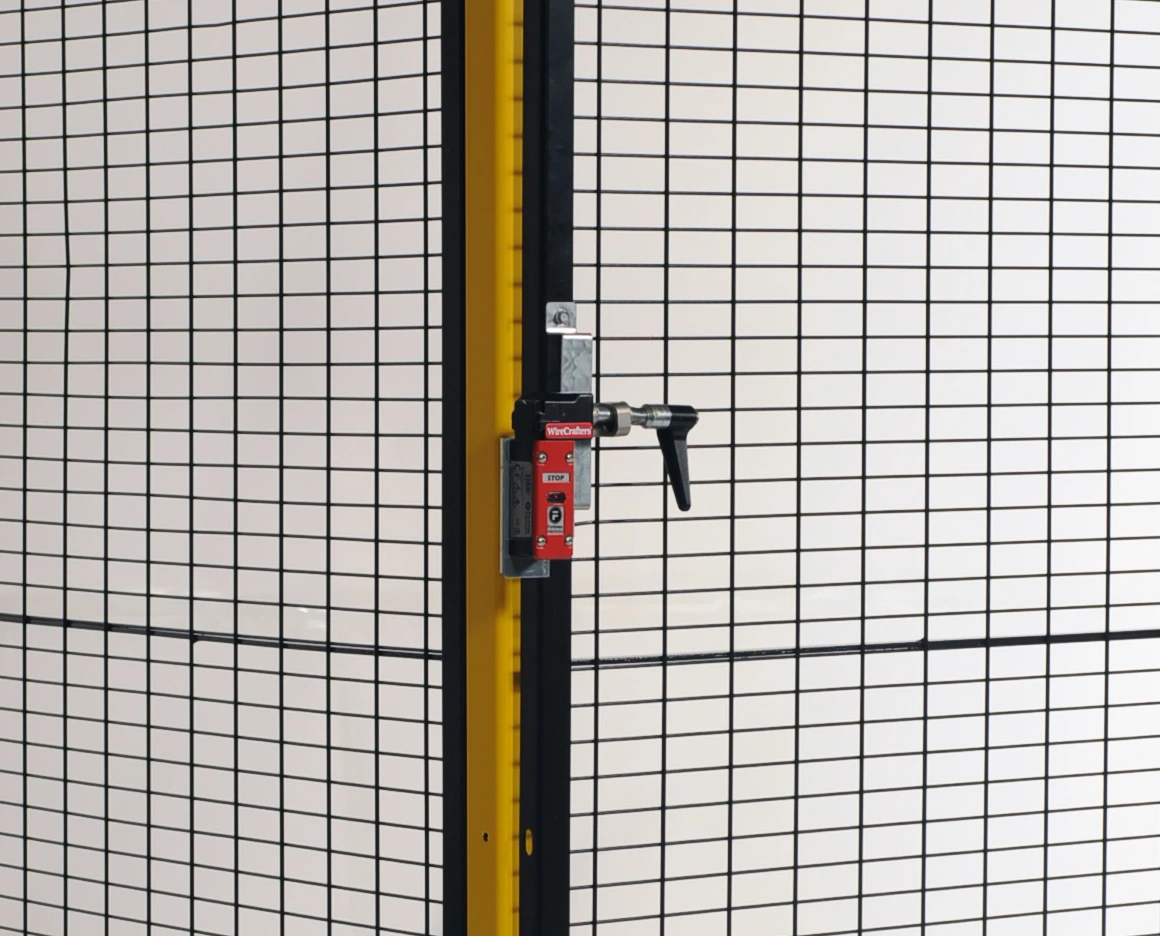
A stronger response would involve an appropriate risk assessment and, where indicated, competent design and installation of suitable fixed or interlocked guarding and associated procedural changes. Relevant tasks include operation, cleaning, setup, troubleshooting and maintenance. No solution should be assumed valid simply because a specific device was installed.
Evidence of implementation might include approved design records, inspection reports and documented installation. Evidence of effectiveness would use previously defined, risk-relevant criteria and safe functional verification performed by competent personnel. It could also include field observations showing that workers can perform the real task without dangerous workarounds.
Testing must never require bypassing a safety function, exposing a worker to dangerous movement or performing unauthorized live tests. This example is entirely fictional.
What counts as suitable effectiveness evidence?
The answer depends on the hazard and the control. A physical guard may require documented condition inspections, technical conformity checks and safely executed functional tests. An exposure control may call for appropriate measurements. A revised maintenance system may need checks showing that the required work practices are practical and maintained under actual working conditions.
A single piece of evidence may not be enough. Even a long period without injuries does not necessarily prove effectiveness: severe events may be rare, exposure opportunities may have changed, and incomplete reporting can distort apparent performance.
Set acceptance criteria before the intervention, drawing on the hazard, design and applicable requirements. In the fictional example, acceptance may require intact guarding, access controlled as designed, specified safety functions verified and no bypass routes identified during an authorized assessment. The scope and number of checks must be justified by risk, without an arbitrary test count or a promise of zero risk.
Before testing, record the safe condition, operating modes covered, competent person, instruments and required records. Compare expected and observed performance, identify limitations and document the technical conclusion. Failure under a relevant condition prevents declaring that safeguard effective within that scope.
| Verification object | Criterion established beforehand | Possible evidence |
|---|---|---|
| Physical guarding | Integrity and access as designed | Documented inspection under safe conditions |
| Safety function | Performance meets specification in relevant modes | Safe functional test recorded by competent personnel |
| Actual work | Task can be performed without unsafe workarounds | Authorized observation and worker accounts |
The difference between activity measures and control performance
Percentages of completed tasks and trained employees are implementation measures. Control performance is better reflected by the outcomes of safeguard inspections, planned verification tests, evidence of corrected faults and sustained safe operating conditions. Lagging measures such as injury recurrence can complement, but not replace, direct evidence about the barrier.
A more meaningful dashboard does not merely report “100% complete.” It distinguishes actions delivered, actions awaiting verification, actions found effective, actions needing rework and safeguards requiring continued monitoring.
Leading indicators track prevention before harm: the proportion of critical safeguards inspected within the program, completed versus planned verifications and identified faults addressed. State the denominator and period; finding more faults may reflect better inspection rather than necessarily worse safety. Direct performance evidence is the result of inspecting, testing or measuring the safeguard itself. Lagging indicators describe recurrence, injuries and damage. Neither group should be confused with the percentage of tasks marked complete.
| Type | Example | Interpretation limit |
|---|---|---|
| Leading | Safeguards inspected / safeguards scheduled in the program | Needs a period, scope and sound inspection quality |
| Lagging | Recurrence, injury or damage | No harm may reflect limited exposure |
| Direct evidence | Safeguard test, inspection or measurement result | Applies to documented conditions and scope |
Who checks and what happens after a failed result?
Verification should be proportionate to the hazard and the complexity of the control. Separating implementation from independent review is useful when feasible, but it should not be invented as a universal statutory requirement. For safety-critical engineered safeguards, appropriately qualified personnel and documented procedures matter.
If a result is unsuccessful, first maintain control of the hazard, investigate why the measure failed, revise the plan and verify the revised control. Subsequent near misses, equipment changes, maintenance work and concerns raised by workers may trigger reassessment.
Perform initial verification after implementation before accepting the measure within its defined scope, then plan continuing checks according to risk. Changes, failures, near misses, maintenance and worker concerns are reassessment triggers. A favorable initial assessment does not remove the need to maintain and monitor the safeguard. There is no universal 30-day deadline for every corrective action.
A practical tracking matrix
The companion Excel matrix links the incident, contributing factor, barrier, action, owner, deadline, implementation evidence, acceptance criterion, verification method, result, residual risk and reassessment date. Its examples are fictional, and the spreadsheet is not a legal form, a certification or a replacement for technical assessment.
The goal is not bureaucracy. It is to let a reviewer follow a clear line from the original finding to the evidence that the new protection performs as intended.
The template includes the hierarchy of controls, owner, deadline, implementation evidence, criterion and method, verification date and evidence, result, residual risk and next review. A calculated status organizes follow-up; it does not technically approve the safeguard or replace a documented decision. Enter only necessary information and keep client records, names and sensitive data out of the publicly shared file.
Download the Excel matrix — Portuguese teaching template →
Closing the loop
An investigation produces understanding. An action plan organizes decisions. Effectiveness verification determines whether the chosen change actually performs its protective role.
It is not enough to show that an action was completed. You need evidence that the safeguard works.
Read the Andrade Safe incident investigation hub for more on evidence, contributing factors and prevention. The linked hub is in Portuguese.
For a deeper connection between findings, safeguards and decisions, explore the Método SAFE investigation course. The template supports reasoning; it does not certify compliance.
Frequently asked questions
Does a photo prove effectiveness?
Usually not by itself. A photo records a visible condition, while effectiveness depends on risk-relevant performance.
Can training be a corrective action?
Yes, when it addresses a demonstrated competency or work-practice gap. It should not be treated as proof that a missing engineering safeguard has been restored.
Is a specific tracking spreadsheet mandatory under Brazil's NR-1?
No universal workbook format is specified. Relevant duties concern measures, records, monitoring and results assessment.
What if a verification test fails?
Keep the hazard controlled, revise the corrective measure, document the decision and carry out an appropriate new assessment.
Does zero incidents mean success?
Not without understanding exposure and verifying the relevant controls.
How do you demonstrate corrective action effectiveness?
Connect the measure to the finding and safeguard, establish acceptance criteria beforehand and gather suitable inspection, test or measurement results. Record conditions, verifier competence, conclusions and follow-up.
Does every action require an inspection?
The method depends on the safeguard and risk. Inspections may be necessary, but functional tests, measurements or observation of actual work may also be needed. Choose evidence that evaluates relevant performance.
How can we document verification without unnecessary bureaucracy?
Keep a short traceable chain: finding, action, owner, implementation evidence, criterion, method, result, decision and next review. Reference existing records instead of duplicating everything in the workbook.
Must an independent auditor verify every measure?
Do not attribute such a universal obligation to Brazil’s NR-1. Separate implementer and verifier where feasible and ensure competence proportionate to safeguard risk and complexity.
Does the matrix’s automatic status close the technical assessment?
No. Its formula helps organize outstanding work, but cannot assess design adequacy, evidence quality or residual risk. The technical decision must be explicit and traceable.
References
- NR-1 — texto vigente / current text / texto vigenteMTE
- NR-1 — vigência / entry into force / vigenciaMTE
- Action for ImprovementILO/OIT
- Accidents and InvestigationsILO/OIT
- Hierarchy of ControlsNIOSH
- Wire mesh perimeter guarding with welding curtains in an industrial installationWireCrafters
- Electrical interlock mounted on a wire mesh machine guard doorWireCrafters
- Naval Safety Center inspector examines shipboard systems with a clipboard aboard USS EssexStephanie M. Bergman / U.S. Navy
- Creative Commons BY-SA 4.0Creative Commons