
Brazil's Senate approved a shorter workweek proposal. Learn what remains pending and how fatigue, rest and shift design affect occupational safety.
Has Brazil already ended the six-day schedule?
Brazil has taken a major step toward changing its standard workweek. On October 14, 2026, the Federal Senate approved Constitutional Amendment Proposal 221/2019 in two rounds, by 75 votes to one. The proposal had already passed the lower house and was awaiting formal promulgation as of October 15. Senate approval alone does not mean the new rules are already in force. This is not only a labor-law story: it raises a broader question about working-time arrangements as an occupational risk factor.
In the October 15, 2026 check, the Senate record stated “approved by the plenary” and “awaiting promulgation.” Each round had 75 votes in favor and one against. Approval, promulgation, publication and the application of transition rules are distinct stages; this article does not describe the new schedule as an already effective obligation.

What changes, and when could the new rules apply?
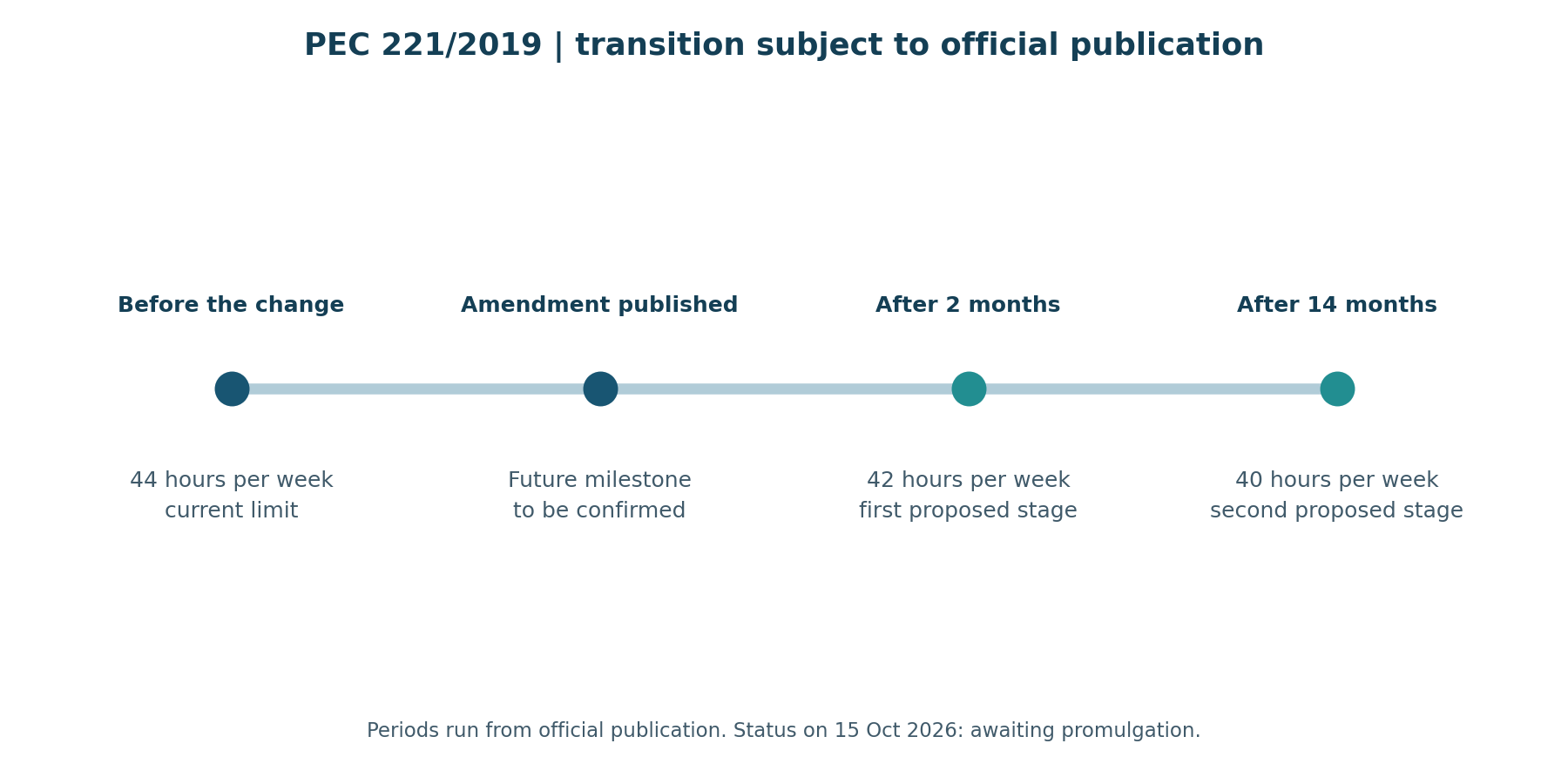
The proposal would gradually reduce Brazil's maximum weekly working time from 44 to 40 hours, establish two paid weekly rest days and preserve pay. The transition outlined in reporting on the approved text is 42 hours two months after publication of the future amendment and 40 hours fourteen months after publication. The actual transition dates cannot be calculated before the future amendment is published. Specific exceptions, differentiated regimes and collective arrangements need to be checked against the authoritative legal text rather than inferred from headlines.
The approved wording uses publication of the future amendment as the legal clock. Article 6 provides for 42 hours after two months and 40 hours one year after that first stage, or 14 months in total. Under Article 10, the two-paid-rest-day provision also begins two months after publication; other provisions are scheduled to take effect upon publication. No calendar transition dates can be assigned before that act is published.
This is not an automatic, identical five-on/two-off pattern for every employment relationship. The text permits exceptional collectively agreed averaging of rest days within the calendar month, with at least one within a maximum working week, and contains provisions for specific regimes and contracts. There are also rules for existing schedules of 40 hours or less and certain public contracts. Application requires checking the actual legal text, later acts and relevant instruments.
PEC 221/2019 — redação aprovada, arts. 6º e 10 →
| Stage | Proposed legal clock | Qualification |
|---|---|---|
| Status on October 15, 2026 | Approved; awaiting promulgation | Not an already applicable new workweek |
| 42 hours and two paid rest days | Two months after publication of the future amendment | Articles 6(I) and 10(I); check specific regimes |
| 40 weekly hours | 14 months after publication | One year after the first stage; Article 6(II) |
Why does a schedule label not define the risk?
A six-day schedule does not create the same risk in every job, and a five-day schedule does not automatically remove fatigue. High workloads compressed into fewer working days, unpredictable overtime and rapidly rotating night shifts may still present important hazards. The appropriate unit of analysis is the real work pattern and its demands, not the label given to the schedule.
A six-on/one-off roster describes consecutive working and rest days; by itself it does not establish weekly hours, daily shift length or timing. A five-on/two-off pattern does not establish workload intensity or guarantee recovery either. Prevention requires comparing actual hours, shift sequence and rotation, breaks, travel and job demands.
Sleep, fatigue and attention: what can science establish?
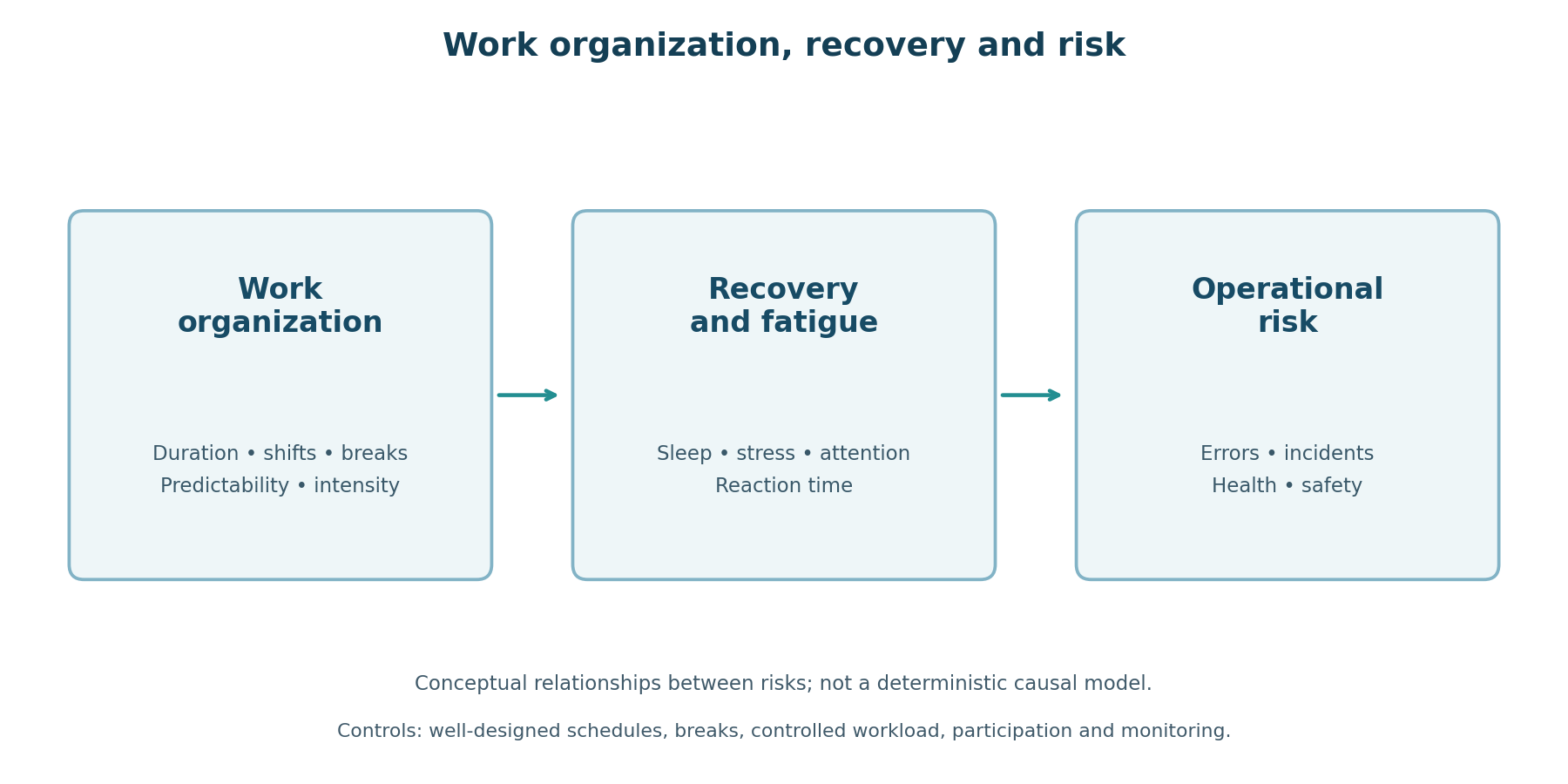
Occupational fatigue can be influenced by shift duration, consecutive working days, night work, workload, heat, sleep deprivation and insufficient recovery time. According to the US National Institute for Occupational Safety and Health (NIOSH), fatigue may reduce attention, reaction speed, short-term memory and judgment. These changes matter to drivers, machinery operators, health professionals, maintenance crews and emergency responders.
Research reviewed by NIOSH links long hours and nonstandard shifts to insufficient sleep, errors and injuries, but observed effects depend on the type of job, worker circumstances, scheduling design and existing safeguards.
Sleep, recovery and fatigue matter to safety-critical work, but a sign of tiredness alone cannot establish the cause of an accident. Investigation should reconstruct schedules, demands, working conditions and safeguards, comparing records and accounts without presuming individual failure.
The accident investigation guide (Portuguese) helps reconstruct actual work. Investigation beyond blame (Portuguese) explores conditions without reducing an event to individual conduct.
Why are cardiovascular outcomes different from workplace accidents?
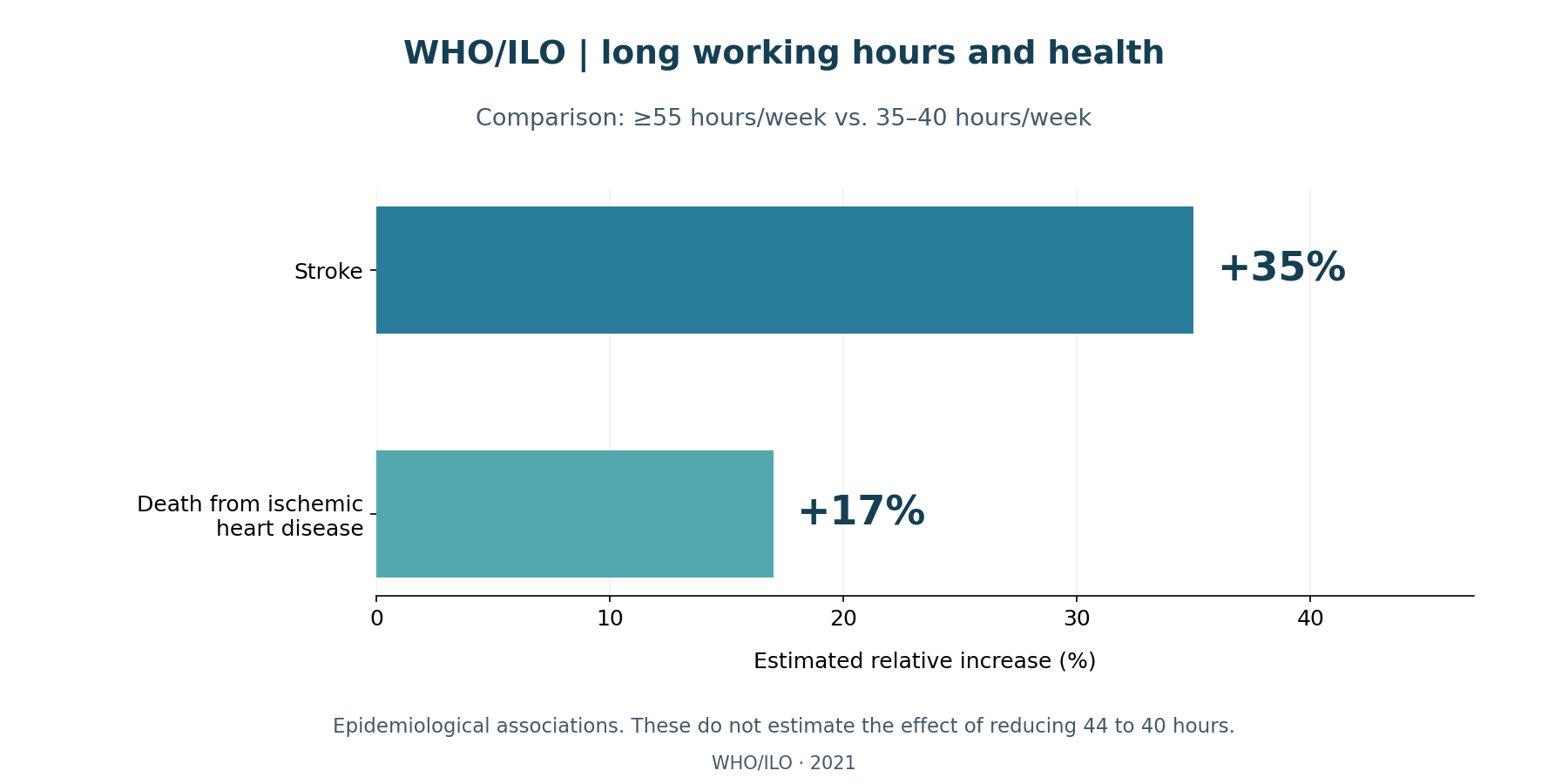
A joint World Health Organization (WHO) and International Labour Organization (ILO) assessment found that working 55 hours per week or more was associated with a 35% higher risk of stroke and a 17% higher risk of death from ischemic heart disease, compared with working 35–40 hours a week. These figures are not estimates of the health impact of Brazil's proposed reduction from 44 to 40 hours. Nor can they be used to predict a fixed reduction in workplace accidents.
The 35% and 17% figures are estimated relative increases for two different outcomes: stroke and death from ischemic heart disease. They are not percentage-point increases in individual probability, overall heart disease incidence or occupational accident rates. The ≥55 versus 35–40-hour comparison does not measure the specific effect of a Brazilian reduction from 44 to 40 hours.
Long working hours increasing deaths from heart disease and stroke: WHO, ILO →
| Outcome | Estimated relative increase | Does not mean |
|---|---|---|
| Stroke | 35% | Predicted accident reduction from 44 to 40 hours |
| Death from ischemic heart disease | 17% | Overall heart disease incidence or absolute individual risk |
How can teams be reorganized without transferring risk?
Consider a factory operating continuously. Reducing maximum weekly hours requires decisions about staffing, handovers, maintenance coverage, production planning and rest periods. An organization could redesign work and reduce unnecessary overtime; alternatively, it could increase work intensity or leave critical shifts understaffed. These choices produce very different safety conditions.
A sound assessment considers driving, equipment operation, night shifts, hot environments, emergency work and other safety-critical activities. Workers should participate in discussions about predictability, rest and workload, while legal and human resources teams review the applicable labor framework.
Staffing, process redesign and continuity of services bring resource and transition-cost challenges. Opportunities for recovery need to be combined with adequate coverage, maintenance and achievable targets. This article does not quantify productivity, employment or financial gains, or attribute health effects to political parties or social groups.
What does this mean for Brazilian GRO/PGR and NR-1?
Brazil's Regulatory Standard NR-1, whose updated Chapter 1.5 has been in force since May 26, 2026, explicitly brings work-related psychosocial risk factors into the occupational risk management framework (GRO/PGR). Excessive demands and harmful work organization may warrant assessment. This does not mean every six-day roster is legally defined as an unacceptable psychosocial risk; risk identification must reflect real exposure and context.
Useful monitoring metrics include actual hours worked, overtime, break opportunities, safety-critical staffing, fatigue reports, near misses and incident patterns. Such monitoring should respect confidentiality and avoid blaming individual employees for systemic scheduling failures.
NR-1 clauses 1.5.3.1.4 and 1.5.3.2.1 explicitly include work-related psychosocial factors and consideration of working conditions under NR-17. Organizational changes that modify risks call for the relevant reassessment. NR-1 does not ban a six-day roster by its name: assessment addresses actual exposure and the effectiveness of controls.
Fatigue reports should not lead to individual exposure or automatic punishment. Worker participation and consultation with the CIPA committee, where present, help identify organizational issues. Use necessary information, controlled access and aggregated results rather than intrusive investigation of private life.
Assessment of work-related psychosocial risks (Portuguese) should examine work factors without intruding into private life.
NR-1 — Disposições Gerais e Gerenciamento de Riscos Ocupacionais →
Fictional case: formal change, planning and follow-up
A fictional industrial team reports fatigue near the end of some shifts. Before changing its weekly schedule, the employer maps critical tasks and coverage needs, limits excessive overtime, protects rest breaks and monitors the new arrangement. Success means more than compliance with a weekly-hour cap: it also means no hidden workload intensification or deterioration in the safety of essential operations. This is an illustrative scenario, not a measured outcome of the Brazilian reform.
Scenario A — a formal calendar change only: the fictional factory reduces working days but compresses tasks, retains habitual overtime and loses maintenance coverage. These are warning hypotheses, not measured outcomes of the reform.
Scenario B — planned reorganization: the employer maps critical tasks, adjusts staffing by shift, protects breaks, reviews targets and arranges handovers. Responsibilities and acceptance criteria are defined before implementation.
Scenario C — effectiveness follow-up: actual overtime, workload, predictability, coverage and near misses are monitored alongside aggregated worker reports. Comparable periods and exposure opportunities are considered, acknowledging changes in production and reporting. Overload or coverage gaps trigger revision of controls.
Corrective action effectiveness verification separates implementation from results. Near-miss investigation (Portuguese) can identify warning signs before serious harm.
| Exposure factor | Warning sign | Preventive measure | Effectiveness evidence |
|---|---|---|---|
| Actual hours | Habitual overtime or unplanned extensions | Review coverage, targets and rosters | Working-hour records compared with the plan |
| Workload and breaks | Compressed tasks and missed breaks | Adjust resources and protect recovery | Observation and aggregated task-level reports |
| Critical operations | Maintenance and handover gaps | Map staffing and shift responsibilities | Documented coverage and fault follow-up |
| Unpredictability | Frequent changes and night rotation | Review sequence and communicate schedules | Change records and worker consultation |
| Near misses | Time-related patterns in failures | Investigate conditions and improve barriers | Exposure-based comparison and control verification |
Which decisions can managers and safety teams take now?
The downloadable checklist is an educational decision aid, with full Portuguese, English and Spanish versions. It is not a mandatory regulatory form, health diagnosis or proof of compliance. The kit includes the checklist, figures, sources and credits.
Download the OSH decision checklist — English →
Download educational kit, figures and credits →
View photo sources and licenses →
- Check the legal text and legislative status without assuming commencement.
- Review actual hours, including overtime and unexpected changes.
- Map critical tasks and coverage by shift.
- Assess physical and mental workload, heat and night work.
- Protect breaks and genuine recovery opportunities.
- Review targets, maintenance and handovers.
- Consult workers and CIPA, where present.
- Set responsibilities, criteria and a reassessment date.
- Monitor aggregated information and protect privacy.
- Correct measures that increase overload or leave coverage gaps.
Rest matters, and so does operational design
Brazil's legislative change creates a timely opportunity to rethink work organization as a component of occupational risk prevention. Rest may support recovery, but real safety gains depend on the design of shifts, tasks, staffing and safeguards. The legislative status described here was checked on October 15, 2026; later acts must be verified in the official record.
Frequently asked questions
Has Brazil already abolished the six-day schedule?
As of October 15, 2026, the amendment had passed the Senate but still awaited promulgation.
Will the maximum drop immediately to 40 hours?
No. The approved proposal outlines a phased transition tied to publication of the future amendment.
Does a five-day schedule eliminate fatigue?
No. Total hours, shift timing, workload and sufficient recovery all matter.
What can safety managers do?
Assess actual schedules, safety-critical coverage, workload and rest, then monitor effectiveness after operational changes.
Why are transition periods counted from publication rather than the vote?
Articles 6 and 10 of the approved wording use publication of the future amendment as the reference. Until that act is published, absolute transition dates cannot be assigned.
Do the WHO/ILO 35% and 17% figures describe workplace accidents?
No. They describe estimated relative increases in stroke risk and risk of death from ischemic heart disease for ≥55 weekly hours compared with 35–40 hours.
Does NR-1 ban six-day rosters?
Not by that label. It requires management of the relevant occupational risks, including work-related psychosocial factors, in light of actual working conditions.
Do two rest days mean the same five-day schedule for everyone?
That should not be assumed. The approved wording contains collective averaging options and specific provisions; application needs assessment of the actual employment relationship and regime.
What evidence shows whether reorganization worked?
Compare actual workload, breaks, critical-task coverage, overtime and aggregated reports alongside incidents and near misses. No single metric or absence of accidents proves effectiveness.
Why is this a Brazilian rather than a universal legal change?
The proposal amends Brazil’s constitutional labor framework. It does not change the law of other countries; the discussion of fatigue is separate from national legal applicability.
References
- PEC 221/2019 — tramitação oficialSenado Federal
- Senado aprova fim da escala 6x1 — votação em dois turnosSenado Federal
- PEC 221/2019 — redação aprovada, arts. 6º e 10Câmara dos Deputados / Senado Federal
- Long working hours increasing deaths from heart disease and stroke: WHO, ILOWHO / ILO
- Fatigue and WorkCDC / NIOSH
- Sleep and WorkCDC / NIOSH
- NR-1 — Disposições Gerais e Gerenciamento de Riscos OcupacionaisMinistério do Trabalho e Emprego
- A worker’s hand beside assembly machinery in a factory.Nenad Stojković (Shixart1985)
- CC BY 2.0Creative Commons
- A worker on a construction site between buildings in Kathmandu, Nepal.Aayushadangol3
- CC BY-SA 4.0Creative Commons