
Explore Statkraft's BESS project in Bahia, the difference between MW and MWh, battery energy storage engineering and thermal runaway safeguards.
What was authorized at Uibaí, Bahia?
On 2 October 2026, Statkraft announced that Brazil's National Electric Energy Agency (ANEEL) had authorized testing operations for storage unit UG1, installed alongside Sol de Brotas 7 photovoltaic plant at the Santa Eugênia Solar Complex in Uibaí, Bahia. According to the company, Order No. 3,843 of 1 October released the unit for testing from 2 October with an installed power rating of 1.25 MW. Authorization to begin tests is not proof of full commercial operation. Statkraft describes the project as the first battery energy storage system co-located with renewable generation in Brazil to receive such authorization.
A solar power plant generates electricity according to sunlight availability. Battery energy storage can help shift delivery to a more useful time, but three concepts must not be confused: power, energy capacity, and safe operation.
The announcement provides an opportunity to examine what lies behind the familiar acronym BESS (Battery Energy Storage System): battery cells and modules, power converters, an energy management system (EMS), a battery management system (BMS), thermal management, electric protection, physical layout, monitoring and emergency measures.
The actual Brazilian case is authorization for testing. The engineering discussion is general, and the exercises are hypothetical. The consulted announcement does not disclose MWh, duration, chemistry, supplier, internal configuration, BMS details, temperatures or firefighting systems. It reports no fire or thermal runaway at this installation.
Statkraft — autorização de operação em teste →
ANEEL — operação em teste e comercial →
| Information | What can be stated |
|---|---|
| UG1 / location | Sol de Brotas 7 PV plant, Uibaí, Bahia |
| Power / stage | 1.25 MW; test authorization, according to Statkraft |
| MWh / chemistry / specific safeguards | Not disclosed in the consulted announcement |
| 2.5 MWh / 88% / thermal model | Educational assumptions, not installation data |
What is a BESS and how does it work?
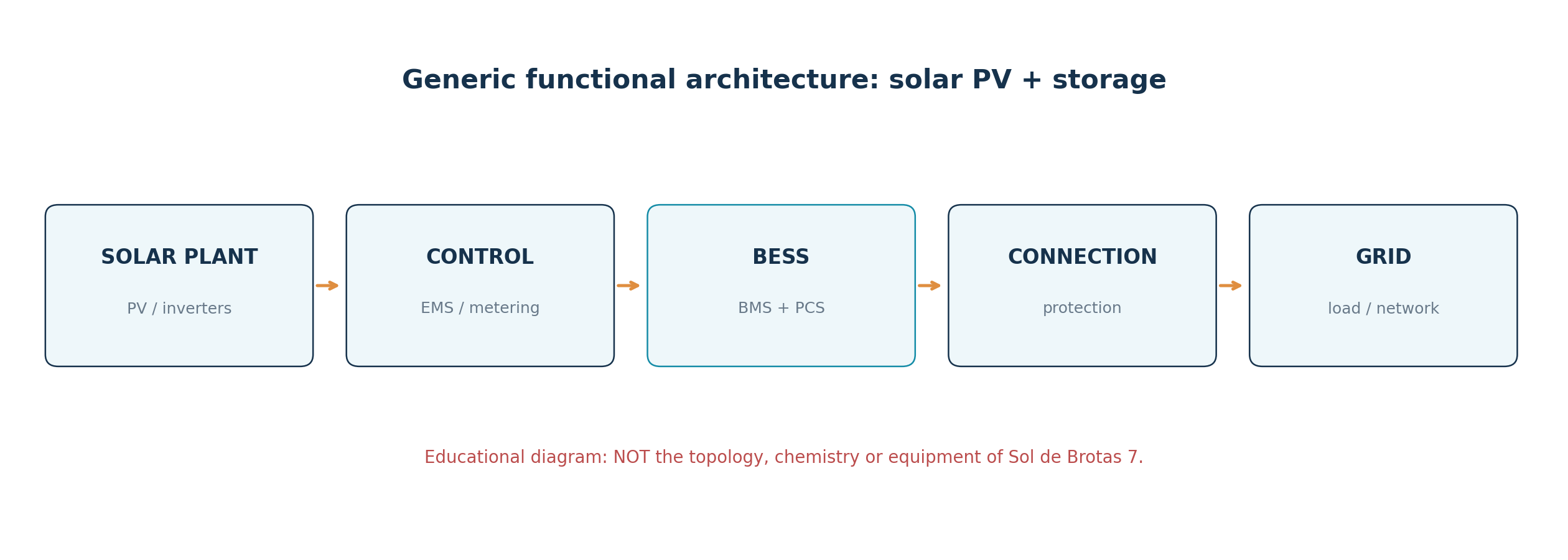
Photovoltaic generation can either be exported or used to charge the battery, depending on the control strategy and electrical architecture. The EMS coordinates energy flows; the PCS converts and conditions electric power; and the BMS monitors critical cell and module parameters, enforces operating limits and participates in protective actions. Circuit breakers, protective relays, grounding, communication and thermal systems add further layers.
The architecture diagram provided with this study is generic. It does not describe Statkraft's actual wiring, battery supplier, chemistry or control configuration. ANEEL's Resolution 1,162/2026 addresses the regulatory procedures for storage co-located with generating facilities.
MW versus MWh: why does power not determine duration?
Megawatts (MW) indicate a rate of energy delivery or absorption. Megawatt-hours (MWh) indicate a quantity of energy. In an ideal constant-power illustration, duration is t = E/P.
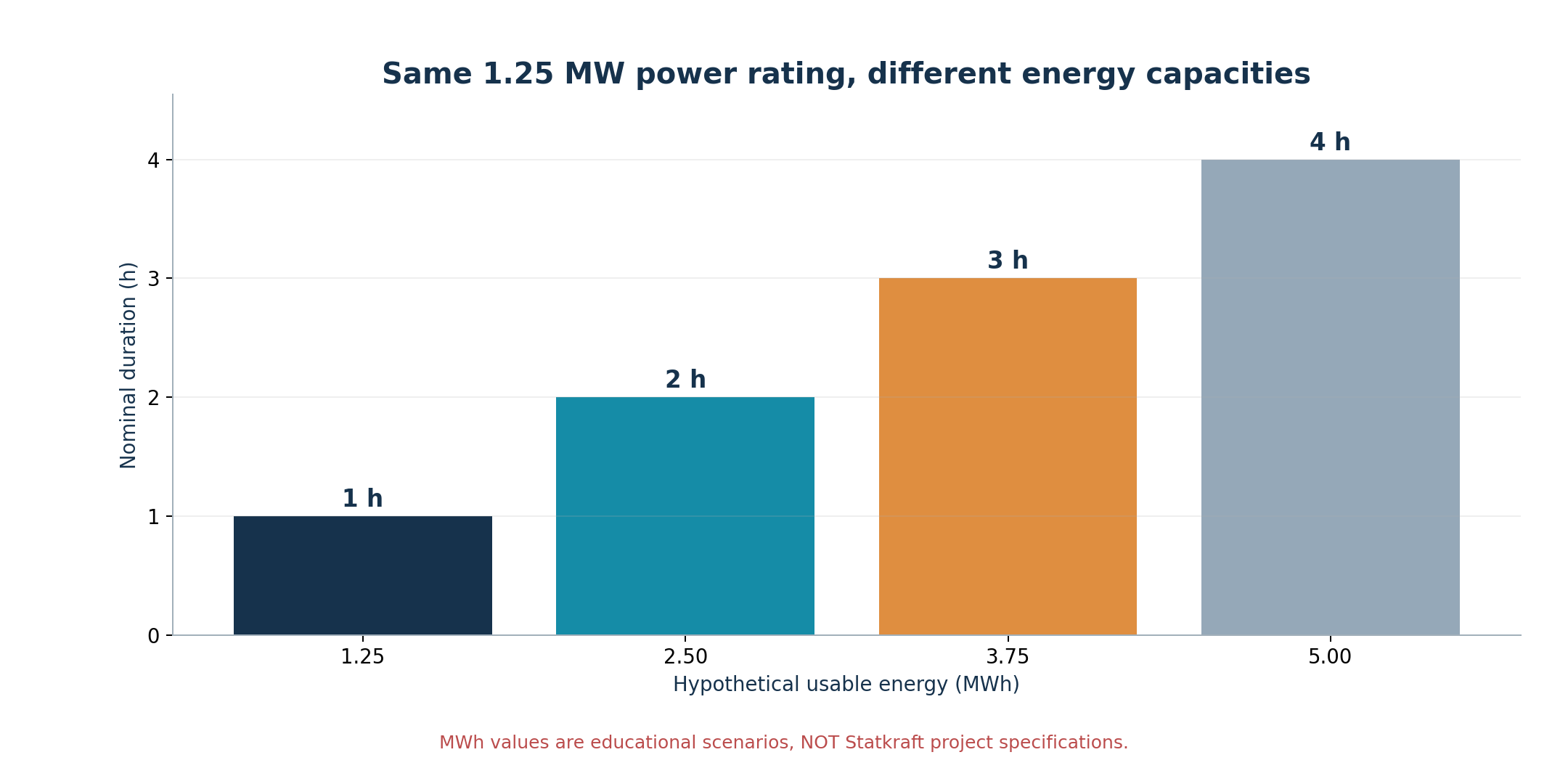
For example, a hypothetical 1.25 MW / 2.5 MWh storage system could deliver nominal power for 2 hours. With 1.25 MWh it would last one hour; with 5 MWh, four hours. These are educational scenarios only. Statkraft's cited announcement specifies 1.25 MW but does not disclose energy capacity in MWh or cell chemistry. Therefore, the illustrative 2.5 MWh value must never be attributed to the Brazilian installation.
Actual duration is influenced by usable state-of-charge window, cell ageing, temperature, power electronics, auxiliary consumption and operating strategies.
Nameplate energy is a rated reference; usable energy is the allowed operating window; delivered energy is measured at a specified boundary, such as the connection point. Compare quantities at the same boundary without deducting the same loss twice. At constant power, P = E/t and t = E/P; MWh divided by MW gives hours.
| Usable energy (MWh) | Power (MW) | Nominal duration (h) |
|---|---|---|
| 1.25 | 1.25 | 1 |
| 2.5 | 1.25 | 2 |
| 3.75 | 1.25 | 3 |
| 5 | 1.25 | 4 |
Where does energy go in a storage cycle?
No storage system is lossless. Round-trip efficiency relates energy delivered during discharge to energy consumed during charging: η = E_out/E_in. If an illustrative system delivers 2.5 MWh at 88% round-trip efficiency, about 2.84 MWh must enter during charging. The resulting 0.34 MWh difference represents total losses over the complete cycle.
Those losses may be distributed across cells, conversion equipment and auxiliary loads, and across different moments of the cycle. They must not automatically be described as 0.34 MWh of heat released inside the battery cells at once. This is a model calculation, not data measured at Uibaí.
With additional precision, the exercise gives Ein = 2.5/0.88 = 2.8409 MWh and cycle losses of 0.3409 MWh, about 341 kWh. This energy balance does not determine instantaneous heat generation or cell temperature.
What is thermal runaway, and how is it different from normal heating?
In certain battery chemistries, internal defects, electrical abuse, overheating or physical damage can trigger self-accelerating exothermic reactions. The phenomenon, known as thermal runaway, can generate heat, flammable or hazardous gases and pressure. Depending on the design and protection measures, an event may develop into fire or propagate to neighboring cells or modules.
This is fundamentally different from the normal temperature rise caused by ordinary losses during charge and discharge. Not every temperature increase constitutes thermal runaway. Furthermore, this article does not report any thermal runaway, fire or battery malfunction at Statkraft's Bahia project. Its discussion of safety concerns is general and educational.
LFP and NMC cells should not be treated as identical, nor should a chemistry label be taken as a safety guarantee. State of charge, construction, ageing and configuration affect behavior; assessment requires data and testing representative of the actual product and installation.
Which layers protect a BESS installation?
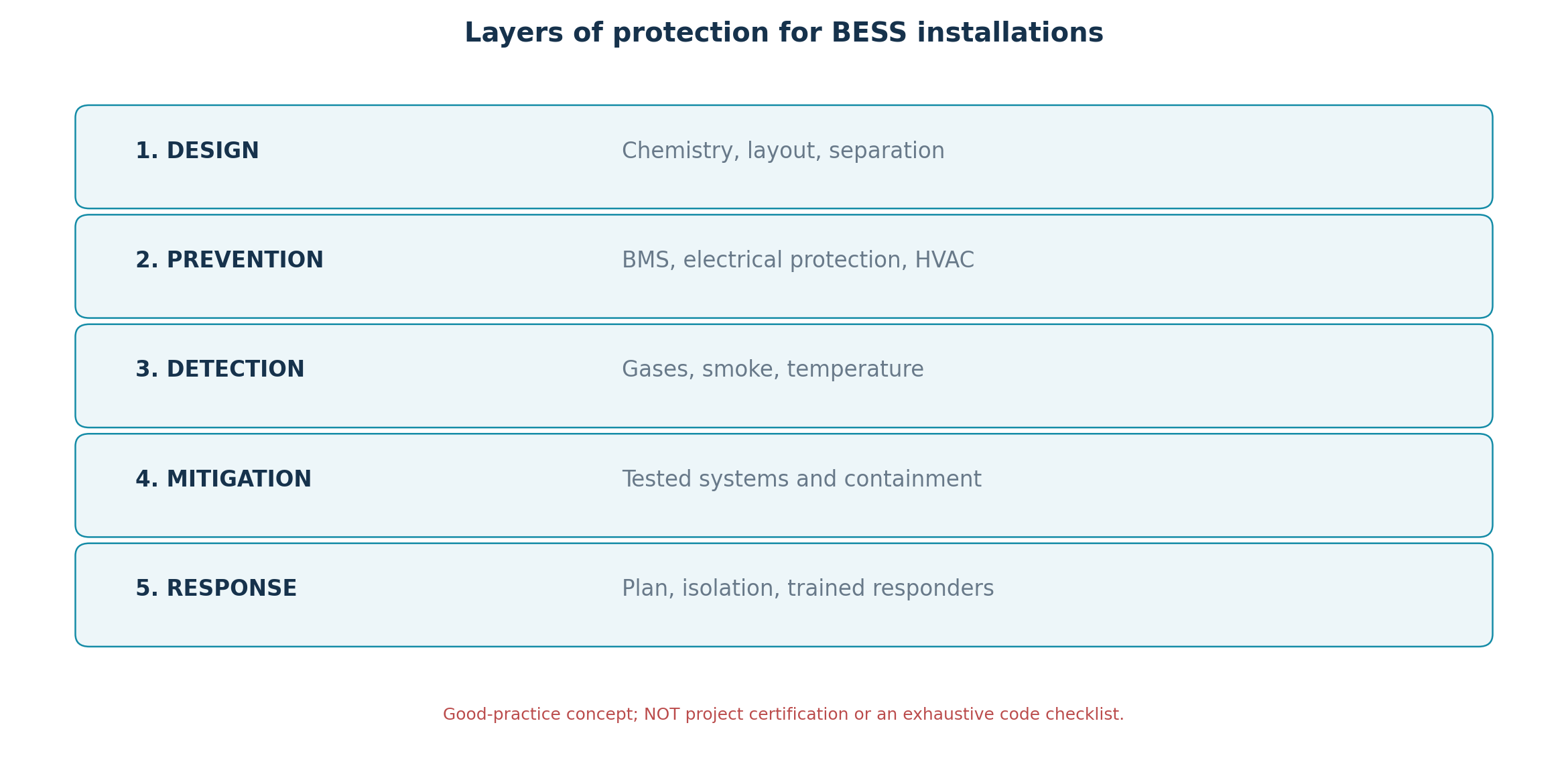
A robust BESS safety strategy combines multiple defenses: chemistry and hardware selection; verified system design; safe physical separation; BMS and electrical protection; cooling and ventilation; fault and gas detection; fire spread mitigation; emergency preparedness and trained responders.
The BMS, electrical protection and cooling have different functions. A strategy must address detection, isolation, containment and failure consequences, including gases and possible propagation. Response must follow the specific emergency plan and competent authorities; this article gives no firefighting or energized-equipment intervention instructions.
What do UL 9540A and NFPA 855 establish, and what are their limits?
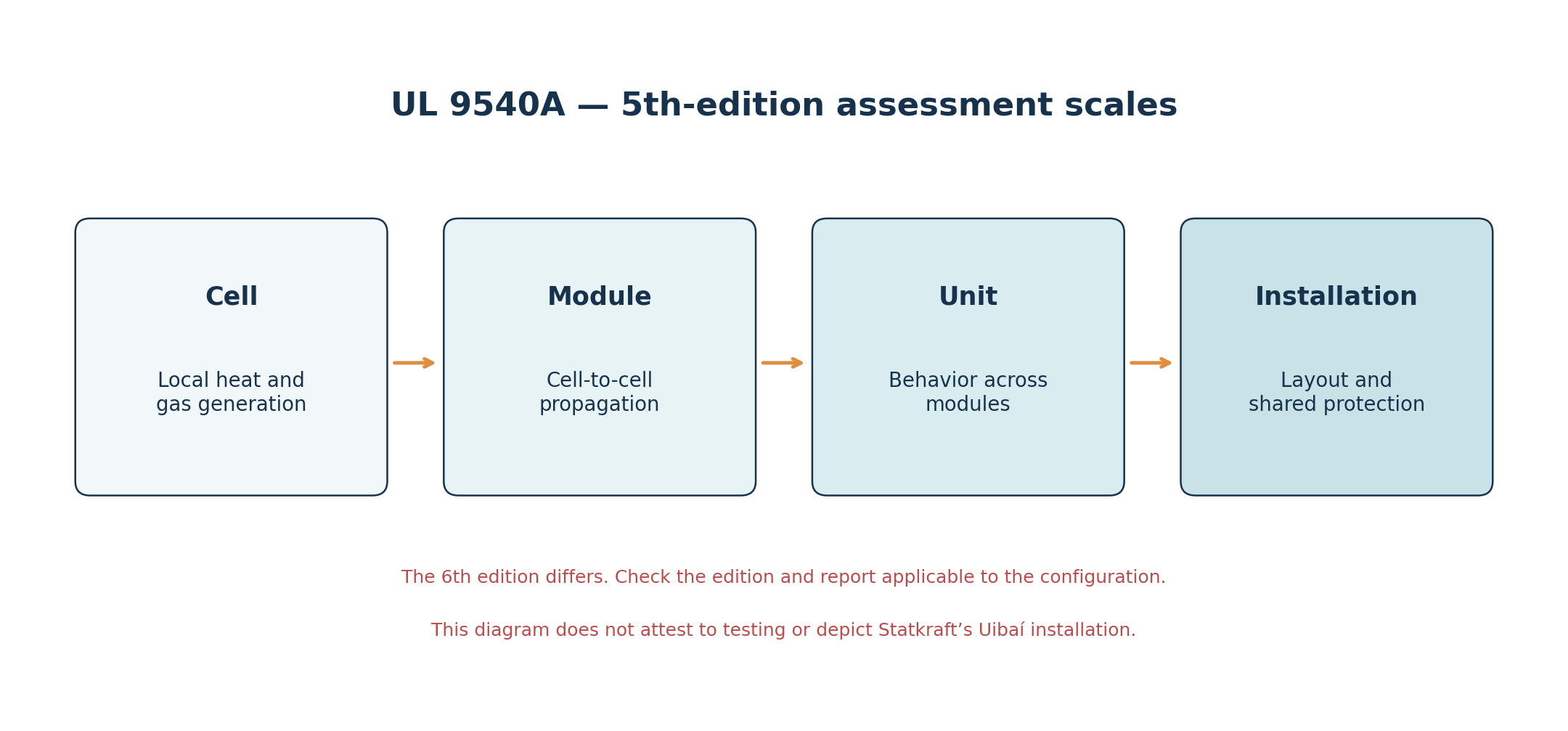
UL 9540A describes testing of thermal runaway fire propagation in energy storage systems. Testing levels, sequences and requirements depend on the edition and application. NFPA 855 (2026 edition) covers safety requirements for stationary energy storage installations. Neither document should be presented as automatically binding Brazilian law for every project. Applicable rules, technical requirements and permitting conditions must be checked locally.
UL Solutions distinguishes the 5th and 6th editions of UL 9540A. The four-scale diagram in this article represents the 5th edition. The 6th changes installation-level assessment and retains unit testing for specific situations. Confirm the edition, configuration and limits of the applicable report rather than transferring a result automatically to another arrangement. Public information pages were reviewed; this does not constitute examination of the full standards or a test report for the Brazilian project.
Arizona, 2019: what can an independent case teach us?
An independent historical lesson comes from the Fire Safety Research Institute's investigation of a 2019 event in Surprise, Arizona. Thermal runaway and gas accumulation were associated with a deflagration at a separate 2.16 MWh installation, injuring four firefighters. The case highlights the relevance of gas hazards, remote monitoring and emergency coordination. It has no established causal relationship with the Statkraft project.
The FSRI report places the event on April 19, 2019, in Surprise, Arizona. Four firefighters suffered serious injuries; the report also describes other people observed in hospital. This history establishes no defect, incident or inadequacy at the Bahia installation.
Four Firefighters Injured in Lithium-Ion Battery ESS Explosion — Arizona →
How does cooling affect temperature in the educational model?
The accompanying interactive laboratory uses a deliberately simplified lumped model: C·dT/dt = P_loss − G·(T − T_ambient). Here C is equivalent thermal capacity, G is thermal conductance to the surroundings, and P_loss is a constant hypothetical heat input. Starting at ambient temperature, ΔT(t) = (P_loss/G)[1 − exp(−Gt/C)].
This helps readers explore how heat capacity and cooling affect temperature rise. It does not represent battery reaction kinetics, gas generation, cell-to-cell propagation, fire probability or the response of any commercial product. It must not be used for safety design or hazard prediction.
Independent thermal example: constant Pheat = 18 kW, C = 3 MJ/K, G = 1.2 kW/K and initial temperature equal to ambient. Steady-state rise is 15 °C, the time constant is 41.7 minutes, and the rise after 60 minutes is about 11.45 °C. This is a temperature difference, not an absolute battery temperature.
The laboratory below runs in the browser and keeps the energy and heat assumptions separate. The kit contains the standalone resource, diagrams, educational data and credits; its examples are not measured Statkraft parameters.
BESS laboratory — energy and heat
Explore power, capacity and losses. Hypothetical models; NOT actual data from the Brazilian plant or a safety assessment.
Cycle energy losses cannot automatically be treated as heat generated inside cells; the thermal model uses an independent loss-power assumption. This does not simulate thermal runaway.
Calculated results
- Nominal duration
- 2.00 h
- Charging input
- 2.8409 MWh
- Cycle losses
- 0.3409 MWh
- Temperature rise
- 11.45 °C
- Steady-state ΔT
- 15.00 °C
- Time constant
- 41.7 min
| Time (min) | Temperature rise (°C) |
|---|---|
| 0 | 0.00 |
| 30 | 7.70 |
| 60 | 11.45 |
| 120 | 14.16 |
| 240 | 14.95 |
In this model, E is usable energy at the same boundary as output power. Efficiency estimates charging input and is not deducted from duration again. Thermal input is an independent assumption. Initial temperature equals ambient; C and G are constant; cooling is linear and there is no phase change.
t = E/P; η = Eout/Ein; Ein = E/η.
C·dT/dt = Pheat − G·(T − Tamb); ΔT(t) = (Pheat/G)·[1 − exp(−Gt/C)].
Does not model battery chemistry, gases, real ventilation, faults or propagation. Educational use only.
Open the standalone laboratory →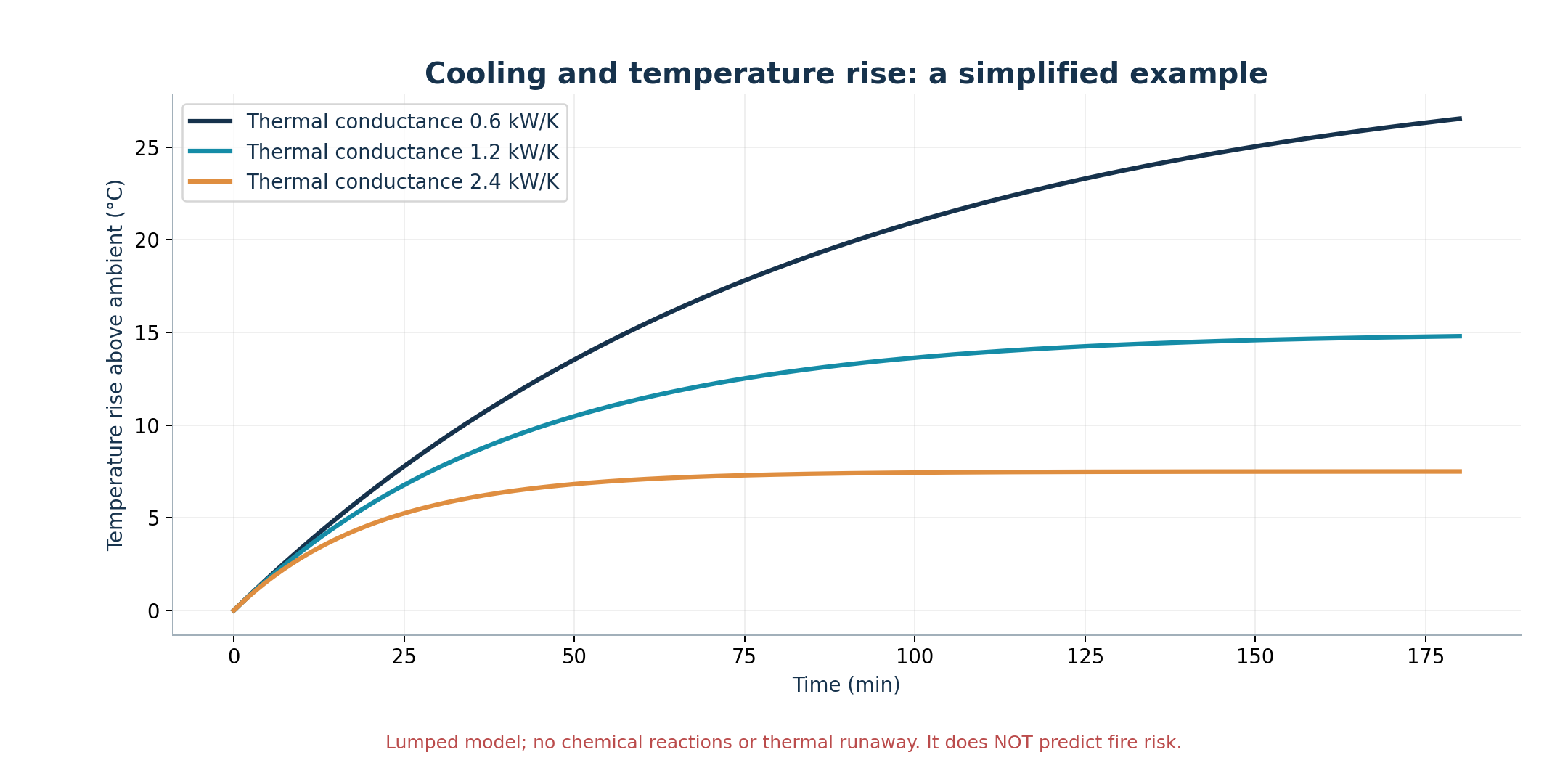
What should be checked at an actual installation?
Real projects require documented energy capacity, chemistry, manufacturer data, thermal-management design, test reports, electrical studies, arc-flash analysis where applicable, fire and gas strategies, BMS/PCS interfaces, inspection and maintenance arrangements, emergency plans and consultation with competent authorities. Environmental considerations include raw materials, operation, replacement, waste and end-of-life management.
These are design and operating questions, not findings from an inspection at Uibaí. Prioritize hazard elimination or reduction and engineering controls while coordinating contractors, permits, communication and safe access. Check evidence of barrier performance; training and PPE complement the appropriate measures without replacing necessary protection.
Corrective action effectiveness verification →
Accident investigation guide (Portuguese) →
| Topic | Evidence to request |
|---|---|
| Battery and configuration | Chemistry, MWh, charge window and representative arrangement |
| Electrical and controls | Studies, BMS/PCS functions, protection and interlocks |
| Thermal and detection | Operating conditions, HVAC, sensors and alarms |
| Testing and emergency | Edition, tested configuration, gases, access and specific plan |
| Maintenance and life cycle | Records, contractor coordination, waste and end-of-life handling |
What does this milestone mean for Brazil?
The Brazilian storage market is also developing. ANEEL opened discussions on large-scale storage procurement and the wider integration of storage technologies into the grid in 2026. These developments make the Bahia announcement significant, without changing the need to distinguish confirmed project data from generic technology characteristics.
Conclusion: a BESS is not merely a large battery. Its performance is shaped by power, energy, controls and losses; its safety depends on validated barriers, reliable information and emergency preparation.
ANEEL — consultas para leilões de armazenamento, 28/07/2026 →
Gas turbines and on-site power →
Download educational kit with figures and credits →
Frequently asked questions
Does 1.25 MW mean the battery can run for 1.25 hours?
No. MW is power; duration depends on MWh and operating constraints.
Does Statkraft's Bahia unit have 2.5 MWh?
The consulted announcement does not establish that value; it is used solely as a hypothetical calculation.
Does thermal runaway mean any temperature increase?
No. It refers to self-accelerating reaction behavior, not ordinary operating heat.
Does UL 9540A certify that a BESS cannot burn?
No. It is a standardized test method that supports hazard assessment; its outputs must be interpreted within the actual configuration and installation.
Can one generic firefighting procedure be used for every BESS?
No. Emergency planning must be tailored to the documented system and local response capabilities.
What is a BESS and how does it work?
It is an integrated storage system with batteries, power conversion, management, protection and auxiliaries. The EMS coordinates flows, the PCS converts electric power and the BMS monitors cell and module operating limits.
How long can a 1.25 MW BESS supply power?
Power alone cannot determine duration. With 2.5 MWh usable at the same boundary, the idealized example lasts two hours at 1.25 MW. The 2.5 MWh assumption is not disclosed Statkraft project data.
What causes thermal runaway in industrial batteries?
Internal defects, electrical abuse, physical damage or overheating can trigger self-sustaining exothermic reactions under certain conditions. Susceptibility and consequences depend on chemistry, state of charge and design.
What are the layers of BESS protection?
They include technology selection and design, BMS and electrical protection, thermal control, detection, propagation mitigation, gas management, maintenance and emergency planning. The combination must be validated for the actual system.
What is the purpose of UL 9540A testing?
It provides experimental evidence about thermal runaway and fire propagation behavior in the tested configuration. The edition and report scope must be identified; it is not a guarantee of zero risk.
Does ANEEL authorization mean Statkraft has entered commercial operation?
The October 2, 2026 announcement concerns the start of test operation. That document alone does not confirm full commercial operation.
References
- Statkraft — autorização de operação em testeStatkraft Brasil
- ANEEL — SAE colocalizado a centrais geradorasANEEL
- ANEEL — operação em teste e comercialANEEL
- UL 9540A — 5th and 6th editionsUL Solutions
- NFPA 855 — 2026 editionNFPA
- Four Firefighters Injured in Lithium-Ion Battery ESS Explosion — ArizonaFSRI
- ANEEL — consultas para leilões de armazenamento, 28/07/2026ANEEL
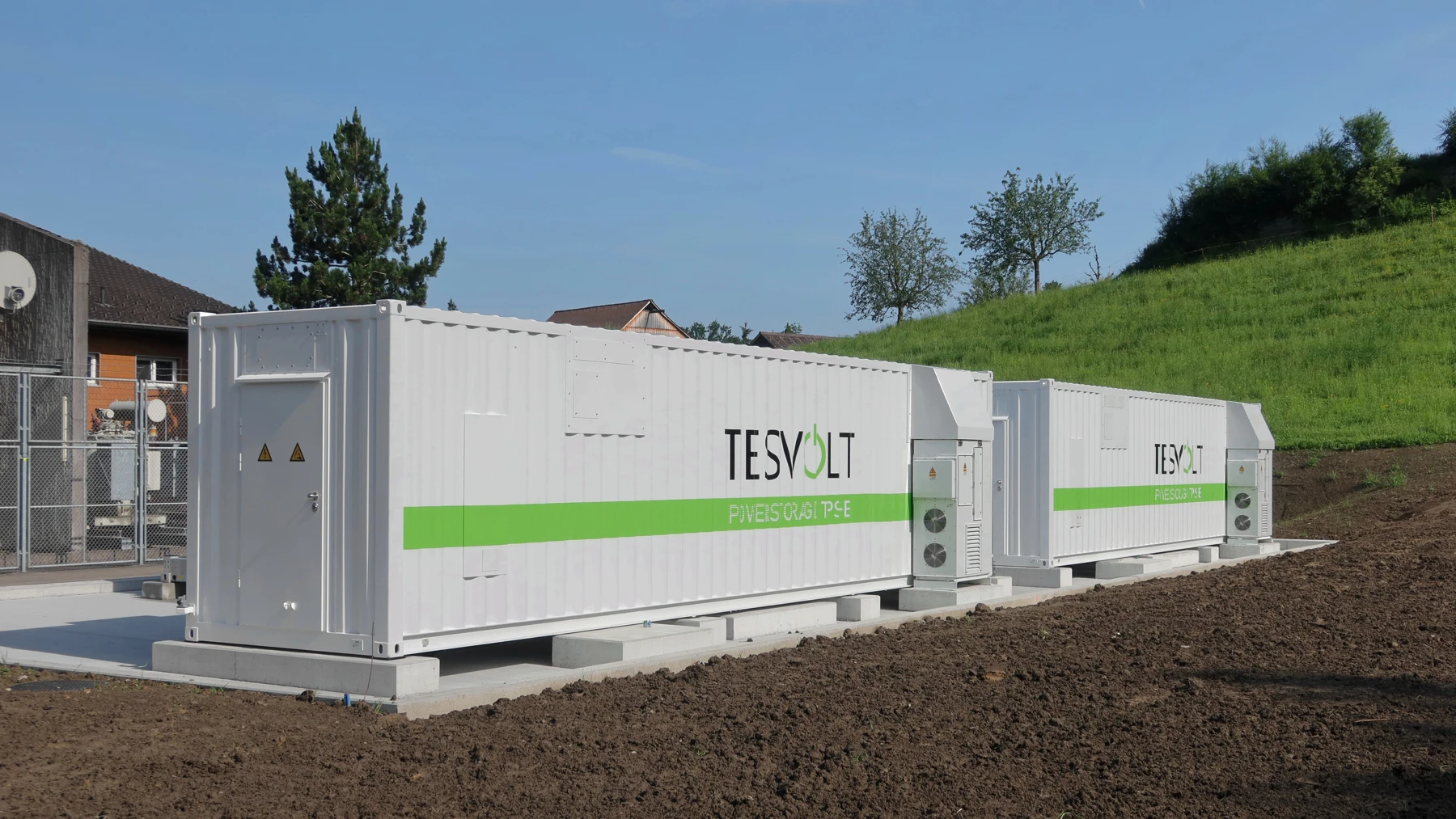
- Real containerized battery energy storage system at a Swiss installationKecko
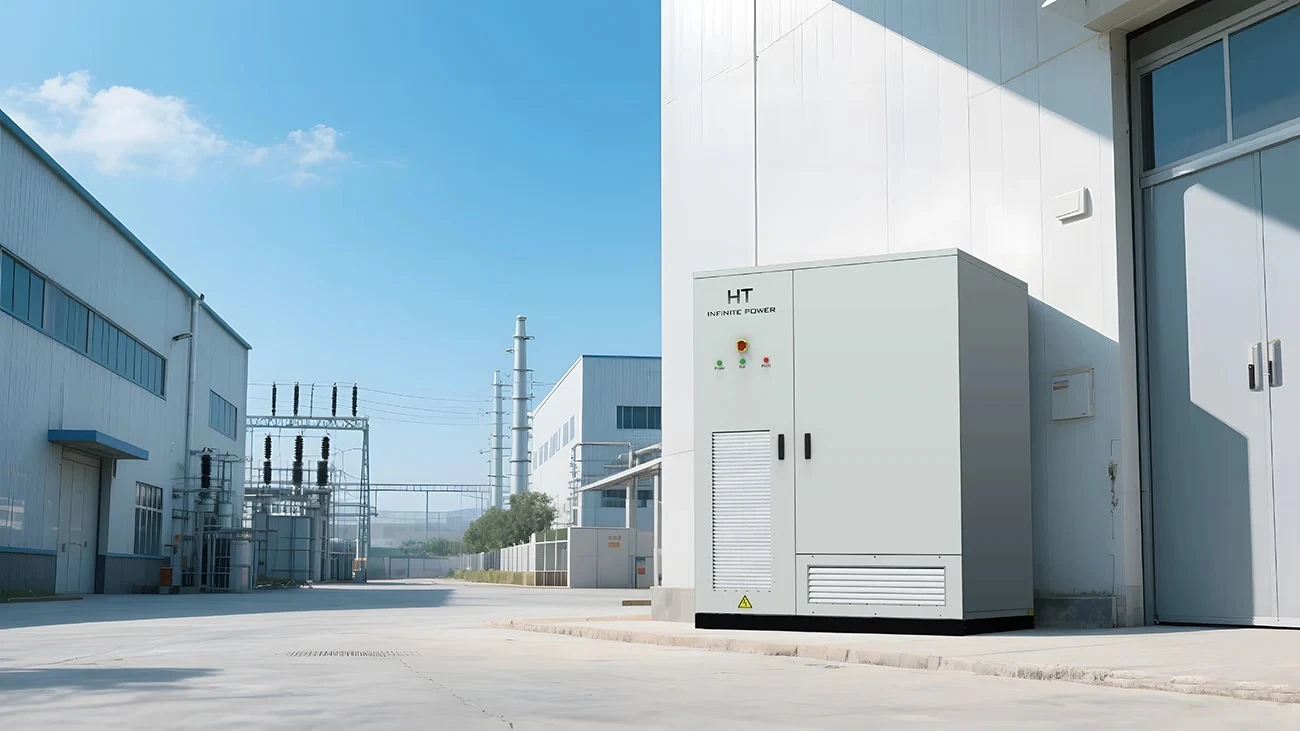
- Air-cooled industrial battery energy storage cabinetYan lance
- CC BY 2.0Creative Commons
- CC0 1.0Creative Commons