
A technical guide to behind-the-meter power, aeroderivative gas turbines, Brayton and combined cycles, heat recovery and data-center reliability.
Direct answer: why many smaller turbines?
On 29 September 2026 Reuters reported rising US demand for small and aeroderivative gas turbines serving data centers. Developers seek power before a permanent grid connection or a large central plant can be delivered. When electrical infrastructure takes longer than the compute campus, time to energization becomes a design parameter.
Multiple units can be added in stages and reduce the share of capacity lost to one unit failure. They are not always cheaper or more efficient over the asset's life. A large combined-cycle gas turbine (CCGT) plant may burn less fuel and emit less greenhouse gas per MWh under comparable conditions. Availability, timing, capital and lifecycle costs determine the choice.
The AI bottleneck reaches the power system
Enverus forecasts 25.5 GW of new US industrial demand served by behind-the-meter (BTM) generation over 2026–2030. Data centers account for 22.5 GW, or 88%, of that demand. Serving the industrial load is projected to require 31.6 GW of BTM generating capacity, including 29.6 GW of gas-fired capacity. The 88% is a share of forecast demand, not a claim about the ownership of 88% of gas capacity.
These are projections, not commissioned facilities. Demand and installed generation differ partly because a reliable system needs spare capacity. MW measures power; MWh delivered depends on operating hours, utilization and availability.
| Enverus US forecast, 2026–2030 | Value | Meaning |
|---|---|---|
| New industrial BTM demand | 25.5 GW | Load served |
| Data-center portion | 22.5 GW (88%) | Share of demand |
| Required BTM generation | 31.6 GW | Installed capacity projection |
| Gas-fired portion | 29.6 GW | Part of generation capacity |

Behind the meter does not mean off the grid
BTM locates generation on the customer's side of the meter or commercial interconnection, depending on the market design. A BTM plant may remain grid connected, operate in island mode if designed to do so, or form part of a controlled microgrid. Meter position, islanding capability and duty are separate concepts.
Bridge power serves a temporary transition; prime power supplies the main load for extended periods; backup assumes load after normal power fails. A hybrid microgrid can coordinate turbines, grid, batteries and renewables. Equipment may change roles as interconnection arrives, but protections, operating plans and contracts must change with it.
Why smaller turbines gained value now
Reuters cites lead times of up to six years for some large CCGT plants, about two years for certain small or medium frame turbines, and roughly 40 months for aeroderivatives in the present supply environment. Enverus uses a broader technology scope: several modular solutions could reach operation in 18–24 months versus as long as 80 months for a large-frame CCGT. These are different comparisons, not universal delivery guarantees.
Incremental capacity can support phased campus expansion and earlier compute revenue. Yet ordering a turbine is not completing a plant: gas supply and compression, inlet, exhaust, emissions controls, generator, switchgear, transformers, construction and permits can govern the critical path.
Aeroderivative: aviation heritage, stationary power plant
An aeroderivative turbine draws on aviation-engine architecture adapted to stationary generation. It is not an unmodified aircraft engine next to a server hall. The complete package includes generator, fuel system, inlet, exhaust, controls, protections and auxiliaries.
Siemens Energy lists SGT-A05 variants at 4–6 MW and SGT-A65 at 66 MW in its current portfolio. Power density and operating flexibility matter, but actual output depends on ambient temperature, altitude, humidity, fuel, degradation, part load and inlet/exhaust losses.
Brayton cycle: from gas to megawatts
In an open Brayton cycle, a compressor raises the pressure of incoming air. Fuel burns in the combustor; hot gas expands through the turbine. Some shaft work drives the compressor and the surplus drives an electric generator.
Exhaust gas retains useful heat. A simple-cycle plant generally rejects it without making more electricity. A heat recovery steam generator (HRSG) can use it to produce steam; a steam turbine then adds electricity in a combined cycle. Aeroderivative versus heavy-duty identifies machine architecture; simple versus combined cycle identifies plant configuration.
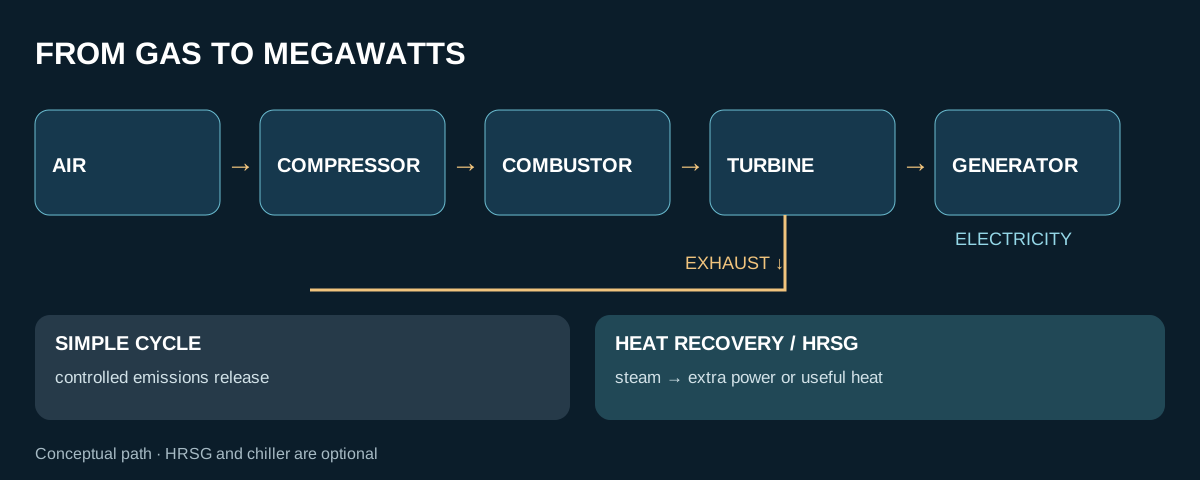
Simple versus combined cycle
Simple cycle can be more modular and have fewer integrated systems, useful when speed or flexibility dominates. Combined cycle adds HRSG, steam turbine, water treatment and more balance of plant, but recovers exhaust energy. The US DOE cites 20–35% for historically surveyed simple-cycle technologies and 60% or more for advanced combined-cycle systems; neither range is a specification for every current model.
Nameplate efficiency is only one input. Operating hours, starts, part load, ambient temperature, fuel, unavailability and the value of an earlier launch affect economics. Compare heat rate, cost and emissions per MWh under like-for-like conditions.
| Criterion | Simple cycle | Combined cycle |
|---|---|---|
| Flow | Gas turbine → generator → exhaust | Gas turbine → HRSG → steam → steam turbine |
| Integration | Fewer thermal systems | More equipment and utilities |
| Exhaust heat | Usually no additional electric generation | Recovered for more power |
| Role | Bridge, modular prime or backup if designed | Long-term larger-scale power when timing permits |
Aeroderivative versus heavy-duty without a ranking
Aeroderivatives often come as lighter, repeatable modules. Heavy-duty or frame turbines are designed primarily for stationary power and can concentrate hundreds of megawatts in one unit. Several small units reduce the percentage of total capacity lost to one failure while multiplying components and maintenance interfaces.
Fast starts do not imply the highest efficiency at every load; modern frame units may also be flexible. Compare net MW at site conditions, heat rate at relevant loads, delivery commitments, redundancy and lifetime cost.
| Dimension | Modular aeroderivative | Heavy-duty/frame |
|---|---|---|
| Scale | A few to tens of MW by model | Large blocks, sometimes hundreds of MW |
| Deployment | Repeatable packages and phasing | Larger balance of plant |
| Contingency | Smaller fractional loss with multiple units | Larger single-block reserve requirement |
| Design focus | Speed, flexibility and stages | Scale and long-term integration |
Crusoe's 29 LM2500XPRESS packages
GE Vernova says it is supplying Crusoe with 29 LM2500XPRESS packages totaling nearly 1 GW. The manufacturer specifies roughly 35 MW per dual-fuel package, a five-minute start, 95% factory assembly and selective catalytic reduction (SCR) for NOx. Reuters says ten units were designated for Abilene, Texas.
These are order details and manufacturer specifications, not proof that all units now operate continuously. Modular delivery can match campus growth. SCR addresses NOx in specified conditions; it does not eliminate CO₂.
Can turbine exhaust help cool the computers?
Potentially, if the systems fit. Combined heat and power uses exhaust energy for a useful thermal load. Trigeneration can use that heat to drive an absorption chiller producing chilled water. Heat powers a refrigeration cycle; exhaust does not turn directly into cooling and the resulting cooling is not free.
GE Vernova describes such a conceptual arrangement. Feasibility depends on exhaust temperature, electrical and cooling-load profiles, chiller availability, water, maintenance, controls and investment. HRSG steam can instead feed a combined-cycle steam turbine, with a different design objective.
The economics include the value of time
Reuters describes developers accepting potentially higher lifetime power costs to bring capacity online sooner. An EPRI expert cited in its report says capital cost per unit of electricity can be up to 50% higher for smaller turbines in certain scenarios; that is not a site-specific quote. Large CCGTs can offer lower average lifetime cost and greenhouse-gas emissions per MWh through heat recovery.
Compare whole-plant CAPEX, fuel, O&M, net available capacity, early compute revenue, future interconnection, availability and emissions. Lower investment per module does not guarantee lower cost per MWh or over ten years.
Reliability is more than N+1 generators
More units reduce a single-unit outage's impact but increase maintenance points. N+1 must cover fuel, transformers, busbars, UPS, controls and cooling, not generators alone. A common gas or switchgear failure can defeat seemingly independent turbines.
Repeated starts, part-load operation, filter fouling and hot ambient conditions affect output and maintenance. Spares, service agreements and degraded operating modes belong in the electrical design.
- What net capacity remains after the largest contingency?
- Which fuel, protection or cooling failures are common-mode?
- Can a sudden load rejection propagate?
- How do BESS and UPS bridge transients?
- What availability is demonstrated under the contracted duty?
Emissions, safety and permits move onto campus
On-site power brings fuel, exhaust, NOx, CO₂, intake and exhaust noise, rotating equipment, fire protection and electrical hazards near the load. Dry low-emissions combustion and SCR address NOx by different mechanisms; neither makes gas generation CO₂-free. Compare pollutants separately per MWh under equivalent fuel and operating conditions, including relevant upstream methane leakage.
Brazilian connection, authorization and environmental permits require a local determination. For occupational safety, NR-1/GRO frames risk management; NR-10 may address electrical installations; NR-12 machinery; NR-13 covered pressure equipment and piping; NR-20 covered flammable-fuel activities; NR-23 and local fire rules may be relevant. None is automatically applied to the US case.
What manufacturers' order books do and do not show
In Q2 2026 GE Vernova said its Gas Power equipment backlog and slot reservations rose from 100 to 116 GW, with at least 125 GW expected by year end. It also reported more than US$5 billion of year-to-date data-center-related Electrification orders. The Gas Power volume covers that business generally; it is not 116 or 125 GW of data-center turbines.
Orders and reservations indicate supply-chain pressure, not commissioned generating capacity. Factory slots, gas, grid, civil work and commissioning remain separate milestones.
What about Brazil?
Reuters and Enverus chiefly describe the United States. Their scale and economics cannot simply be transferred to Brazil. Gas availability and price, interconnection, permits, water, fire protection, land and contract structure require local analysis.
The transferable engineering lesson is to compare grid connection, local generation, storage, renewables and phased growth over the same planning horizon. BESS can bridge transients and support continuity, but is not an unlimited energy source. Mechanical, electrical, environmental and operational studies must meet.
When a data center incorporates a power plant
Some AI campuses are becoming operators of fuel, generation, exhaust, protection, heat recovery and power-plant maintenance. Aeroderivatives gain value when delivery time and phasing dominate; large combined cycles retain potential scale and long-term efficiency advantages. Engines, batteries, renewables and the grid remain alternatives or complements.
The useful question is which combination gives each project demonstrable availability, cost and impact. How far should a campus go in becoming its own power plant?
Frequently asked questions
What is behind-the-meter generation for a data center?
It is generation on the customer side of the meter or commercial interconnection, according to the market arrangement. It may remain grid connected, island if engineered, or work in a hybrid system.
What is an aeroderivative gas turbine?
A stationary turbine adapted from aviation-engine architecture, packaged with a generator, fuel system, controls and auxiliaries. It is not an unmodified aircraft engine beside servers.
Why use several smaller turbines rather than one large plant?
Modules can arrive sooner, follow staged load growth and limit capacity lost to one unit failure. More interfaces and maintenance, plus lifetime efficiency and cost, still need assessment.
How do aeroderivative and heavy-duty turbines differ?
They are machine families. Aeroderivatives draw on aviation architecture and often compact packages; heavy-duty units are designed for large stationary generation. Either can be part of different plant cycles.
How do simple and combined cycles differ?
Simple cycle generally does not use exhaust to make extra electricity. Combined cycle uses an HRSG and steam turbine to extract more power, with added complexity.
How does the Brayton cycle work?
Air is compressed, fuel heats it in a combustor and the hot gas expands through a turbine. Surplus shaft work drives a generator.
Can turbine waste heat cool a data center?
It can indirectly drive an absorption chiller that makes chilled water. The integration needs a suitable heat source and cooling demand; it is not free cooling.
Can gas turbines replace a grid connection?
They may serve as bridge or prime power in a designed project. Behind the meter does not automatically mean islanded; protection and commercial arrangements determine the role.
Is on-site gas always more expensive or polluting?
There is no universal answer. Compare cost and each emission per MWh at equivalent fuel, load, heat recovery and operating assumptions, including the value of earlier energization.
What engineering risks arise with an on-site plant?
Fuel, fire, exhaust, NOx, noise, rotating machinery, electrical protection and common-mode failures all enter the campus, along with local permitting duties.
References
- Dash for small gas turbines set to impact data center costsReuters
- Behind-the-Meter Generation Forecast: Skipping the QueueEnverus Intelligence Research
- LM2500XPRESS Powering Crusoe AI Data CentersGE Vernova
- GE Vernova and Crusoe announce 29-unit aeroderivative turbine dealGE Vernova
- Aeroderivative, Industrial and Heavy-Duty Gas TurbinesSiemens Energy
- How Gas Turbine Power Plants WorkU.S. Department of Energy
- CHP Technologies: Gas TurbinesU.S. Department of Energy
- Innovative solutions for data centers to mitigate impacts of AI and MLGE Vernova Energy Consulting
- GE Vernova reports second quarter 2026 financial resultsGE Vernova
- Normas Regulamentadoras VigentesMinistério do Trabalho e Emprego
- Instruções Gerais — GeraçãoANEEL