
An engineering analysis of Google Project Suncatcher, thermal radiation, heat pipes, orbital power, chip radiation effects and optical links.
Direct answer: space is not a freezer
Vacuum contains no air to convect heat away from a satellite's exterior. A computing chip still dissipates electrical power as heat. That heat has to cross thermal interfaces and be conducted or transported to an emitting surface; the radiator then rejects it as infrared radiation.
The low temperature associated with deep space is not a cold breeze over the processor. Radiator temperature, area, surface properties, orientation and the Sun and Earth in its field of view determine the net heat flow. A chip can overheat in vacuum when the thermal path or emitting area is insufficient.
Project Suncatcher thus raises a measurable system question: can orbital solar energy support useful computation while its heat is rejected continuously and reliably? The answer has yet to be established at scale.
What Project Suncatcher is, and what it is not
Google introduced a long-term research moonshot for scalable space-based machine-learning infrastructure in November 2025. Its 24 September 2026 update described an initial orbital learning mission with Planet on Transporter-18 to study chips and thermal hardware. As of this article's 30 September check, the official update still described that flight as upcoming and published no mission outcome; schedules may change.
A learning prototype is not an operating commercial orbital data center. Google plans a separate two-satellite demonstration of high-bandwidth laser links in 2027. Ground tests, a first flight, a network demonstration and scaled infrastructure are different stages.
| Stage | Evidence or plan | Does not prove |
|---|---|---|
| Ground tests | Trillium proton, vibration and thermal-vacuum testing | Continuous orbital operation |
| Planned first flight | 2026 learning mission | Operational data center |
| Planned 2027 step | Laser links between two satellites | Commercial training network |
| Long-term vision | Scalable orbital AI infrastructure | Demonstrated economic feasibility |

Why put AI in orbit?
A dawn-dusk sun-synchronous low Earth orbit can offer nearly continuous solar exposure. Researchers also examine computing near space-generated data, reducing direct reliance on a terrestrial grid connection, and potentially lowering local land and cooling-water demand. These are conditional advantages, not measured benefits of a commercial system.
Mass, launch loads, shielding, network access, storage and end-of-life disposal add constraints. A valid comparison must account for the entire system and its lifecycle.
Thermodynamics: Earth versus orbit
A terrestrial campus moves heat with air, water and refrigerants to chillers, cooling towers or dry coolers, ultimately rejecting it to the surroundings. An orbital craft can still conduct heat or circulate fluid internally, but its external rejection is primarily radiative. Vacuum removes external convection, not heat generation.
| Dimension | Terrestrial campus | Orbital system |
|---|---|---|
| Power | Grid, generators and renewables | Solar arrays and storage, orbit dependent |
| Heat rejection | Air/water, chillers, towers, dry coolers | Radiators with an appropriate thermal view |
| Maintenance | Technicians and replacement parts | Limited access; redundancy and fault tolerance |
| Radiation | Shielded terrestrial environment | Total ionizing dose and single-event effects |
| Network | Fiber infrastructure | Optical inter-satellite and ground links |
| Water/environment | Possible local cooling-water use | No local cooling tower; launch and debris impacts |
From TPU to deep space: the heat path
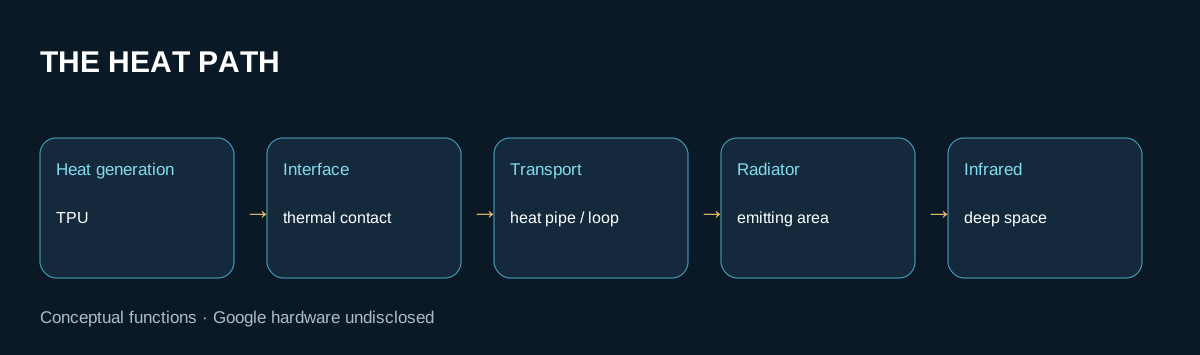
A conceptual chain runs from TPU to a thermal interface, a structural or cold-plate transfer stage, a heat pipe or fluid loop, a radiator and infrared photons. This describes functions, not an undisclosed Google flight drawing.
Heat transport and heat rejection are distinct. A heat pipe moves energy to an emitting surface; the radiator emits it. An interface bottleneck, solar loading or Earth infrared exposure can compromise the chain even if another component is enlarged.
A spacecraft energy balance
Conceptually, absorbed sunlight + Earth-reflected sunlight (albedo) + Earth infrared + electrical dissipation = stored thermal energy + emitted thermal radiation. Storage changes temperature during transients; at a quasi-steady state the inputs must balance the rejected output.
Solar absorptivity and infrared emissivity are different surface properties. Attitude, shadows and view factors determine what the radiator sees. A radiator facing Earth or obscured by another craft is not equivalent to an unobstructed view of deep space.
Stefan–Boltzmann and radiator area
For an idealized illustration, P ≈ εσA(T_rad⁴ − T_sink⁴), where P is thermal power, ε emissivity, σ the Stefan–Boltzmann constant, A effective emitting area and T absolute temperature. With an ideal deep-space sink near 0 K and no solar or planetary load, P/A ≈ εσT_rad⁴.
The fourth-power dependence is powerful, but chip limits, working fluids and interfaces constrain allowable temperatures. This stripped-down equation does not design radiator mass, deployment, orientation or margins; a real orbit needs a detailed thermal model.
Illustrative example: rejecting 1 MW
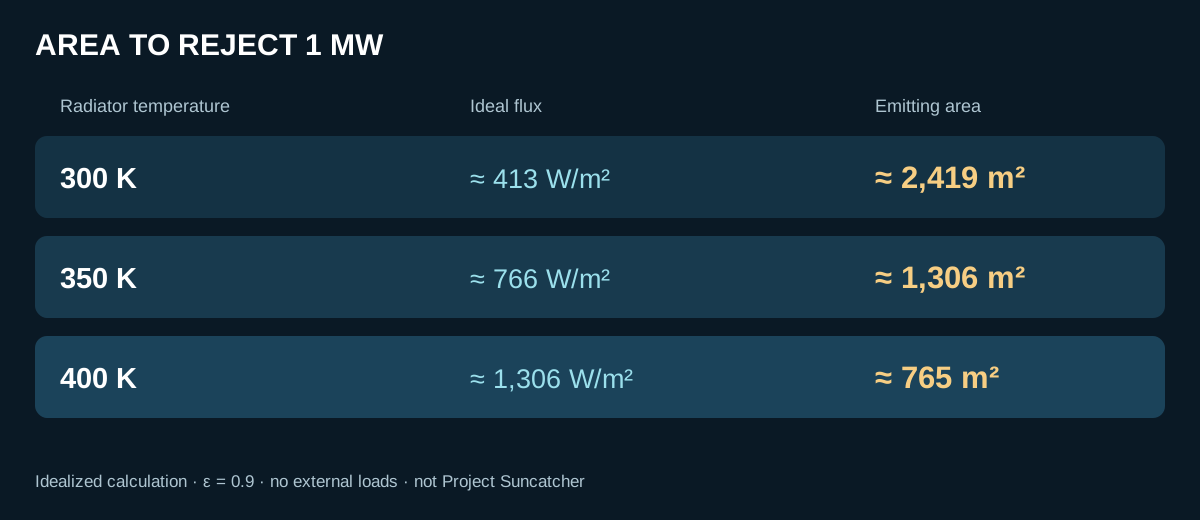
With ε = 0.9 and σ ≈ 5.67 × 10⁻⁸ W·m⁻²·K⁻⁴, ignoring external loads, a 300 K radiator emits about 413 W/m² and needs about 2,419 m² per megawatt. At 350 K the figures are 766 W/m² and 1,306 m²; at 400 K, 1,306 W/m² and 765 m². These rounded values use effective emitting area and do not represent Google's hardware or its power.
A hotter radiator reduces mathematical area, but the entire thermal path must tolerate that temperature and maintain reliability. Mass and deployable geometry are part of the system design.
| Radiator temperature | Idealized flux | Area for 1 MW |
|---|---|---|
| 300 K (~27 °C) | ~413 W/m² | ~2,419 m² |
| 350 K (~77 °C) | ~766 W/m² | ~1,306 m² |
| 400 K (~127 °C) | ~1,306 W/m² | ~765 m² |
Heat pipes connect chips and radiators
A heat pipe often evaporates a working fluid at the hot end, transports vapor to a cooler section, condenses it and returns liquid through a wick or another driving mechanism. Its passive thermal transport has capacity and operating limits.
Google reports thermal-vacuum tests with heat pipes and radiators. That does not reveal the final type or geometry of a constellation. The pipe carries heat; the radiator rejects it to space.
A satellite cluster is also a thermal geometry
The revised preprint uses an illustrative 81-satellite cluster within roughly a 1 km radius in sun-synchronous low Earth orbit. This is a studied architecture, not the initial flight configuration or final product. Close formation helps investigate dense optical links but complicates attitude control and collision avoidance.
A neighboring panel can obstruct a radiator's view or return infrared energy. Pointing, shadowing, optical links and heat rejection must therefore be designed together.
Solar energy and its conditions
For certain orbital and terrestrial comparison assumptions, the study estimates up to eight times the annual solar energy per unit panel area relative to a mid-latitude terrestrial panel. That is annual exposure, not an eightfold improvement in solar-cell conversion efficiency. Eclipses, degradation, orientation, storage and conversion losses still matter.
Radiation: survival is not data integrity
Total ionizing dose (TID) builds up over time. Single-event effects (SEE) may flip bits or corrupt computations. Google's proton-beam tests found Trillium TPU TID tolerance above a modeled five-year requirement, while high-bandwidth memory was more sensitive; SEE and silent data corruption remain engineering problems.
Training, inference and persistent data have different error tolerances. Error correction, checks, redundancy and recovery need application-specific design. A ground test is not five years of demonstrated orbital reliability.
Launch mechanics, laser links and formation
Google describes launch loading of around 10 g at spacecraft level and potentially 50–100 g at components. Three-axis vibration testing, mounting and connector qualification are part of the hardware problem.
Distributed training requires very high throughput and low latency. The preprint examines links on the order of 10 Tbps and reports an 800 Gbps one-way or 1.6 Tbps bidirectional bench demonstration. These are research results, not achieved rates between the initial mission satellites; pointing and orbital availability remain to be proven.
Maintenance, mass and economics
On Earth, technicians replace boards, pumps and transceivers. In orbit, a failed node may require isolation and workload redistribution. Fault tolerance, modularity, replacement, debris control and end-of-life planning all affect lifecycle costs.
The preprint models a launch-price scenario at or below US$200/kg to low Earth orbit in the mid-2030s under learning-curve and reuse assumptions. It is neither a contracted price nor a forecast. Every radiator, shield and cable adds mass to each watt of useful computing.
Environmental benefits require evidence
Orbital computation might displace local cooling-water and land demand for a particular terrestrial workload, but manufacturing, launches, replenishment and deorbiting have their own impacts. The European ASCEND feasibility work conditions potential climate benefits on far less emitting launch systems and full lifecycle accounting. Reduced local water use is not zero environmental impact.
What must work before a large orbital data center
Orbital tests must establish thermal rejection under actual solar and Earth loads, radiation tolerance with data integrity, power availability, optical links and safe formation flight. Multi-year reliability, failures, maintenance or replacement, cost per computation, ground connectivity, disposal and lifecycle impact follow. A successful TPU flight test would answer only part of that system question.
- Radiator area, orientation, view and mass
- TID/SEE tolerance and error detection
- Real orbital power and storage
- Measured laser availability and formation safety
- Fault tolerance, deorbiting and lifecycle economics
What orbital compute teaches terrestrial engineering
On Earth the bottleneck may be delivering megawatts to a campus; in orbit it becomes delivering heat to a radiator and rejecting it. This complements the questions of grid capacity, cooling and physical reliability faced by terrestrial AI data centers.
The cloud may leave Earth; thermodynamics does not. Suncatcher's first value is to turn a long-term vision into measurable questions: how much computing, what emitting area, what reliability and at what cost?
Frequently asked questions
Has Google put a data center in space?
No. As of 30 September 2026, its first orbital Suncatcher test was described as a planned learning mission. Testing chips is not commercial infrastructure.
Why is cooling computers in vacuum difficult?
There is no external convection. Heat must travel to radiator area and leave as infrared radiation under the actual solar and Earth loads.
If space is cold, why does the chip not cool itself?
Deep-space temperature supplies no airflow. Without a thermal path to an emitting surface, the chip retains heat and may overheat.
How does a space radiator work?
A warm surface emits infrared radiation. Its net output depends on emissivity, temperature, area, attitude and what it sees.
What is a heat pipe?
It moves heat, often through evaporation and condensation of an internal fluid, from the source to a cooler surface. The radiator then emits the heat to space.
How much radiator area would reject 1 MW?
In the idealized example with emissivity 0.9 and no external loads, about 2,419 m² at 300 K, 1,306 m² at 350 K or 765 m² at 400 K. Actual spacecraft need a full orbital thermal analysis.
What does space radiation do to AI chips?
It can accumulate dose damage or produce single-event errors such as bit flips. Chip and memory tests, error detection and mitigation are necessary.
Does Project Suncatcher use solar power?
Its research architecture examines solar arrays in orbits with long exposure. Higher annual availability is not higher photovoltaic conversion efficiency.
Why would satellites need laser links?
A distributed cluster must move large volumes of data between nodes. Google plans a two-satellite optical-link test in 2027, not a demonstrated large network.
Would space data centers eliminate water use?
Orbital radiators do not need a local cooling tower, but manufacture, launches and support infrastructure have resource impacts. Lifecycle accounting is required.
Could they ease terrestrial grid demand?
Potentially for a future workload powered in orbit, but the net effect depends on scale, efficiency and ground systems. It has not been commercially demonstrated.
When could an orbital data center become commercial?
There is no reliable date. Thermal, radiation, networking, reliability and economic evidence must follow learning missions.
Is Google the only company exploring orbital computing?
No. Other companies and feasibility studies exist, with different scopes and maturity. Their plans are not proof of Suncatcher's architecture.
How is orbital edge computing different from a large orbital data center?
Edge processing handles data near its source on one spacecraft. A large orbital data center would require much greater power, heat rejection and interconnection across nodes.
References
- Behind Project SuncatcherGoogle Research
- Project Suncatcher: a research moonshotGoogle
- Towards a future space-based, highly scalable AI infrastructure system design, v2Google Research / arXiv preprint
- 7.0 Thermal ControlNASA Small Spacecraft Institute
- Single Event Effects TestingNASA
- Mitigating Risks of Single-Event Effects in Space ApplicationsNASA NTRS
- ST8 Thermal Loop / heat pipe technologyNASA JPL
- ASCEND feasibility studyEuropean Commission CORDIS