
A guide to breast cancer awareness, evidence-based screening, timely diagnosis and the Brazilian legal context in 2026.
A ribbon is a symbol; care is the outcome
The WHO theme for Breast Cancer Awareness Month 2026 is ‘Every story is unique, every journey matters’. Awareness matters when trustworthy information leads to timely assessment, effective treatment and respectful support. A mammogram can screen for or investigate cancer; it does not prevent cancer from developing.
A new breast change warrants clinical assessment regardless of the age used by a population screening programme. The pathways for symptoms and routine screening must remain separate.

How the campaign and ribbon evolved
The American Cancer Society records a one-week awareness campaign in 1985. Susan G. Komen distributed pink ribbons at a New York race in 1991; SELF magazine and Evelyn Lauder helped popularise the ribbon in 1992. The movement has several origins rather than one inventor.
Brazil established annual October activities in Law 13,733/2018 and added Outubrinho Rosa for girls through Law 15,009/2024. These are Brazilian laws, not rules for readers elsewhere.
The global burden and the survival gap
WHO estimates that 2.4 million women were diagnosed worldwide in 2024, 694,000 died and 8.2 million were living with breast cancer at year-end. About 70% of deaths occurred in low- and middle-income countries. Around 80% of cases arise without a specific known factor beyond sex and age.
A Nature Medicine projection points to about 3.2 million new cases and 1.1 million deaths annually in 2050 if trends persist. A separate model estimates median five-year net survival of 77.8% globally, 41.9% in low-income countries and 87.3% in high-income countries. These are population estimates, not individual prognoses.
Brazil, Paraíba and João Pessoa
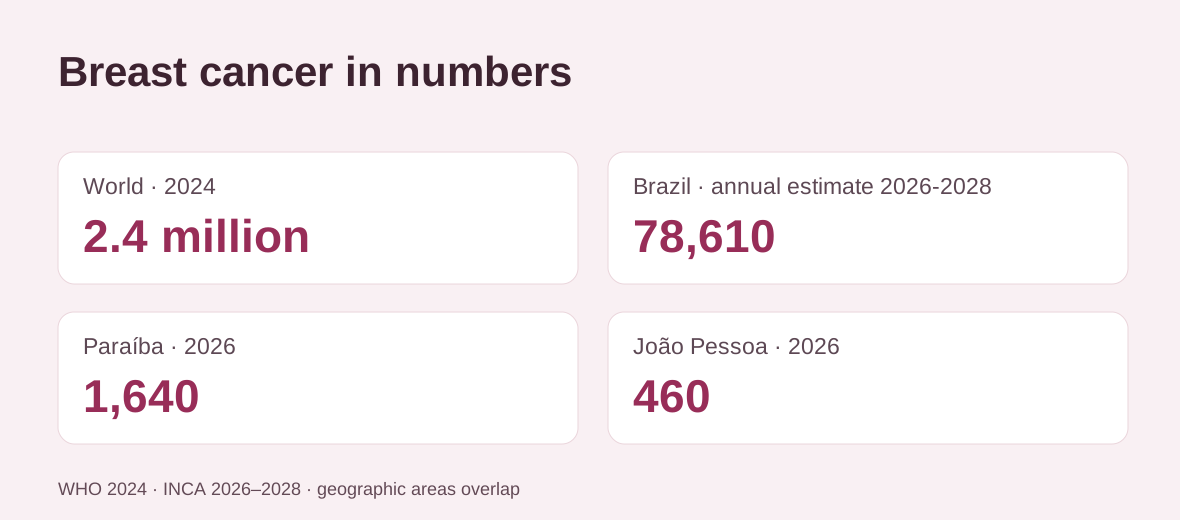
Brazil's INCA estimates 78,610 new female breast cancer cases each year in 2026-2028. It estimates 1,640 in Paraíba and 460 in its capital João Pessoa in 2026. These are estimates, not observed case counts; local rate differences cannot establish a cause on their own.
| Area | Estimated new cases | Reference |
|---|---|---|
| World | 2.4 million | WHO, 2024 |
| Brazil | 78,610 per year | INCA, 2026-2028 |
| Paraíba | 1,640 | INCA, 2026 |
| João Pessoa | 460 | INCA, 2026 |
One name, many diseases and risk profiles
In situ lesions remain at their original site, invasive cancers cross tissue boundaries and metastatic disease has spread to distant organs. Stage, hormone receptors and HER2 status influence treatment. No universal cure percentage describes every case.
Age, family history, inherited variants, radiation exposure, alcohol, weight, tobacco and reproductive or hormonal factors can affect risk. Prevention can reduce some risks but never guarantees an individual outcome. Most affected women have no known family history. Men account for around 0.5-1% of cases.
Recognise changes, seek assessment
A new lump or thickening, change in shape, skin retraction or redness, nipple change, spontaneous discharge especially when bloody, or a new axillary lump warrants assessment. These findings do not by themselves establish cancer.
Breast awareness means knowing what is usual and seeking care when something changes. A rigid monthly self-examination is not a substitute for clinically indicated screening or assessment.
Screening is different from diagnosis
Screening offers mammography to people without symptoms based on population benefit and harm. Diagnostic imaging investigates a symptom or suspicious finding after professional assessment. No screening age threshold should be used to deny a symptomatic person a diagnostic pathway.
Screening may reduce mortality in recommended groups, but false positives, false negatives, extra procedures, overdiagnosis, anxiety and low-dose radiation matter. Quality and timely follow-up are essential.

What Brazil changed in 2025-2026
In Brazil's public SUS system, routine population screening for average risk is biennial from ages 50 to 74. Those aged 40-49 or over 74 may access mammography on request with counselling about benefits and harms. Law 15,284/2025 guarantees access from age 40 under Ministry of Health guidelines. A legal entitlement is distinct from an organised screening recommendation.
From 1 October 2026, Brazil's health-plan regulator ANS requires coverage of digital mammography without an age restriction when prescribed by the treating physician. Coverage is not a universal instruction to screen at every age. These Brazilian rules do not apply in other countries.
How do screening policies compare?
The table describes average-risk population programmes. It does not compare insurance entitlements or recommend an individual schedule. Different systems weigh mortality benefit, false positives, overdiagnosis, incidence and service capacity differently.
| System | Average-risk schedule | Context |
|---|---|---|
| Brazil / Ministry of Health | 50-74, every two years | Priority public screening |
| United States / USPSTF | 40-74, every two years | 2024 grade B recommendation |
| European Council | 50-69; consider 45-74 | National implementation differs |
| England / NHS | 50 to before 71, every three years | Organised invitations |
The WHO 60-60-80 goals
The Global Breast Cancer Initiative aims for at least 60% of invasive cancers diagnosed at stages I or II, diagnosis within 60 days of first presentation to a health facility and at least 80% receiving complete recommended treatment. An awareness campaign needs a functioning care pathway after its message reaches someone.
Workplace action and Brazilian rights
Brazil's labour law allows up to three days in each 12-month period for duly documented preventive cancer tests. Other Brazilian laws address diagnostic and treatment timelines, cancer rights and breast reconstruction. Health information is sensitive personal data under the LGPD; managers should not circulate diagnoses or test results.
Employers can share reliable information, remove scheduling barriers and support treatment and return to work without seeking unnecessary clinical details. Brazil's NR-7 occupational health programme does not impose universal age-based breast screening.
Night work: a careful occupational note
IARC classifies night shift work as probably carcinogenic to humans (Group 2A), with limited human evidence for breast and some other cancers. A hazard classification cannot prove that an individual's cancer was caused by their shift pattern.
From awareness to dignified care
Mammography detects; it does not prevent cancer. A lack of family history does not eliminate risk. Self-examination does not replace indicated assessment, and screening ages are not rules for symptomatic people. The ribbon matters when it helps turn information into access, timely diagnosis, complete treatment and support.
Frequently asked questions
What is the WHO theme in 2026?
Every story is unique, every journey matters.
How many cases are expected in Brazil?
INCA estimates 78,610 new female breast cancer cases annually in 2026-2028.
At what age does Brazil recommend routine screening?
The priority SUS population programme offers mammography every two years from 50 to 74 for average-risk people; other access and symptomatic assessment follow different rules.
Does self-examination replace mammography?
No. Awareness of changes helps prompt care, but does not replace indicated screening or clinical assessment.
What changed in Brazilian health-plan coverage?
From 1 October 2026, digital mammography has no age restriction when prescribed by the treating physician.
Can men develop breast cancer?
Yes. Around 0.5-1% of cases occur in men.
References
- Breast Cancer Awareness Month 2026WHO
- Breast cancer fact sheetWHO
- Estimativa 2026-2028INCA
- ParaíbaINCA
- João PessoaINCA
- Detecção precoceINCA
- ANS aprova mamografia digital sem restrição de idadeANS
- Lei 15.284/2025Planalto
- Breast Cancer ScreeningUSPSTF
- European Council screening recommendationCouncil of the European Union
- Breast screening programmeNHS England
- Night shift workIARC