
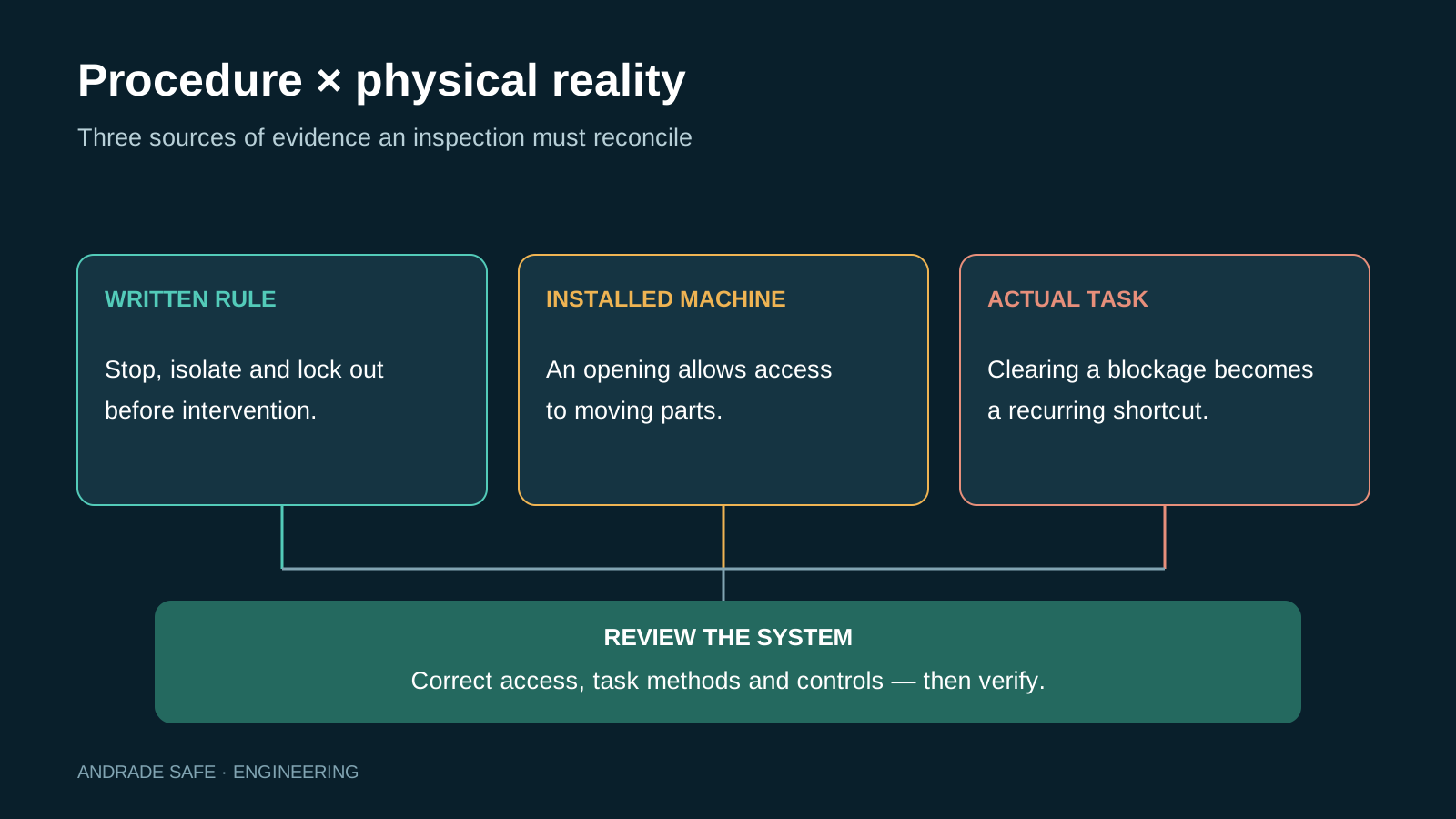
A September 2026 HSE release described a conveyor opening that contradicted the employer's isolation procedure. Conveyor safety requires preventing access to dangerous movement, controlling energy during interventions and designing cleaning and maintenance around actual tasks. A written rule cannot compensate for a machine that still allows people to reach the hazard.
What HSE established in the main case
HSE's 9 September 2026 release concerned Factory Services UK Limited, an animal-feed manufacturer in Merseyside. On 18 March 2025, a maintenance engineer working a night shift reached through a side opening to remove material while a conveyor was running. His arm was drawn into the machinery, causing serious injury. There was no guard or emergency stop button in that area.
HSE found the opening had been cut years earlier to clear blockages during operation. A second conveyor had a similar unauthorised opening. Risk assessments and safe systems required guarding and isolation, yet inspections, audits and management walkarounds had not identified or corrected the modifications. Fixed mesh guarding and an emergency stop were installed afterwards. The company was sentenced on 8 September 2026 under section 2(1) of the Health and Safety at Work etc. Act 1974 and fined £160,000. These are reported findings, not a universal theory about conveyors.
The explanation cannot stop at human error
Describing an action is not the same as explaining the system that made it possible. Investigators must examine access, recurring tasks, modifications, supervision and whether the prescribed method could actually be followed. Recognising a worker's action does not remove the employer's responsibility to provide effective safeguards.
Normalisation of deviance is a useful analytical lens: a dangerous condition may become familiar and cease to attract attention. It is not presented here as HSE's formal causal finding. Production pressure and incentives are questions for a local investigation, not established facts in this case. The documented physical opening already demonstrates a mismatch between the procedure and the available task method.

Different sectors, similar exposure — not a statistical trend
Two further HSE releases illustrate different situations. They are not a representative sample and cannot establish a national injury rate or upward trend.
| Release | Confirmed event | Preventive question |
|---|---|---|
| David Wood Baking Limited — 4 September 2026 | On 1 December 2023, a line initially switched off began moving during cleaning. A worker was caught in an inadequately guarded roller. | Does cleaning control unexpected start-up as well as access? |
| Easy Cleaning Solutions Ltd — 7 August 2026 | On 24 April 2024, removing a box from a running packaging conveyor exposed a hand to unguarded machinery. | Were product handling and interfaces between machines assessed? |
Where conveyor hazards arise
In-running nips occur where a belt meets a pulley or roller. Return idlers, transfers, drive chains, shafts and couplings add drawing-in, entanglement, crushing and shearing hazards. Moving parts beside fixed structures may trap a person even where the top conveying surface looks uncomplicated.
Assessment must include the underside, tail end, drives, tensioners and access from adjoining platforms. Trapped material can move when a blockage is released. Gravity, belt tension and inertia may remain hazardous after motor power is removed. Risk depends on geometry, energy, accessibility and the task, not merely apparent belt speed.
Cleaning and maintenance are not normal production
Feeding, unloading, cleaning, setting, fault-finding and repair involve different body positions, tools and access needs. Assess them separately and involve operators and maintenance staff. Routine observation from a safe location often reveals difficulties absent from a drawing or generic checklist.
Repeated blockages call for investigation of the process: feed conditions, alignment, scrapers, discharge and cleaning access. Engineering may reduce the need for intervention or provide a safe method outside the hazard zone. A longer tool is not a blanket permission to reach into moving equipment; it can itself be caught.
If a guard makes the necessary task impossible, redesign the task or the safeguard. Do not accept defeat as the practical solution. A workable design gives production and maintenance a safe way to perform foreseeable work.
From assessment to machine-safety improvements — Portuguese guide →
Fixed guards and interlocking guards serve different access needs
Fixed guards may suit areas that do not require frequent access. Strength, fastenings, openings and safety distances must be appropriate, and removal should require a tool. A mesh panel is not enough if a person can reach the danger around, under, over or through it.
Frequent access may require a movable interlocking guard. Its safety function must prevent hazardous movement under the relevant conditions and bring the equipment to a safe state when opened. Guard locking may be needed if a person could reach the hazard before it has ceased. Stopping time, access time, foreseeable failures and control-system integration require assessment; closing the guard must not be confused with authorising an automatic restart.
A switch alone is not a complete safety function. Selection and integration must address foreseeable defeat. Specific distances, performance requirements and architectures must come from competent engineering, not from a generic article.
Stopping is not energy isolation
A stop control sends a command; it does not necessarily disconnect energy or prevent remote commands, automatic cycles or restart after power restoration. Lockout/tagout belongs within a task-specific energy-control system, not merely a padlock purchase.
Identify electrical, pneumatic and hydraulic supplies, suspended loads, counterweights, springs, belt tension, inertia and retained material. Depending on the equipment, energy must be dissipated, prevented from reaccumulating or restrained mechanically. Authorised personnel must verify the safe condition using an appropriate method; silence is not proof.
This article is not an executable isolation procedure. Isolation points, verification, individual and group responsibilities, shift changes and release arrangements must be defined for the equipment. An interlock or emergency stop does not automatically replace isolation during intervention.
Emergency stops supplement, not replace, safeguarding
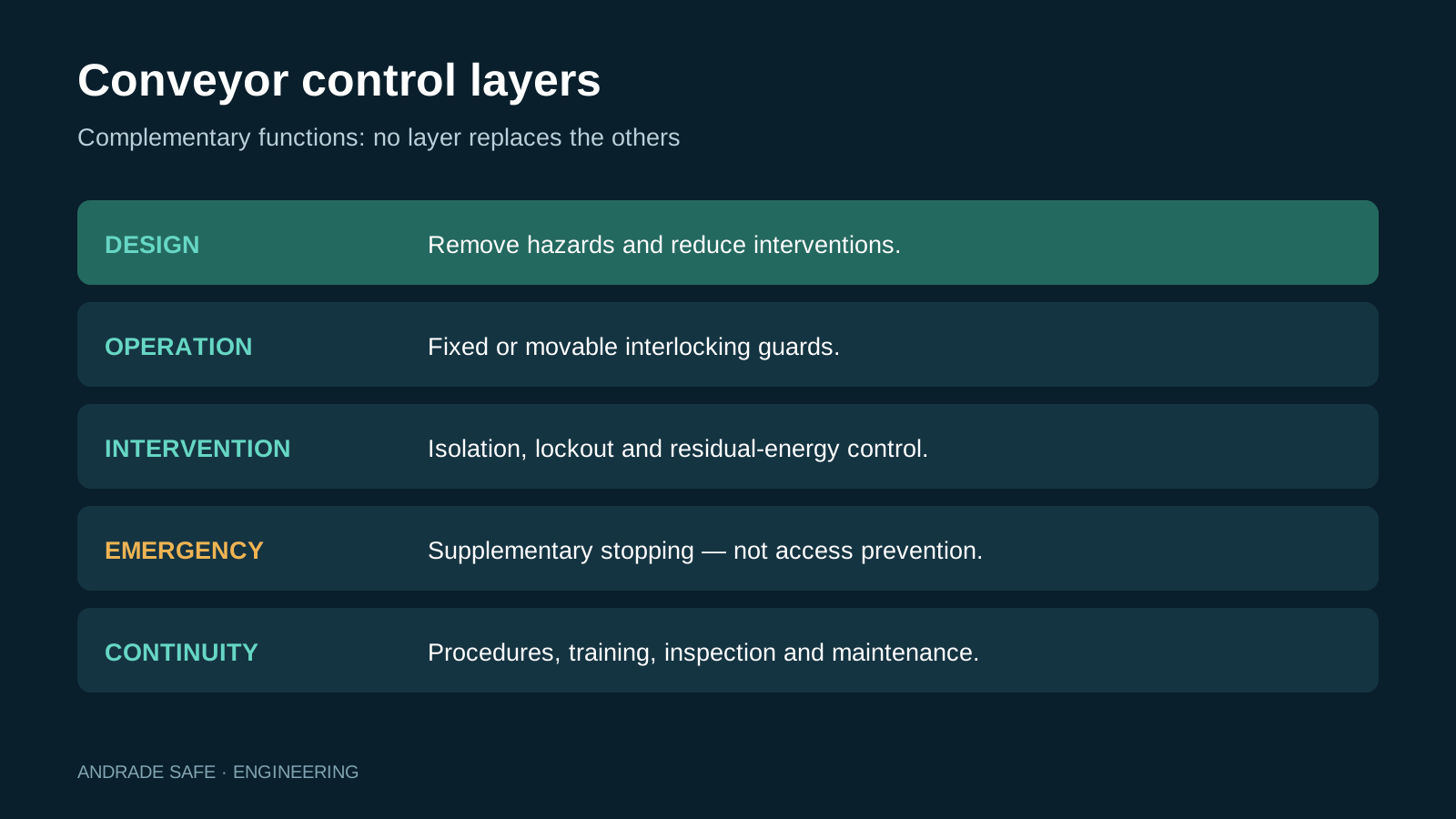
Pull cords and emergency-stop buttons can provide a means to stop an emergency along a conveyor. Their accessibility, operation, installation and inspection must match the design. A visible cable that is disconnected, out of reach or untested is not evidence of an effective function.
Emergency stopping relies on detection and action. It does not physically prevent a hand entering a nip. Resetting the device must not cause an unsafe restart. In the main case, the absence of a local emergency stop matters, but it does not overshadow the missing guard and isolation.
Inspect modifications, not just checklist completion
Look for cut openings, missing covers, altered fasteners, bypassed switches, loose actuators, new walkways and changes to control logic. Compare the current equipment with its drawings and actual tasks. An old modification remains a modification even after it becomes familiar.
As an engineering practice, changes affecting access, guarding, control or intervention should be assessed, approved, documented and verified before release. This is often called management of change. The expression is not presented as a universally named NR-12 programme.
Inspectors should ask whether hazards remain accessible and whether the prescribed work method is achievable. Testing must be planned by competent people without placing body parts in danger or defeating safeguards to demonstrate a fault. The existence of audits is not proof that barriers work.
Brazilian regulatory perspective: NR-12
NR-12 applies in its Brazilian legal context, not to the British cases. On 26 September 2026, Brazil's Ministry of Labour and Employment still listed Portaria MTE nº 344/2024 as its latest modification. Section 12.8 addresses material conveyors, alongside the general machinery provisions and intervention requirements.
Brazil's NR-12 machinery guide — in Portuguese →
| Provision | Scope and qualification |
|---|---|
| 12.8.1 and subitems | Protect accessible dangerous movement; specified exemptions depend on conditions such as absence of people in danger zones or perimeter safeguarding. Height alone is not sufficient. |
| 12.8.2 and subitems | Walkways for elevated belt conveyors, with defined conditions and alternatives for width, mobile conveyors and access platforms. |
| 12.8.6 and subitems | Restrictions on standing or travelling on moving or potentially moving parts not designed for that purpose; stopping, lockout and protected walkways as applicable. |
| 12.8.7 / 12.8.7.1 | Emergency stops along accessible conveyors and work positions; exemption only where justified by risk analysis. |
| 12.8.8 | Safety devices for hazardous abnormal misalignment or overload, with shutdown beyond design limits. |
| 12.11.3 | Stopped equipment, energy isolation and discharge, lockout, identification and relevant additional measures for authorised interventions. |
| 12.11.3.1 | A specific operating mode and prescribed controls for special situations, not general permission to work on running machinery. |
What if fault-finding requires movement?
Brazil's special-mode provision is not equivalent to ‘run slowly and be careful’. Within its scope, the selected mode must disable automatic operation, restrict mode changes to authorised people and provide hold-to-run with reduced speed or limited movement, together with the other prescribed conditions. Selection must be clear and override other commands except emergency stopping.
A technical need must be demonstrated and supported by a system designed for it. A bypassed switch, an improvised opening or a colleague beside the stop button is not that system. If safe conditions are unavailable, stop and redesign the intervention.
PUWER and ISO: keep legal and technical references distinct
In Great Britain, HSE's L22 explains PUWER, including regulation 11 on preventing access to dangerous machinery or stopping dangerous movement before it can be reached. Fixed guarding, other safeguards where necessary and complementary measures have distinct roles. PUWER is not Brazilian law, and NR-12 does not govern these British prosecutions.
The ISO catalogue still listed ISO 14120:2015 as published, with revision development recorded from 25 September 2026. ISO 14119:2024 was published for guard interlocking and foreseeable defeat; ISO 14118:2017 remained published and confirmed for unexpected start-up prevention. A revision project is not a published replacement. These references must be applied within the relevant technical and legal context, without assuming automatic legal force or equivalence to a national adoption.
A practical conveyor review checklist
Use these questions to organise competent assessment, not to improvise live testing. A checklist does not replace risk assessment or validation.
- Are accessible pulleys, rollers, moving parts and in-running nips safeguarded?
- Can a guard be removed without a tool when it should not be?
- Does frequent access require an interlocking movable guard?
- Have cleaning, setting, clearing and maintenance tasks been observed?
- Why is intervention during motion repeatedly requested?
- Are all hazardous energies, retained loads and residual movement controlled?
- Can automation, remote commands or power restoration cause unexpected start-up?
- Are required emergency stops accessible and tested?
- Are physical and electrical changes assessed and documented?
- Are walkways and areas above or below the conveyor suitable?
- Can the intended task be completed without defeating protection?
- Is there recorded verification before return to service?
Return to service requires more than reassembly
Check guard integrity and fastenings, tool removal, safe withdrawal of people, interlocks, stopping, reset and prevention of unintended restart. Confirm that the change has not created new trapping points or compromised access. Define equipment-specific acceptance tests, perform them safely and record results.
Where improvements are phased, prioritise by risk and evaluate interim operating conditions. Budget planning cannot make an uncontrolled hazard acceptable. Separate assessment, design, fabrication, integration and verification in the scope.
Risk-based priorities — Portuguese article →
What determines an NR-12 improvement budget — Portuguese article →
Design, actual work and maintenance must agree
If a procedure says stop and isolate while the machine allows intervention in motion, the rule alone is not the whole problem. Access, controls and the task itself must support a safe method. That lesson transfers without assigning blame to an injured person.
For operations in Brazil, Andrade Safe can support assessment, engineering and implementation or supervision within an agreed scope. Provide equipment identification, recurring tasks, modification history and available drawings. The objective is a verified engineering solution, not a generic NR-12 certification.
Discuss NR-12 assessment and conveyor improvements — Brazil →
Frequently asked questions
Which NR-12 section covers conveyors?
Section 12.8 covers material conveyors in Brazil. General safeguarding requirements and section 12.11 on interventions also apply within their scope and conditions.
Does every roller need the same guard?
No universal layout can be prescribed. Assess hazardous movement, accessibility and foreseeable tasks, including return rollers and maintenance access.
When is an interlocking guard needed?
Frequent access may require it rather than repeated removal of a fixed guard. Guard locking may also be necessary where hazardous movement persists long enough to be reached.
Can a conveyor be cleaned while running?
Interventions normally require stopping and control of hazardous energy. Special modes require engineered safeguards and applicable legal conditions, not improvised access to moving parts.
Does an emergency stop replace a guard?
No. It is supplementary and does not prevent access or replace necessary isolation.
What must be controlled before maintenance?
All relevant energy sources and dangerous movement, including gravity, tension, inertia and retained material. A machine-specific procedure must define isolation and verification.
How should an old conveyor modification be assessed?
Compare the installed configuration with drawings, tasks, hazards and controls. Review the change, correct deficiencies, update records and verify the result before release.
Who can design and validate an improvement in Brazil?
Safety systems require technical responsibility from a legally qualified professional with appropriate registered scope. Design, installation, testing and ART responsibilities must match the contracted work and Brazilian requirements.
References
- Manufacturer fined after worker suffers life-changing injuries in conveyor incidentHSE
- Baked goods company fined £333,333 after worker suffers broken armHSE
- Chemical manufacturer fined £100,000 after employee injured by conveyor machineryHSE
- Safe use of work equipment — L22 (PUWER)HSE
- NR-12 — página oficialMinistério do Trabalho e Emprego
- NR-12 — texto oficialMinistério do Trabalho e Emprego
- ISO 14120:2015 — GuardsISO
- ISO 14119:2024 — Interlocking devices associated with guardsISO
- ISO 14118:2017 — Prevention of unexpected start-upISO