
A living analysis of Meta Muse, market reactions, agentic commerce, payments, platform control, security and the shift from answering to acting.
September 23 snapshot: what is confirmed
Meta launched Muse on September 8 as a personal AI agent. Its official announcement says the rollout is in the United States on iOS, Android and muse.ai, with AI glasses to follow. Reuters cited Apptopia data for US and Canada regions. Neither source supports calling Muse globally available, and it was not officially available in Brazil at this check.
Investors repriced Meta, commerce and payment companies announced or detailed integrations, and Amazon blocked the agent. These events do not yet prove durable adoption, material revenue or a permanent new interface for the internet.
Why Muse matters beyond another chatbot
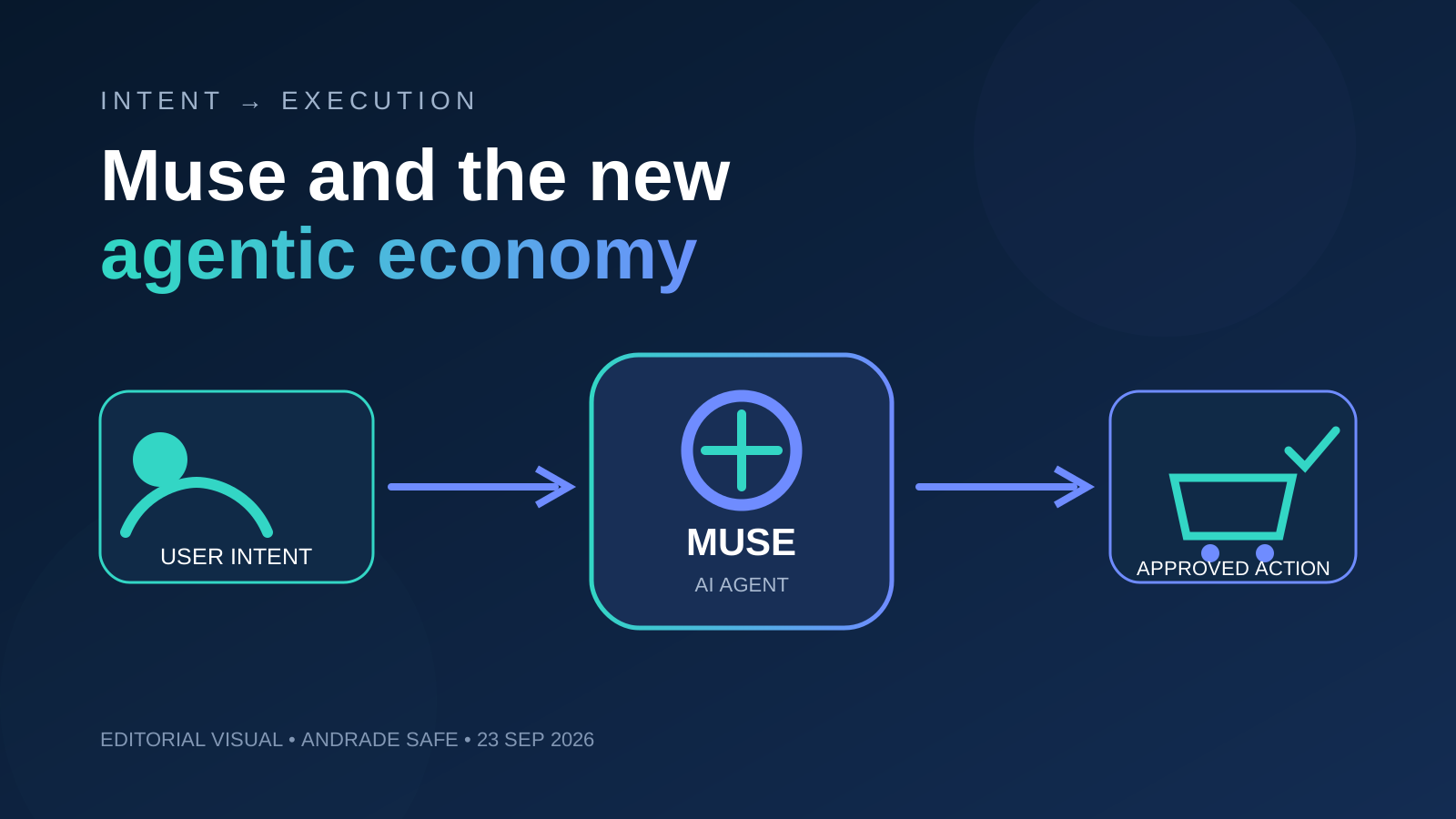
Muse is designed to open a browser, complete forms, book travel, negotiate, work in the background and prepare purchases, while asking for approval before sensitive actions. Meta says Muse Spark powers it and each user receives a dedicated Muse Secure VM.
Our editorial lens is a shift from the attention economy to a delegation economy: platforms compete not only for a click, but for the user’s intent and the route from ‘I want this’ to ‘done’. This is an analytical framework, not an established outcome.
Muse, Muse Spark and Meta AI
Muse is the agent product; Muse Spark is its announced model; Meta AI is the company’s broader set of AI experiences. The distinction matters when assessing distribution across WhatsApp, Instagram, Facebook, Messenger and future glasses.
Meta’s advantage is distribution and social context. The economics still depend on retention, task frequency, inference cost, paid conversion and access to third-party services—metrics that remain unproven publicly.
What the market repriced
Reuters reported that META rose more than 20% from launch through September 22, adding roughly $200 billion in market value amid Muse enthusiasm. The stock had gained more than 11% in the previous session. This is a dated correlation within a broader technology rally, not proof that Muse caused every dollar of the move.
Apptopia estimated 2.8 million downloads in 12 days. Downloads measure acquisition, not active use, retention or revenue. Free, $20 and $100 tiers create a direct subscription story, while analysts’ revenue scenarios remain external assumptions.
| Company/layer | Reported reaction | Responsible reading |
|---|---|---|
| Meta | >20% through Sept. 22; about $200bn added | Monetization expectations, not exclusive causation |
| Shopify | +7.3% on partnership news; +6.53% next session | Merchant-network value; structural benefit unproven |
| PayPal | +1.2% after integration news | Payments positioning; material revenue unproven |
| Twilio | Gains reported amid agent enthusiasm | Market expectation; no proven operating impact |
From launch to ecosystem contest
September 8 brought Muse, Stripe Link and the promise of Shop Pay. Early adoption and analyst commentary helped fuel the September 21 rally. Shopify chose integration while Amazon chose exclusion. By September 22, Meta had patched a macOS flaw; PayPal then widened the payment-rails debate.
The stages differ: Link was integrated for US consumers, while Meta described Shop Pay as ‘coming soon’. Announcements must not be written as universally operational products.
The agentic-commerce stack
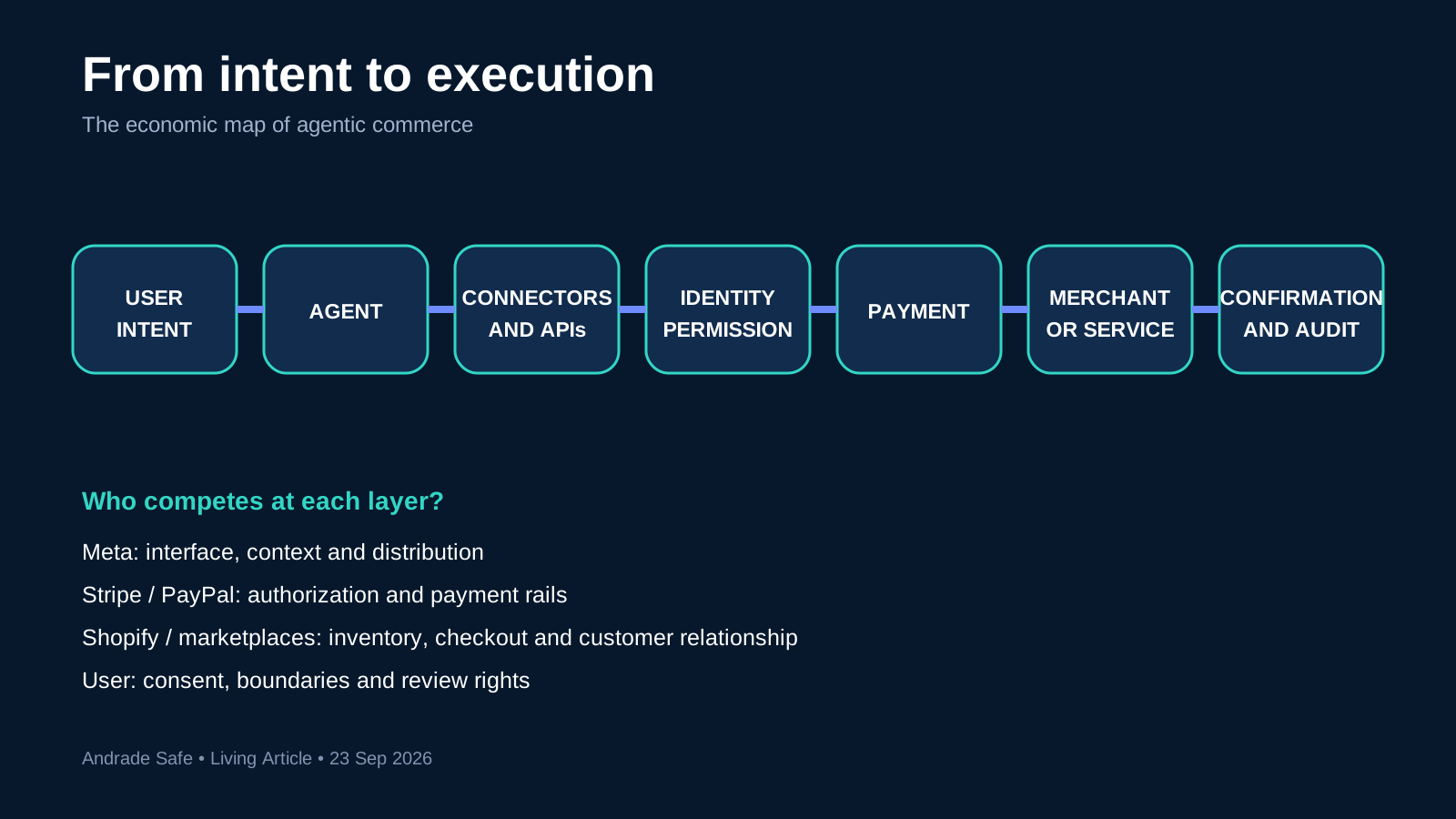
User intent passes through the agent, connectors, identity, permissions, payment, the merchant and an audit layer. Meta wants interface, context and distribution; Stripe and PayPal compete for authorization rails; Shopify supplies merchants and checkout; marketplaces protect customer experience and monetization.
Stripe says Muse can check out instantly at more than one million Link businesses and use a single-use virtual card elsewhere. Consumers approve the total, while Link says Muse never sees the underlying payment details.
Why Shopify opened and Amazon blocked
Shopify can remain infrastructure even when shoppers never visit a storefront: an agent discovers the product, but merchant systems and checkout still execute the order. Amazon said unauthorized agent access violated its terms and raised transparency, credential, data and customer-experience concerns.
There is also an economic conflict. An external agent may reduce time spent with marketplace recommendations, ads and upsells. The strategic question is not whether Amazon is ‘afraid’, but who may represent the customer, under which rules and with which accountability.
Muse versus ACP and UCP
OpenAI’s Instant Checkout uses the open Agentic Commerce Protocol co-developed with Stripe. Its published design keeps the merchant as merchant of record for payment, fulfillment, returns and support. Google connects Universal Commerce Protocol, Universal Cart and payment infrastructure across Search, Gemini, YouTube and Gmail.
The contest is bigger than Meta versus ChatGPT. It covers product data, authorization, tokenization, fraud, returns, identity, interoperability and walled gardens.
Security is the central contradiction
The more useful an agent becomes, the more context and authority it needs. Meta describes per-user isolation, credentials hidden from the main agent, Sentinel as the permission and egress authority, sensitive-action confirmation and an audit trail. Its bug bounty pays up to $300,000. These are company-described controls, not an independent audit.
Meta also promised a future Confidential VM designed so even Meta cannot access its contents. It should not be described as a universal launch-day protection.
The patched zero-day and human concierge test
Patrick Wardle reported a macOS flaw that could redirect processing and enable account control. Meta patched it and said exploitation required malicious code already running locally, so it was not trivial remote compromise. The incident still illustrates the larger blast radius of an agent connected to email, files and payments.
Reuters separately reported a human-concierge test in some phone calls and internal privacy concerns. That report describes a test, not every Muse call. Meta says VM conversations and data are not shared with its ad systems and offers a training opt-out.
Agent discoverability may reshape search and software
If users delegate decisions, brands may compete for agent recommendations rather than human clicks. Catalogs, APIs, price, availability, policy and reputation become machine-readable trust signals.
Effects on SEO, paid media, affiliates, comparison sites and customer-acquisition cost remain scenarios. APIs and CLIs may gain relative importance in SaaS, while ambiguous, regulated or high-impact work still needs human review.
Three 12-to-24-month scenarios
Scenario A: agents become a dominant interface and merchants standardize integrations. Scenario B: major platforms block outsiders and build separate walled gardens. Scenario C: errors, prompt injection, privacy and liability keep agents in assisted mode with frequent approvals.
Different industries can follow different paths. Payment standards may mature before insurance; travel search may automate before complex rebooking.
What remains unknown
Public evidence is insufficient on retention, active users, margins, cost per task, paid conversion, chargebacks, erroneous purchases, geographic expansion, regulation and incremental revenue. Downloads answer none of these questions.
The lasting shift is the strategic question itself: platforms no longer want only to be where users look. They want to be the agent users trust to act.
Frequently asked questions
What is Meta Muse?
A personal AI agent launched on September 8, 2026 to execute multi-step tasks and request approval before sensitive actions.
How do Muse, Muse Spark and Meta AI differ?
Muse is the agent product, Muse Spark is its model and Meta AI is Meta’s broader family of AI experiences.
Why did Meta shares rise?
Investors repriced adoption and monetization expectations after launch, amid other market factors. Muse was not necessarily the only cause.
How could Muse make money?
Meta offers a free tier and paid plans. Commerce and payments are additional strategic possibilities, but material revenue is not yet proven.
Why did Amazon block Muse?
Amazon cited unauthorized access, transparency, credentials, security and customer experience, within a wider contest over control of shopping.
Does Muse data feed Meta ads?
Meta says conversations and Secure VM data are not shared with its ad systems. That remains a company statement tied to product implementation and policy.
Is Muse safe?
Meta describes isolation, Sentinel, approvals and audit logs. A patched macOS flaw required local malicious code according to Meta; no complex agent is risk-free.
What is agentic commerce?
Commerce in which AI agents discover, compare, authorize or execute purchase steps on a user’s behalf.
Does Muse compete with ChatGPT and Gemini?
Yes at the personal-agent layer, but the ecosystems use different commerce standards and distribution surfaces.
Is Muse available globally?
No. Meta described a US rollout as of September 23, 2026; third-party download data also tracked Canada regions.
References
- Introducing Muse: The World’s First Personal AI Agent Built for EveryoneMeta
- How We Built Safety Into MuseMeta AI Research
- Stripe helps Muse shop across the internet with LinkStripe
- Wall Street expects Meta's AI agent to shape into a new revenue engineReuters
- Amazon blocks Meta’s Muse AI agentThe Verge
- Meta patches Muse exploit that let attackers control the AI agentThe Verge
- Buy it in ChatGPT: Instant Checkout and the Agentic Commerce ProtocolOpenAI
- Google Shopping introduces Universal CartGoogle