
Engineered stone has created a modern route to an old disease. This guide connects the California findings with material choice, wet methods, local exhaust, exposure assessment, respiratory protection and health surveillance.
An old disease in a modern material
A finished countertop looks clean and solid. Its most dangerous moment may have happened earlier, when a saw, grinder or drill turned a silica-containing slab into particles small enough to reach deep into a worker’s lungs.
Silicosis did not return because its cause was forgotten. It returns when new materials and fast production recreate intense exposure to an old hazard. Where disease is irreversible, preventing dust generation and inhalation is the most useful technology available.
What the 2026 California study found
From January 2019 through June 2026, California’s health department identified 592 silicosis cases among workers fabricating engineered-stone countertops. Of those workers, 65 underwent lung transplantation and 31 died.
These are deaths among identified cases; this article does not claim silicosis was the sole cause of every death. The finding still shows a severe and preventable burden affecting many workers at relatively young ages.

Why the process matters more than the showroom name
Engineered stone combines mineral aggregates with resin, pigments and other constituents. Traditional products often contain very high crystalline-silica proportions, but composition varies. Quartzite, granite, marble, porcelain and sintered stone are not one category.
An intact installed surface does not reproduce fabrication exposure. Risk grows when cutting, grinding, polishing, drilling, repair or removal produces respirable crystalline silica.
Respirable crystalline silica
Crystalline forms such as quartz and cristobalite differ from amorphous silica. The respirable fraction can penetrate deep into the respiratory system and cannot be explained as one fixed particle diameter.
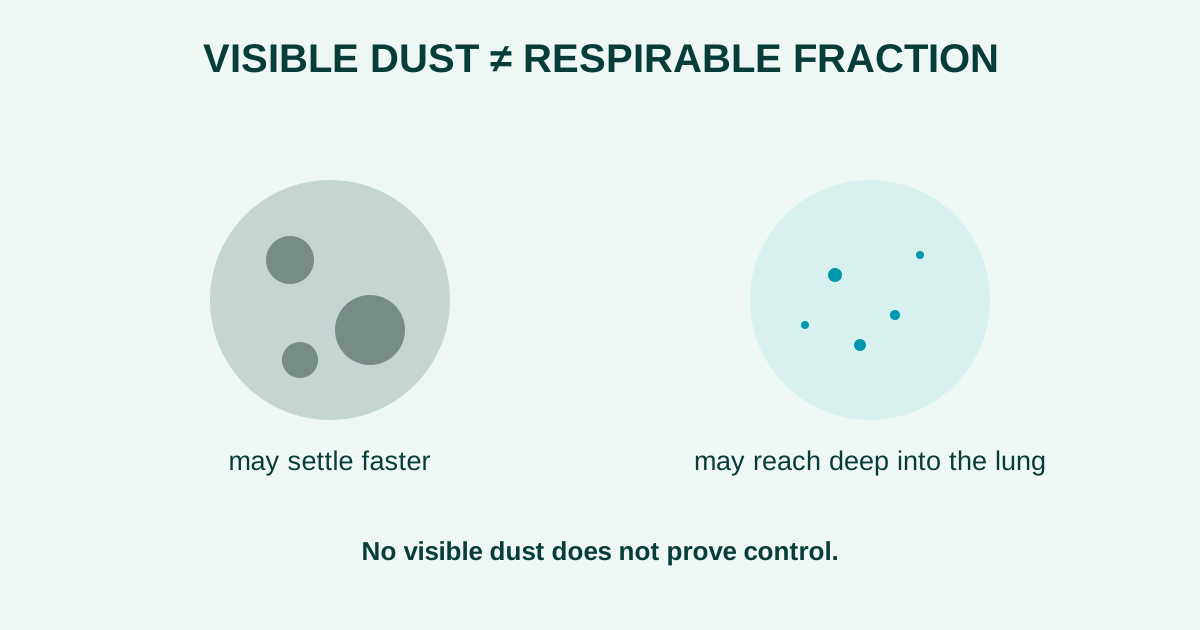
The most relevant particles may not form a visible cloud. Heavy visible dust signals poor control, but a clean-looking process does not prove acceptable exposure.

Silicosis is irreversible — exposure is not diagnosis
Inhaled respirable crystalline silica can cause inflammation and permanent lung scarring. No known treatment reverses established silicotic fibrosis; care focuses on preventing further exposure, managing complications and follow-up. Advanced cases may require transplantation.
Chronic, accelerated and acute forms reflect different exposure intensities and latency. Not every exposed person develops silicosis, and a job title, symptom or photograph cannot diagnose it.
Control begins before the respirator
Start with elimination and substitution, then engineering, administrative measures and PPE. Lower-silica materials can reduce one hazard but still need assessment for other constituents.
Accurate measurement, prefabrication and controlled shop cutting can remove improvised dry adjustments from occupied homes. The best dust is the dust the process never needs to create.

Wet methods help, but do not work by magic
Water delivered at the cutting point can substantially reduce emission. Performance depends on flow, nozzle position, tool, maintenance, material and technique. Local exhaust, tool capture, enclosure, automation and separation may still be needed.
A control on paper is not necessarily a control in the field. Flow, capture, filters, housekeeping and residual exposure need verification.
The dust returns after the tool stops
Dry sweeping and compressed air can put settled silica back into the breathing zone. Suitable wet cleaning or filtered vacuum methods should follow the assessment.
Clothing, footwear, vehicles and tools can transport contamination. Facilities should prevent work dust from becoming a take-home contaminant.
Sampling must represent real work
A pump does not make a sample representative. Strategy must consider worker group, task, material, duration, place, shift, controls and variability. Generic total-dust mass does not answer a respirable crystalline-silica question.
Collect the relevant fraction and use a compatible analytical method. Visual appearance is not a measurement strategy.
Health effects beyond silicosis
Excessive occupational exposure is also associated with lung cancer, COPD, certain autoimmune diseases, chronic kidney disease and increased tuberculosis risk.
IARC Group 1 means evidence supports carcinogenicity of occupationally inhaled crystalline silica; it does not mean every exposed worker will develop cancer.
What the 2026 NIOSH/OSHA alert adds
The joint alert reports that 51% of countertop shops inspected by California’s health department had at least one employee above OSHA’s 50 µg/m³ eight-hour PEL. That is not 51% of every US shop.
The alert prioritises little- or no-silica materials, wet methods, ventilation and avoiding dust-resuspending cleaning. OSHA’s PEL is a US rule, not a universal limit.

Medical surveillance cannot control the source
Medical surveillance can identify effects; it cannot remove dust. Diagnosis combines exposure history, compatible findings and exclusion of other causes. Cough, fatigue and breathlessness are nonspecific.
Workers with an exposure history and health concerns should seek qualified medical assessment and clearly describe their materials, tasks and controls.
Respiratory protection is a programme
A respirator may be necessary, but it does not justify an unnecessarily dusty process. Selection depends on agent, concentration, task, protection factor, wearer and environment.
Training, fit, facial seal, maintenance and follow-up matter. Facial hair in the sealing area can compromise tight-fitting respirators.
Installation and contractors belong in the plan
A small dry adjustment inside a kitchen can expose the installer and bystanders. Short duration alone does not resolve risk; intensity, repetition and cumulative exposure matter.
Builders should coordinate cutting locations, permitted methods, isolation, cleaning and adjacent work. Contracting out the task does not make the hazard disappear.

Australia’s ban is specific
From 1 July 2024 Australia prohibited defined engineered-stone benchtops, panels and slabs; an import ban followed on 1 January 2025. Its definition uses at least 1% crystalline silica and manufacturing characteristics, with exclusions.
It is inaccurate to shorten this to ‘Australia banned quartz’, and the Australian rule does not automatically govern another country.
The exposure is preventable
The 2026 study is alarming because of its cases, transplants and deaths. The harder truth is that the agent and prevention principles have been known for decades.
The problem does not begin in the lung. It begins in the process that generates dust. Silicosis may be irreversible; the exposure that causes it does not have to be inevitable.
References
- Silicosis among Workers Fabricating Engineered Stone (Quartz) Countertops in California, 2019–2026NEJM Evidence / PubMed
- OSHA/NIOSH Hazard Alert: Worker Exposure to Silica during Countertop Manufacturing, Finishing, and InstallationNIOSH / OSHA
- Documento alerta para risco de silicose em trabalhadores de pedras artificiaisFundacentro
- NR-15 — Anexo 12: Limites de Tolerância para Poeiras MineraisMinistério do Trabalho e Emprego
- NR-9 — Avaliação e Controle das Exposições OcupacionaisMinistério do Trabalho e Emprego
- NR-7 — Programa de Controle Médico de Saúde OcupacionalMinistério do Trabalho e Emprego
- Norma de Higiene Ocupacional NHO 08Fundacentro
- Programa de Proteção RespiratóriaFundacentro
- Silica — Engineered stone banSafe Work Australia
- Silica Dust, Crystalline, in the form of Quartz or CristobaliteInternational Agency for Research on Cancer