
A crate of approximately 1.2 tonnes fell from a forklift described as having a two-tonne capacity during a 2020 delivery in Hull. A September 2026 prosecution illustrates why load geometry, rated load centre, equipment suitability, planning and supervision must be assessed together.
Two numbers cannot answer the safety question
A crate weighing about 1.2 tonnes fell from a forklift described as a two-tonne truck. The apparent margin invites a tempting calculation: 1.2 is less than 2. Yet the Health and Safety Executive found that no one had assessed whether that truck was suitable for the characteristics of this particular load. Neither safety nor a capacity exceedance can be deduced from those two figures alone.
The accident happened in Hull on 22 December 2020. Smith & Nephew Medical Ltd was sentenced on 14 September 2026; the HSE issued its account the next day. The publication is recent, not the accident. The engineering question is evergreen: a data plate gives capacity under stated conditions, not blanket approval for every load below its headline rating.
What the HSE established, and what remains unknown
A 64-year-old employee of Nippon Express (UK) Ltd was delivering a large crate containing an electron microscope to Smith & Nephew Medical Ltd. The crate fell from a forklift during unloading and caused life-changing injuries. Nippon Express had intended to supply the truck and its driver, but pandemic access restrictions led Smith & Nephew to take responsibility for unloading.
The HSE found that the task had not been properly assessed, planned or supervised. It identified no assessment of the suitability of Smith & Nephew's two-tonne forklift for the load's characteristics, and inadequate consideration of method, personnel, precautions and control. The company was found guilty under Section 3(1) of the Health and Safety at Work etc. Act 1974, fined £230,000 and ordered to pay £111,000 in costs.
The HSE refers to unsafe positioning and an unsafe lift. It does not publish the crate's dimensions, actual centre of gravity, load-centre distance, fork length, attachment or full mechanical sequence of the fall. We cannot claim that an excessive load centre caused the accident or retrospectively calculate the truck's residual capacity.

Rated capacity is conditional
A forklift's declared capacity is tied to the load centre and configuration shown on its data plate. The US OSHA eTool explains that moving a load's centre of gravity farther forward reduces the capacity available to the truck. Load weight, distribution, size, shape and position on the forks all matter. An attachment may change the approved configuration as well.
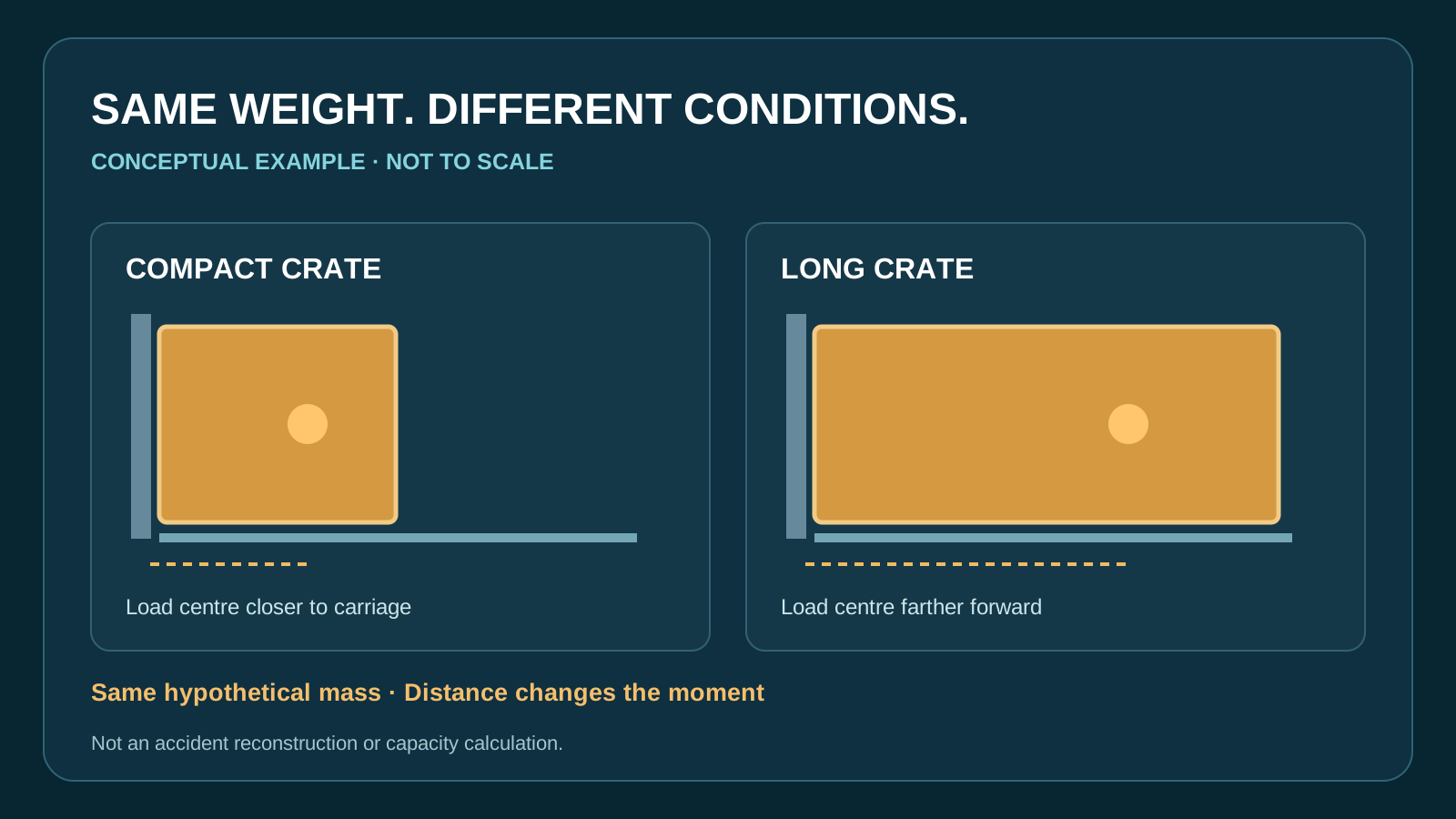
The centre of gravity is the resultant point of the load's weight. Load centre describes the relevant horizontal distance from the vertical face of the forks to that point in the manufacturer's capacity information. Holding an object close to your body feels different from holding the same object at arm's length: the distance changes the moment. The graphic below compares two hypothetical crates of equal mass; it contains no measurements from the Hull accident.
Even an approved weight and load-centre combination does not settle crate support, potential slipping, route, floor, slope, visibility or pedestrian exclusion. The plate and manual are inputs to a planned operation. They are not the plan.
Routine lifts and unusual loads need different levels of planning
The HSE says a straightforward, recurring forklift operation may be covered by an initial generic plan within the normal risk assessment, so long as its assumptions remain valid. Greater complexity or risk calls for more specific planning, competent input and supervision. Its guidance does not say every forklift movement needs a detailed rigging plan.
A bulky, eccentric, fragile, high-value or otherwise non-standard crate can invalidate routine assumptions. Its total weight may be known while the location of its centre of gravity, support points or tendency for contents to shift remains uncertain. Dock layout can affect how the forks approach and who can see the manoeuvre.
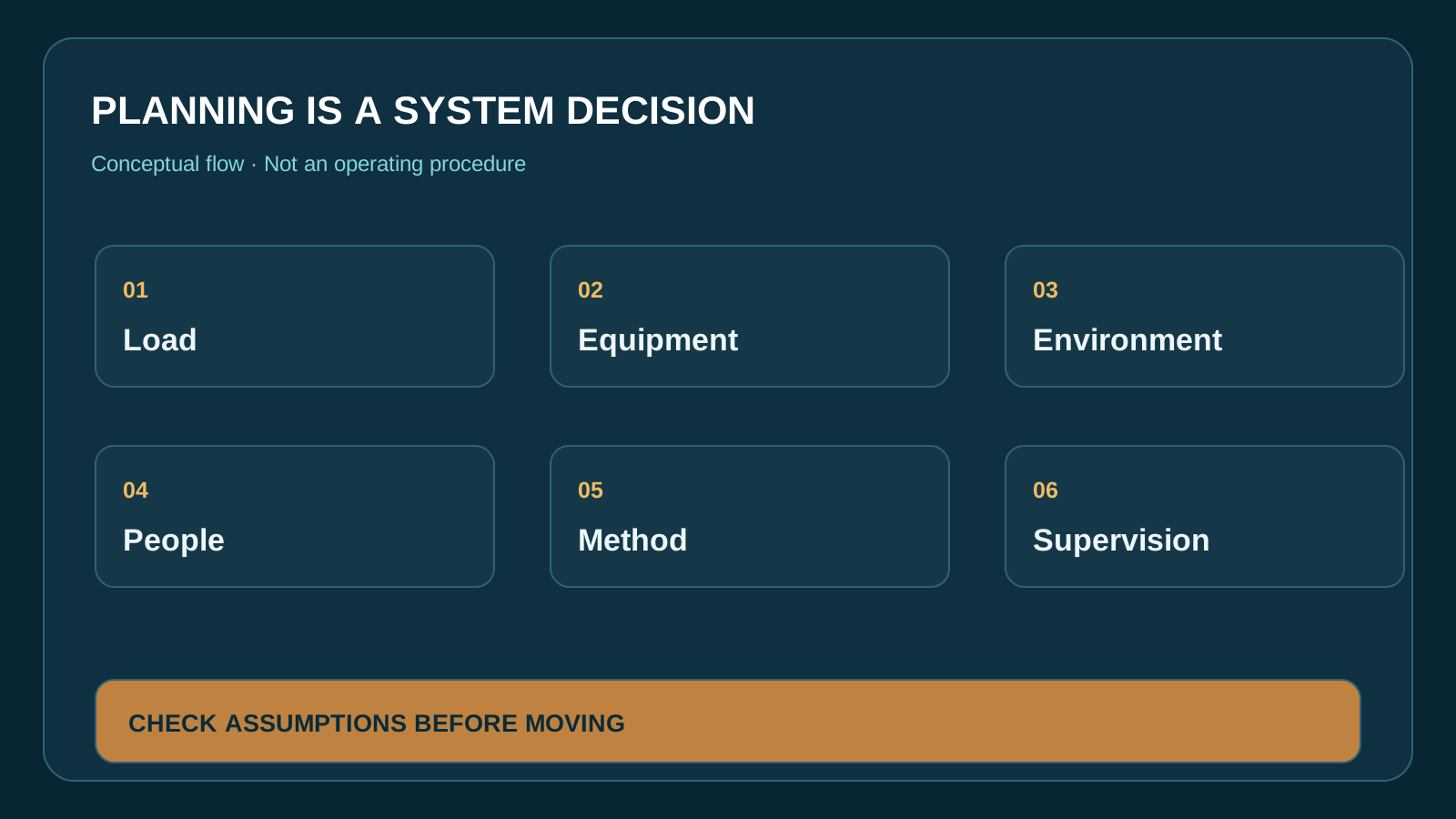
A proportionate review considers the actual truck and configuration, load support and restraint, route, floor, exclusions, communication, personnel, supervision and contingency. If the delivery no longer matches the established method, stop and reassess rather than treating a standard risk assessment as a universal pass.
A change in who unloads changes the risk interface
The carrier had planned to supply a truck and driver; the receiving site instead assumed unloading. That changes the available equipment, operator, command of the job and interaction with the delivery worker. The HSE inspector emphasised that precautions for third parties remained necessary despite the pandemic-driven change.
The parties need a shared answer to who selects the method, drives, guides, controls access, supervises and has stop-work authority. Nobody should end up near or beneath the load because responsibility for a visitor was left ambiguous. These are transferable coordination lessons; the UK prosecution does not automatically establish legal liability under Brazilian law.
Questions before a non-routine unloading operation
These prompts support a competent site-specific assessment. They are not a step-by-step lifting instruction.
Related: inspection of cranes and hoists — Portuguese →
- Is the combined weight of crate, packaging and contents reliable?
- Are dimensions, mass distribution and possible internal movement known well enough?
- Does the truck's data plate and manufacturer guidance cover the actual load centre and attachment?
- Are fork support, packaging and restraint appropriate to foreseeable slipping or falling?
- Have dock, floor, slopes, clearance, route and visibility been assessed?
- Can people be kept outside the load and truck danger zone throughout?
- Who operates, signals, supervises and can stop the job?
- Did the method or responsibility change from the delivery agreement?
- Are pedestrians, vehicles, doors, structures or other work affected?
- What is the stop point and alternative if assumptions prove false?
Brazilian context: current NR-11 versus a proposed revision
Brazil's NR-11 is a special regulation for material transport, handling and storage within its scope. As checked on 28 September 2026, the Ministry of Labour's current page still listed Portaria MTPS 505/2016 as its latest modification. Item 11.1.3 expressly includes forklifts and requires equipment to be built for strength and safety and kept in suitable working condition; 11.1.3.2 requires a visible maximum permitted working load. Items 11.1.5–11.1.6 address operator training and authorisation, while 11.1.7 requires an audible warning on motorised transport equipment.
A public consultation proposes more detailed NR-11 wording and mentions a load plan in particular proposed contexts. That draft is not current law. The current NR-11 does not impose a generic formal load plan for every forklift unloading job. Brazil's NR-01 risk-management framework can inform the assessment without creating a specific NR-11 duty that the published text does not contain.
LOLER and HSE guidance belong to the UK context; OSHA is a US technical reference. ISO 3691-1:2011 remains published and current in the ISO catalogue, while ISO/FDIS 3691-1 is still an approval-stage draft. Neither the draft nor a foreign source should be presented as a Brazilian legal requirement.
Engineering and Brazilian regulations guide — Portuguese →
| Source | Status on 28 September 2026 | How to use it |
|---|---|---|
| Brazilian NR-11 | Current published text; latest change listed as 2016 | Apply relevant Brazilian requirements. |
| NR-11 consultation | Draft proposal | Track it without treating draft provisions as law. |
| HSE/LOLER, OSHA, ISO | UK law/guidance, US reference, international standard | Identify jurisdiction and edition. |
When to seek specific engineering support
If the load's mass distribution, support, centre of gravity or the truck's approved capacity in its actual configuration cannot be demonstrated, the operation has not been justified. An unusual shape, uncertain packaging, attachment change, constrained space or public interface may justify a deeper review, manufacturer input and qualified engineering. The solution may be a different truck, attachment, delivery arrangement or method.
That is not a universal statement that every delivery needs an engineer, an ART or a formal load plan. Scope and responsibility follow the actual complexity and applicable requirements. In a production environment, conveyor interfaces introduce different hazards; the related article addresses guarding and isolation.
The complete system must make sense before the lift
Weight and headline capacity are only two inputs. Compatibility among the load, truck, surroundings, method and people must be established before the crate leaves the ground. In the HSE case, the documented deficit was inadequate assessment, planning and supervision—not a published calculation of why the crate fell.
For Brazilian operations, Andrade Safe can assess non-routine movements, verify technical assumptions and develop load-handling plans or mechanical inspections according to the agreed scope. A useful enquiry begins with the equipment, the load and the actual unloading constraints, not an assumption that all routine forklift work needs a formal plan.
Frequently asked questions
Can a two-tonne forklift lift a 1.2-tonne crate?
The two figures alone cannot settle it. Check the actual configuration and load centre against the data plate and manufacturer information, plus load support, surroundings and people. The HSE found that suitability had not been assessed in this case.
What is a forklift load centre?
It is the horizontal distance relevant to the load's centre of gravity and the vertical face of the forks in the manufacturer's rated-capacity information.
How do I establish capacity for a particular load?
Use the data plate and manufacturer's instructions for the actual load centre, attachment and configuration. If the data are missing, do not infer a safe capacity from the headline tonnage.
Can a longer load reduce available capacity?
Yes, if its centre of gravity lies farther forward, the load moment rises and available capacity may fall. The specific limit depends on the manufacturer-approved configuration.
Does every forklift lift need a written lifting plan?
No. Planning is proportionate. A valid generic assessment may cover common routine work; unusual loads and changed methods can require specific planning and supervision.
Does Brazilian NR-11 require a formal load plan for every forklift job?
The current text checked on 28 September 2026 does not impose that generic requirement. A public-consultation proposal is not the published regulation.
Who should assess a non-standard load?
People competent for the load, truck and task, with supervision proportionate to the risk; seek the manufacturer and qualified engineering when assumptions cannot be verified.
References
- Crate falls from forklift truck and seriously injures workerHSE
- Planning and organising lifting operationsHSE
- Lifting Operations and Lifting Equipment Regulations 1998 — overviewHSE
- Powered Industrial Trucks eTool — Load CompositionOSHA
- NR-11 — página oficial vigenteMinistério do Trabalho e Emprego
- NR-11 — texto oficial vigenteMinistério do Trabalho e Emprego
- Consulta pública de revisão da NR-11Participa + Brasil
- ISO 3691-1:2011ISO
- ISO/FDIS 3691-1ISO