
A lifecycle guide to occupational risks and controls in utility-scale solar, wind and hybrid projects.
Direct answer: what are the main hazards?
Solar and wind farms combine electricity, work at height, lifting, machinery, traffic, excavations, severe weather, ergonomics, hazardous energy, remote logistics and complex emergencies. Renewable generation does not remove occupational hazards.
The strongest prevention begins in design: access, isolation, anchorage, routes, drainage, lighting, rescue, traffic separation and maintainability should be decided before they become permanent constraints.
Why the issue became urgent in Brazil
A September 2026 Fundacentro seminar highlighted rapid expansion, limited practical technical material and requirements spread across several Brazilian standards. This is not a legal vacuum: applicability follows the task and hazard.
Brazil's BEN 2026 reported 86.8% renewables in internal electricity supply in 2025. Wind and solar together accounted for 26.4% of generation. Growth at this scale makes the coordination of design, contractors and controls a core performance issue.

No single renewable-energy rule
In Brazil, NR-1 risk management connects with NR-10 for electricity, NR-18 for construction and NR-35 for work at height. Other standards may apply depending on the work. International readers should map the same hazards to their own jurisdiction.
A nacelle is not automatically a confined space; classification depends on the applicable criteria and actual conditions.
| Topic | Primary Brazilian reference | Design question |
|---|---|---|
| Risk management | NR-1 | Are hazards, contractors, changes and emergencies integrated? |
| Electricity | NR-10 | Are isolation, re-energization prevention and competencies controlled? |
| Construction | NR-18 | Were access, excavations and collective protection planned? |
| Work at height | NR-35 | Can exposure be avoided and how will rescue work? |
Risk changes across the lifecycle
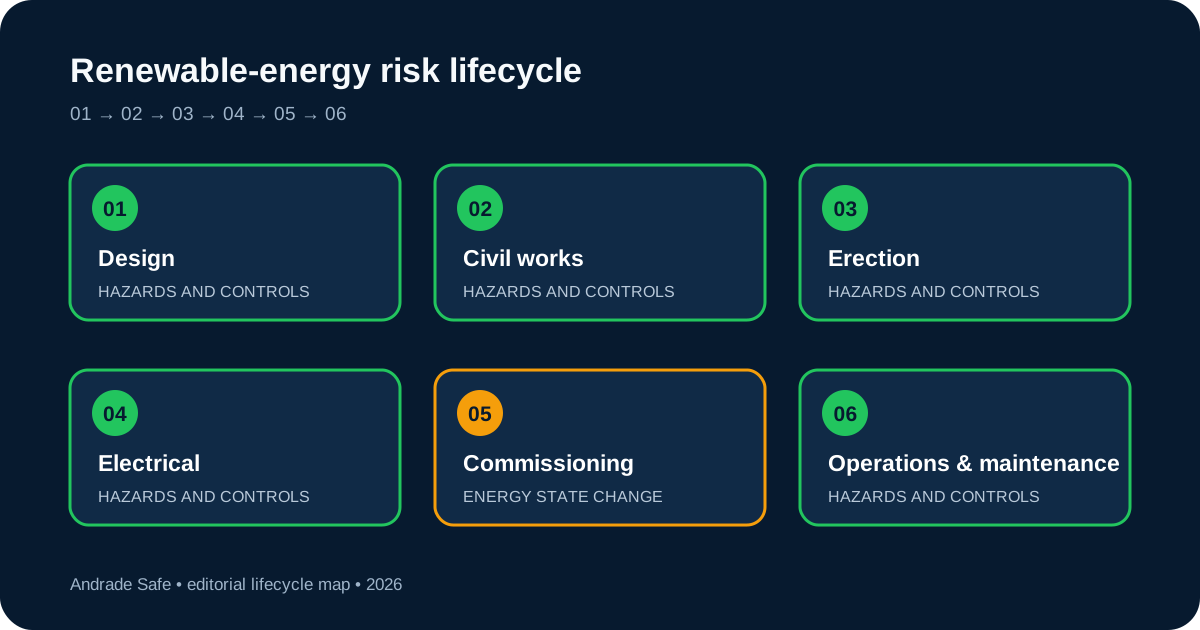
Civil works emphasize traffic, excavation and stability; erection adds lifting and falls; electrical installation introduces conductors and tests; commissioning creates transitional states; operations bring routine, degradation and remote response; repowering reopens old interfaces.
| Stage | Dominant exposures | Critical decision |
|---|---|---|
| Design and mobilization | Layout, access, logistics, weather | Eliminate hazards by design |
| Civil works | Machinery, excavation, traffic, dust | Separate people and equipment |
| Erection | Lifting, falls, crushing, ergonomics | Plan method and exclusion zones |
| Electrical | Shock, arc, cables, testing | Control configuration and competence |
| Commissioning | Progressive energization, backfeed, SIMOPS | Set boundaries and release authority |
| Operations and maintenance | Routine, weather, faults, remoteness | Maintain barriers and response |
| Repowering/decommissioning | Residual energy, ageing structures | Revalidate drawings and actual state |
Solar farms: DC demands specific discipline
Photovoltaic modules produce voltage under irradiation. Switching off an inverter does not automatically de-energize all upstream components. Strings, connectors, combiner boxes, inverters, transformers and networks require configuration-aware isolation and verification.
Manual handling, repetitive posture, heat, UV, dust, vegetation, trenches, traffic and fire must also be controlled. Fire risk depends on faults, connections, installation and protection—not a simplistic claim that panels ignite easily.
Wind farms: height, energy and rescue
Towers, nacelles, hubs and blades combine falling hazards, objects, electrical energy, rotation, gravity, hydraulics and weather. Major components also require engineered lifts and controlled exclusion zones.
Rescue must fit geometry, access and remote response time. GWO BST V20 and ART V6 are useful industry references, but they do not replace national law or site-specific controls.
Commissioning: when the hazard becomes live
During commissioning, assemblies begin to receive, store, transform or return energy. Backfeed, temporary supplies, partial release, functional tests and simultaneous work may coexist.
Use an energization matrix, system boundaries, visible status, key control, lockout, permits, single release authority, shift handover and SIMOPS coordination. ‘Still under construction’ never proves de-energization.
- define each system, physical boundary and release owner
- publish the sequence and authorized states
- verify drawings against the real configuration
- control normal, temporary and possible return sources
- record handover among construction, commissioning and operations
- stop the test when assumptions or conditions change
Hazardous-energy control is more than a lock
Isolation must cover electrical, mechanical, hydraulic, pneumatic, gravitational, thermal and stored energy. Identify every source, dissipate residual energy, verify the safe state and control removal.
Outdated drawings or unclear boundaries can invalidate lockout. The padlock is one barrier within an engineering and management system.
Weather and remoteness are operational variables
Wind, lightning, heat, rain, visibility and ground conditions change lifting, access and rescue. Stop-work criteria need instruments, authority and communication before schedule pressure appears.
Emergency plans should address coordinates, communications, gates, internal roads, medical resources, transport and rescue scenarios—not a generic response time.
Contractors and simultaneous operations
Developments combine EPCs, manufacturers, hauliers, erection, electrical teams, testing and operators. Each company may control its task yet still create risk for another. Interface meetings, workfront maps, compatible permits and stop-work authority are operational controls.
Ten questions before mobilization
Answers should identify evidence, owner and acceptance criteria.
- Which hazards were eliminated in layout and design?
- Who controls configuration and energization at each stage?
- How will construction, testing and operations share information?
- Which energy can remain or return after isolation?
- Which tasks can be completed at ground level?
- How do wind, lightning, heat and rain stop work?
- What is the actual rescue and remote medical plan?
- How will machinery, pedestrians and lifts be separated?
- Which drawings and as-built records must be available?
- How will contractors demonstrate competence and control effectiveness?
What international references add
OSHA provides solar and wind hazard libraries; EU-OSHA examines traditional hazards in green jobs; GWO structures sector training; IRENA and ILO estimated at least 16.6 million renewable-energy jobs worldwide in 2024. These sources support learning, not automatic legal transposition.
Conclusion: safety is an asset-performance requirement
Designing safety early reduces improvisation, rework and downtime. A reliable farm must allow isolation, inspection, maintenance and rescue throughout its life—not only produce megawatts at acceptance.
The mature indicator is the ability to work with known states, clear boundaries and verifiable barriers.
Frequently asked questions
Is there one Brazilian rule for solar and wind farms?
No. Brazilian requirements form a hazard- and activity-based framework, including NR-1, NR-10, NR-18 and NR-35 where applicable.
Does switching off an inverter make PV strings safe?
Not necessarily. Modules generate under irradiation and DC sections can remain live; configuration-aware isolation and verification are essential.
Is every wind-turbine nacelle a confined space?
No. Classification depends on the applicable criteria and actual space and task.
Is GWO mandatory in Brazil?
Not as a general legal rule. It is an international industry standard and may be contractually required, but does not replace Brazilian requirements.
Why is commissioning critical?
Because the plant changes state and multiple supplies, backfeed, tests and simultaneous work can coexist.
References
- Seminário discute urgência na regulamentação de SST para o setor de energias renováveisFundacentro
- Publicações institucionaisFundacentro
- Relatório Síntese do Balanço Energético Nacional 2026Empresa de Pesquisa Energética
- Expansão da matriz elétrica em agosto é de quase 2 GWANEEL
- Norma Regulamentadora nº 10Ministério do Trabalho e Emprego
- Norma Regulamentadora nº 18Ministério do Trabalho e Emprego
- Norma Regulamentadora nº 35Ministério do Trabalho e Emprego
- Solar Energy — Green Job HazardsOSHA
- Wind Energy — Green Job HazardsOSHA
- Health and safety of workers in green jobsEU-OSHA
- Basic Safety Training Standard V20Global Wind Organisation
- Advanced Rescue Training Standard V6Global Wind Organisation
- Solar Safety Training StandardGlobal Wind Organisation
- Renewable energy and jobs: Annual review 2025IRENA / ILO