
A practical guide to finding, interpreting and applying U.S. Chemical Safety Board reports, videos, appendices and recommendations without confusing an international reference with local law.
Direct answer: what is the CSB?
The CSB is the U.S. Chemical Safety and Hazard Investigation Board, commonly called the U.S. Chemical Safety Board. It is an independent, nonregulatory US federal agency that investigates serious chemical incidents, determines causes or probable causes and issues safety recommendations.
Its practical value extends beyond the United States. Safety, engineering, maintenance and operations professionals can freely access real incident reports, evidence, testing, animations, recommendations and investigation updates.
The CSB does not issue fines or enforcement citations. Its findings are sources of evidence and learning, not automatic legal requirements in another jurisdiction.
Why the agency is independent and nonregulatory
The CSB was authorised by the Clean Air Act Amendments of 1990 and became operational in January 1998. Congress separated its investigative role from EPA and OSHA rulemaking, inspection and enforcement, drawing partly on the separation represented by the National Transportation Safety Board model.
Board members are appointed by the US President and confirmed by the Senate. Investigative teams include chemical and mechanical engineers, industrial safety experts and other specialists.
Since 1998, the agency says it has deployed to roughly 180 incidents involving more than 200 fatalities, over 1,300 injuries and many billions of dollars in damage. These are approximate historical figures, not a fixed 2026 count.

CSB, OSHA and EPA: who does what?
The organisations may appear around the same event, but their functions differ.
| Organisation | Core role here | Do not assume |
|---|---|---|
| CSB | Independent investigation and safety recommendations | It does not fine or cite |
| OSHA | Occupational safety regulation and enforcement within its authority | A CSB finding is not automatically an OSHA citation |
| EPA | Environmental regulation and chemical accident-prevention programmes | Its role is not independent accident investigation |
| Other jurisdictions | Apply their own laws and institutions | There is no simple one-agency equivalent |
How a CSB investigation works
Investigators interview witnesses, obtain records and may send samples and equipment for independent testing. They examine safety and maintenance records, inventories, procedures, operations, industry practices and relevant rules.
The team evaluates evidence, consults specialists and Board members, and drafts findings, conclusions, causes and recommendations. A final report may be adopted by written Board vote or at a public meeting.
The mission page says the process generally takes six to eighteen months. That is a tendency, not a deadline. The Board may also conduct hazard studies without one specific accident.
What you can find free on the CSB website
The archive contains materials at different stages and for different purposes.
| Resource | What it contains | Best use |
|---|---|---|
| Current Investigations | Open cases and available facts | Confirm status; do not infer a final cause |
| Completed Investigations | Final reports and recommendations | Study formally adopted analysis |
| Investigation Updates | Interim facts and evidence | Track progress without treating it as final |
| Appendices and testing | Models, test data and contractor reports | Resolve technical questions |
| Safety Videos | Visual reconstructions and animations | Support learning after reading sources |
| Recommendations | Text, recipient, status and follow-up | Understand the requested change |
| Advocacy Products | Alerts, bulletins, spotlights, studies and digests | Explore recurring hazards |
| Documents Search | Search by category, case and keyword | Navigate hundreds of documents |
| PSM Training App | BP Texas City-based tour of OSHA PSM's 14 elements | Legacy educational resource; verify compatibility |
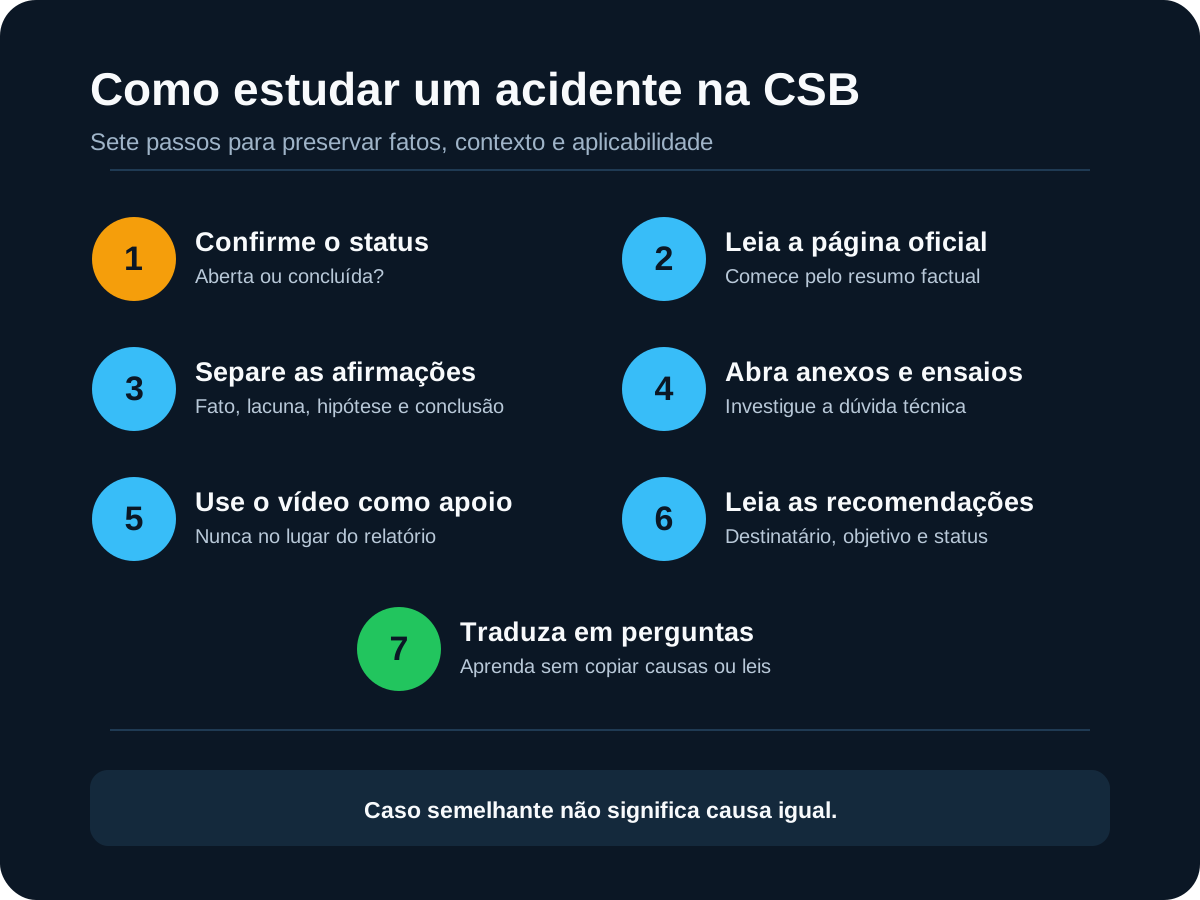
How to study an accident in seven steps
Use this sequence to avoid beginning with someone else's conclusion or copying one case to another site.
- 1. Confirm whether the investigation is current or completed.
- 2. Read the official investigation page and factual summary first.
- 3. Separate confirmed facts, gaps, hypotheses, conclusions and recommendations.
- 4. Open appendices, test reports and figures for technical questions.
- 5. Use the official video as a visual supplement, never as a report substitute.
- 6. Read each recommendation, recipient, objective and current status.
- 7. Convert the learning into questions for your process without automatically copying a cause or rule.
Golden rule: a similar case does not prove the same cause
A CSB case is evidence about that event. Similar equipment or consequences can generate useful hypotheses but cannot establish causation elsewhere.
Transfer questions instead: what hazard existed, what moved, which safeguards were expected, which were available in the actual mode, and which earlier decision created vulnerability?
An Investigation Update is not a Final Report
An update records what the agency can support at that stage. It may describe sequence, equipment, substances, tests and open questions, but it does not authorise readers to fill gaps with speculation.
On September 20, 2026, Nippon Dynawave and Catalyst Refiners were listed as current investigations. Clairton and Shell Polymers Monaca were completed investigations with final reports. Writing must follow that distinction.
How to read a CSB recommendation
Ask who received it, what problem it addresses, what action it requests and what its current status means. Companies, regulators, standards bodies, unions, universities and emergency organisations may all be recipients.
Open and closed contain substatuses. Closure can reflect acceptable action, acceptable alternative action, action exceeding the request, reconsideration, no longer applicable status or an unacceptable outcome. Closed therefore does not always mean literal implementation.
As of the June 9, 2026 Board vote, the published snapshot listed 1,061 recommendations: 129 open and 932 closed. Those figures are dated, not permanent.
Using the CSB outside the United States
A CSB report does not create legal duties in another country. OSHA, EPA, NFPA, API, ANSI/ISA or CCPS references also do not become local law merely because a US report cites them.
Separate local legal duties, applicable technical standards, recognised good practice and international reference. Confirm the law and standards in force for the actual site before drawing a compliance conclusion.
Do not search for a simplistic one-to-one institutional equivalent. Different bodies may perform parts of investigation, research, enforcement and standard-setting.
Turning the archive into routine practice
In hazard analysis, CSB cases can expand the deviations, modes and barrier failures considered. In maintenance, they sharpen questions about degradation, isolation and decisions to continue operation. In training, videos help visualise sequences when their limitations remain explicit.
For audits and management systems, recommendations and appendices help test whether an organisation addressed only the immediate act or also the conditions that made escalation possible. For toolbox talks, use one transferable question instead of sensationalising victims.
Five studies to start with
This is not a ranking. The cases were selected for teaching value and variety.
| Case | Learning focus | Useful question |
|---|---|---|
| BP Texas City, 2005 | Startup, process safety culture, facility siting and management systems | Is personal safety masking process risk? |
| Imperial Sugar, 2008 | Combustible dust, accumulation, confinement and propagation | Where can accumulated material fuel secondary events? |
| Chevron Richmond, 2012 | Corrosion, mechanical integrity and maintenance decisions | How do degradation signals become intervention decisions? |
| Foundation Food Group, 2021 | Liquid nitrogen, oxygen deficiency, alarms and ventilation | Will the system respond before exposure? |
| Shell Polymers Monaca, 2025 | Administrative controls, HMI, modes and engineered safeguards | Which controls are truly independent and available? |
How Andrade Safe uses the CSB
Our editorial rule is to separate fact, gap, hypothesis, conclusion and learning. Clairton and Shell Monaca show what final reports support; open cases preserve causal uncertainty.
The CSB shows what a deep investigation can reveal. The SAFE Method organises evidence, timelines, safeguards, causal factors and actions in the Brazilian occupational-safety context without reducing the event to individual blame.
Essential CSB links to save
Return to official pages whenever an investigation or recommendation changes.
Conclusion
The value of the CSB is not collecting dramatic accidents or copying recommendations. It is seeing how design, maintenance, procedures, change, interfaces and organisational decisions combine until a safeguard no longer performs.
Choose a relevant case, confirm its status, read the primary evidence and turn the lesson into testable questions. The aim is to find similar pathways before your own safeguards fail.
Frequently asked questions
What does CSB stand for?
U.S. Chemical Safety and Hazard Investigation Board, commonly called the U.S. Chemical Safety Board.
Is the CSB the same as OSHA?
No. The CSB investigates and recommends; OSHA regulates and enforces within its authority.
Does the CSB issue fines?
No. It does not issue fines or enforcement citations.
Are CSB reports free?
Yes. Reports, updates, appendices, videos and recommendations are free on the official website.
Can I use a CSB report outside the United States?
Yes, as technical evidence and learning. It does not automatically create a local legal duty.
How do I know whether an investigation is finished?
Check Current Investigations and Completed Investigations. An Investigation Update is not a Final Report.
Where can I find CSB safety videos?
Use the Videos section and investigation pages. Treat videos as supplements to source documents.
Is a CSB recommendation legally binding in my country?
Not automatically. Separate international recommendations from applicable local law and standards.