
An evidence-led comparison of incident investigation approaches: ILO, HSE, ISO 45001/45002, IEC 62740, CSB, CCPS, DuPont/dss+, ICAM, Tripod Beta, DNV, human factors and Brazil's NR-1. Includes a hypothetical case and effectiveness checks.
The short answer: a tool is not an investigation
A professional incident investigation builds a traceable chain: what happened, what evidence supports each claim, which controls were absent or ineffective, how the work was actually performed, and which changes reduce the likelihood or consequence of recurrence. 5 Whys, a causal tree or ICAM can organise parts of that thinking. A method's name cannot establish causation by itself.
This comparison asks what the major references do well, where each stops and how to match effort to an event. The site's central investigation guide addresses the whole process, while its evidence article goes deeper into facts, hypotheses and causal conclusions. Preventive internal investigations, regulatory inquiries, legal expert reports and criminal inquiries also have distinct purposes and powers.
Brazilian law: what NR-1 actually requires
Brazil's NR-1, in force on 28 September 2026, requires organisations to analyse work-related accidents and illnesses under item 1.5.5.5.1. Item 1.5.5.5.1.1 also calls for analysis of dangerous events that could have had serious consequences. Documented analyses must account for the activity actually performed, workplace, materials, production process, work organisation and other related factors; use organisational and epidemiological data and information from workers; and provide evidence to revise and improve preventive measures.
The regulation states a duty and outcomes, not a mandatory universal technique such as 5 Whys, a causal tree or ICAM. The occupational risk management action plan specifies responsibility, schedule, follow-up and assessment of results. Formal accident notification and preventive investigation are different tasks. This Brazilian law does not govern investigations in other jurisdictions.
The Ministry of Labour identifies the wording effective from 26 May 2026. Future amendments require revalidation of the original text. We use Brazil here as an explicit legal example while the remaining references are technical or educational unless local law says otherwise.
Brazilian accident notification versus investigation — Portuguese →

What sound references share
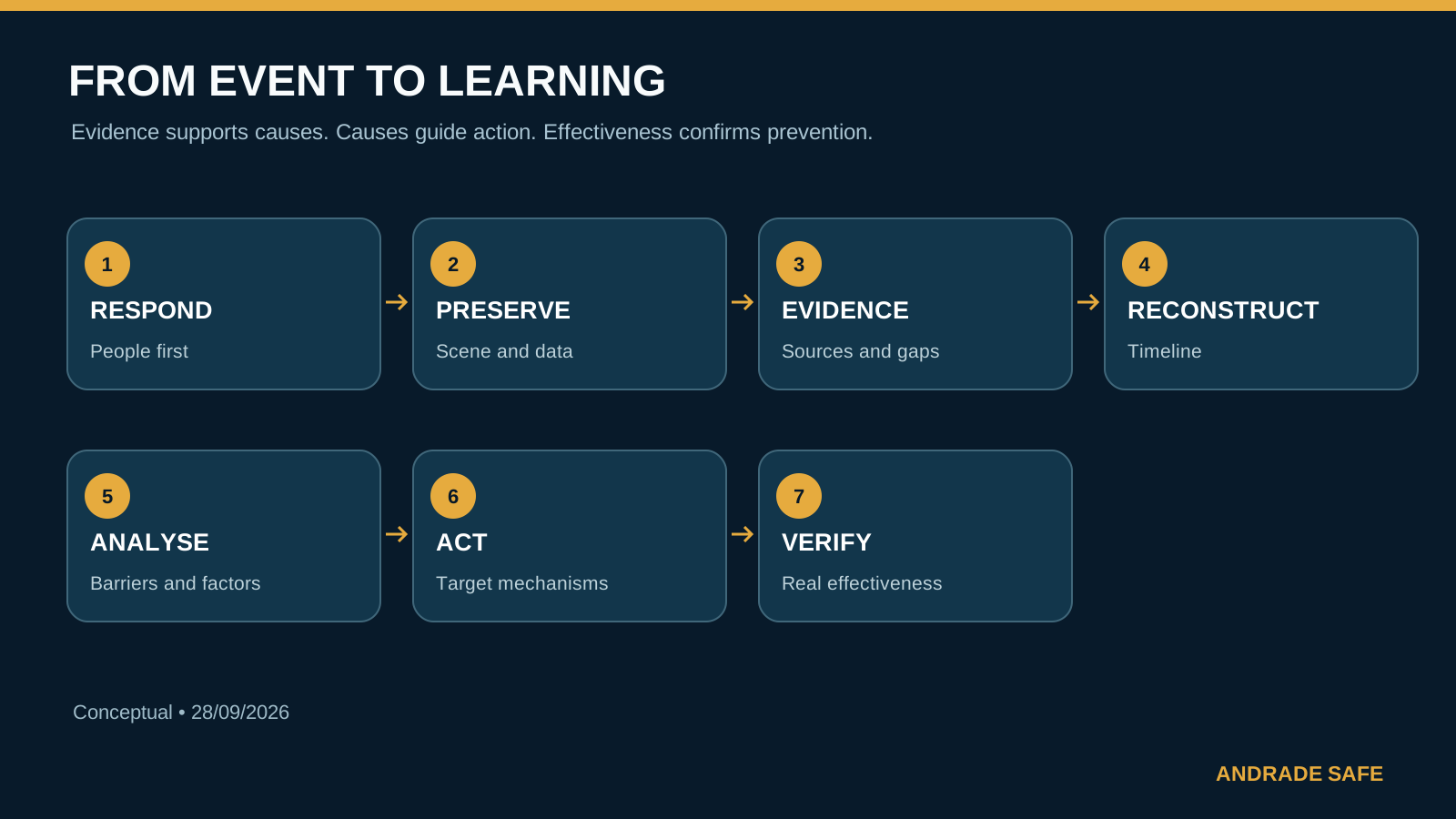
Across sectors, credible investigations prioritise safe response and preservation, collect physical and documentary evidence, build a chronology, test technical and organisational safeguards, connect recommendations to demonstrated mechanisms, and revisit the work to check effectiveness. The formality can vary; the distinction between observation and inference cannot.
Open interviews ask what people saw, did, knew and expected at the time. Process logs, maintenance records, work orders, alarms, images, samples and digital traces help test accounts. A timeline should show gaps and conflicting accounts instead of silently smoothing them away. Actual work is a source of evidence, not an assumed deviation from a written procedure.
'Human error' describes an action at most; it cannot close an inquiry into interface design, time pressure, staffing, competing goals, communication or supervision. Claims about fatigue or personal factors also require specific evidence. A good investigator tests alternative explanations and their preventive implications.
ILO and HSE: public starting points
The ILO's free Investigation of Occupational Accidents and Diseases is a practical guide for labour inspectors, available in several languages. It develops information gathering, causes and prevention. Internal company teams can learn from it while recognising that they do not have an inspector's powers.
The UK HSE's free HSG245 workbook, first published in 2004, organises work into gathering information, analysing it, identifying risk controls and implementing an action plan. NEBOSH and HSE jointly offer a one-day qualification for non-complex incidents, including witness interviews, evidence and action planning. That course is training, not a requirement of Brazilian NR-1 or a universal licence to lead complex investigations.
These public guides teach the process before a company chooses a commercial system. Serious engineering failures may still need domain specialists, laboratory tests and a larger multidisciplinary team.
ISO 45001/45002 and IEC 62740 answer different questions
ISO 45001:2018 concerns occupational health and safety management: incidents, nonconformities, corrective action, risk review and improvement. ISO 45002:2023 guides implementation of that management system. Neither is a branded root-cause method or mandates ICAM, 5 Whys or another technique. As of September 2026, ISO listed a revision project for ISO 45001; a draft does not replace the published 2018 edition.
IEC 62740:2015, in contrast, describes basic root cause analysis principles and steps for an RCA process. It helps structure causal work without being a Brazilian statutory requirement or a licence to assign blame. The detailed technique must still fit the evidence, event and investigators' competence. We do not reproduce the protected text of these standards.
| Reference | Nature | Useful question |
|---|---|---|
| Brazilian NR-1 | Regulatory duty in its jurisdiction | Did documented analysis improve prevention? |
| ISO 45001 / 45002 | Management standard / guidance | How is learning integrated into the system? |
| IEC 62740:2015 | RCA technical standard | How is the causal process structured? |
| ILO / HSG245 | Public guides | How are the stages carried out rigorously? |
What CSB teaches, and what its app does not
The U.S. Chemical Safety and Hazard Investigation Board is an independent, nonregulatory federal agency for serious chemical incidents. Its reports, updates, videos and recommendations show the use of interviews, documents, physical evidence, tests and operational analysis. Reading a completed investigation closely develops judgment about what is measured, inferred and recommended; an ongoing case should not be treated as a final causal finding.
CSB offers a free Process Safety Management training application on OSHA's 14 PSM elements, using the 2005 BP Texas City disaster as a model. This is not a general investigator certification course. The download page does not establish compatibility with current operating systems. We did not find an official general investigator certification programme on the agency's site in this review.
The strongest educational resource is its public case library. The Andrade Safe guide to CSB reports explains how to use it without confusing a U.S. investigation agency with a Brazilian regulator.
CCPS: depth for process safety events
The AIChE Center for Chemical Process Safety offers Incident Investigation and Root Cause Analysis training and Guidelines for Investigating Process Safety Incidents, 3rd Edition. Its published description covers incident classification, initial response, team selection, scene preservation, evidence, interviews, what happened, causal analysis, recommendations, implementation and communication. The book targets process safety while noting use in other reliability and occupational events.
A release, fire, explosion or integrity failure can demand process, materials and instrumentation engineers, digital evidence, laboratory tests and management-of-change review. The test of depth is evidence for each important causal link, including plausible alternatives, not the number of boxes in the chart. Scale resources to actual severity, potential severity and uncertainty.
Shell Monaca illustrates why the architecture of administrative safeguards and human-machine interfaces matters beyond an isolated operator action.
DuPont and dss+: related history, separate organisations
Industrial company DuPont reported adopting Apollo Reality Charting in its 2022 Sustainability Report to improve its internal incident investigations and recommendations. That historical statement does not prove universal current use and does not make Apollo a mandated standard. We do not reproduce its proprietary method.
DuPont Sustainable Solutions became independent in 2019 and adopted the dss+ brand in 2022. The independent consulting firm currently lists four Incident Investigation e-learning modules, covering team formation and information through analysis, recommendations and follow-up, and describes a web app with a seven-stage workflow. Those are dss+ offerings, not current 'DuPont courses'. Public descriptions allow comparison, not a review of course quality without taking the course.
ICAM, Tripod Beta, DNV and human factors
Safety Wise describes ICAM as a systemic method linking local conditions to organisational factors such as communication, procedures, conflicting goals, change management and equipment. Energy Institute's public Tripod Beta overview starts with missing, failed or successful barriers, then examines immediate actions, performance-influencing conditions and underlying organisational factors. Training, manuals, accreditation and applicable licences belong to their providers.
DNV advertises a practical course, particularly in a maritime setting, covering evidence, interviews, STEP timelines, event and causal factor charts, fact trees and its M-SCAT tool. IOSH offers human factors training that explicitly addresses investigators' own biases. Summarising these public aims neither teaches the proprietary procedures nor certifies a reader to use them formally.
Barrier performance and conditions for human action are shared questions, but proprietary workflows are not interchangeable. Ask what made a decision reasonable or likely in context before writing 'human error' as the end of an investigation.
Fundacentro and the causal tree
Brazil's Fundacentro has promoted the Método da Árvore de Causas (ADC). Its key discipline is linking established facts while distinguishing observations from comments, opinions and judgments. Multiple antecedents can be represented without forcing one linear cause. An elegant tree with unsupported links is still a hypothesis, so the team must document and test each connection.
A 2025 Fundacentro technical report discusses deeper and systemic approaches, including the MAPA model, bow-tie ideas and work as performed. It warns against superficial blame explanations that hide design and organisational conditions. The causal tree is a useful technical reference, not the only method prescribed by Brazilian NR-1.
Five tools, five distinct jobs
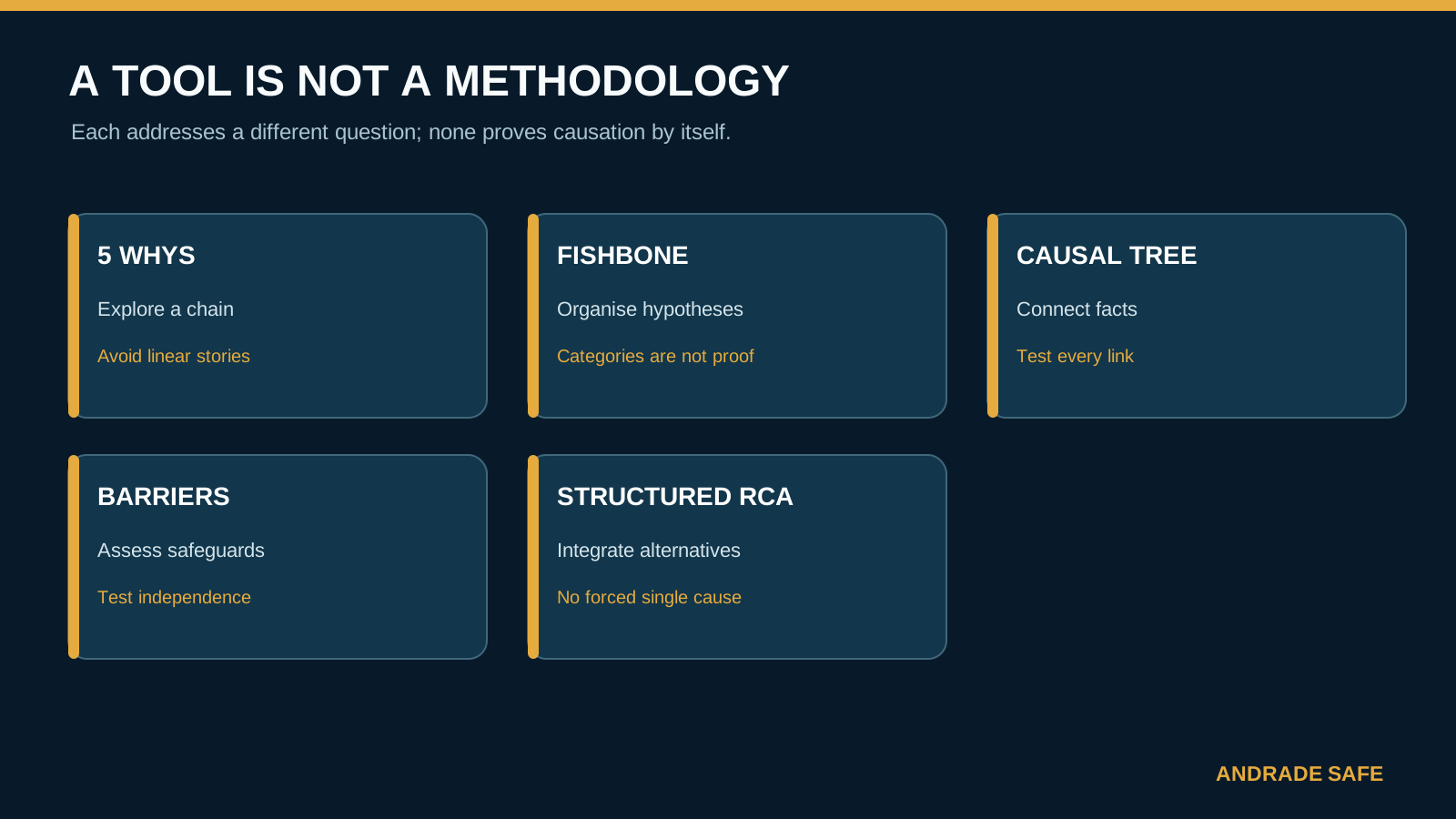
5 Whys can probe a fairly bounded causal chain if each answer is supported. There is no obligation to ask exactly five questions; a neat linear story may miss parallel factors. A fishbone diagram organises candidate categories for inquiry but its arrows are not proof. A causal tree relates established facts and multiple antecedents, demanding careful language and logical links.
Barrier analysis asks which controls should have prevented an event or limited its escalation, whether they were available and independent, and how they actually performed. Counting correlated safeguards is not redundancy. Structured RCA is a family of processes for testing explanations, not a promise of one magic 'root cause'. Bow-tie can visualise threats, a central event, consequences and controls but does not replace factual reconstruction. FTA, FMEA and HAZOP can support a specialised technical or risk analysis; they are not universal incident investigation equivalents.
| Tool | Strongest use | Main limitation |
|---|---|---|
| 5 Whys | Explore a simple causal chain | Unverified linear answers. |
| Fishbone | Organise candidate hypotheses | Categories do not prove causation. |
| Causal tree | Connect facts and multiple antecedents | Every link requires evidence. |
| Barrier analysis | Test intended and actual safeguards | Count is not independence or effectiveness. |
| Structured RCA | Integrate evidence and alternatives | Do not force a single root cause. |
An international map of access and use
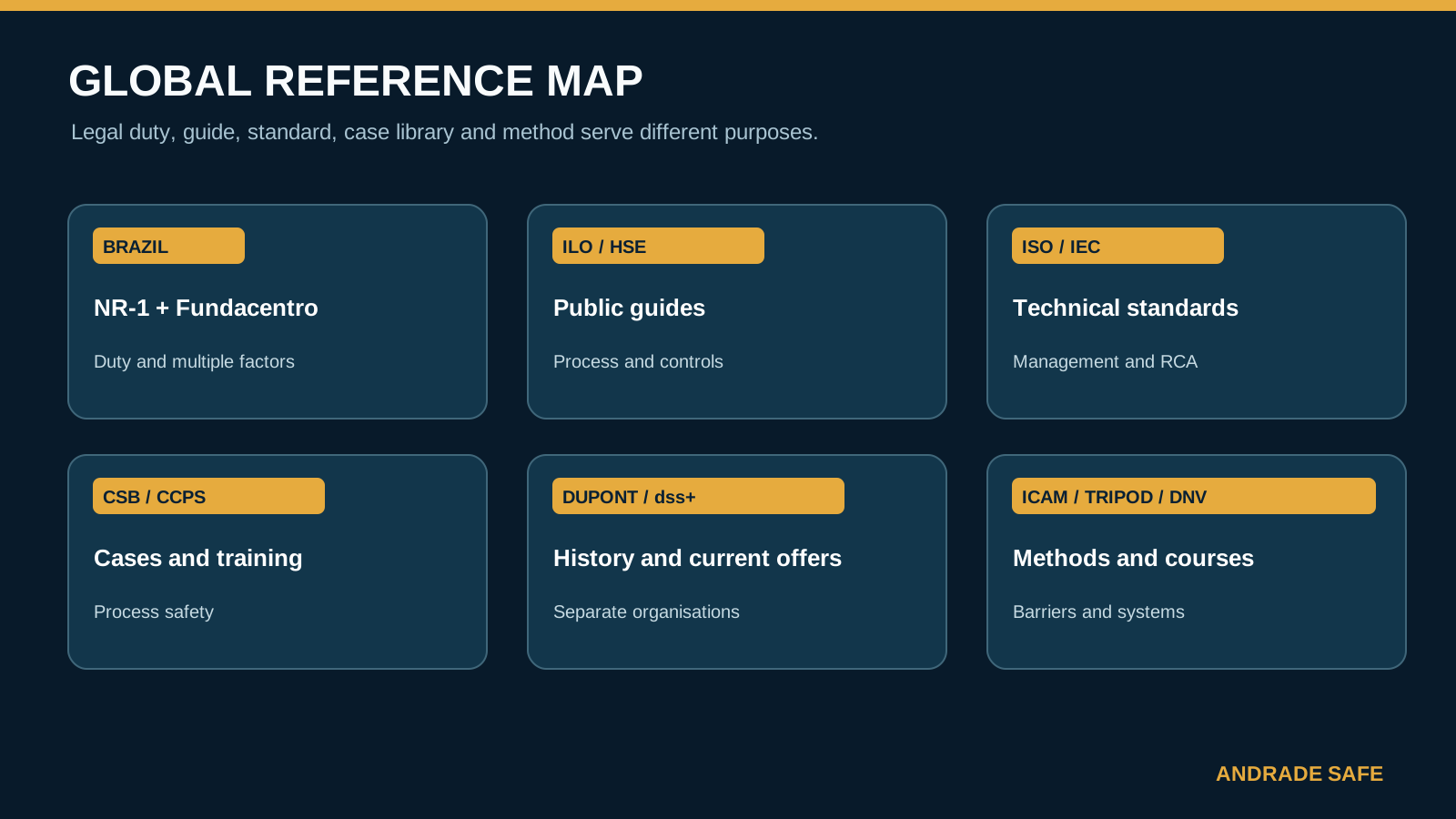
Free means an official resource is openly available; a paid standard, course, software licence or companion material may still exist. Availability and prices change, so check the provider.
| Reference | Access / nature | Best use | Caution |
|---|---|---|---|
| Brazilian NR-1 / Fundacentro | Public law / public technical material | Brazilian duty and multifactorial analysis | ADC is not mandated. |
| ILO / HSE HSG245 | Free public guides | Process, evidence and action | Adapt jurisdiction and scale. |
| ISO 45001/45002 / IEC 62740 | Standards; full texts usually purchased | Management versus RCA process | No mandated brand of tool. |
| CSB | Public reports and videos | Complex process cases | PSM app is not general investigator training. |
| CCPS / AIChE | Public description; commercial book/course | Process safety depth | Respect book copyright. |
| DuPont / dss+ | Historical company report / separate current offers | Compare practice and training | Do not conflate the firms. |
| ICAM / Tripod Beta | Public overview; proprietary training/method | Systemic barriers | Respect training and licences. |
| DNV / IOSH / NEBOSH | Commercial courses, public syllabi | Specialist skills and human factors | Short course does not license all investigations. |
Match rigour to severity, potential and uncertainty
For a bounded event with sound evidence, a timeline, evidence-tested Why questions and barrier review may suffice. Multiple changes, conflicting accounts or interacting factors call for a causal tree, event and causal factor chart or fact tree to display connections and unknowns. A more detailed chart does not repair weak evidence.
Serious or high-potential events warrant formal preservation, multidisciplinary competence, worker input, alternative hypotheses, safeguards and technical tests. A near miss deserves resources based on credible potential and nearly failed barriers, not merely the absence of injury. Specialist mechanisms demand process, materials, electrical, fire, structural or digital experts as appropriate.
Regulatory, employment, civil or criminal implications can create separate evidence-handling duties and decision makers. This preventive framework does not replace those processes.
Clearly fictional example: a jammed conveyor
This example is invented solely to compare reasoning. An operator enters a conveyor danger zone to clear a jam. A weak report ends with 'careless worker ignored the procedure'. That does not explain why entry was possible, why jams recurred or why the formal alternative was impractical.
Suppose the hypothetical evidence establishes that a guard allowed access, jams repeatedly occurred, stoppages hurt output, there was no workable safe clearing method, supervision knew the routine and previous near misses prompted no change. These are stipulated facts of the exercise, not claims about an actual case. A timeline, interviews and safeguard review should test the roles of guarding, interlocking, energy isolation, process design, maintenance, goals and supervision.
Better actions could eliminate the jam at source, redesign access and guards, make isolation practicable, revise the real task, train after the system changes and measure recurrence and entry. Retraining alone cannot fix a technical defect deliberately left in place. The conveyor article treats that hazard in more detail.
Recommendations and effectiveness checks
A strong recommendation identifies the mechanism to change, owner, deadline, proof of implementation and effectiveness test. 'Raise awareness' is weak if the evidence identified recurring jams or a defeated guard. Prefer elimination and engineered controls where feasible; procedures and training may still be necessary but must work in actual operations.
An action is not effective merely because its status turns green. Observe the job after change, test the safeguard, check whether risk moved to another task and hear workers using the new method. Set indicators and a timeframe suited to exposure. A short period without an injury alone proves little; reopen the analysis if the control does not perform.
How Andrade Safe structures the work
Método SAFE — Sistema de Análise de Falhas e Evidências — uses five operational steps: prepare and preserve, reconstruct with evidence, analyse causes and barriers, act on supported mechanisms, and verify effectiveness. This is Andrade Safe's way to organise preventive work. It is consistent with broad principles in the references above, but is not certified, endorsed or equivalent to ISO, ILO, HSE, CSB, CCPS, DuPont, dss+, ICAM, Tripod or DNV methods.
Readers who want practical training can explore the Portuguese-language Método SAFE programme after using the open guides and comparison. Sound evidence and effective changes matter whether or not a course is purchased.
Investigator's closing checklist
Review the work before closing the report and again after preventive changes.
- Were people protected and evidence preserved during initial response?
- Are facts, sources, dates, gaps and hypotheses distinguished?
- Were actual work, interviews, records and physical evidence compared?
- Is the timeline auditable and explicit about uncertainty?
- Were absent, degraded and common-cause safeguards tested?
- Did the team examine technical, human and organisational alternatives beyond blame?
- Does team competence match severity, potential and uncertainty?
- Does each recommendation address an evidence-supported mechanism?
- Are ownership, deadlines and implementation criteria clear?
- Will the task be observed and controls tested after the change?
- Are worker feedback and cross-site learning planned?
- Will risk assessments and action plans change when findings require it?
Frequently asked questions
What is the best method for incident investigation?
No single tool fits every event. Match process and techniques to severity, potential, complexity, evidence and required expertise; link findings to actions and verify their effectiveness.
Does Brazil's NR-1 require 5 Whys or a causal tree?
No. As of 28 September 2026 it requires documented analysis that informs prevention, but does not mandate a branded or universal causal technique.
Does ISO 45001 prescribe an investigation method?
No. ISO 45001:2018 is an occupational safety management standard; ISO 45002:2023 guides implementation. Neither mandates ICAM, 5 Whys or another named tool.
What is IEC 62740?
IEC 62740:2015 describes basic principles and steps in a root cause analysis process. It is distinct from a country's legal duty to investigate.
Does the CSB offer investigator training?
It offers public reports and videos and a free PSM application using BP Texas City. That app is not a general investigator certification course; this review found no official general certification programme.
Does DuPont use an investigation method?
A 2022 DuPont report recorded Apollo Reality Charting adoption, which is not proof of current universal use. Independent dss+ now offers its own incident investigation courses and app.
What is ICAM?
A systemic Safety Wise approach examining local and organisational conditions and defences; formal training belongs to its provider.
What is Tripod Beta?
An Energy Institute barrier-focused method examining immediate actions, performance conditions and organisational factors. Obtain official materials for formal application.
Are 5 Whys sufficient for a serious incident?
Usually not as the sole method. High-severity or high-potential events require proportionate preservation, expertise, alternative hypotheses, barrier and technical analysis.
Does every accident have one root cause?
No. Multiple interacting mechanisms and safeguards may demand several preventive interventions.
How should near misses be investigated?
Use credible potential, nearly failed barriers, actual work and prior weak signals to set the depth, even without an injury.
When is a multidisciplinary team needed?
When severity, potential, complexity or uncertainty require complementary process, materials, electrical, human factors or digital expertise.
How do we know corrective action worked?
Define success for the causal mechanism, confirm implementation, observe actual work and test the control over a suitable period. A brief absence of accidents alone is not proof.
References
- NR-1 vigente — disposições gerais e gerenciamento de riscos ocupacionaisMTE
- Método da Árvore de Causas investiga as múltiplas razões de acidentesFundacentro
- Análise de acidentes do trabalho requer métodos aprofundadosFundacentro
- Investigation of occupational accidents and diseasesILO/OIT
- HSG245 — Investigating accidents and incidentsHSE
- NEBOSH HSE Introduction to Incident InvestigationNEBOSH
- ISO 45001:2018ISO
- ISO 45002:2023ISO
- IEC 62740:2015 — Root cause analysisIEC
- About the CSBCSB
- CSB Process Safety Training ApplicationCSB
- Incident Investigation and Root Cause AnalysisAIChE/CCPS
- Guidelines for Investigating Process Safety Incidents, 3rd EditionAIChE/CCPS
- DuPont 2022 Sustainability ReportDuPont
- Environmental Health & Safety eLearning Curriculumdss+
- Incident Investigation applicationdss+
- ICAM coursesSafety Wise
- Tripod BetaEnergy Institute
- Practical Incident Investigation and Root Cause AnalysisDNV
- Human factors in accident investigationIOSH