
Waldo Castillo Barraza died on October 1, 2026 during maintenance in the crushing and materials-handling area of Codelco's Radomiro Tomic division. The investigation remains open. This technical article examines hazardous energy controls without asserting an unproven cause.
What is known, and what remains unknown
On October 1, 2026, a mechanical maintainer died during work in the crushing and materials-handling area of Codelco's Radomiro Tomic division in Chile's Antofagasta region. Codelco identified him as Waldo Castillo Barraza, 49, an employee of contractor Berliam. Its preliminary statement placed the accident at approximately 8:50 a.m. The division stopped work in the affected area and initiated an investigation. Berliam/Veltis said it activated emergency and family-support protocols.
Respect for Waldo and his family requires separating the known event from its explanation. Crushing and conveyor systems hold several forms of energy, but the public statements do not establish which was involved, how exposure occurred, or whether a control failed. Stopping a machine does not make it safe for intervention; knowing the area does not reveal the root cause.
| Established by official statements | Not yet established publicly |
|---|---|
| Date, division, approximate time and general maintenance activity. | Exact sequence, specific equipment and operating state. |
| One fatality, area suspension and investigation. | Isolation points, lockout, residual energy and safeguard performance. |
| Employment by Berliam and support announced for the family. | Position, permits, technical and organizational factors and root cause. |

Radomiro Tomic and the maintenance context
Radomiro Tomic is an open-pit copper mine near Calama. Crushing, material transfer and conveyors link processing stages. Codelco has described extensive belts at the division, but the October 1 statement identifies only the crushing and materials-handling area, not the equipment involved.
Industry reports have named a conveyor and particular components. These remain preliminary details, not established technical facts for this article. Investigators must confirm the sequence, exact location and working conditions.
A conveyor is more than a moving belt
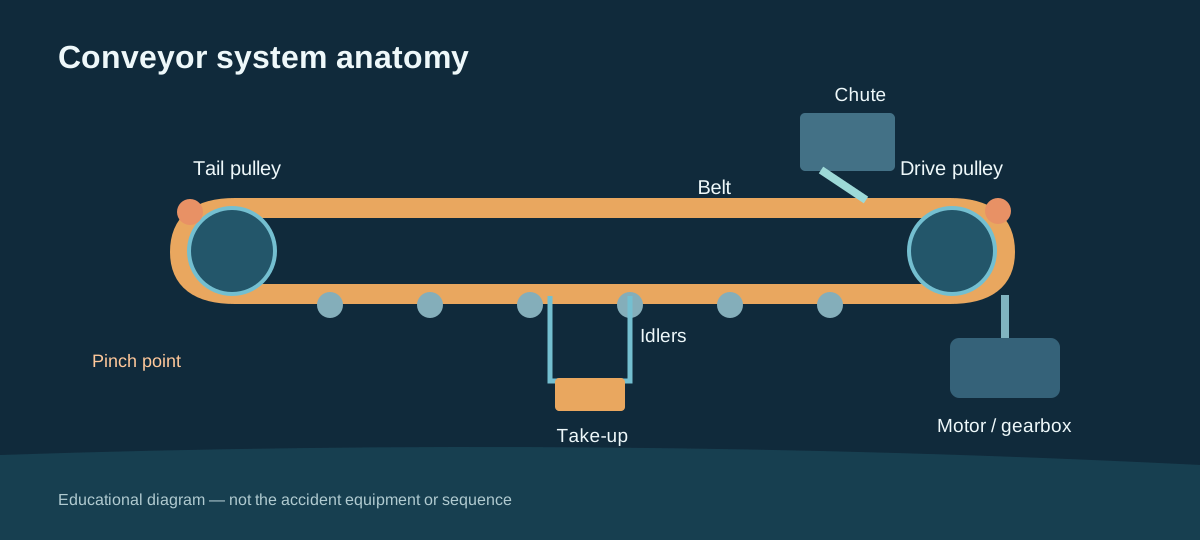
A system can contain a motor and gearbox, drive and tail pulleys, idlers, brakes, backstops, a tensioning system, counterweights and the belt itself. Chutes, trapped material, elevated structures, actuators, sensors and local or remote controls add interfaces. Belt-to-pulley and converging surfaces form pinch points. Suspended or tensioned parts can move after the normal drive has stopped.
The diagram identifies typical functions to support a whole-system review. It is not an engineering drawing of Radomiro Tomic or a reconstruction of the event. Actual isolation points depend on the equipment, current configuration and work scope.
Switching off is not a zero-energy state
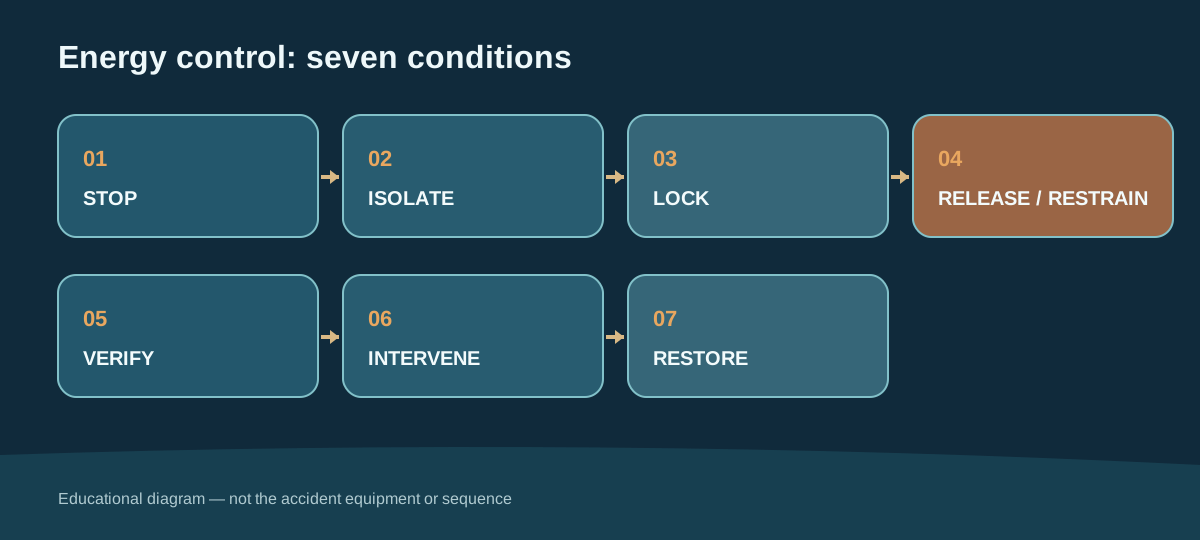
Stopping ends normal operation. Isolation separates energy sources. Lockout prevents unauthorized alteration of an isolation device. Release or restraint addresses pressure, gravity, inertia, tension and other stored energy. Verification proves the safe state before exposure. Intervention follows; restoration requires clearing people and tools, restoring guards, authorized unlocking and notice before startup.
An emergency stop is not, by itself, an isolation point for maintenance. A lock does not prove every source was found or residual energy controlled. Lockout without verification can create false confidence. A controlled try-start, where required, must avoid exposure and does not replace other necessary tests.
Energy that may remain
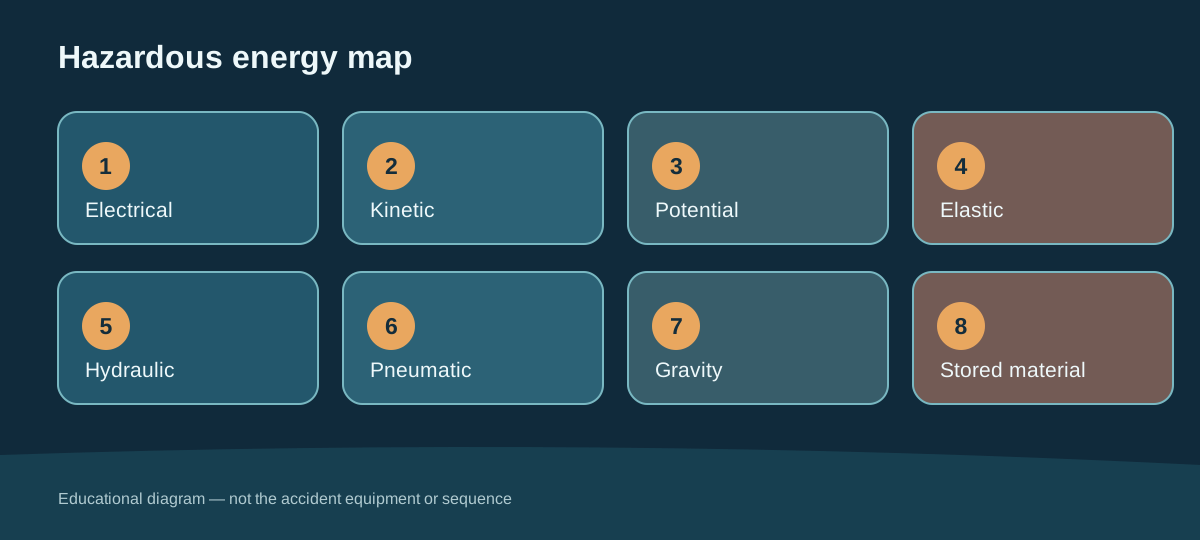
A 2019 campaign at Radomiro Tomic stressed that mechanical potential, elastic and kinetic energy, as well as hydraulic, pneumatic and residual energy, matter alongside electricity. A task-specific energy map should identify each source, isolation point, stored energy, method of restraint or release, responsible person and verification method.
The examples below are general; they do not describe the actual energy state in the October 1 task.
Codelco: energy-control campaign →
| Energy | Possible example | Hazard to prevent |
|---|---|---|
| Electrical | Motor, drive, panel and control circuit | Shock, arc or startup |
| Kinetic | Coasting pulley or belt | Entrapment and impact |
| Potential and gravity | Counterweight or suspended component | Fall and crushing |
| Elastic | Tensioned belt, spring or take-up | Sudden release |
| Hydraulic / pneumatic | Cylinder, accumulator or pressurized line | Movement and pressure |
| Stored material | Ore trapped in a chute or crusher | Sudden flow |
| Thermal | Hot surface | Burn |
Chilean regulation and Codelco's rules
Chile's Mining Safety Regulation (D.S. 132, as amended) addresses safe operation and maintenance of equipment and conveyors. Whether any provision applies to a particular event is a matter for the competent authority and established facts. Nothing published so far supports a claim of noncompliance here.
Codelco's Rules for Life call for de-energized and locked equipment during intervention, avoiding work on moving equipment and keeping safety devices intact. Written rules matter, but protection depends on controls that are suitable, available, tested and effective in real work. Mentioning a rule does not allege it was breached.
Critical controls before, during and after work
Define scope and system boundaries; identify every energy source, including automation and adjacent equipment. Map accessible isolation points and use individual or group lockout as prescribed. Mechanically restrain loads and tension, release or contain pressure, and verify the absence of hazardous energy. Set work boundaries, stay out of the line of fire and coordinate operations, maintenance and contractors.
A scope change requires reassessing isolation and everyone exposed. Before restart, clear tools and personnel, reinstate guards, confirm integrity, unlock under defined authority, notify affected people and observe the first operation. An emergency stop does not replace preventive isolation.
The energy-control sequence
Stop → isolate → lock → release or restrain → verify → intervene → restore under control. Each verb represents a condition that can be demonstrated. This is a conceptual sequence; actual tasks need equipment-specific procedures and competence.
Verification must check isolated points and residual energy by suitable methods. If a counterweight can fall or a tensioned belt can move, the system is not safe simply because its motor will not start. Physical control and a position outside the energy path must remain in place throughout the task.
Line of fire: where can the energy go?
Picture a belt running backward, a pulley rotating, a counterweight descending, ore flowing from a chute, a tool ejecting or a cylinder advancing. Is someone between converging surfaces? Is a load supported only by hydraulic pressure? Has belt tension been measured and restrained? Has a guard been removed, opening access to a hazard?
Hazardous energy control and safe positioning complement each other. Eliminate the need to enter the zone, use engineered supports and avoid foreseeable trajectories. These questions apply to maintenance generally; they do not describe what happened to Waldo.
Owner and contractor need one control system
Waldo worked for Berliam. That employment fact does not assign fault to either company. Shared work nonetheless requires clear authority for operation, isolation, testing, individual locks, unlocking, work authorization and communication of changing conditions.
Permits, shift handovers, competence, supervision and simultaneous work must integrate. Every exposed person needs effective protection in the chosen lockout arrangement. Hazardous energy does not recognize contractual boundaries; the system must work end to end.
What the division's own history teaches
In 2017 Codelco described a 4,500-meter replacement of conveyor CV 205 as highly critical, with six months of planning. A 2019 campaign emphasized non-electrical energy and field verification. In 2020 an auto-alignment project aimed to remove workers from exposure during belt alignment. Codelco also reported approval of a digital lockout system at the division.
These records show experience and initiatives; they prove neither that a particular safeguard was present nor absent in the 2026 task. The useful question is whether planning, exposure elimination, isolation and verification become usable physical controls in each job.
Investigation requires evidence first
Investigators should preserve the scene and reconstruct the sequence from drawings, work orders, permits, lockout logs, alarms, controls, automation, component positions, interviews and physical conditions. Establish the state of each energy source and safeguard at exposure, distinguishing design, availability and actual use.
Then examine planning, interfaces, scope changes, competence, supervision and earlier warning signs. Unexpected startup, residual energy, a missing guard, line-of-fire position or human error are hypotheses until supported by evidence. A human action alone rarely explains why a system allowed a fatal outcome.
What if a similar job were in Brazil?
Brazilian regulations do not govern an accident in Chile. For facilities in Brazil, NR-12 addresses machinery and energy control during maintenance; NR-22 adds mining and continuous-conveyor requirements. NR-10 becomes relevant to work on electrical installations. Zero energy is not only electrical.
A risk assessment or PGR organizes hazards but does not replace physical isolation, lockout and verification. Use the current text and site-specific engineering before selecting controls.
15 questions before hands-on work
Save this checklist for a conversation among operations, maintenance and safety. It does not replace a task-specific procedure.
- What exactly is the scope?
- Which adjacent systems affect the task?
- Which energy sources feed the system?
- What energy remains stored?
- Where are the isolation points?
- Are they identifiable and reliable?
- Who may lock and unlock?
- Is every exposed person protected?
- Has hydraulic and pneumatic pressure been released or restrained?
- Have gravity and elastic tension been mechanically controlled?
- Has the zero-energy state been verified?
- Are local, remote and automatic controls addressed?
- Is anyone still in the line of fire?
- Did a scope change trigger reassessment?
- How will the system be restarted safely?
What to watch in the investigation
Follow Sernageomin, Codelco, Berliam/Veltis and Chilean authority updates. Official findings on the sequence, energy sources, safeguard performance, contributing factors and corrective action will require an article revision. Conveyor identifiers reported by third parties cannot substitute for evidence.
Last editorial check: October 3, 2026 at 23:00 BRT. The official statement still describes an open investigation without a determined cause.
The enduring lesson
Maintenance is planned exposure to systems that normally keep people apart from energy. Critical controls must be physical, verifiable and reliable across shifts and companies. A rigorous investigation resists naming a culprit before understanding the sequence and system.
Safety begins before a tool touches the equipment: when every energy source is identified, controlled and verified. May the investigation clarify the circumstances of Waldo Castillo Barraza's death and lead to prevention that works.
Frequently asked questions
What is hazardous energy in maintenance?
Any source capable of causing harm during work, including electricity, motion, gravity, tension, pressure, heat or accumulated material as applicable.
Is stopping a conveyor enough?
No. Sources must be isolated and locked, stored energy controlled and the safe state verified before exposure.
What is a zero-energy state?
The verified safe condition for the task after sources that could cause dangerous movement or release have been isolated and controlled.
What is LOTO?
Lockout/tagout is a system for securing and identifying energy isolation devices, coupled with stored-energy control and verification.
What caused the Radomiro Tomic accident?
Official statements reviewed through October 3, 2026 do not establish the sequence or root cause.
Do Brazil's NRs apply in Chile?
No. They are cited only to translate the general lesson to operations governed by Brazilian law.
References
- Comunicado sobre o acidente em Radomiro TomicCodelco
- Comunicado da Berliam/VeltisVeltis Latam / Berliam
- Fatal accident at Radomiro Tomic mineReuters
- División Radomiro TomicCodelco
- Campaña de control de energías en RTCodelco
- Reglas por la VidaCodelco
- Cambio de 4.500 metros de correa transportadoraCodelco
- Sistema de alineamiento de correasCodelco
- Sistema de bloqueo digital en Radomiro TomicCodelco
- Reglamento de Seguridad Minera, D.S. 132Biblioteca del Congreso Nacional de Chile
- Norma Regulamentadora NR-12Ministério do Trabalho e Emprego, Brasil
- Norma Regulamentadora NR-22Ministério do Trabalho e Emprego, Brasil
- The control of hazardous energy (lockout/tagout)OSHA