
Learn how combustible dust explosions occur, why the Imperial Sugar disaster escalated, and which engineering barriers can prevent similar industrial accidents.
A hazard that can accumulate quietly
A dust explosion can occur when fine combustible particles become airborne at a suitable concentration, encounter oxygen and an ignition source, and are confined. Settled deposits can feed further clouds and secondary explosions. Prevention requires understanding the actual dust, controlling releases and accumulations, managing ignition sources and verifying engineered protection and emergency barriers.
Sugar, flour and sawdust may look ordinary. Yet finely divided combustible material can behave differently from bulk solids when particles are dispersed in air and exposed to an ignition source. Deposits on beams, ductwork, machinery and enclosed equipment can contribute to a dangerous chain of events.
On February 7, 2008, a sequence of explosions and fires at the Imperial Sugar refinery in Port Wentworth, Georgia, killed 14 workers and injured 36, according to the final investigation report of the US Chemical Safety and Hazard Investigation Board (CSB). The agency's online case summary lists 38 injuries; this article follows the final report's count and flags the difference in its source notes.
The tragedy illustrates why industrial explosions must be investigated as system failures involving design, maintenance, housekeeping, protective equipment and emergency preparedness—not merely as a spark or an individual's mistake.
This is a historical case study. The accident occurred in 2008; the final report dates from September 2009 and was released on September 24, 2009. October 17, 2026 identifies this article’s editorial review, not a new accident or a new investigation update.
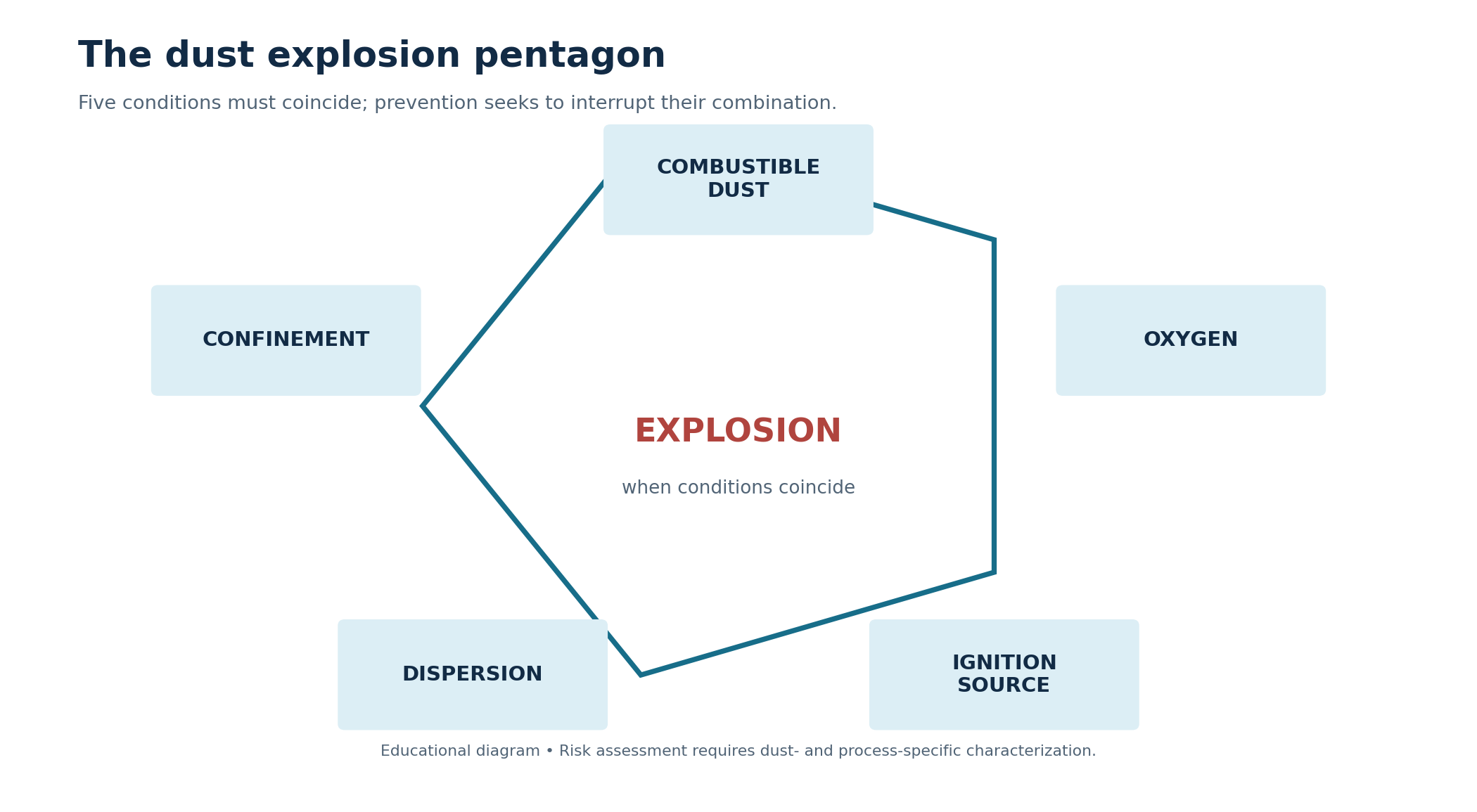
The dust explosion pentagon
Five conditions are involved: combustible dust, oxygen, an ignition source, dispersion and confinement. These conditions must coincide for a dust explosion. The existence of a deposited powder does not, by itself, mean that an explosive cloud is present. The behavior also depends on the specific material, particle size, moisture, concentration and process geometry.
OSHA identifies potentially combustible dusts in food processing, wood products, plastics, coal, pharmaceuticals and certain metal-processing operations. Not all powders are equivalent. Technical assessment and, where needed, specialized laboratory characterization are essential.
A flash fire involves rapid flame spread without damaging overpressure. Deflagration is subsonic combustion propagation; confinement or partial confinement can allow pressure buildup and an explosion. Detonation involves supersonic propagation and is not a general synonym for explosion. This article does not classify Imperial Sugar as a detonation. Lack of confinement also does not remove the burn hazard from a flash fire.
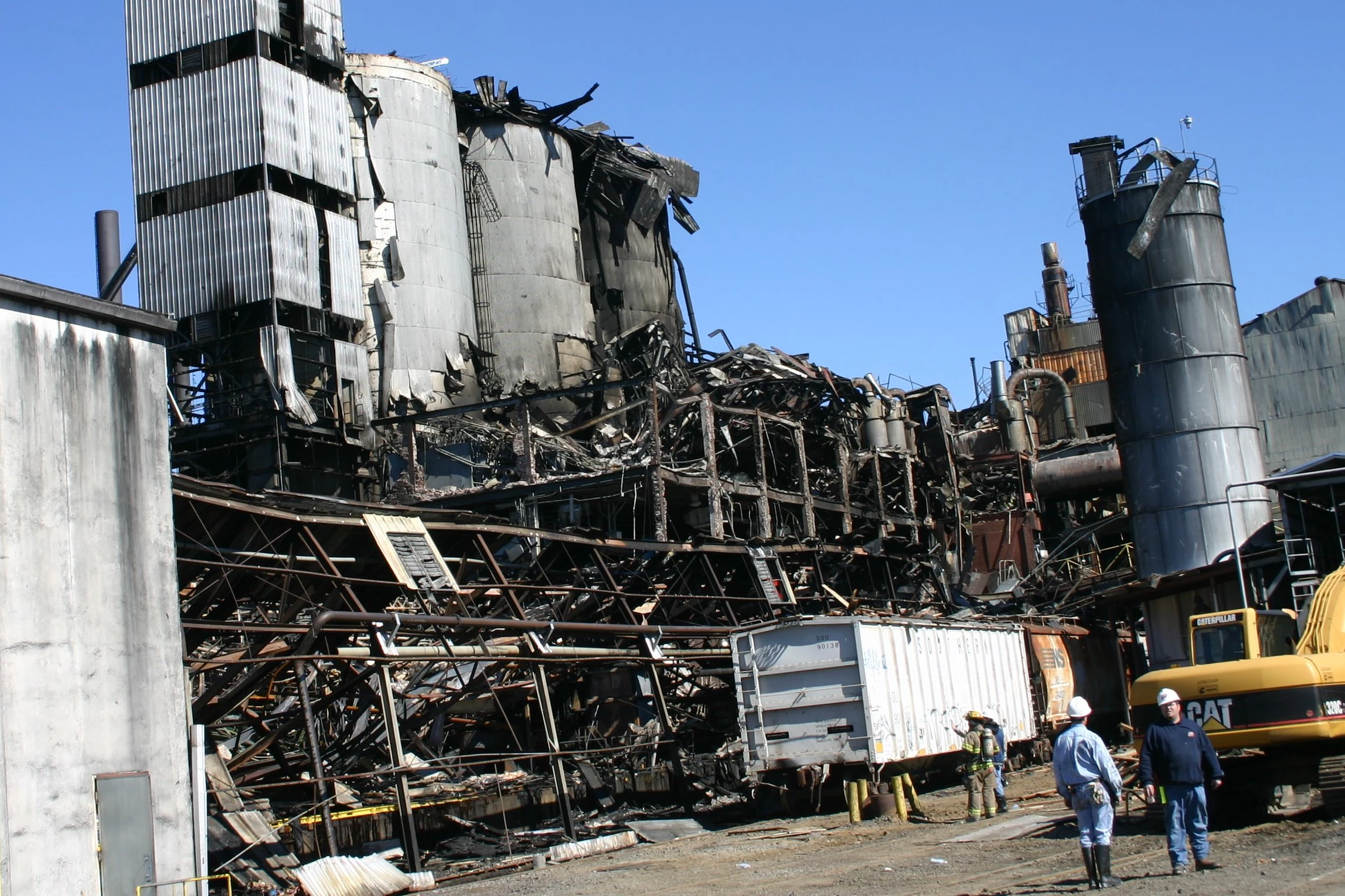
What the Imperial Sugar investigation established
The CSB found an interacting chain of failures:
Persistent dust releases. Sugar conveying and handling equipment allowed releases into work areas. Dust and granulated sugar accumulated on floors, machinery and elevated surfaces. Housekeeping practices did not adequately control the hazard.
A newly enclosed conveyor. Steel panels enclosed a belt conveyor beneath two silos, creating a confined, poorly ventilated space where airborne sugar dust could accumulate to an explosible concentration.
Likely initial ignition. According to the CSB, an overheated bearing most likely ignited the primary explosion. That is an investigation conclusion expressed as likelihood, not direct proof captured on video.
Escalation. The first event dispersed accumulated dust in packaging buildings. Massive secondary explosions and fires followed. According to the CSB, all 14 fatalities most likely resulted from those secondary explosions and fires.
Emergency weaknesses. The investigation identified inadequate emergency notifications, evacuation drills and preparation.
The case is therefore a lesson about the interaction between physical conditions and organizational decisions.
The 2007 modification aimed to protect sugar from contamination. The report records that its dust hazards were not adequately evaluated: the new enclosure lacked dust removal and deflagration vents. The lesson is to reassess hazards introduced by changes and engineer suitable containment, collection and protection, rather than treating every enclosure as unsafe. Management of change is an engineering lesson drawn from the findings, not a claim that the CSB imposed a particular Brazilian program.
| Case evidence | Source qualification | General application |
|---|---|---|
| 14 deaths; 36 injuries | Final report; online summary lists 38 injuries | Identify the document and discrepancy without inventing a reconciliation. |
| Overheated bearing | Most likely ignition source | Assess heating and maintenance without assuming all ignitions involve bearings. |
| New conveyor enclosure | Introduced dust concentration hazards were inadequately evaluated | Review design and operational changes. |
| Secondary explosions | Deposits fueled escalation | Inspect elevated and concealed deposits beyond initial equipment. |
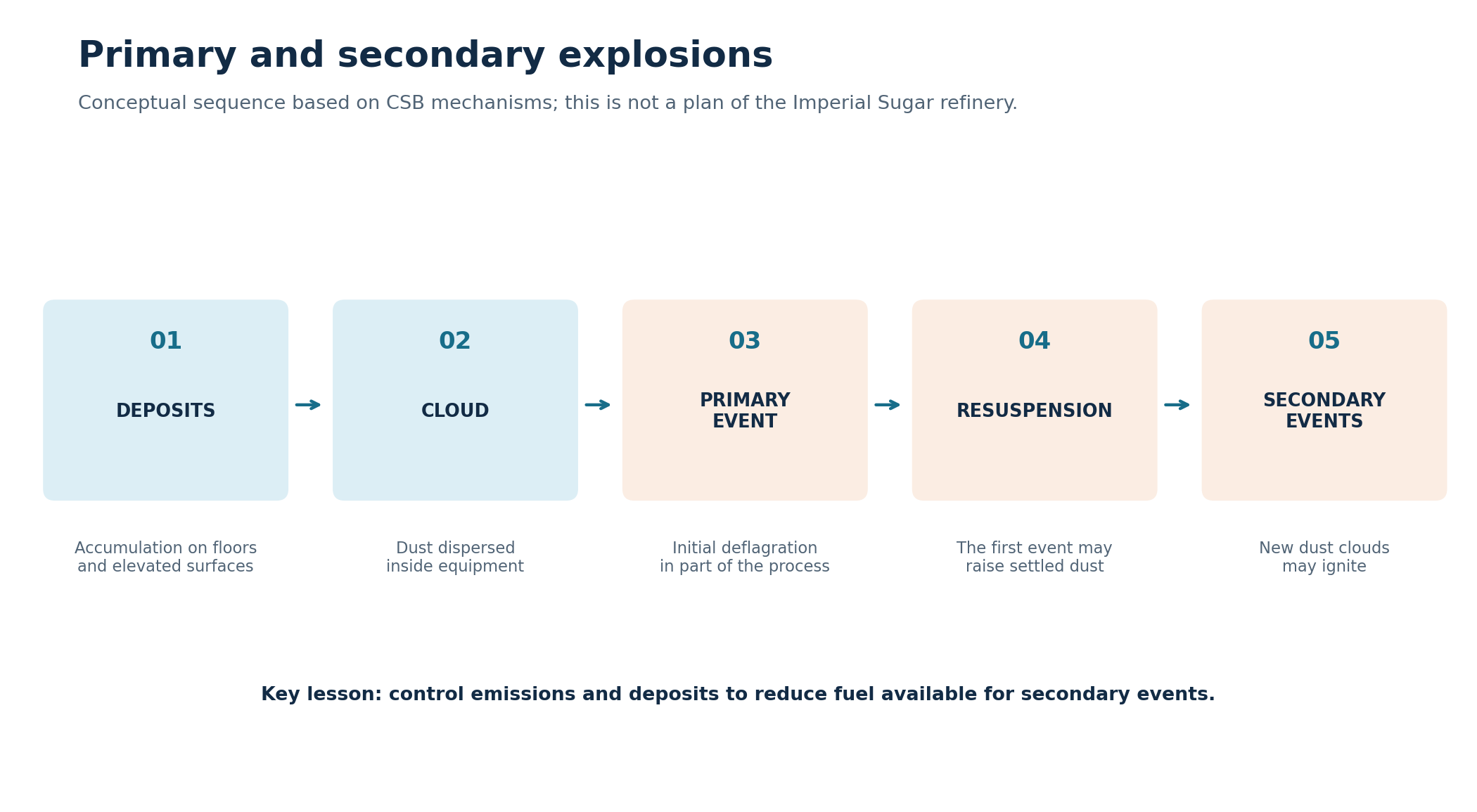
Why secondary explosions can be more destructive
A primary event can produce pressure waves, damage equipment and raise previously settled dust into the air. New airborne clouds can ignite if sufficient conditions are present. The amount and location of deposits outside the initial equipment can therefore influence escalation.
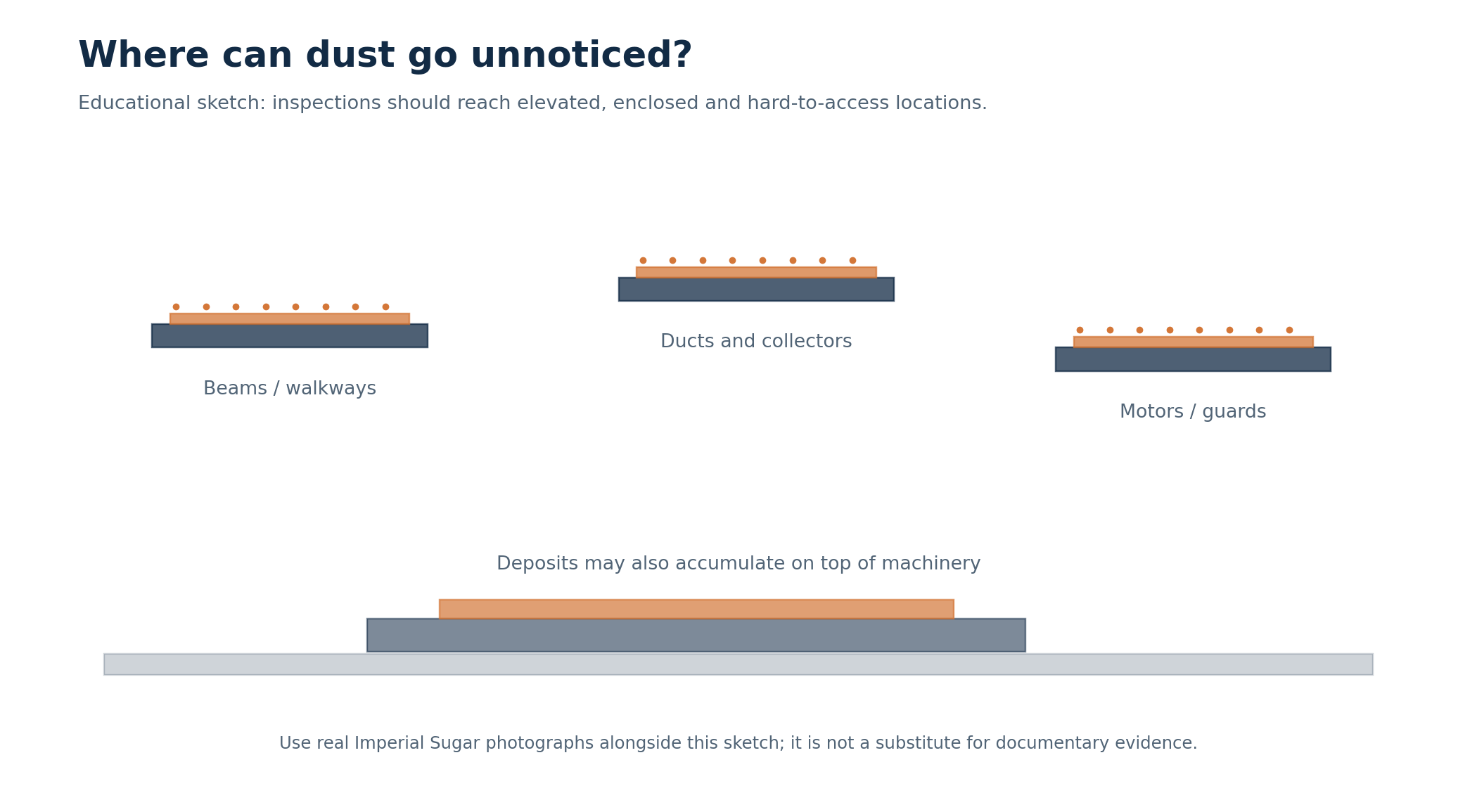
This is why inspections must go beyond the floor. Beams, overhead piping, cable trays, ductwork, motor housings, concealed spaces and adjacent rooms all require attention when assessing combustible dust accumulation.
Engineering barriers and the hierarchy of controls
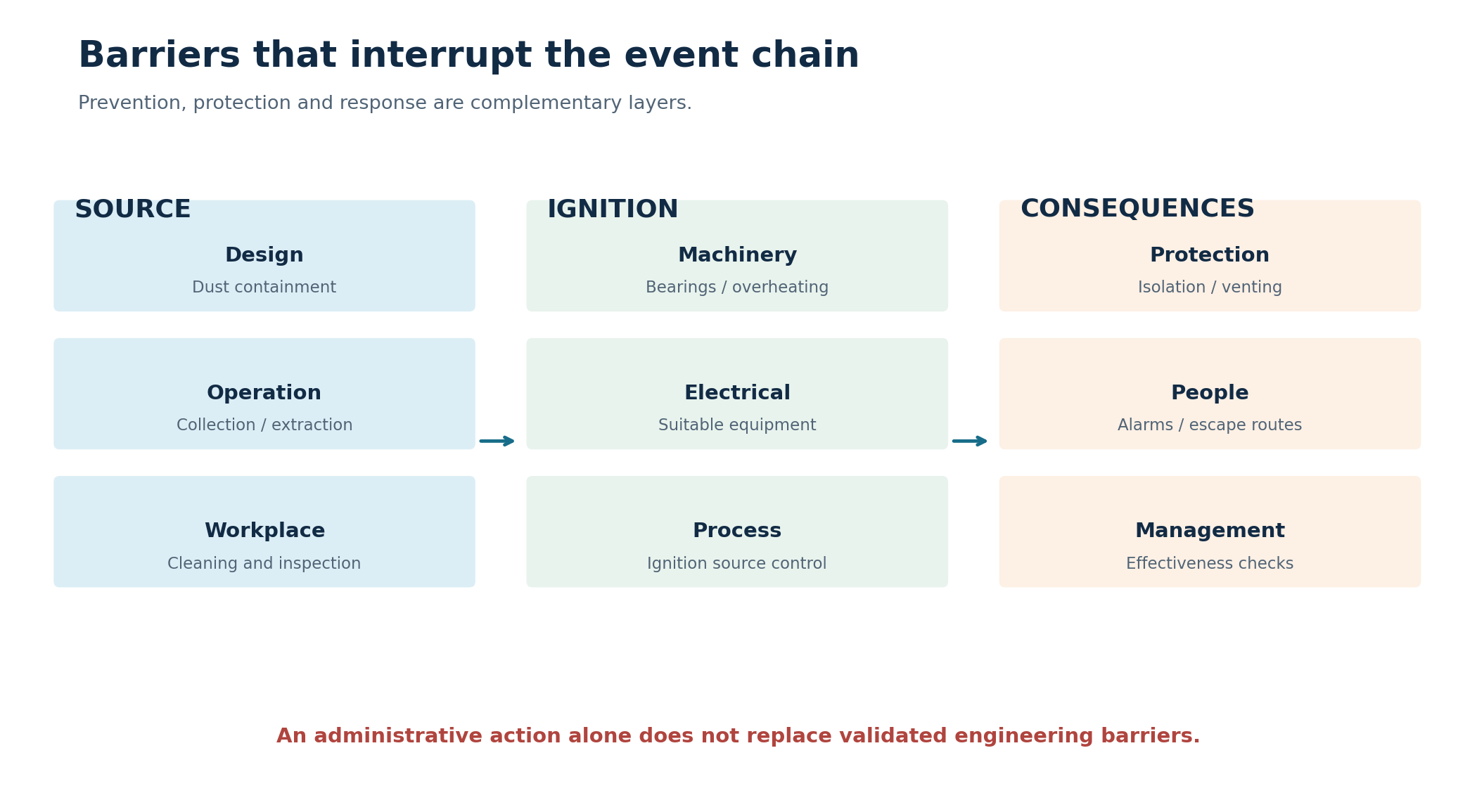
A prevention strategy should first characterize the dust hazard and the process, then address the various layers of risk:
Training matters, but training alone cannot compensate for uncontained dust releases or missing engineering protection.
Metal powders are not interchangeable with flour or sugar. Collection, cleaning and firefighting methods must be compatible with the actual material; a suitable measure for one dust can introduce hazards for another. Compressed air and ordinary vacuum cleaners are not generic recommendations for removing deposits: methods need to avoid dispersion and ignition, based on a specific assessment.
| Barrier | Relevant evidence | Limit |
|---|---|---|
| Containment and collection | Inspection, maintenance and performance verification | A collector’s presence does not prove control. |
| Safe housekeeping | Completed routines covering elevated and hidden surfaces | A clean floor does not represent the whole facility. |
| Ignition control | Checks of heating, electrical/static sources and hot work | One verified item does not eliminate other sources. |
| Protection and isolation | Specialist engineering, specifications and verification | A checklist cannot size protection systems. |
| Emergency response | Documented alarm tests, exit checks and drills | A written plan does not demonstrate effective response. |
- Source containment and dust collection: limit release at conveying, milling, sieving and packaging equipment.
- Safe housekeeping: remove deposits using methods appropriate for combustible dust and avoid unnecessarily dispersing them.
- Ignition-source control: assess hot surfaces, bearings, electrical equipment, static electricity and hot work.
- Explosion consequence protection: evaluate engineered isolation, suppression, deflagration venting or other systems when justified for the application.
- Emergency preparedness: effective alarms, clear evacuation routes, drills and emergency-team coordination.
- Performance verification: inspect, test and maintain controls so that a completed action is not mistaken for an effective barrier.
What are Kst, Pmax and MIE?
Engineers use terms such as Kst (dust deflagration index), Pmax (maximum pressure measured in a standardized test) and MIE (minimum ignition energy) during hazard characterization. These are not universal material constants that can be copied from unrelated samples. Test results may change with dust characteristics and test conditions. They must be interpreted by competent specialists.
This article deliberately does not estimate the explosive pressure in Imperial Sugar's buildings or offer a calculator for designing explosion events. The investigation provides the supported facts; actual equipment design requires specialist engineering.
Kst characterizes the normalized maximum rate of pressure rise in testing; Pmax is the maximum pressure under test conditions; MIE is the minimum energy producing ignition under the applied method. They answer different questions. None is, by itself, an accident probability, occupational exposure limit or predicted building pressure.
Regulatory context: what applies where?
NFPA 660:2025 consolidated several earlier NFPA documents governing combustible dusts and particulate solids. Those editions are relevant engineering references in the United States and elsewhere when appropriate, subject to the applicable legal and technical framework.
For Brazilian facilities, the assessment should begin with the relevant requirements of NR-1 (GRO/PGR), NR-12 (machinery safety) and NR-23 (fire protection), state fire-safety requirements and applicable technical standards. Do not imply that Brazil's NR-20 automatically covers every solid combustible dust: its scope must be assessed for the substances and operations involved.
NFPA 660:2025 consolidates material formerly covered by NFPA 61, 484, 652, 654, 655 and 664. It was not the reference used in the 2009 report, as it did not then exist. Technical use depends on edition and application; publication does not automatically make it Brazilian law. OSHA’s advisory bulletin does not itself create new legal obligations.
Brazil’s NR-1 includes preliminary hazard review when processes change or are introduced (1.5.4.2.1), followed by hazard identification and risk assessment. Within its scope, NR-12 addresses additional hazards and accidental combustion/explosion in 12.10 and maintenance in 12.11. NR-23 refers to state law and complementary applicable official technical standards, alongside alarm/evacuation information and exit conditions. These are Brazilian requirements, not a universal specification for every stationary device or every powder.
Practical questions for an industrial inspection
Where is dust generated? Is its combustibility understood and documented? Are conveyors and collectors leaking? Are elevated and concealed surfaces inspected? Has the process been modified without re-assessment? Are hot bearings, static discharge and hot work controlled? Are protective systems selected and tested for the actual dust? Can all personnel hear alarms and reach safe exits?
A checklist helps surface gaps, but is not a substitute for a qualified Dust Hazard Analysis (DHA) or equivalent facility-specific assessment.
Educational laboratory: barrier verification
The panel below organizes eight inspection questions and qualitative observations. Mark only conditions supported by adequate evidence. The selection count records responses; it is not a safety grade, compliance score or probability. Checking everything does not authorize operation or replace a DHA, engineering and tests.
Educational lab: combustible dust safety barriers
Only mark conditions backed by appropriate evidence. This panel organizes questions; it is not a formal hazard assessment or permission to operate.
Check an item only after evidence is obtained. Checking a box does not prove compliance. Record technical references only. Do not include personal data. Notes remain on this page and are not saved automatically.
Inspection notes
0 of 8 conditions marked verified
Verified with evidence: 0 · Pending verification: 8
- Gap to examine: Dust characterization
Obtain material characterization and specialist assessment. - Gap to examine: Containment
Investigate leakage and containment improvements. - Gap to examine: Dust collection
Review design, maintenance and equipment condition. - Gap to examine: Elevated deposits
Include beams, ducts, housings and platforms. - Gap to examine: Ignition sources
Review and verify ignition source controls. - Gap to examine: Management of change
Review modified designs and change management. - Gap to examine: Explosion consequence protection
Require qualified specialist review of protection selection. - Gap to examine: Emergency preparedness
Test communications and response capabilities.
Educational checklist based on general inspection questions. It does not calculate explosion probability, determine legal compliance or replace a specialized Dust Hazard Analysis (DHA), engineering or tests.
Sources: CSB — Imperial Sugar · OSHA — Combustible dust
The enduring lesson
The main lesson of Imperial Sugar is not the scale of destruction: it is how ordinary-looking deposits and longstanding weaknesses can accumulate without triggering adequate corrective action, until a first event initiates a catastrophic escalation.
Process safety depends on understanding the fuel, containing dust, controlling ignition opportunities, limiting consequences and verifying that protective barriers remain effective.
Investigating causes and verifying actions
Investigating accidents beyond blame (Portuguese article) connects design, maintenance and organizational decisions. After implementation, verifying corrective action effectiveness must establish whether barriers actually work. The Ulsan chemical fire offers a process-safety comparison: different substances and mechanisms need specific controls. Our accident investigation guide presents the broader method in Portuguese.
Study and inspection resources
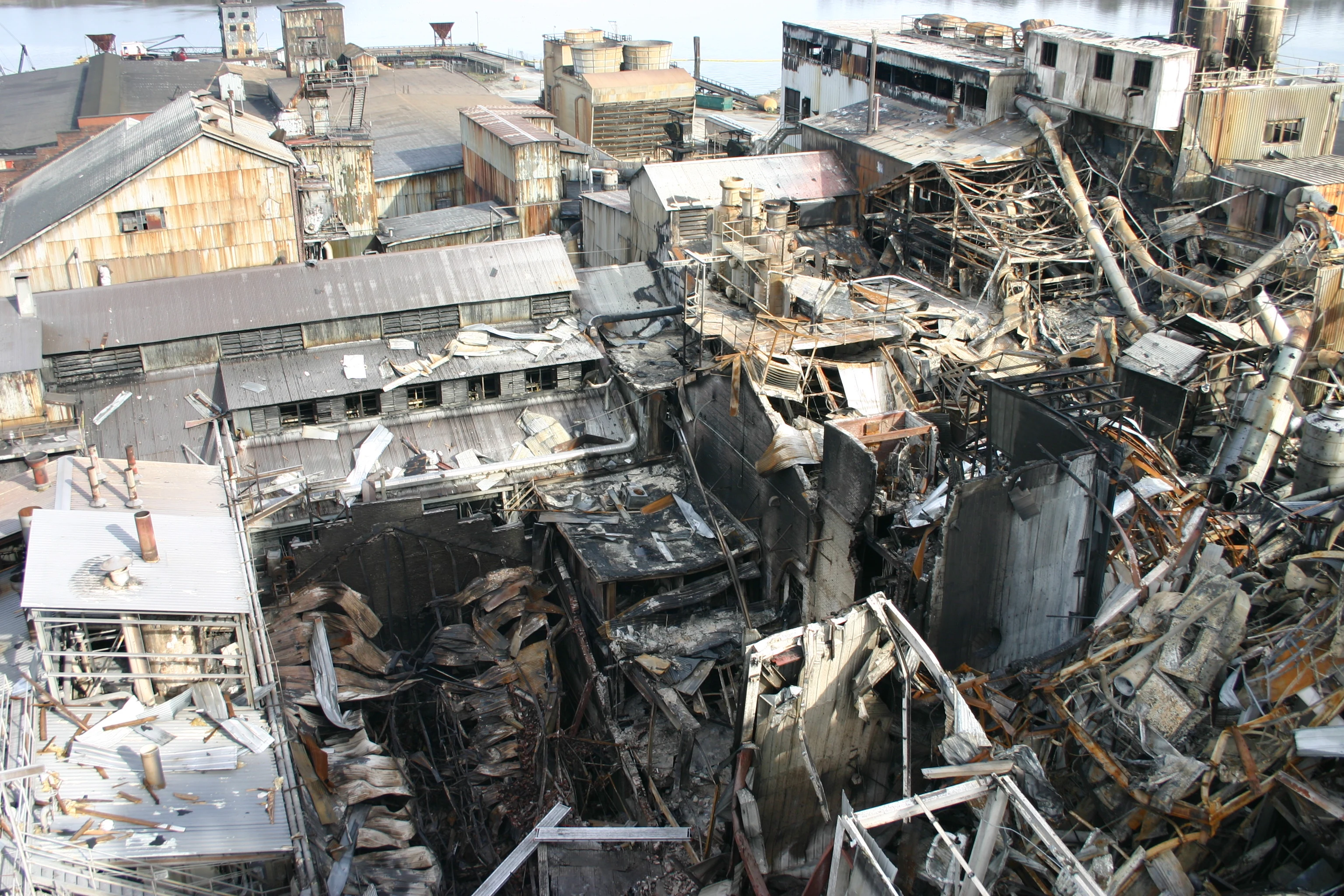
Editorial review: October 17, 2026. Documentary photographs show the aftermath; educational diagrams do not reconstruct the plant. Educational technical content: real assessments and protection engineering require facility-specific analysis and competent professionals.
Open standalone laboratory — PT/EN/ES →
Download English checklist CSV →
Primary sources and scope
CSB — final report, 2008-05-I-GA (September 2009) →
CSB — investigation overview (injury-count discrepancy) →
OSHA — combustible dust overview →
OSHA — prevention and mitigation advisory bulletin →
OSHA — Technical Manual, Combustible Dusts →
Frequently asked questions
Can every powder explode?
No. Combustibility, particle properties and the process conditions determine whether a dust cloud can be explosible.
Is sugar an explosive?
Finely divided sugar can participate in dust explosions under specific conditions. Ordinary bulk sugar is not the same as an explosive dust cloud.
What is a secondary dust explosion?
An event that can arise when an initial deflagration lofts settled dust into the air, enabling further ignition.
Is cleaning enough?
No. Housekeeping complements engineering design, containment, ignition-source control, protective systems and emergency preparedness.
Which standards are relevant?
NFPA 660 is a key technical reference; Brazilian operations also require a specific review of applicable NRs, standards and fire-safety rules.
How can dangerous dust buildup be prevented?
Contain releases, verify collection performance and carry out safe, documented housekeeping on floors, equipment and elevated or hidden surfaces. Methods depend on the material and should avoid lofting dust or introducing ignition; effectiveness needs verification.
References
- CSB — final report, 2008-05-I-GA (September 2009)CSB
- CSB — investigation overview (injury-count discrepancy)CSB
- CSB — Inferno documentaryCSB
- OSHA — combustible dust overviewOSHA
- OSHA — prevention and mitigation advisory bulletinOSHA
- OSHA — Technical Manual, Combustible DustsOSHA
- NFPA — Standard 660, 2025 editionNFPA
- MTE — NR-1Ministério do Trabalho e Emprego
- MTE — NR-12Ministério do Trabalho e Emprego
- MTE — NR-23Ministério do Trabalho e Emprego