
A worker died in an accident at CSN in Volta Redonda on October 13. Explore questions about industrial traffic, pedestrians and risk management.
A fatal accident and questions that require evidence
A CBSI worker died following an accident at CSN’s Presidente Vargas Steelworks, UPV, in Volta Redonda, Rio de Janeiro state, on the afternoon of October 13, 2026, according to regional reports. Foco Regional describes, as initial information, a worker struck in an incident involving a dump truck. Correio Sul Fluminense reports forensic examination and investigation by the 93rd Police Precinct.
The CBSI statement reproduced by Foco Regional expresses condolences, support for the family and investigation of causes. We do not treat it as a technical conclusion. In our October 14 consultation, we found no conclusive public report demonstrating the maneuver, speed, people’s positions or the functioning of barriers.
This article aims to study prevention of hazardous encounters between people and vehicles with respect for the victim and family. Engineering and occupational safety questions help organize an investigation; their answers cannot be presumed from a news report or generic photograph.
Foco Regional — notícia de 13/10/2026, atualizada às 20h →
Correio Sul Fluminense — notícia de 13/10/2026 →

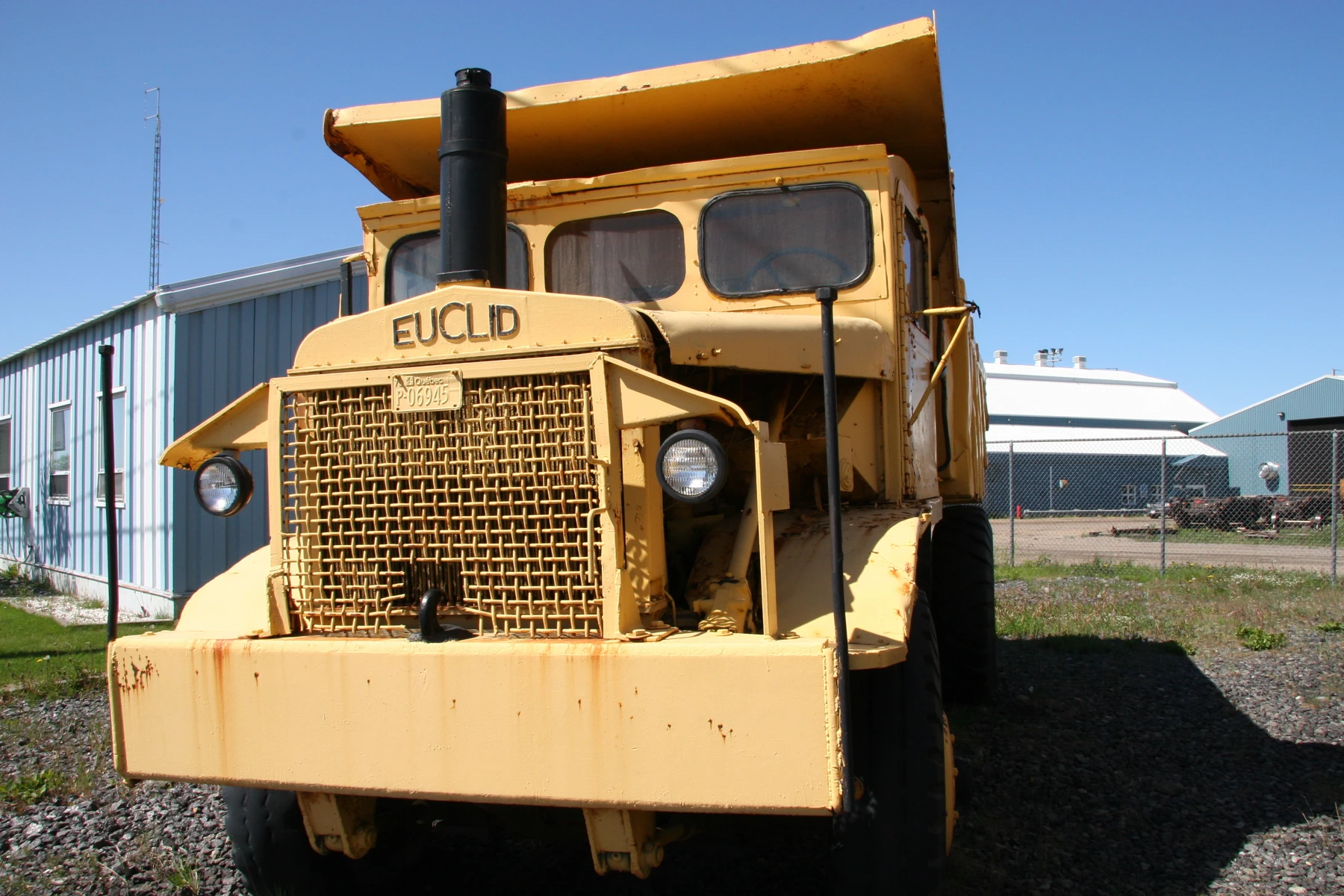
Where reports agree — and where they differ
The facility and employment relationship appear consistently across the consulted sources. The internal location, however, receives different descriptions: Foco Regional mentions the old steelmaking area, aciaria velha; Correio Sul Fluminense cites pig-iron desulfurization, Dessulfuração de Gusa. Folha do Aço describes the SAC area near the blast furnace. We do not consider these expressions equivalent confirmations of one point on the map.
Folha do Aço also mentions a truck loaded with crushed stone. This information remains attributed to the news outlet; we do not adopt the load as a calculation input or forensic fact. A pedestrian being struck, as reported, does not by itself establish whether the truck was moving forward, reversing, maneuvering or unloading.
The limits column below is as important as the information column. It prevents the preventive study plan from being confused with reconstruction of the case. Terms such as blind spot, brake failure and unsuitable route appear in this article only as general examination topics without asserting their presence in this accident.
Folha do Aço — notícia de 13/10/2026 →
| Topic | What was reported | What not to conclude |
|---|---|---|
| Date and facility | October 13, afternoon; UPV/CSN, Volta Redonda | Do not presume the exact plant location |
| Employment relationship | CBSI worker; company statement reproduced | Employment does not determine responsibility for the event |
| Vehicle | Foco Regional: initial report of a dump truck | Maneuver, speed and mechanical condition not demonstrated |
| Area | Old steelmaking area; pig-iron desulfurization; SAC near the blast furnace, according to different sources | Do not declare the locations equivalent |
| Load | Folha do Aço mentions crushed stone | Do not use as confirmed vehicle data |
| Investigation and controls | Forensic examination and 93rd Precinct cited; no public conclusion located | Do not attribute cause, PGR failure or absence of barriers |
Industrial traffic is part of the process
An industrial complex cannot be understood merely as a collection of roads. Routes serve production, supply, material removal and maintenance activities. An apparently clear area may become a waiting point, team access route or maneuvering zone during another stage of work.
Preventive analysis starts with actual movements: who needs to reach each workstation, which vehicles circulate, where they stop and what tasks occur nearby. Less frequent activities, suppliers, visitors and temporary changes must also be considered. An outdated drawing may no longer represent everyday exposure.
The UK HSE proposes examining site, vehicle and driver together in its workplace transport guidance. This is a foreign technical reference, not Brazilian law. Here, that organization helps avoid analysis focused solely on driver attention or pedestrian behavior without examining traffic as a system.
HSE — Introduction to workplace transport safety →

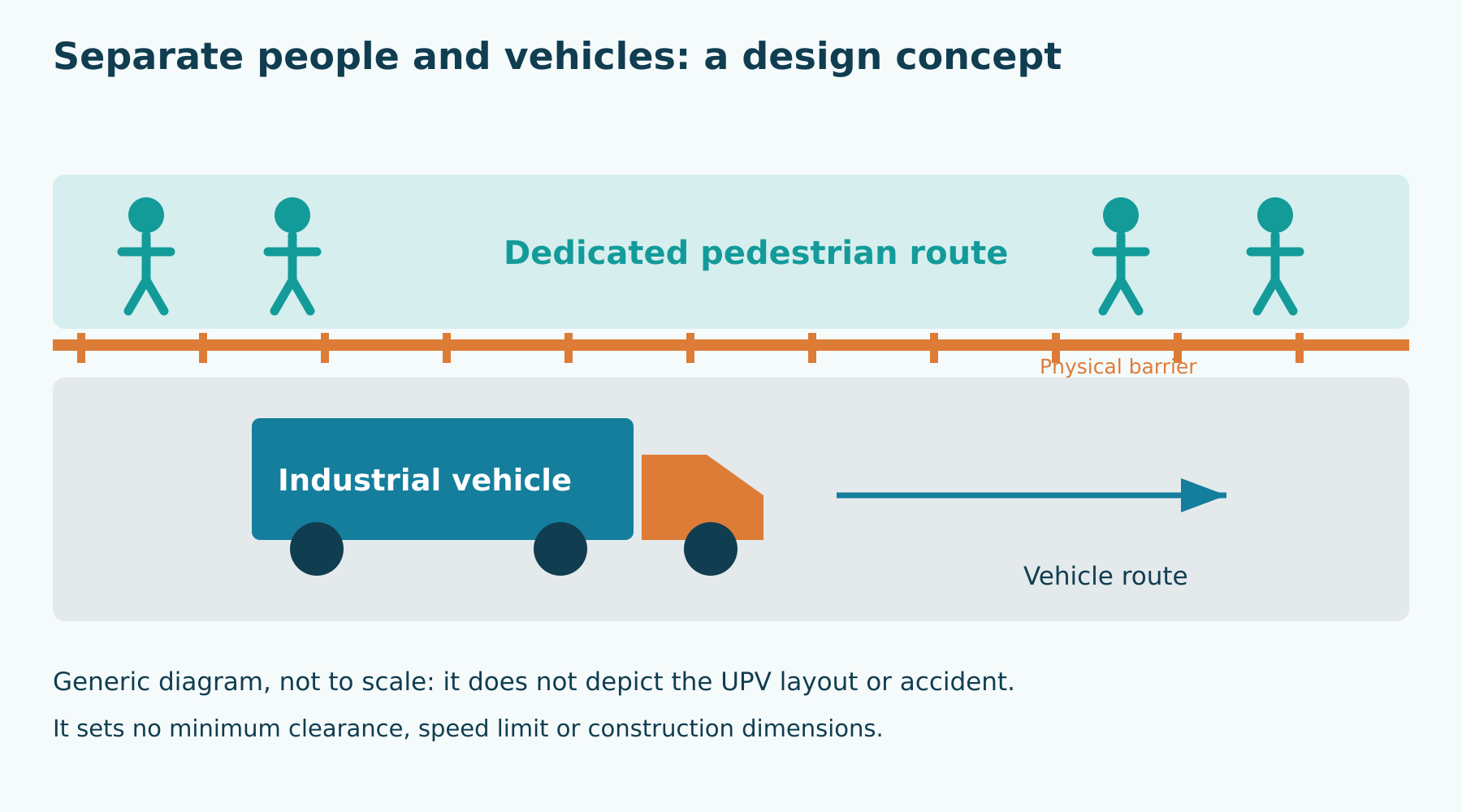
Separate paths before relying on attention
Where people and vehicles need to occupy the same space, prevention should seek to reduce opportunities for encounters. Wherever feasible, independent routes and physical segregation remove people from the vehicle’s path. Where a crossing is necessary, it must be planned as an interface with access and visibility compatible with the activity.
A painted line may communicate a rule but does not physically prevent access. A barrier may prevent access yet create another problem if it blocks visibility or guides people into a conflict point. Design must assess route continuity, accessibility, entrances, exits and how work actually takes place.
The diagram is conceptual: it does not reproduce UPV’s layout or indicate which controls existed there. It shows why a pedestrian route must connect destinations in a usable way. A passage requiring an impractical detour, ending in the roadway or becoming obstructed warrants assessment without turning that hypothesis into a case finding.
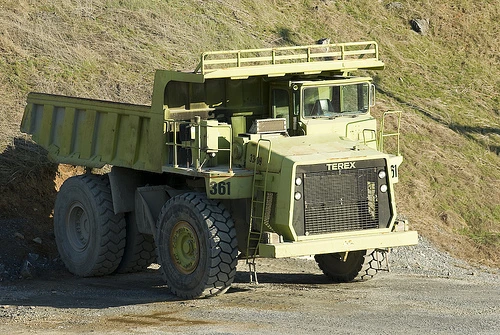
Reversing, crossings and temporary changes
Reducing the need to reverse, where feasible, can eliminate a complex traffic situation. One-way routes, suitable loading and unloading locations and turning areas are general possibilities to assess. The consulted sources do not establish whether reversing occurred in the Volta Redonda accident.
At intersections, it matters where a person emerges, which obstacles restrict visibility and how passage is decided. Signage, lighting and access controls must work together. The criterion is not just whether a sign exists but whether the rule can be perceived and followed under actual conditions.
Internal construction, stored materials, stopped equipment and process changes can modify routes. Management of temporary changes should therefore establish who communicates the new path, how access to the altered area is prevented and how traffic is checked afterward. These are prevention topics; no such change has been demonstrated in this episode.

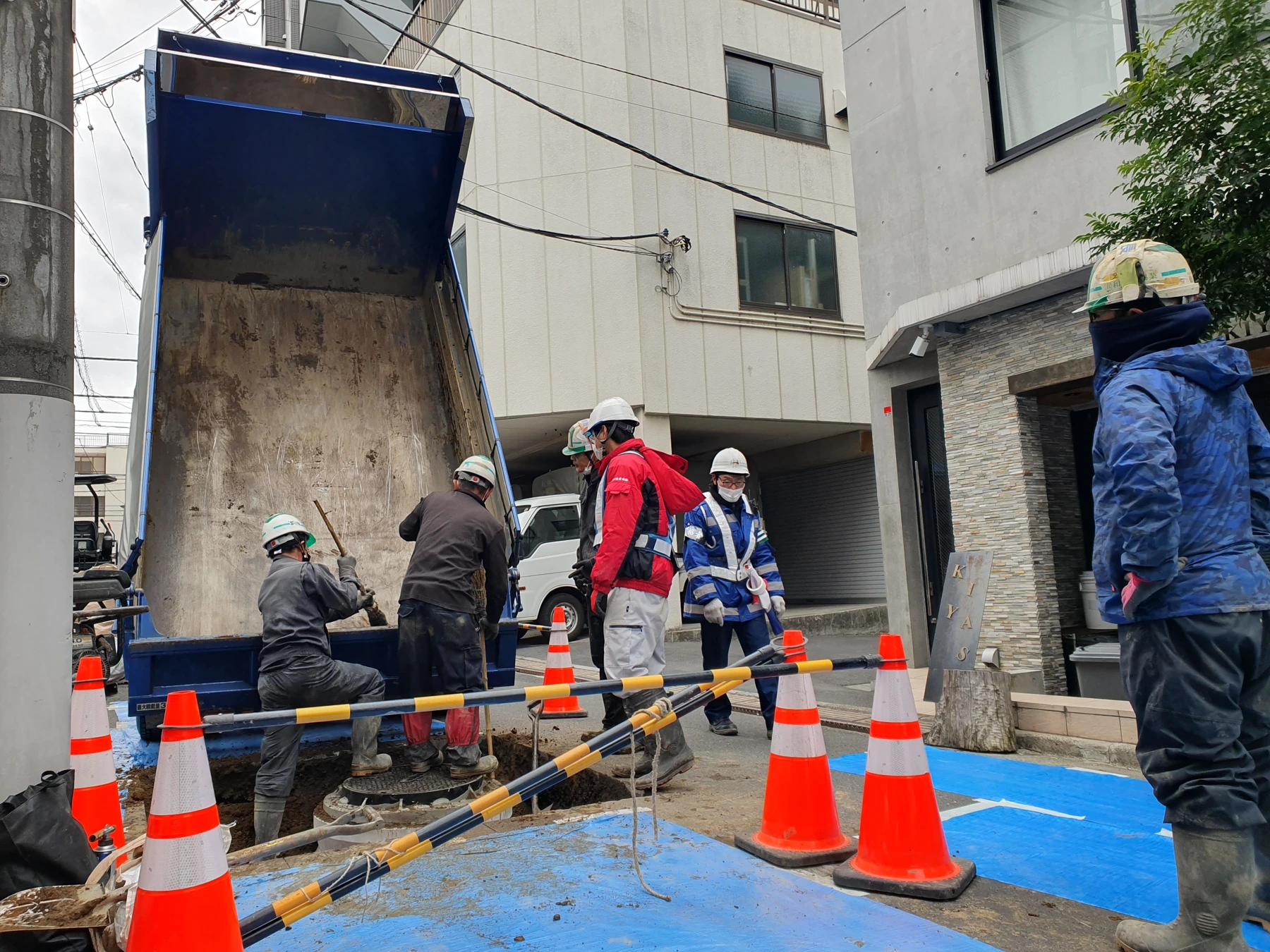
Stopping distance has two components
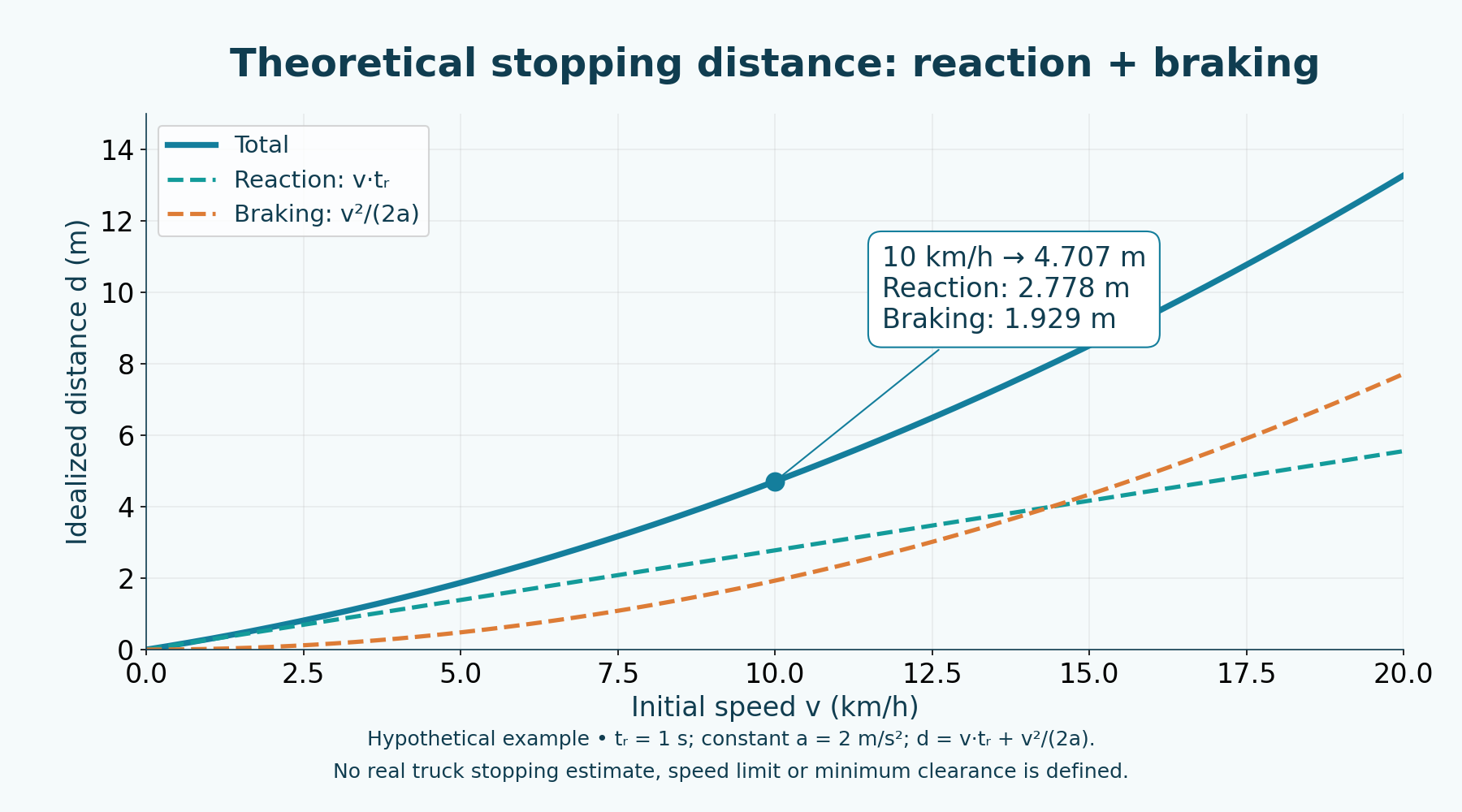
For an idealized straight-line exercise, we can write d = v·t_r + v²/(2a). The first component is displacement during the chosen reaction time. The second is braking with constant positive deceleration. Speed must be converted to m/s before using the expression.
The formula assumes speed remains constant during reaction and deceleration starts afterward, retaining the adopted value until the vehicle stops. It does not include additional braking-system delay, gradient, variable grip, trajectory changes, pedestrian movement or time until an obstacle becomes visible.
The calculation therefore does not provide a safe segregation distance, a speed limit or a specific truck’s performance. Mass and load do not appear as inputs because deceleration was imposed in the model; that does not make them irrelevant to real braking. The example helps illustrate the need to control exposure without estimating the accident’s dynamics.
Fictional exercise: 10 km/h does not mean an immediate stop
We adopt v = 10 km/h = 10/3.6 = 2.777778 m/s, reaction time t_r = 1.0 s and deceleration a = 2.0 m/s². These are teaching assumptions unrelated to the vehicle, driver or pavement at UPV.
The reaction component is 2.777778 m. Idealized braking is 2.777778²/(2×2) = 1.929012 m. The total is 4.706790 m, approximately 4.71 m. Rounding intermediate speed to 2.778 m/s produces a small numerical difference; table values use the conversion without that rounding.
With t_r and a constant, doubling speed doubles the reaction component and quadruples braking. The total does not necessarily quadruple because it adds components with different dependencies. The table and chart show this comparison; they propose neither authorized speeds nor design distances.
| Speed | Reaction | Idealized braking | Total |
|---|---|---|---|
| 5 km/h | 1.388889 m | 0.482253 m | 1.871142 m |
| 10 km/h | 2.777778 m | 1.929012 m | 4.706790 m |
| 15 km/h | 4.166667 m | 4.340278 m | 8.506944 m |
| 20 km/h | 5.555556 m | 7.716049 m | 13.271605 m |
Explore the model without making it an operating rule
The lab lets you change speed, reaction time and constant deceleration, separating the two components. The selected point and table use the same assumptions. If an input is blank or outside its range, the calculation is hidden until corrected.
Try keeping 10 km/h and increasing reaction time from 1 to 2 s: the model adds 2.777778 m to reaction distance. Then restore the example and reduce deceleration from 2 to 1 m/s²: braking distance doubles. These changes explain calculation sensitivity; they do not measure the event driver’s or truck’s conditions.
Observe the curve but preserve the main conclusion: reducing speed does not automatically replace segregation. The calculation does not assess collision, blind spots or distance to a moving pedestrian. The local files are also educational and certify neither a vehicle nor a traffic design.
Teaching laboratory: reaction and braking
Change three assumptions in a straight-line model and compare the two stopping components.
Fictitious values. Does not measure the accident truck or establish an authorized speed, safe distance or design clearance.
- Speed (m/s)
- 2.77778
- Reaction distance (m)
- 2.77778
- Idealized braking (m)
- 1.92901
- Theoretical total (m)
- 4.70679
View equivalent chart data
| v (km/h) | Reaction (m) | Idealized braking (m) | Theoretical total (m) |
|---|---|---|---|
| 0 | 0 | 0 | 0 |
| 5 | 1.38889 | 0.48225 | 1.87114 |
| 10 | 2.77778 | 1.92901 | 4.70679 |
| 15 | 4.16667 | 4.34028 | 8.50694 |
| 20 | 5.55556 | 7.71605 | 13.2716 |
| 25 | 6.94444 | 12.05633 | 19.00077 |
d = v·t_r + v²/(2a); v (m/s) = v (km/h)/3.6
Model: constant speed during reaction, constant deceleration during braking. Excludes additional brake-system delay, gradient, changing grip, pedestrian movement and perception distance. Lower speed does not automatically replace segregation.
Download the educational HTML lab →
Download fictional scenarios in CSV →
Download the mathematical Python model →
Investigate beyond “did not see the person”
Visibility is relevant, but saying did not see can prematurely end the analysis. The investigator must determine what could be seen, from where, at what moment and under which conditions. Next, they must examine why person and vehicle could be close together during that activity.
Camera records, where available and lawfully accessible, help establish sequence but may not show depth, obstacles outside the frame or the driver’s field of view. Statements and records must be compared while preserving origin and times. A reliable chronology may require reconciling different clocks.
Readers should not enter a preserved location, collect materials or reproduce a hazardous maneuver. Examination of physical evidence and systems belongs to authorized teams. The questions below guide preventive study without anticipating an answer for the official investigation.
HSE — HSG245, Investigating accidents and incidents →
Incident investigation methods →
- Which activity was taking place, and which paths can be demonstrated?
- Was the vehicle traveling, maneuvering, reversing, loading or unloading?
- Which visibility, lighting and pavement conditions can be established?
- Which routes, crossings and access controls were planned and usable?
- How did operations, logistics and contractors coordinate activities?
- What changed at the location, and which evidence supports the sequence?
Contractors: coordination must reach the task
The employment relationship with CBSI makes interaction between organizations relevant to discuss without attributing irregularity to either. Site-entry induction conveys initial information; work coordination must reach tasks, routes, interfaces and changes during activity.
Brazil’s NR-1, in items 1.5.8.1 through 1.5.8.4 of the current wording consulted, addresses prevention involving contractor organizations, exchange of risk information and joint measures for risks arising from interaction. In this situation, the regulation establishes coordination by the contracting organization. This does not resolve responsibility for the accident without verifying facts.
Analysis should ask how information reached the team and how its implementation was confirmed. Who needed to communicate a changed route? How were simultaneous activities coordinated? A certificate or signature establishes a record but does not independently allow inference of how the process worked at that moment.
GRO and PGR: represent actual traffic
Under NR-1, Occupational Risk Management, GRO, takes the form of a Risk Management Program, PGR, covering accident risks relevant to activities. At minimum, the program contains a risk inventory and action plan. In the inventory, identification must connect hazard, exposure circumstances, exposed workers, existing measures and assessment.
For internal traffic, simply stating risk of being struck is insufficient to describe where and how exposure occurs. Useful analysis distinguishes crossings, travel to workstations, loading and unloading interfaces and less frequent conditions. This is guidance applied to the assessment process, not an assertion that CSN’s PGR omitted these topics.
Items 1.5.5.2.1 and 1.5.5.2.2 link the plan to measures and to schedule, responsibilities, monitoring and result evaluation. Items 1.5.5.5.1 and 1.5.5.5.2 address documented accident analysis considering actual work and event-related factors. Learning should not become a generic recommendation without checking effectiveness.
NR-11 and NR-12: identify the applicable provision
NR-11 is a reference for transporting, moving, storing and handling materials. Consulting it requires relating provisions to the actual equipment and activity. The name dump truck in a report is insufficient to define which specific requirements apply to the operating configuration.
An example of the importance of precise reading: NR-11 item 11.1.7 addresses an audible warning signal, specifically a horn. This does not authorize claiming the item generically requires a reversing alarm on every truck. Likewise, we infer neither defect nor absence of a device in the accident.
NR-12 must also be analyzed within its scope and context. We assert neither a blanket exclusion of trucks nor automatic coverage of every vehicle. NR-1’s prevention hierarchy favors eliminating risks and prioritizing collective protection before relying solely on organization or personal protection. HSE guidance complements the technical discussion without replacing Brazilian legislation.
Prevention layers and evidence to compare
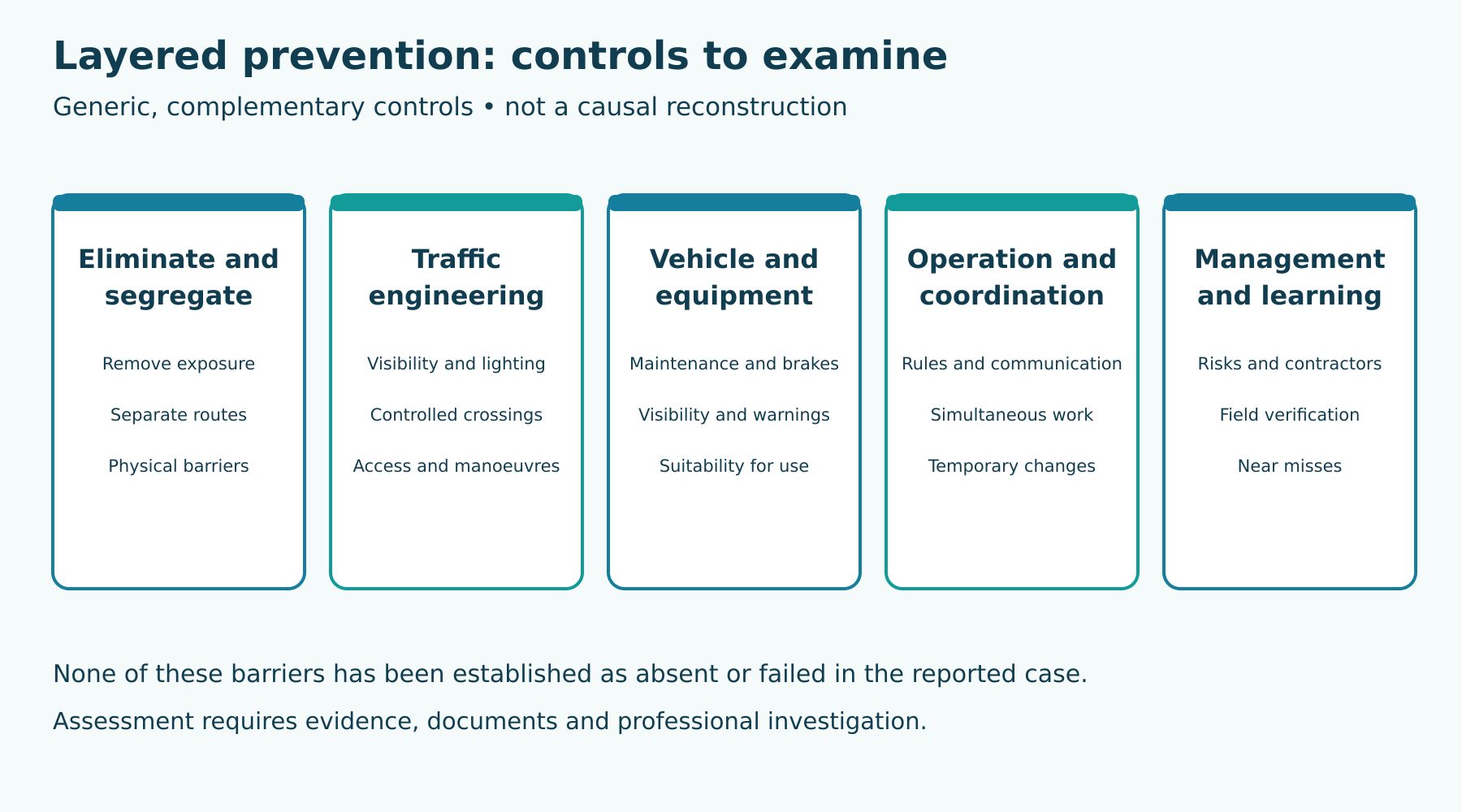
Route design, segregation, vehicle condition, operational coordination and risk management have distinct functions. Alarms, mirrors, cameras and detection may contribute where suitable but do not independently ensure every pedestrian will be noticed. High-visibility vests and guidance also do not physically prevent an encounter.
This section’s diagram presents generic layers. It does not represent the event sequence, identify barriers present at UPV or declare any failed. Its purpose is to organize verification: protection needs a defined function, conditions of use and a criterion to assess performance.
The evidence table connects questions to records. It is not a list of documents supposedly absent from the company. A near-miss account, for example, can guide priorities where reliable records exist, but its existence and relationship to this case have not been demonstrated in the consulted sources.
HSE — Workplace transport, getting the basics right →
Functional safety: verify barrier functions →
| Layer | What to examine | Possible evidence |
|---|---|---|
| Layout and segregation | Route continuity and interfaces | Plans, accesses, changes and authorized observations |
| Traffic | Crossings, maneuvers and loading/unloading | Procedures, records and planning |
| Vehicle | Suitability and condition of relevant systems | Identification, maintenance and professional examinations |
| Coordination | Interaction between teams and organizations | Communication, scheduling and risk information |
| Management | Planned controls and effectiveness | Inventory, action plan, checks and documented analysis |
From recommendation to verification
A preventive action must address a demonstrated risk and defined condition. If the recommendation is to change a route, there must be responsible parties, a deadline and verification that the new path can be used. If visibility is to be improved, the criterion must consider actual operation without creating false confidence in a device.
Tracking only the absence of new accidents may fail to reveal persistent exposure. Checks of obstructions, crossing use, changes and team interaction provide information about implementation. Indicators must be interpreted in context; an isolated count does not establish safety.
The Tapiratiba article, published separately, can be read as another exercise in questions and evidence. Facts and mechanisms from the two episodes are not interchangeable. Here, the focus remains on industrial traffic and relationships among people, vehicles and work organization.
Tapiratiba: a separate case with its own facts and mechanisms →
Preventing hazardous encounters is a design choice
A worker’s death requires respect, investigation and care with public conclusions. Available sources do not allow determination of the cause, each person’s conduct or responsibility for the October 13 episode. Investigation must compare reports with records and examinations.
The preventive principle is clear: coexistence between people and vehicles must be addressed in facility design and work control with verifiable barriers. Individual attention matters but cannot alone bear responsibility for preventing a hazardous encounter. Safety as strategy, not bureaucracy.
Frequently asked questions
What happened at Presidente Vargas Steelworks on October 13, 2026?
Regional reports described a CBSI worker’s death inside UPV/CSN in Volta Redonda. Foco Regional initially describes a worker struck by a dump truck; other sources cite forensic examination and investigation by the 93rd Precinct. The article presents no forensic conclusion about the dynamics.
Has the cause of the dump-truck accident been established?
We found no public conclusion in the sources consulted on October 14. Reports do not demonstrate speed, maneuver, people’s positions, mechanical condition or barrier failure. These questions must be examined through records and forensic work without prejudging cause or responsibility.
Why separate pedestrians from industrial vehicles?
Separate routes and appropriate controls can reduce opportunities for encounters between people and vehicles. Warnings and PPE do not physically prevent every exposure. Design must consider access, crossings, continuity and actual conditions without presuming which controls existed at UPV.
How should the PGR address internal traffic?
The inventory must identify relevant hazards and exposure circumstances, exposed people, measures and assessment. The plan defines actions, responsible parties and monitoring. Interaction with contractors must also be considered under NR-1. This does not prove omission in a particular company’s PGR.
What should be investigated when a pedestrian is struck in an industrial setting?
Vehicle identification, activity, paths, visibility, pavement, routes, barriers, records and coordination are relevant topics. Each conclusion requires evidence. Examination must consider actual work and organization without limiting explanation to assumed distraction or a label of human error.
Does NR-11 apply to every dump truck?
It should not be asserted that all provisions apply automatically based on the vehicle name. Equipment, activity and context must be analyzed against the current text. Item 11.1.7 mentions a horn; it cannot be used as a generic reversing-alarm requirement for every truck. The accident report does not demonstrate a violation.
References
- Foco Regional — notícia de 13/10/2026, atualizada às 20hFoco Regional
- Correio Sul Fluminense — notícia de 13/10/2026Correio Sul Fluminense
- Folha do Aço — notícia de 13/10/2026Folha do Aço
- MTE — NR-1, redação vigente consultadaMTE
- MTE — Programa de Gerenciamento de RiscosMTE
- MTE — NR-11, redação vigente consultadaMTE
- MTE — NR-12, redação vigente consultadaMTE
- HSE — Introduction to workplace transport safetyHSE
- HSE — Separating pedestrians and vehiclesHSE
- HSE — Workplace transport, getting the basics rightHSE
- HSE — HSG245, Investigating accidents and incidentsHSE
- euclid-photo.webpEuclid haul truck photographed in Havre-Saint-Pierre, Canada, in 2005; illustrative vehicle with no demonstrated connection to CSN, UPV or the accident. Photo: SyGrnwd / Wikimedia Commons, CC BY-SA 4.0. Resized and converted to WebP.
- workers-photo.webpWorkers beside a dump truck in Japan, as identified by the author; an illustrative image with no demonstrated connection to the accident. It is not a prescribed procedure or evidence of safe operation. Photo: Syced / Wikimedia Commons, CC0 1.0. Resized and converted to WebP.
- quarry-photo.webpTerex haul truck in a quarry, as described in the original record; an illustrative image with no demonstrated connection to CSN, UPV or the accident. Photo: jster91 / Wikimedia Commons, CC BY 2.0. Converted to WebP; original 500 × 335 resolution retained.