
A technical look at humanoid robots on factory floors: BMW pilots, embodied AI, reliability, productivity and industrial robot safety.
An impressive movement is the beginning of the test
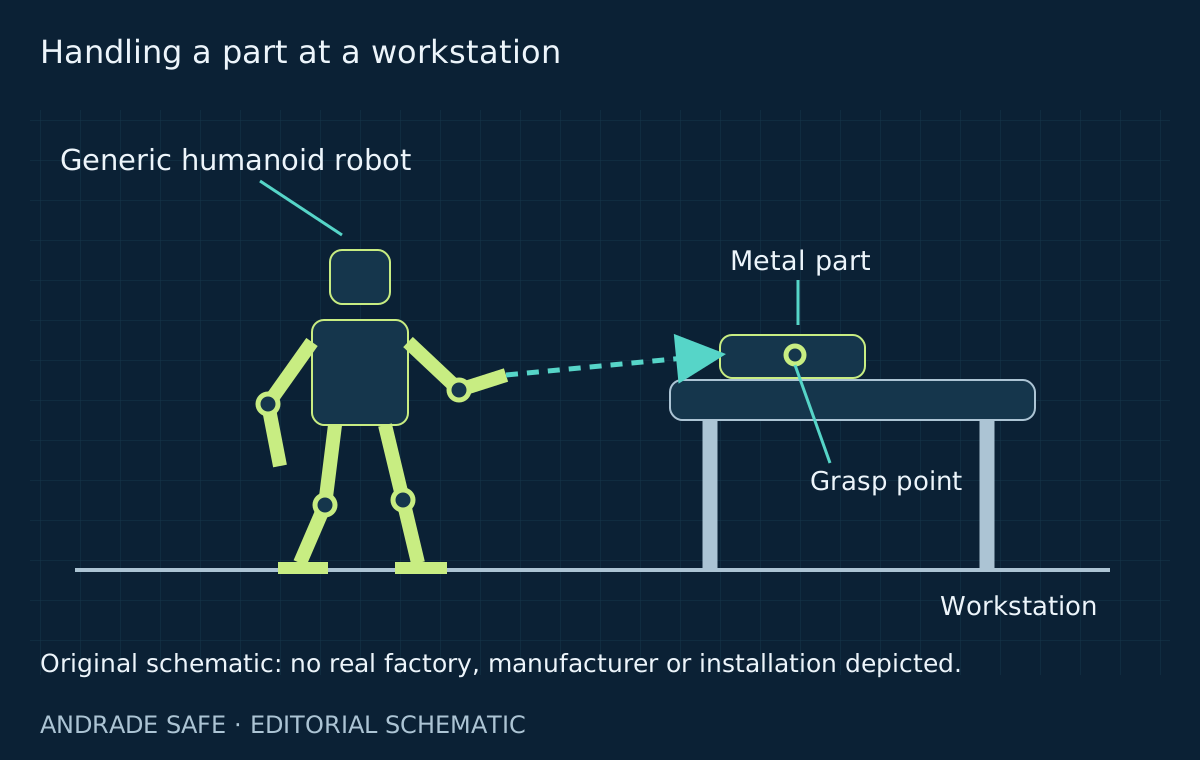
A humanoid retrieves a component and places it on a workstation. The sequence looks convincing on video. Manufacturing asks what happens after the successful take: can the machine repeat the operation through a shift, cope with displaced parts, recover from faults and maintain safe conditions around people? Useful automation is a sustained process, not a collection of selected movements.
China's guidance published on 9 October 2026 brings industrial AI back into the discussion. Meanwhile, documented BMW deployments offer a practical way to assess humanoids without dismissing progress or assuming that general-purpose factory labour has already arrived. The evidence must remain attached to the particular task and operating conditions that produced it.
This article distinguishes a demonstration of a capability, a pilot in a defined application, repeatable production under verified conditions and scaling across teams or facilities. Those stages ask different questions. Engineers and buyers need to know which stage an announcement actually describes before treating it as an investment case.

China encourages industrial AI while addressing risk
China's official 9 October release calls for industrial AI adoption alongside monitoring, risk alerts and emergency response. Reuters' report, accessed through its identified StreetInsider republication, adds accountability for losses from blind investment. This is policy context rather than a safety approval for a particular robot. The short news report does not establish the maturity of a humanoid product.
A Reuters investigation published on 27 August describes limits to flexible work and dependence on human training in the Chinese environments it observed. That does not establish an absence of progress across all companies. It offers an independent commercial counterpoint to demonstrations, not a universal verdict on every industrial application.
Market statistics require the same discipline. IFR's September 2026 release reports roughly five million industrial robots operating worldwide in 2025 and more than 600,000 installations that year. These are industrial robots as a whole, not five million humanoids. Shipment estimates for humanoids use a different population and cannot be combined with this stock figure to invent a market share.
Chinese guidance: official release →
Reuters: blind investment and AI risk controls →
Industrial arms, cobots, AMRs and humanoids serve different purposes
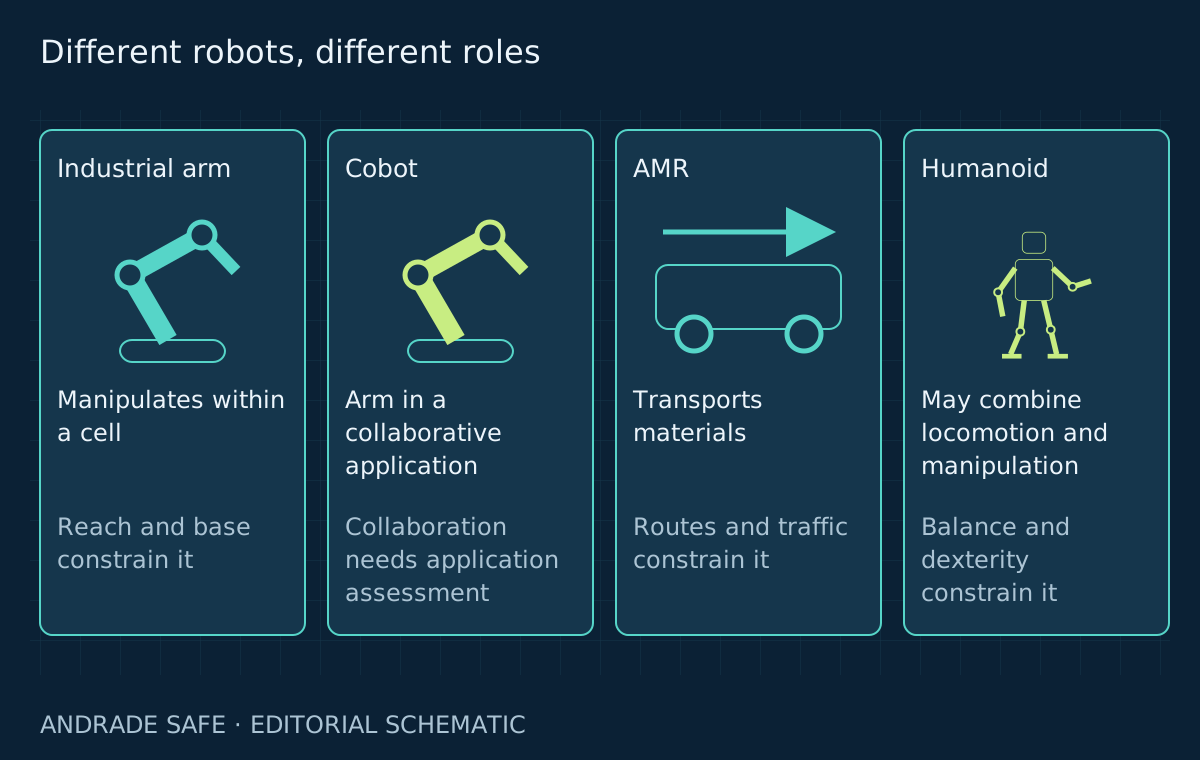
A conventional industrial arm works within a designed envelope. Tooling, fixtures and process integration allow it to handle repeated welding, painting or part transfer. Engineering the station to reduce variation can be more effective than asking a more complex robot to compensate for every uncertainty.
Cobot generally describes a robot intended for collaborative applications. Collaboration still depends on the task and protective measures. A sharp tool, heavy load or trapping point remains hazardous even when attached to an apparently approachable robot. The label does not automatically make an application safe without guarding.
An autonomous mobile robot, or AMR, navigates and transports material within its operating architecture. A humanoid combines human-like body features with manipulation and, in some designs, mobility. These categories can overlap: a wheeled humanoid can also be a mobile manipulator. A mobile manipulator need not be humanoid, and a humanoid need not walk on two legs.
Human proportions may help a robot access existing workstations, tools and heights. That is a design hypothesis to test. A dedicated gripper may outperform a versatile hand; wheels may suit a smooth floor better than legs. Selecting the body before defining the task reverses the engineering decision.
| System | Typical application | Limits to assess |
|---|---|---|
| Industrial arm | Repeated welding, painting, assembly and handling | Tooling, fixtures, envelope and safe integration |
| Cobot / collaborative application | Bounded interaction under specific safety strategies | Tools, loads, force, speed and protective measures |
| AMR / mobile robot | Material transport and navigation | Traffic, obstacles, visibility and mixed zones |
| Humanoid / mobile manipulator | Handling at human-designed workstations | Dexterity, mobility, energy, faults and safety |
Why a demonstration is not production validation
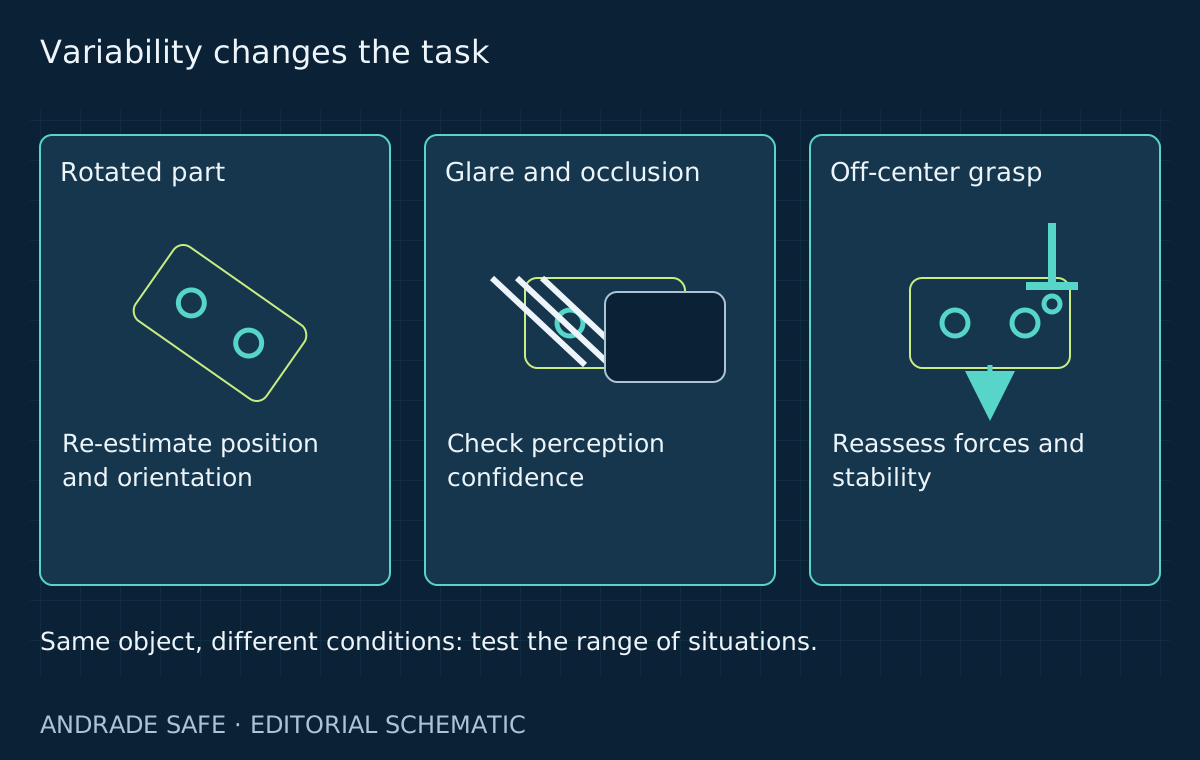
A demonstration may use consistent lighting, carefully placed objects and a selected successful attempt. That is useful for showing a capability. It does not reveal how many retries, resets or human corrections were needed. Without the attempts as well as the successes, a reliability claim lacks its denominator.
Consider a rotated part inside a bin. The machine must estimate its pose, choose a contact, avoid neighbouring objects and confirm the grasp. Replaying yesterday's trajectory may drop the load or hit the fixture. Recovery must be designed: retry within limits, return the object, stop safely or request authorised help.
Define the operating domain before accepting a pilot: parts, loads, tolerances, floor conditions, lighting, obstacles and work modes. Include warm equipment, battery changes and realistic variation. Success in one station does not establish general competence across a factory. Expanding the conditions without testing expands the claim rather than the evidence.
Embodied AI connects sensing to physical action
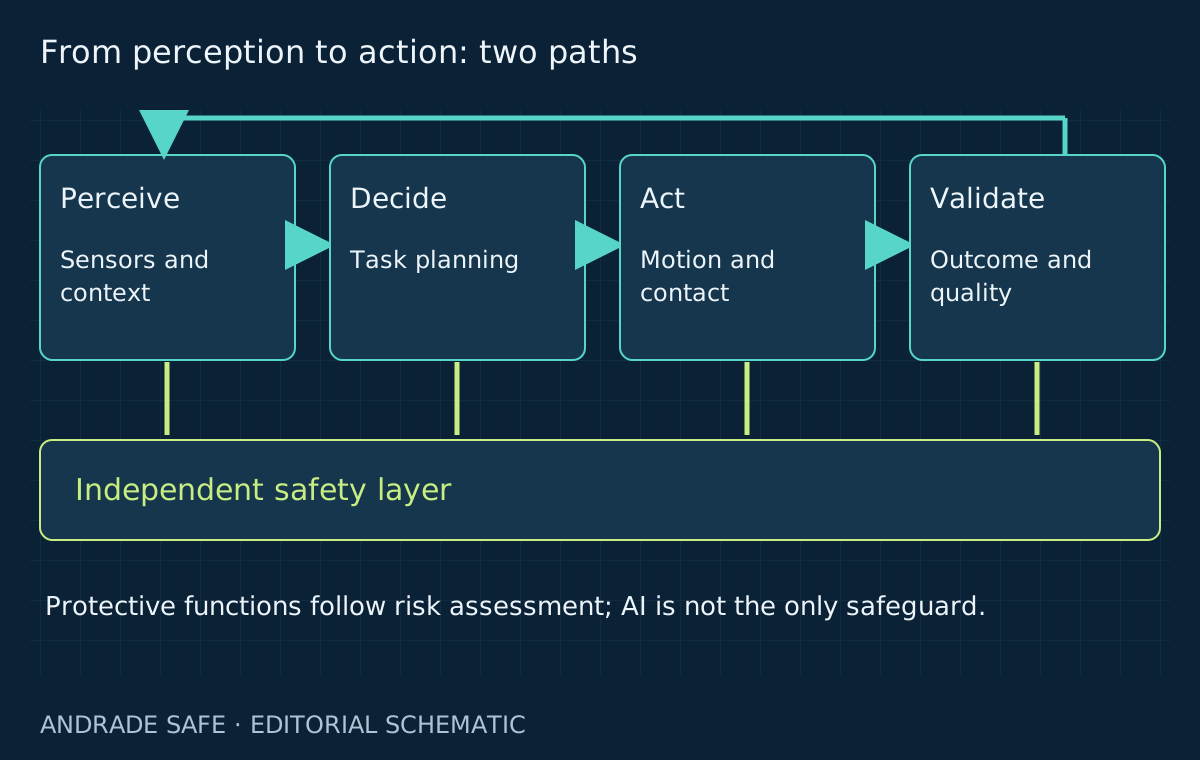
Embodied AI, often called physical AI in industrial discussions, links computation to a body interacting with the environment. One possible chain starts with cameras and force or tactile sensors. Perception estimates objects and state; planning selects an action; controllers drive actuators; feedback checks what happened. Architectures vary between systems.
Imitation learning can use human demonstrations. Teleoperation lets a person guide the machine remotely and collect training examples, but must be distinguished from autonomous execution. Simulation can explore behaviours and conditions; sim-to-real transfer must address differences in friction, lighting, compliance and contact. A simulated success does not replace a physical test.
A high-level instruction still needs to become feasible trajectories and actuator commands. Position estimates, motor response and communication influence the result. Computing infrastructure, discussed in our ASML and semiconductor article, supports the process. It does not validate the installed application on its own.
Safety functions require a separate engineering argument. Asking an AI model to avoid people is insufficient. Detection, stopping, limits and diagnostics must be specified and validated for the relevant architecture and risks. Frequent object recognition is not automatically a dependable protective function.
Dexterity and uptime are harder than the highlight reel suggests
Manipulation involves controlling contact. Reflections can confuse vision; oil changes grip; small clearances affect insertion. The tool must coordinate position and force without damaging, dropping or trapping the object. Sensors, end effectors and station fixtures work together. A hand with more fingers is not automatically the best handling solution.
Repeatability concerns consistent outcomes under defined conditions. Accuracy concerns closeness to a target. Neither establishes universal dexterity: repeating a trajectory does not prove correct recognition of an unfamiliar part. Measurement must match the actual task and its acceptable product tolerances.
Mobility introduces traffic, obstacle and stability issues. Legs bring fall hazards; wheels require compatible routes. Load and posture affect operating limits. Charging, battery replacement, thermal constraints, wear and maintenance also interrupt availability. A purchasing decision needs sustainable output, not peak movement speed.
What the Figure 02 pilot at BMW demonstrates
BMW reports that Figure 02 retrieved and positioned sheet-metal parts for welding at Spartanburg in its 2025 pilot. It handled more than 90,000 components, accumulated around 1,250 operating hours and contributed to production of over 30,000 BMW X3 vehicles. It did not assemble those cars alone.
This is meaningful evidence for a bounded operation. BMW also describes barriers and infrastructure integration. The published totals alone do not disclose every fault, cost, intervention or shift-level result. They cannot establish unrestricted safety in another facility or general autonomy across unrelated tasks.
The official video below provides useful visual context. It is not a complete operational record. Buyers should ask for acceptance criteria, quality data and recovery conditions alongside the footage. Figure's own account provides manufacturer corroboration and should be read with that interested-source status in mind.
BMW Group — Figure 02 / Spartanburg
Official BMW Group video. It illustrates a bounded application rather than complete operational, quality or safety records.
AEON at Leipzig: a humanoid can move on wheels
BMW's February 2026 announcement describes Hexagon's AEON with a human-like upper body and wheel-based movement, targeting battery and component applications. Body form and locomotion are separate design decisions. The relevant question is whether that arrangement suits the workstation and process.
There is a newer update: on 6 October 2026, Hexagon stated that AEON was performing production tasks at Leipzig within a staged programme. This is a current manufacturer statement, not an independent audit of uptime, safety or return on investment. It does not establish widespread deployment throughout the factory.
Progress should be followed with comparable evidence. A programme announcement and a task video describe development stages. Dependable expansion also requires maintainable equipment, controlled changes and results reproducible beyond the original implementation team. Maturity belongs to the verified application rather than the product name alone.
BMW Group — AEON / Leipzig
Official BMW Group video published in February 2026. It shows programme context rather than an audit of the performance reported in October.
Measure the pilot before expanding it
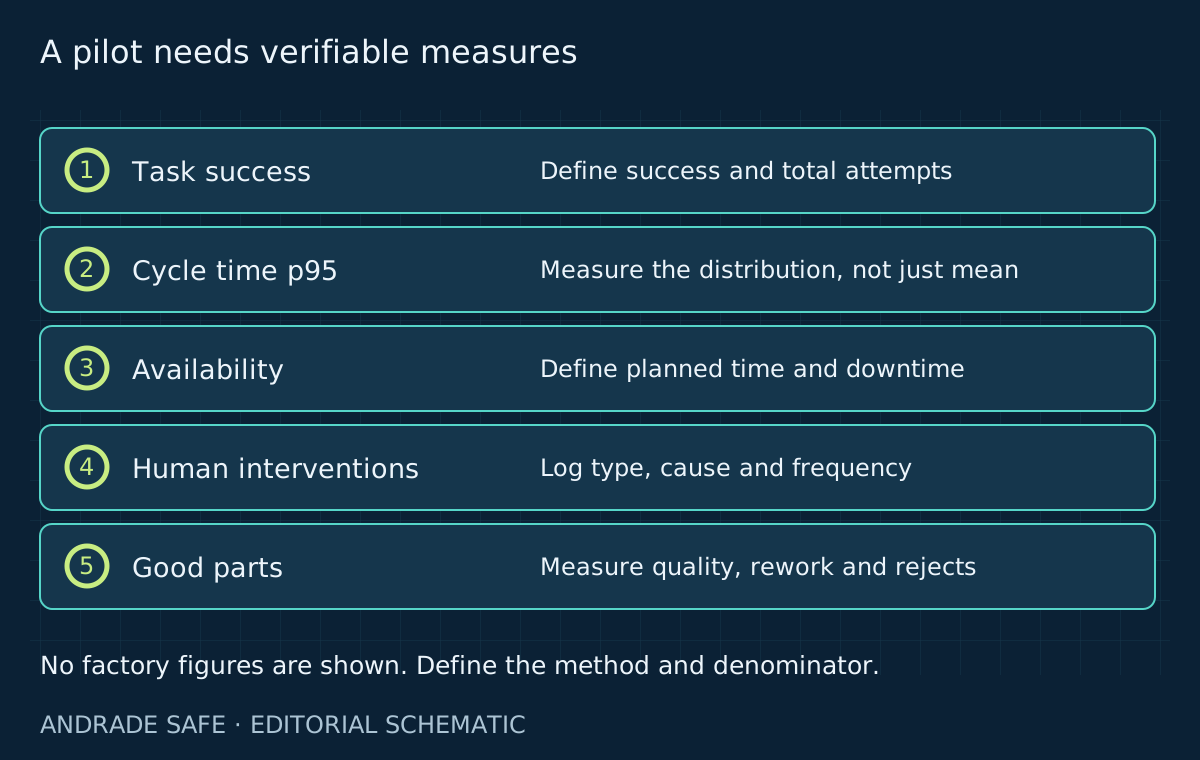
NIST's work on evaluation and benchmarking supports characterising robot capabilities through measurement. In practice, begin with a task definition: what qualifies as success, when does a cycle start and how are failed attempts recorded? Agree acceptance criteria before the trial rather than selecting them after seeing the results.
Cycle time needs a distribution. The median, p50, describes the centre; p95 reveals slower cycles. Neither replaces recording charging, recovery or downtime outside completed cycles. Availability must state which stops are counted. Success rates should separate independent completion, completion after assistance and unrecoverable failure.
Consider an explicitly hypothetical editorial example, unrelated to BMW or China. A cell delivers 100 parts during a planned eight-hour shift; 90 pass on the first attempt and five human interventions occur. That gives 11.25 first-pass good parts per planned hour and five interventions per 100 cycles if each part represents one cycle. Availability cannot be calculated without downtime records.
Cost per good part includes integration, fixtures, training, energy, supervision, maintenance and quality losses. Compare several production volumes and available-time assumptions with a conventional alternative. A throughput improvement matters only while required quality and safety controls remain effective. Safety performance is not a tradeable allowance for faster production.
NIST: evaluation and benchmarking →
| Measure | How to measure | Interpretation caution |
|---|---|---|
| Task success | Successes ÷ attempts for a defined task and period | Separate assisted from independent completion |
| Cycle p50 / p95 | Median and 95th percentile of recorded cycles | Also record downtime outside completed cycles |
| Availability | Time fit to produce ÷ planned time | Define the included stoppages |
| Interventions | Count per 100 or 1,000 cycles | Record cause, duration and severity |
| Quality | First-pass good parts, damage and rework | Movement does not mean accepted output |
| Safety | Hazardous events, near misses and protective tests | No accident does not validate every safeguard |
| Total cost | Cost per good part including integration and operation | Compare alternatives under equivalent conditions |
Human–robot interaction demands application-level safety
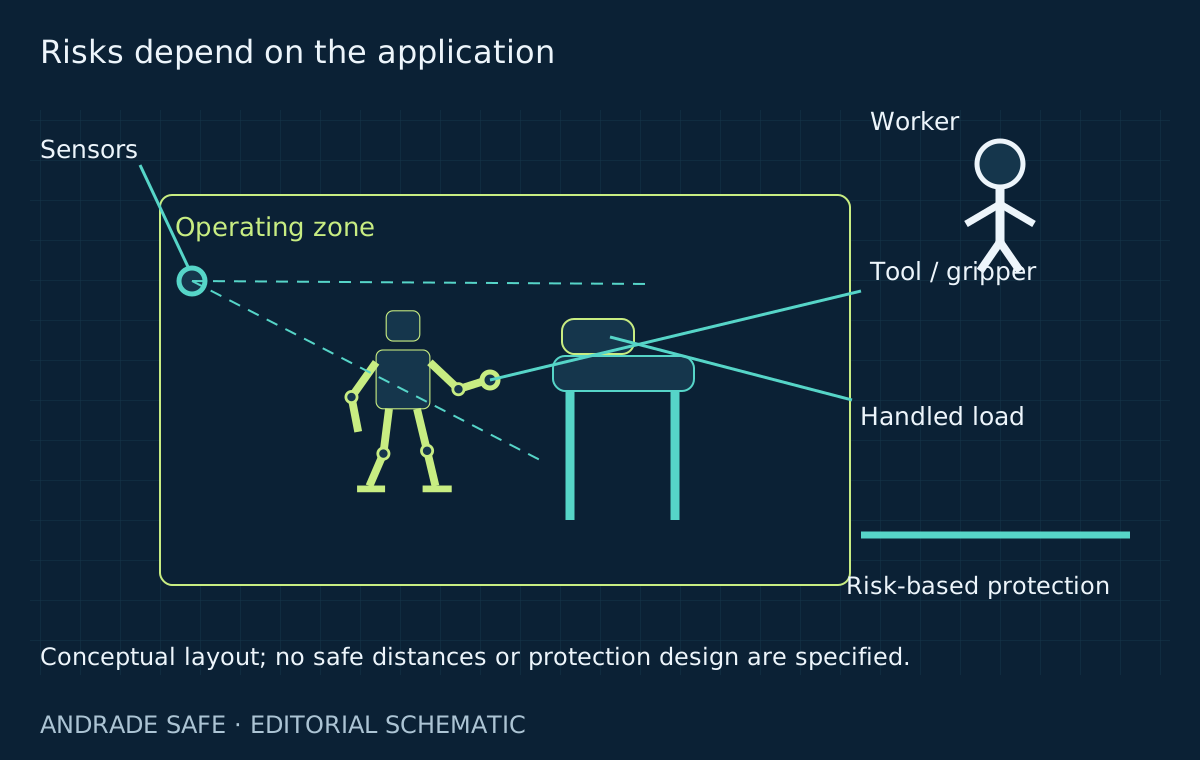
Assess collisions, trapping, instability, dropped loads, unexpected movement and stored energy. The end effector and workpiece can change the hazard: a gripper may pinch, a load may have sharp edges and a station may create a crushing point. Evaluating only the robot's body leaves out essential parts of the application.
OSHA highlights accidents during non-routine activities such as programming, testing, setup and maintenance. Those interventions need suitable modes and procedures. A software pause does not establish electrical, pneumatic, gravitational or other energy isolation. Safe conditions must be verified before authorised intervention.
Guarding, interlocks, detection, limited motion and protective stopping should follow the application's risk assessment. This article prescribes no universal separation distance or force limit. Detection can be too late if response time and stopping distance are incompatible with the hazard. Our guide to guards and interlocks explains the underlying distinction.
ISO references and the Brazil-specific NR-12 context
ISO 10218-1:2025 addresses industrial robots; part 2:2025 addresses applications and cells. Their public scopes exclude hazards associated with mobility on mobile platforms. The series therefore does not automatically address every travel hazard of a humanoid. ISO/TS 15066:2016 supplements industrial collaborative applications rather than all non-industrial robots. This review used public scopes, not the full paid standards.
In Brazil, NR-12 provides a regulatory framework for machinery and equipment within its scope. Assess the installed system and applicable requirements rather than treating a foreign catalogue or collaborative label as proof of compliance. NR-12 is a Brazilian context, not legislation governing factories in other countries.
Identify the system classification, limits and relevant references, then document risk assessment and reduction. Changing the model, software, tool or layout may alter behaviour. Version records, testing, authorisation and a known rollback configuration support controlled change. A technological update should not break the traceability of safety decisions.
ISO 10218-1:2025 — public scope →
ISO 10218-2:2025 — public scope →
Jobs, ergonomics and selecting the right automation
A pilot may remove physically demanding work while introducing programming, maintenance or supervision tasks. That does not establish the net employment impact for a company or country. Examine work organisation, skills, remaining tasks and the participation of the people who know the process.
Removing repetitive handling can help ergonomics. Passing every failure to an overloaded operator can create another problem. Observe intervention frequency, recovery posture, restart pressure and instructions. Human supervision needs a workable environment as well as responsibility, a theme connected to our analysis of Tesla FSD and automation limits.
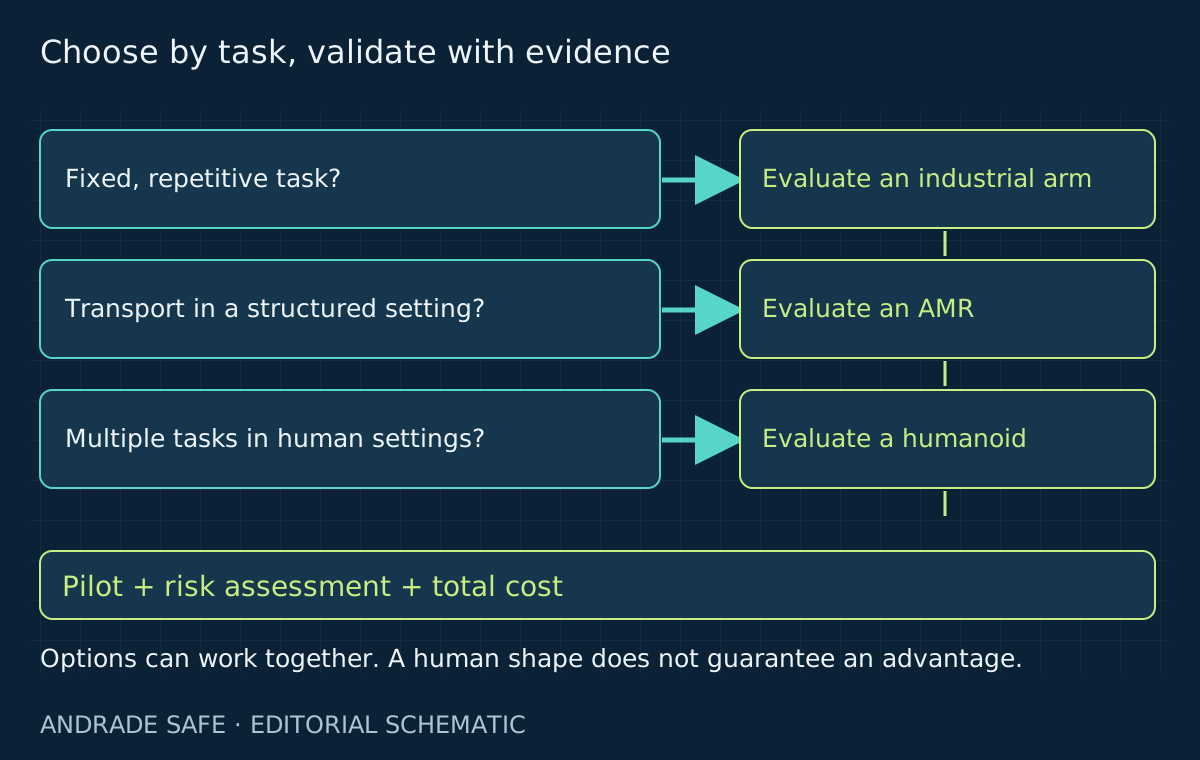
For a fixed repetitive task, compare a specialised cell first. For structured transport, assess suitable mobile systems. For varied tasks in human-designed stations, a humanoid may justify a controlled pilot. Volume, infrastructure, maintenance and hazards still determine the comparison. Flexibility has value when it is needed and demonstrated.
The evidence needed to move from pilot to scale
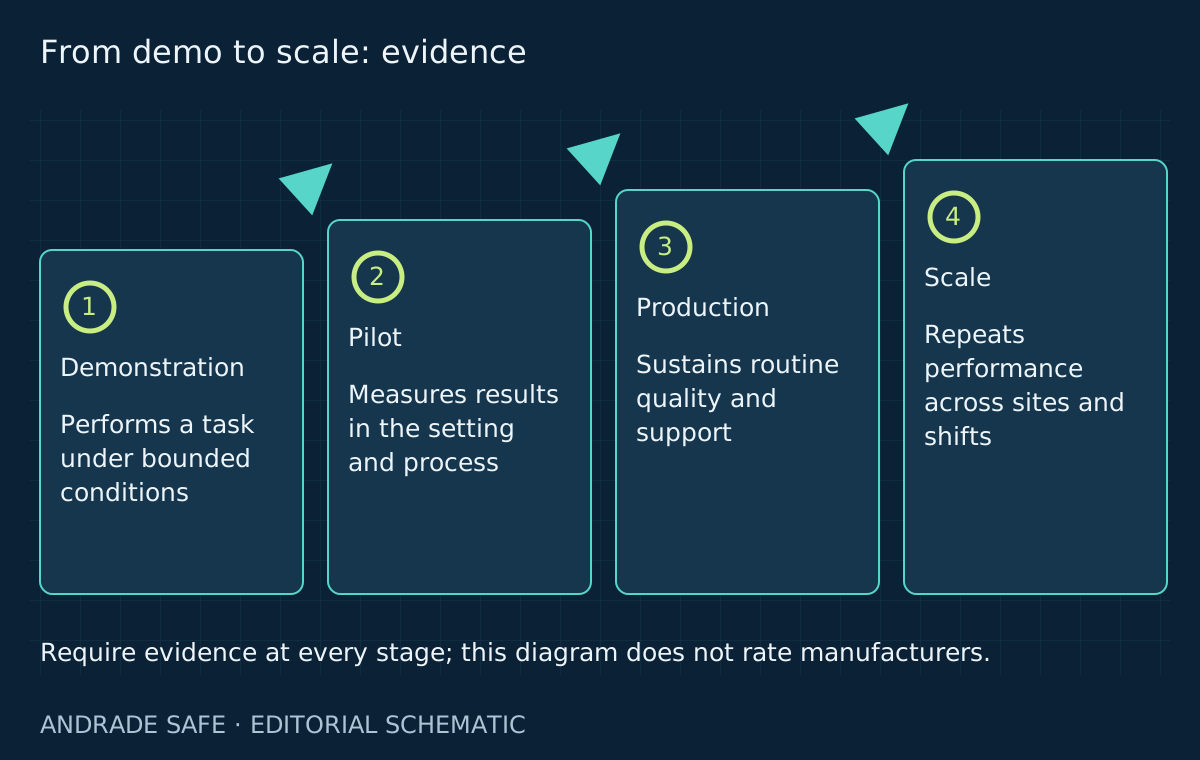
A demonstration shows a capability. A pilot measures a defined task. Production adds sustained quality, availability and anomaly management. Scale adds reproducibility across shifts, teams and installations. Each transition needs acceptance criteria and an explicit decision about the remaining operating limits.
Before expansion, request attempts, failures and intervention logs, tested safety functions, integration documentation and a maintenance plan. Establish who controls updates and investigates unexpected behaviour. An accident-free short trial alone cannot prove the effectiveness of every protective measure.
New technology needs responsible integration. The factory needs a system that completes a useful task safely, repeatably and at a sustainable cost. Human-like form may help the design. Verified results are what justify adoption.
Frequently asked questions
Are humanoid robots used in manufacturing?
Documented pilots and production tasks exist, including Figure 02 at Spartanburg and AEON at Leipzig. They demonstrate bounded applications rather than a factory-wide replacement. Check the task, date and source, then request sustained performance, failure and intervention records before treating an announcement as evidence of scalable deployment.
What is embodied AI?
Embodied AI links computation to a physical system that senses and acts on its environment. Perception, planning, actuator control and feedback may form the chain, although architectures differ. Teleoperation and simulation can support training. They do not establish autonomous performance, and protective functions require their own risk-based validation.
Are humanoid robots safer than industrial arms?
Body shape does not establish safety. Assess the robot, tool, load, workstation, mobility and intervention modes together. A humanoid can introduce instability or travel hazards as well as manipulation hazards. A short accident-free demonstration does not replace tested protective functions and an application-specific risk assessment.
How do humanoid robots compare with cobots?
Humanoid describes body form; cobot commonly describes a robot intended for collaborative applications. These labels concern different characteristics. Neither establishes that people can safely share every task or space. Tooling, loads, operating modes and protective measures determine whether a particular interaction is acceptable within the assessed application.
Why is dexterity hard for robots?
Contact is sensitive to part pose, surface condition, clearances and gripping force. Vision may be affected by reflections or occlusion. A successful grasp must also avoid damage and allow safe recovery after an error. Evaluate consistent good output across realistic variations rather than the fastest selected movement.
How should factories measure robot ROI?
Use cost per good part and realistic operating-time assumptions. Include tooling, integration, training, supervision, energy, maintenance and quality losses. Record interventions and compare a conventional alternative under equivalent conditions. A nominal purchase price or demonstration cycle is insufficient, and a productivity gain must preserve required quality and safety measures.
References
- China: diretrizes de IA e investimentos / AI policy / política de IAState Council / Xinhua
- Reuters: China issues guidelines for new productive forces including AIReuters / StreetInsider
- Reuters investigation: China's humanoid robots aren't smart enough to take your job — yetReuters / The Business Standard
- World Robotics 2026: Five Million Robots now Operate in Factories GloballyIFR
- BMW Group: First humanoid robot introduced in Plant LeipzigBMW Group
- BMW Group to deploy humanoid robots in production in Germany for the first timeBMW Group
- AEON: October 2026 update on staged industrial deploymentHexagon Robotics
- F.02 Contributed to the Production of 30,000 Cars at BMWFigure AI
- ISO 10218-1:2025 — Industrial robotsISO
- ISO 10218-2:2025 — Industrial robot applications and robot cellsISO
- ISO/TS 15066:2016 — Collaborative robotsISO
- Robotics — OverviewOSHA
- NR-12 — Segurança no trabalho em máquinas e equipamentosMTE Brasil
- Advancing Capabilities of Industrial Robots Through Evaluation, Benchmarking, and CharacterizationNIST